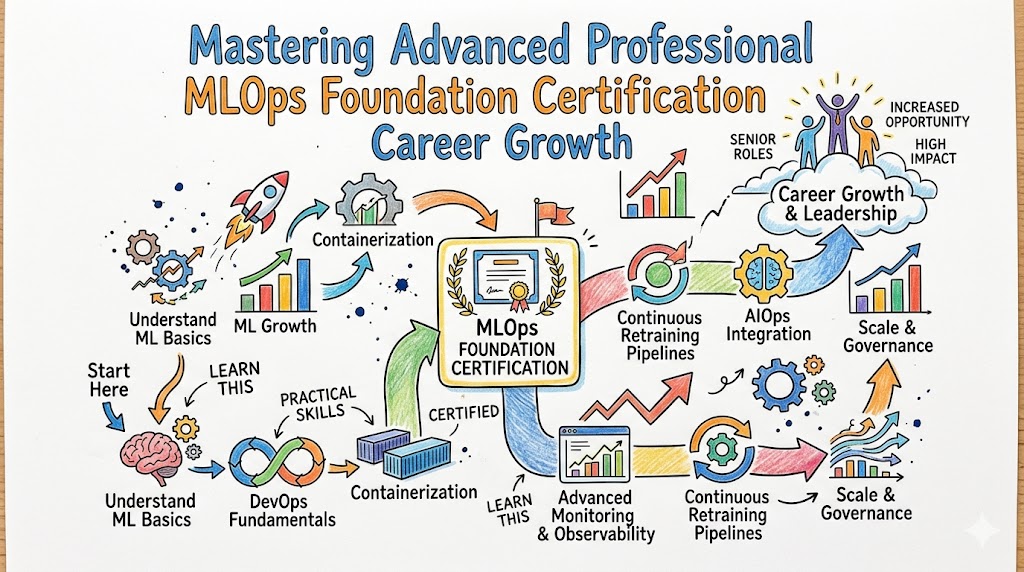
Professionals aiming to bridge the gap between machine learning and reliable production environments often seek the MLOps Foundation Certification to validate their expertise. This guide serves engineers, architects, and managers who recognize that building a model is only a small fraction of the actual lifecycle. Within the broader ecosystem of DevOps and platform engineering, understanding how to automate and monitor these specialized workloads is becoming a mandatory requirement. Consequently, this comprehensive roadmap helps you navigate the technical landscape of AIOpsSchool while making informed decisions about your professional development.
What is the MLOps Foundation Certification?
The MLOps Foundation Certification represents a standard for professionals who need to manage the lifecycle of machine learning models at scale. It exists because traditional software delivery methods often fail to address the unique challenges of data drift and model retraining. Therefore, this program emphasizes real-world, production-focused learning rather than just theoretical concepts or academic research. It aligns perfectly with modern engineering workflows by treating model code, data, and configuration as first-class citizens in a CI/CD pipeline.
Who Should Pursue MLOps Foundation Certification?
Software engineers and SREs who are transitioning into data-heavy environments find this certification particularly beneficial for their daily tasks. Furthermore, cloud professionals and security experts who need to govern machine learning workloads will gain the necessary architectural oversight. This path is suitable for beginners looking for a solid starting point and experienced engineers aiming to formalize their production knowledge. Because the demand for these skills is rising globally, including across major tech hubs in India, it remains relevant for both individual contributors and technical managers.
Why MLOps Foundation Certification is Valuable and Beyond
The demand for specialized engineers who can stabilize machine learning systems continues to grow as enterprise adoption of artificial intelligence accelerates. Obtaining this certification ensures longevity in your career because it focuses on core principles that outlast specific tool versions or temporary trends. Moreover, organizations are moving away from siloed data science teams toward integrated platform teams that require these exact competencies. Investing time in this domain provides a significant return on investment by positioning you at the intersection of data science and systems engineering.
MLOps Foundation Certification Overview
The program is delivered via the official course page at AIOpsSchool and is hosted on the primary platform. It features a structured assessment approach that evaluates a candidate’s ability to handle deployment, monitoring, and automation tasks effectively. Since the certification is owned and governed by industry experts, the structure remains practical and grounded in enterprise requirements. Students move through various modules that cover the end-to-end lifecycle, ensuring they understand the ownership of each stage in a professional pipeline.
MLOps Foundation Certification Tracks & Levels
The curriculum typically begins with a foundation level that establishes the primary vocabulary and core concepts required for collaborative work. Following this, professional and advanced levels delve deeper into complex orchestration, security hardening, and performance tuning at scale. Specialization tracks allow learners to align their studies with existing roles like DevOps, SRE, or even FinOps for cost-optimized cloud infrastructure. These levels provide a clear career progression, helping engineers move from basic automation to designing resilient, global machine learning platforms.
Complete MLOps Foundation Certification Table
| Track | Level | Who it’s for | Prerequisites | Skills Covered | Recommended Order |
| Core Systems | Foundation | Associate Engineers | Basic Linux & Git | CI/CD, Model Versioning | 1st |
| Engineering | Professional | SRE & DevOps | Docker & Kubernetes | Orchestration, Monitoring | 2nd |
| Architecture | Advanced | Solutions Architects | Cloud Networking | Scalability, Security | 3rd |
| Governance | Specialist | Managers & Leads | Agile Basics | Compliance, Ethics | 4th |
Detailed Guide for Each MLOps Foundation Certification
MLOps Foundation Certification – Foundation Level
What it is
This certification validates a professional’s understanding of the fundamental lifecycle of machine learning models in a production environment. It confirms that the holder knows how to integrate data science workflows with traditional software engineering practices.
Who should take it
Aspiring MLOps engineers, junior DevOps professionals, and data scientists wanting to understand the operational side of their work should enroll. It is also ideal for project managers who need to speak the language of technical teams.
Skills you’ll gain
- Mastery of version control for both code and large datasets.
- Understanding of basic CI/CD pipelines tailored for model deployment.
- Ability to identify different stages of the machine learning lifecycle.
- Knowledge of environment consistency using containerization basics.
Real-world projects you should be able to do
- Automate a basic pipeline that triggers a model build upon code changes.
- Set up a versioned data repository that tracks changes in training sets.
- Deploy a simple model as a REST API within a container.
Preparation plan
- 7–14 days: Focus on core terminology and the relationship between DevOps and machine learning.
- 30 days: Spend time building hands-on labs with Git and basic Docker containers.
- 60 days: Complete a full end-to-end project and review all architectural best practices.
Common mistakes
- Ignoring the data versioning aspect and focusing only on the application code.
- Underestimating the importance of monitoring for model drift after the initial deployment.
Best next certification after this
- Same-track option: MLOps Professional Engineer
- Cross-track option: SRE Certified Professional
- Leadership option: Technical Product Manager in AI
Choose Your Learning Path
DevOps Path
Engineers on this path focus on extending their existing automation skills to include specialized data pipelines and model artifacts. They learn to treat models as software packages that require testing, scanning, and rapid deployment cycles. By mastering these skills, they ensure that the bridge between data science and IT operations remains robust and automated.
DevSecOps Path
Security-focused professionals prioritize the integrity of the data supply chain and the safety of model endpoints. They implement automated security scanning for containers and ensure that data privacy regulations are met throughout the training process. This path is essential for organizations operating in highly regulated industries like finance or healthcare.
SRE Path
Site Reliability Engineers focus on the availability, latency, and performance of machine learning services in live environments. They develop advanced monitoring strategies to detect when a model is no longer performing as expected due to real-world changes. Their goal is to maintain a high level of service reliability while managing the inherent unpredictability of AI.
AIOps Path
This path involves using artificial intelligence and machine learning to improve IT operations and infrastructure management itself. Professionals learn how to apply predictive analytics to system logs and performance metrics to prevent outages before they happen. It creates a self-healing environment where the system learns from past incidents to improve future stability.
MLOps Path
The MLOps path is dedicated to the specialized engineering required to keep machine learning models running accurately and efficiently. It covers the entire loop from data ingestion and experiment tracking to deployment and continuous retraining. Engineers here become experts in managing the “hidden technical debt” often found in machine learning systems.
DataOps Path
DataOps practitioners focus on the flow of data from various sources to the consumers, ensuring high quality and low latency. They apply DevOps principles to data pipelines to reduce the cycle time of data analytics and reporting. This path is foundational for any successful machine learning initiative as it guarantees the fuel for the models is reliable.
FinOps Path
As cloud costs for GPU and specialized hardware rise, FinOps professionals manage the financial accountability of machine learning infrastructure. They implement cost-tracking tags and optimize resource allocation to ensure that AI projects remain profitable and within budget. This path bridges the gap between engineering execution and business value.
Role → Recommended MLOps Foundation Certification Certifications
| Role | Recommended Certifications |
| DevOps Engineer | MLOps Foundation + Professional DevOps |
| SRE | MLOps Foundation + SRE Specialist |
| Platform Engineer | MLOps Foundation + Kubernetes Expert |
| Cloud Engineer | MLOps Foundation + Cloud Architect |
| Security Engineer | MLOps Foundation + DevSecOps Specialist |
| Data Engineer | MLOps Foundation + DataOps Professional |
| FinOps Practitioner | MLOps Foundation + FinOps Associate |
| Engineering Manager | MLOps Foundation + Strategic Leadership |
Next Certifications to Take After MLOps Foundation Certification
Same Track Progression
Once the foundation is established, the logical step is to pursue professional-level certifications that focus on advanced orchestration and scale. These programs typically involve deep dives into tools like Kubeflow or MLflow and complex pipeline architectures. Achieving higher levels demonstrates a commitment to technical mastery within this specific niche.
Cross-Track Expansion
Broadening your skills by moving into SRE or DevSecOps provides a more holistic view of the modern infrastructure landscape. Since machine learning does not exist in a vacuum, understanding how it interacts with security protocols and reliability targets is invaluable. This makes you a more versatile engineer capable of leading multidisciplinary teams.
Leadership & Management Track
For those looking to move into management, certifications in technical leadership or product management are the best next steps. These programs help you translate technical accomplishments into business outcomes and lead large-scale digital transformation efforts. It prepares you to manage the budget, people, and strategy behind complex engineering organizations.
Training & Certification Support Providers for MLOps Foundation Certification
DevOpsSchool
This provider offers extensive resources and instructor-led sessions for those wanting a deep dive into automation and culture. Their curriculum covers a wide range of tools and methodologies that support the modern engineering lifecycle.
Cotocus
Focusing on technical consulting and training, this organization helps teams adopt new technologies through hands-on workshops. They are known for their practical approach to solving complex architectural challenges in the cloud.
Scmgalaxy
As a community-driven platform, it provides a wealth of information regarding source code management and continuous integration. It is an excellent resource for professionals looking to stay updated on the latest industry trends.
BestDevOps
This site curates high-quality content and training paths for engineers who want to excel in delivery and operations. Their focus remains on providing clear, actionable advice for career advancement in the tech sector.
devsecopsschool.com
Specializing in the intersection of security and operations, this site provides focused training on shifting security to the left. They help engineers integrate compliance and safety into every step of their automated pipelines.
sreschool.com
This platform is dedicated to the principles of site reliability engineering, offering paths that cover error budgets and monitoring. It is a go-to destination for those aiming to build highly resilient and scalable systems.
aiopsschool.com
This is the primary destination for learning how to apply machine learning to operations and managing the MLOps lifecycle. It offers a structured path for professionals looking to master the future of intelligent infrastructure.
dataopsschool.com
Focused on the data lifecycle, this provider teaches how to manage data pipelines with the same rigor as software code. Their courses are essential for anyone dealing with large-scale data processing and analytics.
finopsschool.com
This school addresses the growing need for cloud financial management, helping professionals optimize their infrastructure spend. They provide the tools and knowledge needed to balance technical performance with business costs.
Frequently Asked Questions
- Is the MLOps Foundation Certification difficult for someone without a data science background?
The foundation level focuses more on the operational and engineering side, so a strong background in software engineering is actually more helpful than deep mathematical knowledge. - How much time should I dedicate to studying for the exam?
Most working professionals find that 30 to 60 days of consistent study for an hour a day is sufficient to cover the materials and labs. - What are the specific prerequisites for this certification?
You should have a basic understanding of Linux command lines, Git for version control, and a general awareness of the software development lifecycle. - Will this certification help me get a job in India?
Yes, many Indian tech firms and global capability centers are actively hiring for these roles to support their growing artificial intelligence departments. - Does the certification expire?
Most professional certifications require renewal or continuing education every two to three years to ensure your skills remain current with technology shifts. - Can I take the exam online?
Yes, the program is designed to be accessible globally through an online proctored format, allowing you to take it from home or office. - Is there a heavy focus on coding?
The focus is more on scripting and pipeline configuration rather than writing complex algorithms or deep learning models from scratch. - What is the return on investment for this program?
Engineers with validated skills in this niche often command higher salaries and have access to more senior roles in platform engineering teams. - How does this differ from a standard DevOps certification?
This program specifically addresses challenges like data versioning, model monitoring, and hardware acceleration that are not covered in general DevOps courses. - Are there hands-on labs included in the training?
The most effective preparation involves practical labs where you actually build and deploy pipelines, which are central to the learning experience. - Can managers benefit from this technical certification?
Managers gain the ability to accurately estimate project timelines and understand the technical constraints their teams face during model production. - Which cloud provider is used during the training?
The principles are generally cloud-agnostic, though labs may utilize popular platforms like AWS, Azure, or Google Cloud to demonstrate concepts.
FAQs on MLOps Foundation Certification
- Does the MLOps Foundation Certification cover specific tools like Kubeflow or MLflow?
While it covers the principles that these tools implement, the focus is on the underlying architectural patterns rather than just clicking buttons in a specific UI. This ensures your knowledge remains applicable even if your company switches its primary tool stack. - How does this certification address the issue of model drift in production?
The curriculum includes specific sections on monitoring and observability, teaching you how to set up automated alerts when the statistical properties of incoming data change significantly. This allows teams to trigger retraining cycles before the model’s accuracy drops. - Is there any focus on security within this foundation level?
Yes, it introduces the concept of securing the data supply chain and ensuring that model endpoints are protected against common vulnerabilities. It emphasizes that security must be an integrated part of the pipeline rather than an afterthought. - How do I verify my certification after passing the exam?
Upon successful completion, you receive a digital badge and a certificate that can be shared on professional networks or verified directly through the hosting platform’s database. This provides immediate proof of your competency to potential employers. - Are there any community forums for students taking this path?
Students gain access to a network of peers and experts where they can discuss challenges and share best practices. This community aspect is vital for staying updated on how other organizations are solving similar production problems. - What is the passing score for the final assessment?
The passing threshold is designed to ensure a high standard of competency, typically requiring a score of 70% or higher on the practical and theoretical components. This ensures the certification remains respected in the industry. - Can I skip the foundation level if I have experience?
While experienced engineers might find the content familiar, completing the foundation ensures there are no gaps in your knowledge of the standardized vocabulary and framework used in later levels. - Is the course material updated frequently?
The providers monitor industry shifts closely and update the curriculum to reflect new best practices in automation, container orchestration, and data governance as they emerge.
Final Thoughts: Is MLOps Foundation Certification Worth It?
If you are looking to move beyond traditional infrastructure and enter the high-growth field of machine learning engineering, this certification is a solid investment. It provides a structured way to learn complex topics that are often scattered across various blogs and documentation sites. By focusing on the “Ops” in MLOps, you make yourself indispensable to organizations that have plenty of data scientists but few people who can actually keep models running. It is a practical, no-nonsense path for any engineer who wants to stay relevant in an increasingly automated world.




Leave a Reply
You must be logged in to post a comment.