Most people do not fail because they lack ambition.
They fail because their goals are vague, scattered, emotional, or disconnected from daily execution.
A CEO cannot afford that. CEOs, founders, leaders, managers, creators, students, and high performers all need one thing in common: a clear system for turning big ideas into measurable progress.
That is where goal-setting frameworks become powerful.
A good framework helps you answer five practical questions:
What exactly do I want?
Why does it matter?
How will I measure success?
What could block me?
What should I do next?
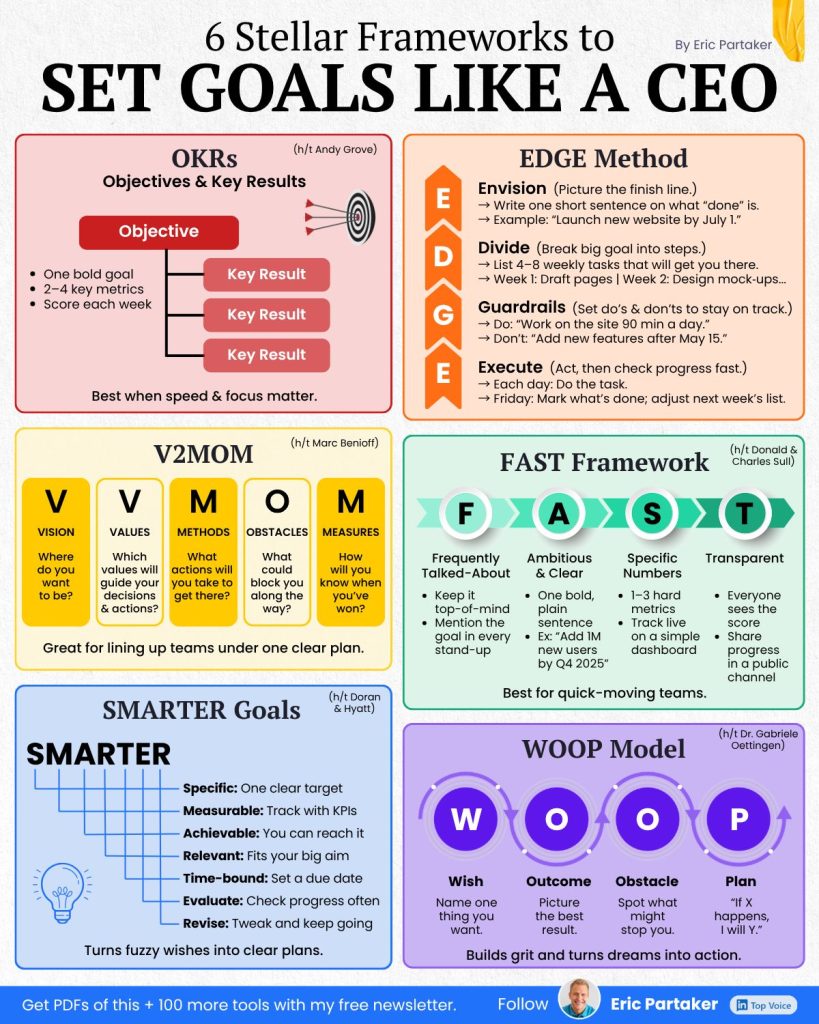
In this guide, we will explore six highly effective goal-setting frameworks:
OKRs, EDGE Method, V2MOM, FAST Goals, SMARTER Goals, and WOOP.
Each framework has a different purpose. Some are best for teams. Some are best for personal productivity. Some help you clarify direction. Others help you execute faster.
The real magic is knowing which one to use, when to use it, and how to apply it properly.
1. OKRs: Objectives and Key Results
What are OKRs?
OKR stands for Objectives and Key Results.
It is one of the most popular goal-setting frameworks used by companies, startups, product teams, and high-performance organizations.
The structure is simple:
Objective: What do we want to achieve?
Key Results: How will we know we achieved it?
The objective gives direction. The key results make progress measurable.
For example:
Objective: Improve customer onboarding experience.
Key Results:
Increase onboarding completion rate from 52% to 75%.
Reduce average setup time from 30 minutes to 15 minutes.
Improve new-user satisfaction score from 3.8 to 4.5 out of 5.
Notice something important: the objective is inspiring, but the key results are measurable.
That is what makes OKRs powerful.
Why OKRs work
Many people set goals like this:
“Improve sales.”
“Grow the business.”
“Become more productive.”
“Build a better product.”
These sound good, but they are not precise. You cannot easily measure them. You cannot tell whether you are winning or losing.
OKRs force you to define success clearly.
They also help teams avoid confusion. Everyone knows the main objective and the few measurable outcomes that matter most.
How to create strong OKRs
A good OKR should have one bold objective and two to four key results.
The objective should be clear, memorable, and meaningful.
The key results should be measurable, specific, and outcome-based.
Weak OKR:
Objective: Work on marketing.
Better OKR:
Objective: Build a stronger inbound marketing engine.
Key Results:
Publish 12 high-quality blog posts this quarter.
Increase organic website traffic by 40%.
Generate 300 qualified inbound leads.
Improve landing page conversion from 2.5% to 5%.
When to use OKRs
OKRs are best when speed, focus, and measurable progress matter.
Use OKRs when you want to:
Align a team around one priority.
Track progress weekly.
Create measurable outcomes.
Avoid working on too many things at once.
Push beyond comfortable goals.
Common mistakes with OKRs
The biggest mistake is creating too many OKRs.
If everything is important, nothing is important.
Another mistake is using tasks as key results.
For example, “launch a campaign” is a task. But “generate 500 qualified leads from the campaign” is a result.
OKRs should measure outcomes, not just activity.
OKR template
Objective:
What is the most important thing we want to achieve?
Key Result 1:
How will we measure success?
Key Result 2:
What number proves progress?
Key Result 3:
What final outcome matters most?
Weekly score:
Are we on track, at risk, or off track?
2. EDGE Method: Envision, Divide, Guardrails, Execute
What is the EDGE Method?
The EDGE Method is a practical execution framework.
EDGE stands for:
Envision
Divide
Guardrails
Execute
It helps you move from a big goal to a clear weekly action plan.
This framework is especially useful because many people know what they want, but they do not know how to break it down into manageable steps.
EDGE solves that problem.
Step 1: Envision
Start by picturing the finish line.
Ask yourself:
What does “done” look like?
What result am I trying to create?
How will I know the goal is complete?
A vague goal sounds like this:
“I want to improve my website.”
A clear envisioned goal sounds like this:
“Launch a redesigned website with five core pages, mobile-friendly layout, updated copy, and working contact form by July 1.”
That is much stronger.
Step 2: Divide
Once the goal is clear, break it into smaller steps.
Most people procrastinate because the goal feels too large. Dividing makes the goal less scary and more actionable.
Example:
Goal: Launch a new website by July 1.
Weekly plan:
Week 1: Finalize website structure.
Week 2: Write homepage and about page copy.
Week 3: Design mockups.
Week 4: Build core pages.
Week 5: Test mobile responsiveness.
Week 6: Fix bugs and publish.
Now the goal has movement.
Step 3: Guardrails
Guardrails are rules that keep you from drifting.
They define what you will do and what you will not do.
For example:
Do: Work on the website for 90 minutes every weekday.
Do: Review progress every Friday.
Do not: Add new features after May 15.
Do not: redesign the logo during the website project.
Do not: switch tools halfway through the process.
Guardrails are underrated. They protect your focus.
Without guardrails, goals expand, deadlines slip, and simple projects become endless monsters wearing a tiny productivity hat.
Step 4: Execute
Execution means doing the work, checking progress, and adjusting quickly.
A simple execution rhythm could look like this:
Daily: Complete the most important task.
Weekly: Review what was done.
Friday: Update the next week’s plan.
Monthly: Decide whether the goal still matters.
When to use EDGE
Use the EDGE Method when you have a big goal but need a clear action path.
It is great for:
Personal goals.
Product launches.
Website projects.
Course creation.
Writing a book.
Building a new habit.
Completing a business initiative.
EDGE template
Envision:
What does success look like?
Divide:
What are the major steps?
Guardrails:
What rules will keep me focused?
Execute:
What will I do today, this week, and this month?
3. V2MOM: Vision, Values, Methods, Obstacles, Measures
What is V2MOM?
V2MOM is a strategic alignment framework.
It stands for:
Vision
Values
Methods
Obstacles
Measures
This framework is especially useful for leaders, teams, and organizations because it connects purpose with execution.
It does not only ask, “What do we want?”
It also asks:
Why does it matter?
What principles will guide us?
How will we get there?
What could stop us?
How will we measure success?
That makes it broader than a simple goal-setting method.
Vision
Vision answers:
Where do we want to go?
A strong vision should be clear and inspiring.
Example:
“Become the most trusted online learning platform for beginner cloud engineers.”
That vision gives direction.
Values
Values answer:
What principles will guide our decisions?
For example:
Simplicity.
Student-first design.
Practical learning.
Transparency.
Speed with quality.
Values matter because they shape how you pursue the goal.
Two teams may have the same vision but behave very differently depending on their values.
Methods
Methods answer:
What actions will we take to achieve the vision?
Example methods:
Create beginner-friendly tutorials.
Publish one lab guide every week.
Build hands-on dashboards and exercises.
Collect learner feedback after each module.
Improve weak lessons every month.
Methods turn vision into practical work.
Obstacles
Obstacles answer:
What could block us?
This is where V2MOM becomes realistic.
Many planning systems pretend everything will go smoothly. V2MOM makes you face the friction early.
Possible obstacles:
Limited time.
Unclear ownership.
Technical complexity.
Low learner engagement.
Slow content review.
Poor documentation.
When you name obstacles early, you can prepare for them.
Measures
Measures answer:
How will we know we have succeeded?
Examples:
Publish 20 tutorials in 6 months.
Reach 10,000 monthly readers.
Achieve an average learner rating of 4.5 out of 5.
Reduce support questions by 30%.
Increase course completion rate to 70%.
Measures keep the plan honest.
When to use V2MOM
V2MOM is best when you need alignment.
Use it for:
Business planning.
Team strategy.
Product direction.
Department goals.
Founder planning.
Large projects involving many people.
V2MOM template
Vision:
Where do we want to go?
Values:
What principles will guide us?
Methods:
What actions will get us there?
Obstacles:
What could block progress?
Measures:
How will we know we succeeded?
4. FAST Goals: Frequently Talked-About, Ambitious, Specific, Transparent
What are FAST Goals?
FAST stands for:
Frequently Talked-About
Ambitious
Specific
Transparent
FAST Goals are designed for fast-moving teams where goals need to stay visible, measurable, and alive.
Many goals fail because they are written once and forgotten.
FAST solves this by making goals part of regular conversations.
Frequently Talked-About
A goal should not live quietly in a document nobody opens.
It should be discussed often.
Bring it up in:
Weekly team meetings.
Daily standups.
Monthly reviews.
One-on-one conversations.
Project check-ins.
The more visible the goal is, the more likely people are to act on it.
Ambitious
FAST goals should stretch people.
They should not be so easy that they create no energy.
For example:
Weak goal:
“Add some new users.”
Stronger goal:
“Add 1 million new users by Q4.”
Ambitious goals create urgency and creativity.
Of course, ambition should not become fantasy. A good goal should stretch the team, not break it.
Specific
FAST goals require numbers.
Vague goal:
“Improve customer support.”
Specific goal:
“Reduce average first-response time from 12 hours to 3 hours by the end of Q2.”
Specificity removes confusion.
Transparent
Everyone should be able to see progress.
Transparency creates accountability.
A transparent goal might live in:
A shared dashboard.
A public team tracker.
A weekly scorecard.
A project board.
A company-wide update.
When progress is visible, people stay aligned.
When to use FAST Goals
FAST is best for quick-moving teams.
Use it when:
The team needs regular alignment.
Goals need to stay visible.
Progress changes quickly.
Multiple people contribute to the same outcome.
You want accountability without micromanagement.
FAST template
Frequently Talked-About:
Where and how often will we discuss this goal?
Ambitious:
Is this goal bold enough to create momentum?
Specific:
What exact number or result are we targeting?
Transparent:
Where will everyone see progress?
5. SMARTER Goals: Specific, Measurable, Achievable, Relevant, Time-Bound, Evaluate, Revise
What are SMARTER Goals?
SMARTER is an expanded version of the classic SMART goal framework.
It stands for:
Specific
Measurable
Achievable
Relevant
Time-bound
Evaluate
Revise
SMARTER is excellent for turning fuzzy wishes into clear plans.
A fuzzy wish sounds like this:
“I want to get better at writing.”
A SMARTER goal sounds like this:
“I will publish one 1,500-word blog post every week for the next 12 weeks to improve my writing consistency and build my professional audience.”
That is much clearer.
Specific
A goal should name exactly what you want.
Bad:
“I want to be healthier.”
Better:
“I will walk 8,000 steps daily and exercise three times per week.”
Measurable
You need a way to track progress.
Ask:
What number will I measure?
How often will I check it?
What does success look like?
Examples:
Revenue.
Weight.
Hours studied.
Articles published.
Customers acquired.
Completion percentage.
Achievable
The goal should be realistic enough to pursue.
This does not mean easy. It means possible.
A goal that is too unrealistic can create discouragement. A goal that is too easy creates boredom.
The sweet spot is challenging but believable.
Relevant
The goal should connect to a bigger purpose.
Ask:
Why does this goal matter?
Does it support my bigger direction?
Is this the right goal for this season?
Relevance prevents you from chasing random goals just because they sound impressive.
Time-bound
A goal needs a deadline.
Without a deadline, there is no urgency.
Compare:
“I will launch a course someday.”
With:
“I will launch the first version of my course by September 30.”
Deadlines create movement.
Evaluate
SMARTER adds something important that SMART often misses: review.
A goal should be evaluated regularly.
Ask:
Am I making progress?
What is working?
What is not working?
Do I need more time, support, or focus?
Revise
Sometimes the plan needs to change.
Revision does not mean failure. It means learning.
You may revise:
The deadline.
The method.
The measurement.
The scope.
The priority.
The goal should remain useful, not become a prison.
When to use SMARTER Goals
SMARTER is best for personal goals, professional development, student planning, habit building, and clear individual projects.
Use it for:
Learning a skill.
Building a habit.
Completing a certification.
Writing content.
Improving health.
Managing personal productivity.
SMARTER template
Specific:
What exactly do I want?
Measurable:
How will I track progress?
Achievable:
Can I realistically do this?
Relevant:
Why does this matter?
Time-bound:
What is the deadline?
Evaluate:
When will I review progress?
Revise:
What will I adjust if needed?
6. WOOP Model: Wish, Outcome, Obstacle, Plan
What is WOOP?
WOOP stands for:
Wish
Outcome
Obstacle
Plan
It is a powerful goal-setting and behavior-change framework because it combines positive thinking with realistic planning.
Many people only visualize success.
WOOP goes further. It asks you to visualize success and then identify what might stop you.
That balance is what makes it useful.
Wish
Start with one meaningful wish.
Example:
“I want to exercise consistently.”
The wish should be important, clear, and personally meaningful.
Outcome
Next, picture the best result.
Ask:
What would be the best outcome if this wish came true?
Example:
“I would feel more energetic, stronger, and more confident.”
This creates emotional motivation.
Obstacle
Now identify the main internal or external obstacle.
Example:
“I feel tired after work and convince myself to skip exercise.”
This step is essential.
A lot of goal-setting fails because people ignore the obstacle. WOOP makes you face it directly.
Plan
Finally, create an if-then plan.
Example:
“If I feel tired after work, then I will do a 10-minute workout instead of skipping completely.”
The plan should be simple and specific.
More examples:
“If I get distracted by my phone, then I will put it in another room for 30 minutes.”
“If I miss one study session, then I will restart the next morning without guilt.”
“If I feel nervous before presenting, then I will take three slow breaths and begin with my opening sentence.”
When to use WOOP
WOOP is best for behavior change and personal discipline.
Use it for:
Habits.
Motivation.
Health goals.
Study routines.
Confidence building.
Emotional blocks.
Procrastination.
Personal transformation.
WOOP template
Wish:
What do I want?
Outcome:
What is the best result?
Obstacle:
What might stop me?
Plan:
If that obstacle appears, what will I do?
Which Goal-Setting Framework Should You Use?
There is no single best framework for every situation.
The best framework depends on your goal.
| Framework | Best For | Main Strength |
|---|---|---|
| OKRs | Teams, startups, business goals | Focus and measurable outcomes |
| EDGE | Big projects and execution planning | Breaking goals into action |
| V2MOM | Strategy and team alignment | Connecting vision with execution |
| FAST | Quick-moving teams | Visibility and accountability |
| SMARTER | Personal and professional goals | Clarity and review |
| WOOP | Habits and behavior change | Overcoming obstacles |
Here is a simple way to choose:
Use OKRs when you need measurable business outcomes.
Use EDGE when you need to break a big goal into steps.
Use V2MOM when a team needs strategic alignment.
Use FAST when goals must stay visible and frequently discussed.
Use SMARTER when you need a clear personal or professional goal.
Use WOOP when motivation, habits, or obstacles are the main challenge.
How to Combine These Frameworks Like a CEO
The best leaders do not use frameworks as decoration. They use them as operating systems.
You can combine them in a very practical way.
Step 1: Use V2MOM for direction
Start with the big picture.
Define your vision, values, methods, obstacles, and measures.
This gives you strategic clarity.
Step 2: Use OKRs for quarterly focus
Turn your strategy into one to three major objectives.
Add measurable key results.
This gives you focus.
Step 3: Use EDGE for execution
Break each objective into weekly tasks.
Add guardrails to prevent distraction.
This gives you action.
Step 4: Use FAST for team visibility
Discuss goals often.
Keep progress transparent.
This gives you accountability.
Step 5: Use SMARTER for individual planning
Each person can create SMARTER goals connected to the larger objective.
This gives personal clarity.
Step 6: Use WOOP for behavior and obstacles
When motivation drops or resistance appears, use WOOP.
This gives resilience.
Together, these frameworks create a complete goal system:
V2MOM gives direction.
OKRs give measurable focus.
EDGE gives execution steps.
FAST gives visibility.
SMARTER gives personal clarity.
WOOP gives mental discipline.
That is how you move from intention to results.
A Complete Example: Launching a New Online Course
Let’s imagine your goal is to launch an online course.
V2MOM
Vision:
Create a beginner-friendly course that helps students learn cloud monitoring through hands-on labs.
Values:
Clarity, simplicity, practical learning, student confidence.
Methods:
Create weekly lessons, record demos, build lab exercises, collect student feedback.
Obstacles:
Limited time, technical errors, unclear explanations, low student engagement.
Measures:
Launch the course by August 31, enroll 500 students, achieve a 4.5 rating, and maintain a 70% completion rate.
OKR
Objective:
Launch a high-quality beginner cloud monitoring course.
Key Results:
Complete 10 course modules.
Record 20 practical demo videos.
Enroll 500 students in the first launch.
Achieve an average student rating of 4.5 out of 5.
EDGE
Envision:
A complete online course with videos, lab manuals, exercises, and final project.
Divide:
Week 1: Finalize curriculum.
Week 2: Write lesson scripts.
Week 3: Record first five modules.
Week 4: Build lab exercises.
Week 5: Record remaining modules.
Week 6: Review and publish.
Guardrails:
No new modules after the curriculum is finalized.
Work 90 minutes daily.
Review progress every Friday.
Test each lab before publishing.
Execute:
Complete one lesson or lab every weekday.
FAST
Frequently Talked-About:
Review course progress every Monday and Friday.
Ambitious:
Launch with 500 students in the first cohort.
Specific:
Complete 10 modules and 20 videos by August 31.
Transparent:
Track progress on a shared dashboard.
SMARTER
Specific:
Create and launch a beginner-friendly cloud monitoring course.
Measurable:
10 modules, 20 videos, 500 students, 4.5 rating.
Achievable:
Yes, with six weeks of focused work.
Relevant:
Supports the goal of helping students learn practical DevOps skills.
Time-bound:
Launch by August 31.
Evaluate:
Review every Friday.
Revise:
Adjust scope if recording or lab creation takes longer than expected.
WOOP
Wish:
Launch the course successfully.
Outcome:
Students gain confidence and practical skills.
Obstacle:
I may overcomplicate the lessons.
Plan:
If a lesson becomes too complex, then I will simplify it into one concept, one demo, and one hands-on task.
Common Goal-Setting Mistakes to Avoid
1. Setting too many goals
Too many goals create mental noise.
A CEO-level goal system is not about doing everything. It is about choosing what matters most.
2. Confusing tasks with results
“Send 100 emails” is a task.
“Generate 20 qualified leads” is a result.
Tasks matter, but results matter more.
3. Ignoring obstacles
Every goal has friction.
Time, energy, money, fear, confusion, distraction, and competing priorities can all interfere.
Great goal-setters identify obstacles early.
4. Reviewing goals too rarely
A goal written once and ignored is just a nice sentence.
Review your goals weekly.
Ask:
What moved forward?
What got stuck?
What needs to change?
What is the next best action?
5. Making goals too vague
Vague goals create vague effort.
Specific goals create specific action.
Instead of saying, “I want to grow,” say, “I will publish two technical blogs per week for the next 12 weeks.”
6. Measuring activity instead of impact
Being busy is not the same as making progress.
A good goal should help you measure meaningful outcomes.
A Simple Weekly Goal Review System
To make these frameworks useful, create a weekly review habit.
Every Friday, answer these questions:
What was my main goal this week?
What progress did I make?
What result changed?
What blocked me?
What did I learn?
What should I stop doing?
What should I continue doing?
What is the most important goal for next week?
This review turns experience into improvement.
Without review, you repeat mistakes.
With review, you compound learning.
Final Thoughts
Setting goals like a CEO does not mean writing fancy strategy documents.
It means thinking clearly, choosing priorities wisely, measuring progress honestly, and executing consistently.
The six frameworks in this guide each solve a different problem.
OKRs help you focus on measurable outcomes.
EDGE helps you break big goals into action.
V2MOM helps align vision, values, and execution.
FAST keeps goals visible and alive.
SMARTER turns vague wishes into structured plans.
WOOP helps you overcome obstacles and build discipline.
The best goal is not the one that sounds impressive.
The best goal is the one that changes your behavior, guides your decisions, and produces measurable progress.
Do not just set goals.
Build a goal system.
That is how you move from ambition to execution — and from execution to results.