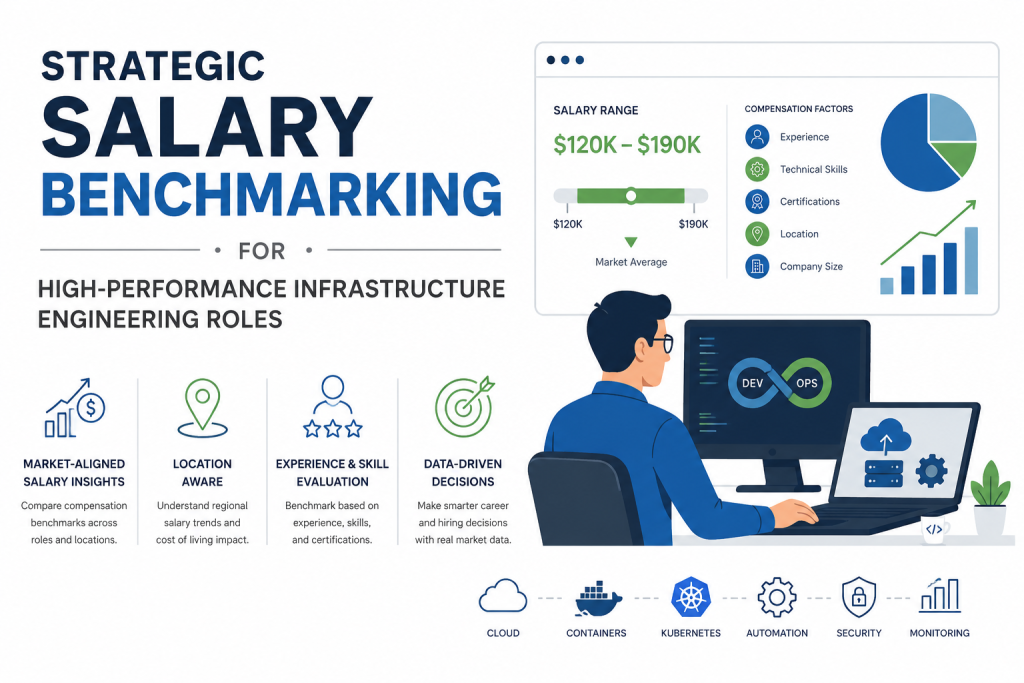
Software enterprises depend on skilled engineers to maintain robust digital pipelines, yet determining a fair financial reward for these vital roles remains a complex undertaking. Generic online estimators often output broad, meaningless averages that fail to capture the nuances of regional economies or specialized technical stacks. Because of this information gap, talented platform professionals frequently settle for compensation offers that fall far below their true market value. This comprehensive guide provides an authoritative blueprint for evaluating your financial trajectory with precision. By applying the Best DevOps Salary framework, you gain the ability to map your architectural capabilities against verified global metrics and engineer a successful long-term strategy to maximize your total earnings.
Mastering the Valuation Matrix
Calculating technology compensation requires you to view your paycheck as a multi-variable engineering equation. Employers determine your annual worth by assessing your systemic impact, the scarcity of your specialized skills, and the business risk you assume within the enterprise.
Organizational Compensation Objectives
Businesses utilize structured pay bands to balance talent acquisition with operational budgets. As a professional, tracking your market position ensures that your intensive on-call commitments, pipeline optimizations, and architectural designs align with industry realities. Regular benchmarking prevents you from falling behind as your technical expertise expands.
The Corporate Leveling Engine
Enterprise human resource departments analyze specific telemetry points when assigning your placement within a salary band. Rather than scanning generic job titles, these systems measure your value through three distinct vectors:
- Your Technical Stack: The depth of your daily proficiency with orchestration engines, automated policy frameworks, and cloud-native landing zones.
- Systemic Operational Risk: The direct link between your infrastructure deployments and enterprise revenue stability.
- Geographic Market Liquidity: The local or remote competition driving vacancy rates for your exact skill profile.
[Stack Expertise] + [Uptime Ownership] + [Regional Market Demand] ➔ Pay Band Placement
Code language: CSS (css)
Essential Thresholds vs. Premium Levers
Hiring committees distinguish between minimum baseline requirements and the premium factors that allow you to command maximum pay. Baseline requirements include foundational cloud certifications or standard years of scripting experience. Premium levers include a proven history of migrating legacy monoliths to microservices, managing large-scale system failures under pressure, or reducing annual cloud compute overhead by significant percentages.
Core Systems Governing Compensation
Compensation structures shift dramatically based on your employer’s funding model, organizational maturity, and industry sector. You must understand these frameworks to avoid applying universal salary expectations to diverse corporate landscapes.
The Components of Total Compensation
Modern technical packages combine three financial pillars to form your Total Compensation (TC):
Total Compensation = Fixed Base Pay + Performance Bonuses + Long-Term Equity
Your base salary provides predictable financial stability. The performance bonus connects directly to your personal project achievements and overall corporate profitability. Long-term equity instruments—such as stock options or restricted stock units—provide wealth generation that scales as the organization increases its market value.
Industry-Specific Salary Dynamics
The balance between your cash income and stock grants changes depending on your employer’s sector:
- Hyperscale Product Firms: These companies tilt offers heavily toward equity instruments, linking your long-term wealth directly to corporate stock performance.
- Financial Institutions: Banks and traditional giants minimize equity in favor of exceptionally high base salaries and formulaic cash bonuses tied to system availability.
- Global Technical Consultancies: These service-based firms utilize rate-card models where your compensation directly scales with your billable hours and client satisfaction ratings.
Global Mobility and Compensation Pathways
Infrastructure automation remains a globally demanded skill set, providing talented engineers with clear pathways to secure international visas and cross-border career growth.
Priority Migration Categories
Highly developed nations actively recruit infrastructure engineers, placing them into critical skill shortage categories. These special visa tracks grant faster processing, corporate sponsorship opportunities, and clear paths to residency. Mastering platform automation effectively functions as a globally recognized passport for your relocation goals.
Median Salary Distribution Across Markets
Optimizing your global earnings requires you to analyze how salaries scale across different zones. Local currency values provide varying levels of purchasing power depending on regional tax policies and living costs. This data highlights the median trends across fifteen premier international markets.
| Country | Local Currency | Base Salary Range (USD Equivalent) | Dominant Market Trait |
|---|---|---|---|
| United States | USD | $92,058 – $143,840 | High-scale product markets, equity-driven |
| Switzerland | CHF | $114,682 – $179,191 | Premium base pay, stable financial sector |
| Netherlands | EUR | $71,629 – $111,921 | Expanding European hubs, regulated pay bands |
| Singapore | SGD | $71,319 – $111,436 | Central APAC financial nexus, rapid cloud growth |
| Canada | CAD | $66,734 – $104,271 | High-growth near-shore market |
| France | EUR | $64,408 – $100,638 | Domestic tech growth, sovereign cloud initiatives |
| United Arab Emirates | AED | $63,247 – $98,824 | Tax-free base pay, rapid infrastructure scaling |
| Israel | ILS | $62,517 – $97,682 | Deep-tech startup ecosystem, advanced R&D |
| Sweden | SEK | $57,782 – $90,284 | Collaborative cultures, high social benefits |
| Spain | EUR | $55,148 – $86,169 | Emerging Mediterranean remote-work hub |
| Poland | PLN | $47,310 – $73,921 | Premier European center for R&D services |
| South Korea | KRW | $43,423 – $67,848 | Centralized technology conglomerates |
| India | INR | $18,424 – $28,788 | Highly competitive product engineering centers |
| Kenya | KES | $12,223 – $19,099 | East African innovation gateway |
| Nigeria | NGN | Local Median: 2,947,906 NGN | High-potential West African tech center |
Reliability Tiers and Market Premiums
The engineering market enforces a compensation hierarchy based on your specific area of platform ownership. As teams mature, they phase out generic titles to reward specialists who master clear system boundaries.
- Security Platform Engineers: These specialists earn 15% to 35% above the baseline by building automated compliance boundaries and enterprise identity architectures.
- Platform Product Engineers: This role captures a 5% to 20% premium by treating infrastructure as a product, creating self-service portals that remove developer roadblocks.
- Site Reliability Engineers (SREs): Operating within the revenue pathway, SREs capture a 0% to 15% market premium by defining service objectives and orchestrating incident responses.
- Cloud Infrastructure Engineers: These profiles anchor the market baseline by handling routine cloud configuration and continuous integration workflows.
Optimizing Your Compensation Profile
Securing the upper limits of the global technology matrix requires you to execute a structured plan to present your professional impact.
1
Gathering Necessary Documents
Documentation Phase
1.Gathering Necessary Documents:Documentation Phase.
Collect your historical performance ratings, pipeline speed statistics, and current cloud certifications. Document the precise scale of systems you have managed, including concurrent user metrics and annual compute budgets.
2
Practicing the Core Assessments
Technical Validation
2.Practicing the Core Assessments:Technical Validation.
Sharpen your ability to solve complex design challenges under interview pressure. Practice explaining your infrastructure trade-offs regarding system availability, security, and cost optimization.
3
Checking Market Demand Lists
Market Mapping
3.Checking Market Demand Lists:Market Mapping.
Compare your tool stack against regional skill shortage lists. Identify gaps between your daily skills and top-tier market desires, such as policy-as-code or container orchestration.
4
Adding Secondary Factors
Profile Amplification
4.Adding Secondary Factors:Profile Amplification.
Highlight your leadership history coordinating incident responses, mentoring junior engineers, and working with finance leaders to reduce infrastructure waste.
5
Calculating the Final Result
Negotiation Planning
5.Calculating the Final Result:Negotiation Planning.
Input your professional variables into a valuation engine to produce a data-backed salary goal. Use this figure as your non-negotiable floor during final contract negotiations.
Active Strategies to Elevate Market Value
Raising your market value demands an active approach to shaping your professional narrative. Do not wait for annual reviews to spontaneously upgrade your financial standing.
Reframing Operational Impact
Connect your daily work to direct business revenue drivers. Instead of listing tools, demonstrate how your automation patterns reduced software delivery timelines or prevented expensive system downtime.
[Tool-Focused Narrative: "I deployed Kubernetes clusters for our application teams"]
                        ⬇
[Value-Focused Narrative: "I redesigned cluster architecture, slashing annual compute spend by 22%"]
Code language: CSS (css)
Migrating to Scarce Specializations
The fastest way to break a salary ceiling is to pivot your focus into premium specialized tracks. Transition from routine support toward building secure infrastructure frameworks or internal developer platforms. Developing expertise in cloud cost engineering (FinOps) or secure supply chains places you into an exclusive talent pool, forcing companies to compete for your time with better financial packages.
Frequently Asked Questions (FAQs)
- How does remote work influence compensation structures for engineers?Remote employment splits the market into two corporate philosophies. Global tech firms pay location-independent, premium salaries to secure rare profiles, while mid-market firms often index your offer to the cost of living in your local city.
- Which cloud certifications yield the highest measurable impact on your salary?Financial returns scale highest with professional-level architectural certifications from major cloud hyperscalers and independent validations in container security. These credentials prove your technical baseline to automated hiring filters.
- Can you negotiate total compensation if the base salary remains fixed?Yes. When companies reach the rigid top of a pay band, negotiate alternative levers such as larger signing bonuses, accelerated equity vesting, milestone cash incentives, or flexible working allowances to increase the overall value of your offer.
- What salary premium exists for moving from DevOps to DevSecOps?Professionals who integrate automated security into delivery pipelines capture a 15% to 35% premium over baseline engineers, reflecting the global shortage of talent capable of constructing self-healing security guardrails.
- How frequently should you benchmark your salary against market data?Perform a benchmark at least annually or immediately after completing a major career milestone, such as a multi-region cloud migration or a significant platform cost-optimization project.
- Do advanced university degrees impact your trajectory in engineering bands?While technical mastery drives interview success, degrees still carry weight within traditional banking and government sectors, which often use formal grids that assign higher starting baselines to academic credentials.
- How do Platform Engineering roles differ from DevOps in terms of compensation?Platform Engineering positions typically command a 5% to 20% premium because these teams create self-service developer portals that eliminate friction and scale delivery velocity across the entire organization.
- Do internal developer platforms influence bonus payouts?Modern firms increasingly link variable bonuses to platform adoption metrics, cloud uptime percentages, and developer velocity. Demonstrating that your platform enhancements accelerated delivery gives you undeniable leverage for maximum bonus payouts.
- What specific metrics should appear on a senior engineer’s resume?Recruiters hunt for quantitative indicators of impact, such as historical mean time to recovery, change success rates, and the explicit financial size of the cloud budgets you protected. Vague descriptions of tool usage fail to prove senior-level mastery.
- How should you handle salary offers that fall below the market median?Build a spreadsheet documenting your infrastructure optimizations, platform stability contributions, and cost-cutting achievements. Present this evidence to leadership to request an internal adjustment, while preparing to interview elsewhere if the company fails to match your worth.
Closing Thoughts on Career Progression
Achieving a premium compensation package requires a deep, calculated understanding of how software enterprises calculate professional worth. Sustainable financial growth never occurs by accident; it demands that you treat your career as an actively engineered product. By linking your daily automation projects to core business revenue, migrating toward scarce specializations, and evaluating your standing against verified global benchmarks, you navigate the technology sector with total confidence. Take ownership of your professional value, use empirical data to guide your contract discussions, and build an exceptional career that rewards your architectural expertise to the absolute limit.






Leave a Reply
You must be logged in to post a comment.