Introduction
Modern engineering teams now face the massive challenge of moving complex machine learning models from research into reliable production. The Certified MLOps Architect curriculum offers a definitive roadmap for those who want to dominate the intersection of data science and cloud infrastructure. By focusing on automation and scalability, AIOpsSchool equips professionals with the technical depth required to manage high-stakes AI lifecycles. This guide breaks down everything you need to know about navigating this career-defining credential. You will learn how to design robust pipelines that ensure model performance remains consistent in the most demanding enterprise environments.
What is the Certified MLOps Architect?
The Certified MLOps Architect credential serves as a professional standard for building the infrastructure that powers artificial intelligence. It moves beyond theoretical modeling to focus on the mechanical reality of running machine learning at scale. This program bridges the gap between data science and traditional operations by introducing rigorous engineering practices to the world of AI. Organizations rely on these architects to transform experimental code into sustainable, revenue-generating software products. Most importantly, it emphasizes practical proficiency over academic knowledge to ensure you can solve actual production bottlenecks.
Who Should Pursue Certified MLOps Architect?
Platform engineers and SREs who want to lead the next wave of infrastructure automation will find this path indispensable. Data scientists looking to understand the operational side of their work also benefit immensely from these architectural principles. Even engineering managers gain the necessary perspective to lead cross-functional teams and select the right toolstacks for their departments. The relevance of this certification spans across global markets, with a particularly high demand in the rapidly growing Indian tech sector. If you aim to specialize in a high-growth niche, this certification provides the perfect entry point.
Why Certified MLOps Architect is Valuable and Beyond
Enterprise leaders are currently shifting their focus from basic AI adoption to long-term operational sustainability. This certification holds immense value because it teaches you how to maintain models as they evolve over time. By mastering principles like drift detection and automated retraining, you ensure your skills remain relevant even as specific tools change. The career investment pays off through access to senior-level roles that command higher salaries and greater influence. Since AI is becoming a core component of every software product, MLOps expertise provides a recession-proof foundation for your future.
Certified MLOps Architect Certification Overview
Candidates access the full curriculum via the official course page, while the primary hosting site manages the administration. The program utilizes a balanced assessment model that tests both your strategic thinking and your ability to execute technical tasks in a lab setting. You will find that the structure respects your time as a working professional, offering clear milestones and manageable learning modules. Because the content reflects real-world engineering scenarios, you gain more than just a certificate—you gain actual operational experience. This focus on utility ensures that every graduate can immediately contribute to their team’s AI objectives.
Certified MLOps Architect Certification Tracks & Levels
The certification offers three distinct tiers—foundation, professional, and advanced—to match your current level of expertise. Foundation modules introduce the core concepts of the MLOps lifecycle, while professional tracks dive deep into CI/CD and container orchestration. The advanced level challenges senior engineers to design entire ecosystems that balance security, cost, and high availability. These tracks allow you to specialize in specific areas like FinOps or DevSecOps depending on your career goals. This modular approach ensures that your learning path remains flexible and aligned with your daily professional responsibilities.
Complete Certified MLOps Architect Certification Table
| Track | Level | Who it’s for | Prerequisites | Skills Covered | Recommended Order |
| Operational Core | Foundation | Associate Developers | Cloud Literacy | Pipelines, Versioning | First |
| Pipeline Engineering | Professional | SREs / Data Engineers | Professional Experience | CI/CD, Containers | Second |
| Systems Architecture | Advanced | Senior Architects | Expert Knowledge | Scaling, Governance | Third |
Detailed Guide for Each Certified MLOps Architect Certification
Certified MLOps Architect – Foundation Level
What it is
This baseline certification confirms your ability to understand the fundamental stages of moving a model into production. It focuses on the primary terminology and the essential components of a modern MLOps stack.
Who should take it
Junior engineers and career changers should start here to build a solid conceptual foundation. It also serves as an excellent primer for developers who work alongside data science teams but lack operational context.
Skills you’ll gain
- Automating basic model deployment tasks.
- Implementing version control for data and code.
- Understanding model monitoring metrics.
- Managing basic cloud-native resources.
Real-world projects you should be able to do
- Creating a versioned repository for a machine learning experiment.
- Deploying a pre-trained model as a microservice.
- Setting up basic logs for a running model.
Preparation plan
- 7 Days: Study the core MLOps lifecycle and master the relevant vocabulary.
- 30 Days: Complete foundational labs involving Git and container basics.
- 60 Days: Build and document a small-scale end-to-end pipeline.
Common mistakes
- Neglecting the importance of data lineage.
- Spending too much time on algorithm tuning instead of deployment.
Best next certification after this
- Same-track option: MLOps Professional
- Cross-track option: Cloud Associate
- Leadership option: Project Management Basics
Certified MLOps Architect – Professional Level
What it is
The professional tier validates your competence in building and managing high-scale, automated machine learning environments. You must demonstrate a deep understanding of how to integrate various tools into a cohesive production pipeline.
Who should take it
Mid-to-senior level engineers with a background in DevOps or cloud engineering should pursue this level. It requires hands-on experience with automation tools and container management systems.
Skills you’ll gain
- Building complex CI/CD pipelines for AI.
- Implementing advanced feature engineering workflows.
- Detecting model and data drift in real-time.
- Optimizing compute resources for training.
Real-world projects you should be able to do
- Orchestrating a multi-stage pipeline using Kubernetes.
- Automating the retraining process based on performance triggers.
- Designing a high-availability serving layer for global models.
Preparation plan
- 7 Days: Deep dive into specialized orchestration tools.
- 30 Days: Work through complex troubleshooting scenarios in a lab environment.
- 60 Days: Finalize a production-grade project that includes monitoring and security.
Common mistakes
- Ignoring the cost implications of high-scale training.
- Failing to implement robust security protocols for data access.
Best next certification after this
- Same-track option: Advanced Architect
- Cross-track option: Kubernetes Professional
- Leadership option: Technical Team Leadership
Choose Your Learning Path
DevOps Path
Traditional DevOps professionals use this path to apply their automation skills to the world of machine learning. They focus on building pipelines that treat models just like any other piece of software code. This transition enables them to manage the unique complexities of data-heavy applications with confidence. Furthermore, they ensure that every deployment remains repeatable and transparent.
DevSecOps Path
Security-focused engineers prioritize the protection of sensitive data and model integrity throughout the lifecycle. They learn to inject security checks into the pipeline without slowing down the deployment process. Additionally, they manage the risks associated with adversarial attacks on machine learning models. This path is essential for engineers working in highly regulated industries.
SRE Path
Site Reliability Engineers focus on the availability and performance of machine learning endpoints in production. They develop systems that can automatically scale based on traffic and handle compute-intensive inference tasks. Moreover, they build sophisticated monitoring tools to ensure models provide accurate predictions over time. This role keeps the entire AI ecosystem stable and responsive.
AIOps Path
Engineers in the AIOps track use machine learning to improve the reliability of their own IT infrastructure. They build models that can predict hardware failures or automatically resolve common system incidents. Consequently, they spend their time analyzing massive volumes of log data to find patterns. This path transforms traditional monitoring into a proactive, intelligent operation.
MLOps Path
This path serves as the central journey for anyone wanting to master the automation of the entire model lifecycle. It requires deep collaboration with data scientists to ensure their research translates smoothly into production. Engineers here manage specialized components like model registries and feature stores. This role defines the standard for modern AI operations.
DataOps Path
DataOps specialists ensure that high-quality data flows continuously into the training and inference pipelines. They build automated systems that clean and validate data before it ever reaches a model. Furthermore, they maintain strict data lineage to ensure every prediction is traceable. This foundation is necessary for any machine learning project to succeed.
FinOps Path
The FinOps track addresses the significant costs associated with training large models and running high-performance inference. These professionals optimize cloud usage to ensure that AI projects remain financially viable for the business. Additionally, they implement cost-tracking systems to provide visibility into compute spending. This role balances technical innovation with economic reality.
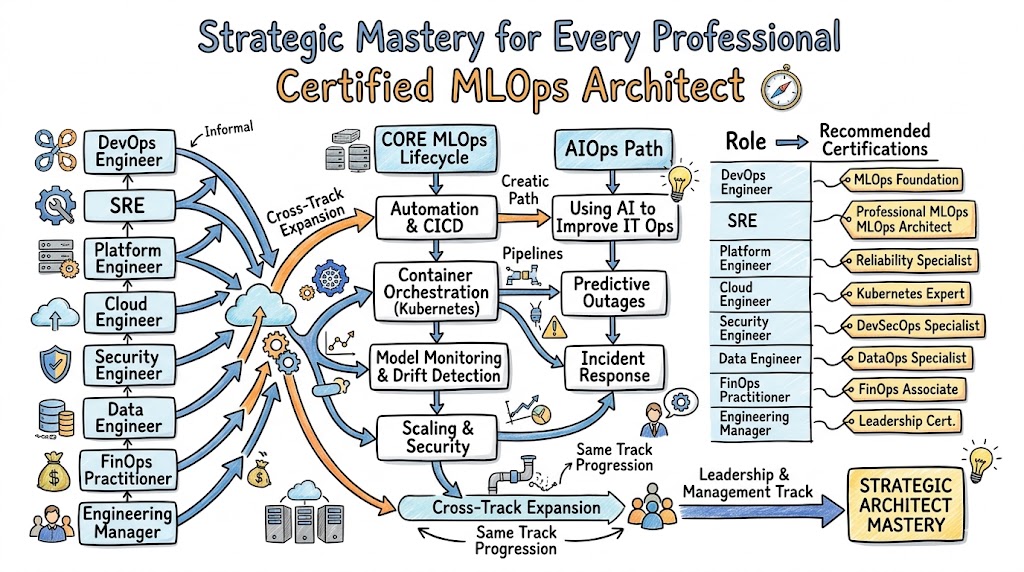
Role → Recommended Certified MLOps Architect Certifications
| Role | Recommended Certifications |
| DevOps Engineer | Professional MLOps, Cloud Automation |
| SRE | MLOps Architect, Reliability Specialist |
| Platform Engineer | Advanced Architect, Kubernetes Expert |
| Cloud Engineer | Foundation MLOps, Cloud Professional |
| Security Engineer | DevSecOps Specialist, MLOps Architect |
| Data Engineer | DataOps Specialist, Professional MLOps |
| FinOps Practitioner | FinOps Associate, Foundation MLOps |
| Engineering Manager | MLOps Architect, Leadership Certification |
Next Certifications to Take After Certified MLOps Architect
Same Track Progression
Mastering the architect level opens the door to even more specialized certifications in fields like Generative AI operations. You should continue to seek out advanced credentials that focus on the latest shifts in container technology and serverless AI. This ongoing education keeps you at the pinnacle of your profession as an industry authority.
Cross-Track Expansion
Gaining expertise in adjacent fields like advanced Cybersecurity or Data Engineering makes you a much more versatile leader. Since MLOps relies on so many different technical layers, understanding the full stack is a massive advantage. This strategy allows you to take on larger, cross-departmental projects that impact the entire organization.
Leadership & Management Track
Transitioning into executive or management roles is a logical step for those with deep technical backgrounds. You can use your knowledge to shape the AI strategy for your entire company rather than just building the pipelines. This path focuses on team growth, budget management, and the high-level alignment of technology with business goals.
Training & Certification Support Providers for Certified MLOps Architect
DevOpsSchool
This organization provides a comprehensive library of courses designed to turn engineers into automation experts. Their programs focus on practical, hands-on learning that prepares students for the realities of modern production environments.
Cotocus
This provider delivers high-impact training and consulting services for teams adopting cloud-native technologies. They emphasize a holistic approach to engineering that includes culture, process, and the latest technical tools.
Scmgalaxy
As a hub for configuration management and DevOps resources, this platform offers extensive guides and training modules. They help professionals master the intricacies of software delivery through a community-driven learning model.
BestDevOps
This site curates the most effective learning paths for engineers who want to excel in the DevOps and MLOps domains. They focus on delivering clarity and practical skills through expert-led tutorials and projects.
devsecopsschool.com
This portal specializes in the critical field of security within the automated pipeline. Their courses teach you how to protect your infrastructure without sacrificing the speed of your delivery.
sreschool.com
Dedicated to the art of reliability, this provider offers in-depth training on maintaining high-scale systems. Their curriculum covers everything from monitoring to automated incident management.
aiopsschool.com
This is the primary provider for AI-driven operations training and the host of the architect certification. They lead the industry in teaching engineers how to manage machine learning lifecycles at scale.
dataopsschool.com
This platform focuses on the data side of the equation, teaching the skills needed to manage complex data pipelines. Their training ensures that your models always have access to clean, reliable data.
finopsschool.com
This provider helps engineers and managers master the financial aspects of cloud and AI infrastructure. Their curriculum focuses on cost optimization and maximizing the return on your technology investments.
Frequently Asked Questions (General)
1. Does this certification require prior coding knowledge?
Yes, you should have a basic understanding of programming and shell scripting to complete the labs.
2. How long does it typically take to finish the professional level?
Most candidates finish the professional curriculum within eight to twelve weeks of consistent study.
3. Are the exam questions based on a specific cloud provider?
The exam focuses on universal principles, though you will use major clouds like AWS or Azure for the labs.
4. Can I earn this credential while working a full-time job?
The self-paced nature of the training makes it ideal for working professionals to balance with their careers.
5. Is there a community for networking with other architects?
Enrolled students gain access to exclusive forums and groups to discuss technical challenges and career opportunities.
6. What is the format of the final certification exam?
The assessment includes a mix of multiple-choice questions and hands-on laboratory tasks to prove your skills.
7. Does the program cover the ethical implications of AI?
Yes, the curriculum addresses governance and ethics to ensure you build responsible and transparent systems.
8. Is technical support available during the laboratory exercises?
Instructors and support teams provide guidance if you encounter technical issues during your hands-on training.
9. Will this certification help me if I work in a non-tech industry?
Every industry from finance to healthcare now uses AI, making these skills universally valuable across sectors.
10. How often does the course content receive updates?
The providers update the curriculum regularly to reflect the latest tools and best practices in the field.
11. Are there any prerequisites for the foundation exam?
No formal prerequisites exist for the foundation level, though basic IT literacy is highly recommended.
12. Can I share my certification badge on professional social networks?
You will receive a digital badge and certificate that you can easily display on platforms like LinkedIn.
FAQs on Certified MLOps Architect
1. How does the curriculum address the challenges of scaling LLMs?
The program includes specific modules on managing large-scale models, including resource allocation and low-latency serving.
2. Does the course teach specific tools like MLflow or Kubeflow?
You will gain hands-on experience with these industry-standard tools as part of the core engineering labs.
3. Is model security a major part of the architect certification?
Security is a foundational pillar of the curriculum, covering everything from data access to model hardening.
4. Will I learn how to build a feature store from scratch?
The course teaches you both the theoretical design and the practical implementation of feature stores.
5. How does the exam evaluate my architectural design skills?
The advanced level includes scenarios where you must design a full system architecture to meet specific business goals.
6. Is there a focus on the cost-efficiency of training models?
FinOps principles are woven into the curriculum to help you minimize unnecessary cloud spending.
7. Does the program cover hybrid and multi-cloud deployment strategies?
Yes, you will learn how to deploy and manage models across diverse environments and cloud providers.
8. Can I access the course materials after I pass the exam?
Most providers offer ongoing access to the materials so you can stay updated on future changes.
Final Thoughts: Is Certified MLOps Architect Worth It?
Taking the step to become a certified professional is the most effective way to separate yourself from the crowd in a competitive market. This journey transforms your understanding of how modern software and artificial intelligence actually work together. You move from being someone who just manages servers to someone who architecturally enables the future of the company.
The depth of knowledge you gain ensures that you can lead any team through the complexities of AI integration. While the training requires significant effort, the resulting career growth and technical confidence far outweigh the initial investment. You should view this not just as a badge, but as a total upgrade to your professional identity in the age of AI.




Leave a Reply
You must be logged in to post a comment.