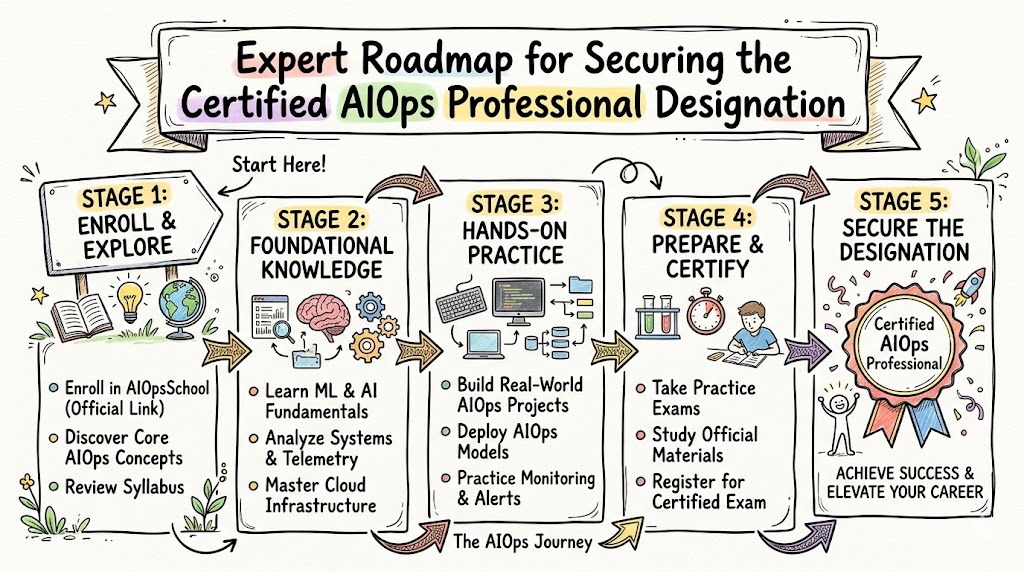
Introduction
Modern infrastructure demands smarter management, making the Certified AIOps Professional a vital credential for ambitious engineers. This detailed guide addresses SREs, platform specialists, and DevOps leaders who want to master the intersection of artificial intelligence and IT operations. We focus on shifting from manual troubleshooting to automated, data-centric stability. By following this path at AIOpsSchool, you learn to leverage machine learning for real-world production challenges. Our analysis helps you determine how this specific certification elevates your technical influence and career trajectory in an increasingly complex cloud landscape.
What is the Certified AIOps Professional?
The Certified AIOps Professional program delivers a framework for applying algorithmic intelligence to traditional system administration. It exists to transform massive streams of telemetry data into clear, actionable insights for engineering teams. Unlike academic data science, this certification prioritizes the engineering workflows necessary to keep large-scale production environments healthy. It aligns with current enterprise needs by teaching professionals how to automate root cause analysis and eliminate alert fatigue.
Who Should Pursue Certified AIOps Professional?
Site Reliability Engineers, Cloud Architects, and Platform Engineers find the most immediate value in this specialized certification. Security analysts and data specialists also benefit by applying anomaly detection patterns to their specific infrastructure domains. While seasoned leads use these skills to optimize global clusters, early-career engineers use the credential to stand out during competitive hiring cycles. Managers should pursue this track to effectively lead AI-driven digital transformation initiatives within their organizations.
Why Certified AIOps Professional is Valuable and Beyond
Enterprises now face infrastructure scales that exceed human capability, making intelligent automation a permanent requirement. This certification guarantees long-term relevance by focusing on core algorithmic concepts rather than fluctuating tool features. Organizations prioritize hiring certified experts to reduce operational overhead and improve system reliability across distributed networks. Mastering these skills provides a high return on investment through expanded leadership opportunities and the ability to drive high-impact technical strategy.
Certified AIOps Professional Certification Overview
Candidates access the entire program through the official course link and the AIOpsSchool host platform. The curriculum uses a hands-on assessment model to ensure that every participant can apply theoretical concepts to production-grade scenarios. Industry veterans maintain the content to reflect the latest shifts in observability and automated remediation. The structure guides you through a logical progression from basic data ingestion to complex architectural design.
Certified AIOps Professional Certification Tracks & Levels
The program offers three distinct tiers: foundation, professional, and advanced to support engineers at every career stage. The foundation level introduces basic telemetry concepts, while the professional level focuses on implementing machine learning models for operations. Advanced tracks prepare candidates for high-level architectural roles involving custom AIOps framework development. Each level mirrors a step in career growth, moving from individual task execution to strategic system design.
Complete Certified AIOps Professional Certification Table
| Track | Level | Who it’s for | Prerequisites | Skills Covered | Recommended Order |
| Operations | Foundation | Junior Admins | Linux Basics | Alerting, Metrics | First |
| Engineering | Professional | Mid-Level SREs | Python, Stats | Log Clustering | Second |
| Architecture | Advanced | Senior Leads | Professional Cert | Predictive Modeling | Third |
Detailed Guide for Each Certified AIOps Professional Certification
Certified AIOps Professional – Foundation
What it is
This certification confirms your ability to understand how artificial intelligence improves monitoring and incident response. It establishes the groundwork for using data to drive operational decisions.
Who should take it
Aspiring DevOps engineers and traditional sysadmins should take this to modernize their skill sets. It serves as the ideal entry point for anyone transitioning into data-driven infrastructure management.
Skills you’ll gain
- Mastery of telemetry types including logs and traces.
- Basic understanding of pattern recognition in systems.
- Ability to configure automated threshold alerts.
Real-world projects you should be able to do
- Build a monitoring dashboard that filters out redundant alerts.
- Create a basic log analysis script to find system errors.
Preparation plan
- 7–14 days: Focus on terminology and core concepts.
- 30 days: Complete all interactive labs and sample tests.
- 60 days: Deploy a small-scale monitoring project in a sandbox.
Common mistakes
- Overlooking the importance of high-quality data ingestion.
- Mistaking basic automation for true AIOps.
Best next certification after this
- Same-track: Professional AIOps level.
- Cross-track: SRE Foundation.
- Leadership: Platform Engineering Lead.
Choose Your Learning Path
DevOps Path
The DevOps path centers on embedding AI within the continuous delivery lifecycle to predict and prevent deployment failures. Professionals learn to analyze historical release data to identify risk patterns before code hits production. This track emphasizes building self-correcting pipelines that learn from every iteration. It is perfect for engineers who want to make the software release process more resilient.
DevSecOps Path
The DevSecOps path focuses on utilizing AI to detect security threats and automate vulnerability patching in real-time. Engineers learn to identify unusual traffic patterns and potential breaches using sophisticated behavior analysis. This track combines operational stability with proactive defense mechanisms to protect cloud-native assets. It provides a critical skill set for securing modern distributed applications.
SRE Path
The SRE path prioritizes system reliability and the reduction of manual toil through intelligent, data-driven automation. Engineers apply AIOps to perform lightning-fast root cause analysis during critical production incidents. This path focuses on maintaining strict SLOs by predicting potential failures before they impact the user experience. It represents the highest level of operational excellence for web-scale systems.
AIOps Path
The dedicated AIOps path dives deep into the specific machine learning algorithms used to manage infrastructure. Professionals focus on building custom models for anomaly detection and predictive maintenance across diverse tech stacks. This track prepares you to build the internal platforms that empower other engineering teams to work more efficiently. It bridges the technical gap between pure data science and core systems engineering.
MLOps Path
The MLOps path addresses the unique challenges of managing machine learning models in a live production environment. It covers model deployment, monitoring for data drift, and ensuring the scalability of AI-driven features. This track is essential for companies that incorporate machine learning directly into their customer-facing products. It ensures that the AI models remain accurate and performant over time.
DataOps Path
DataOps focuses on the orchestration and quality of the data pipelines that fuel AIOps engines. Professionals learn to automate the delivery of high-quality telemetry data to ensure accurate model performance. This track emphasizes data governance, speed, and reliability throughout the data lifecycle. It provides the essential foundation for any successful AI-driven operations strategy.
FinOps Path
The FinOps path applies intelligent automation to cloud cost management and financial optimization. Engineers learn to use predictive analytics to forecast spending and automatically identify waste in cloud resources. This track focuses on balancing technical performance with financial efficiency to maximize cloud ROI. It is a high-impact role that directly influences corporate profitability.
Role → Recommended Certified AIOps Professional Certifications
| Role | Recommended Certifications |
| DevOps Engineer | AIOps Professional, Pipeline Expert |
| SRE | AIOps Advanced, SRE Professional |
| Platform Engineer | Foundation AIOps, Kubernetes Admin |
| Cloud Engineer | FinOps Specialist, AIOps Professional |
| Security Engineer | DevSecOps AIOps, Security Architect |
| Data Engineer | DataOps Expert, ML Infrastructure |
| FinOps Practitioner | Cost Optimizer, AIOps Foundation |
| Engineering Manager | AIOps Strategy, Management Lead |
Next Certifications to Take After Certified AIOps Professional
Same Track Progression
Deep specialization involves moving toward the Advanced AIOps Architect level to design large-scale enterprise solutions. This path focuses on mastering neural networks and long-term infrastructure strategy for global organizations. Professionals at this level lead the technical vision for how AI transforms their company’s operational capabilities.
Cross-Track Expansion
Broadening your skills into MLOps or DevSecOps creates a more versatile and valuable professional profile. Understanding the security implications of AI or the lifecycle of a production model makes you an indispensable asset. This approach builds a comprehensive expertise that spans multiple high-growth technical domains.
Leadership & Management Track
Transitioning to leadership requires certifications that focus on technical strategy and people management. At this stage, you move from individual technical execution to guiding teams through complex AI implementations. This path suits those who want to shape the future of engineering culture and operational standards.
Training & Certification Support Providers for Certified AIOps Professional
DevOpsSchool
This provider delivers comprehensive training and hands-on labs for diverse engineering certifications. They emphasize practical skills that candidates can immediately apply to real-world infrastructure.
Cotocus
A premier training organization that specializes in corporate-level cloud and AI education. They offer highly tailored programs that fit the specific needs of modern engineering teams.
Scmgalaxy
This community-focused platform provides deep technical guides and resources for configuration management. They help candidates master the technical nuances required for professional-level assessments.
BestDevOps
They offer a streamlined and efficient curriculum for DevOps and SRE professionals. Their training focuses on high-impact learning to help engineers certify quickly and effectively.
devsecopsschool.com
This portal specializes in the security aspects of the software development lifecycle. They offer dedicated tracks for engineers who want to integrate AI with security operations.
sreschool.com
A dedicated resource for everything related to Site Reliability Engineering and system uptime. They provide specialized training on maintaining high availability through intelligent monitoring.
aiopsschool.com
The official authority for the AIOps certification program and curriculum. They host the primary assessments and provide the gold standard for AI-driven operational education.
dataopsschool.com
This site focuses on the essential data management skills needed to support AI systems. They teach engineers how to build the resilient pipelines required for accurate AIOps.
finopsschool.com
A specialized training provider for cloud financial management and cost optimization. They help professionals use data to drive significant savings in cloud infrastructure spending.
Frequently Asked Questions (General)
- How challenging is the Certified AIOps Professional exam?
The exam presents a moderate to high challenge because it tests both theoretical knowledge and practical system configuration. - What is the typical preparation time for this certification?
Most candidates require 30 to 60 days of consistent study to fully grasp the material and pass the exam. - Does the professional level have specific requirements?
Yes, candidates should possess two years of DevOps experience and a basic understanding of Python scripting. - What kind of career boost can I expect?
Certified individuals often qualify for senior architect roles and see significant increases in their total compensation packages. - Is it necessary to start with the foundation level?
We recommend the foundation level for those without prior experience in machine learning or data-driven monitoring. - How long does the certification remain valid?
The certification typically remains valid for two to three years, after which you must renew to stay current. - Are there performance-based tasks in the assessment?
Yes, higher-level exams include practical labs where you must solve real operational problems in a live environment. - Can I complete the testing process remotely?
The program supports proctored online exams, allowing you to certify from any location with a stable internet connection. - How does this differ from generic Data Science courses?
This program focuses exclusively on system telemetry and IT operations rather than general business or research data. - Does this credential help me move into management?
Yes, it proves you understand the strategic value of automation, which is a prerequisite for modern engineering leadership. - Are study guides included with the enrollment fee?
The AIOpsSchool platform provides full access to video lessons, practice exams, and comprehensive study guides. - Do major enterprises recognize this certification?
Yes, global organizations and top-tier consulting firms recognize this as the standard for AI-driven operational expertise.
FAQs on Certified AIOps Professional
- Which technical tools does the course emphasize?
The curriculum focuses on core principles while using industry standards like Prometheus, ELK, and various ML libraries for labs. - Is heavy coding required during the exam?
Candidates need to demonstrate proficiency in Python and Shell scripting to automate the tasks presented during the assessment. - Does the program address Generative AI for ops?
Yes, the latest modules cover how to use Large Language Models for incident summaries and automated script generation. - Is the training applicable to all cloud providers?
The strategies you learn work across AWS, Azure, and GCP, emphasizing vendor-neutral architectural patterns for maximum career flexibility. - How do the lab environments function?
The platform provides access to cloud-based sandboxes where you practice identifying anomalies in real-world system data. - Can this help me reduce cloud spending?
The FinOps track specifically teaches you how to use AI to find and eliminate cloud waste automatically. - What score do I need to pass the exam?
Most assessments require a minimum score of 70% to prove you have mastered the professional competencies. - Is there a community for certified professionals?
Graduates gain access to an exclusive network where they can discuss advanced implementations and career opportunities with peers.
Final Thoughts: Is Certified AIOps Professional Worth It?
Pursuing this designation offers a clear advantage in a technical landscape moving rapidly toward total automation. We see that human-only monitoring simply cannot scale with modern microservices and global cloud architectures. This certification provides the expertise needed to build systems that anticipate issues before they become outages. You gain a unique blend of data science and systems engineering that very few professionals currently possess. While the study requirements are rigorous, the resulting architectural influence and career stability make this investment highly worthwhile for any serious engineer.




Leave a Reply
You must be logged in to post a comment.