Introduction
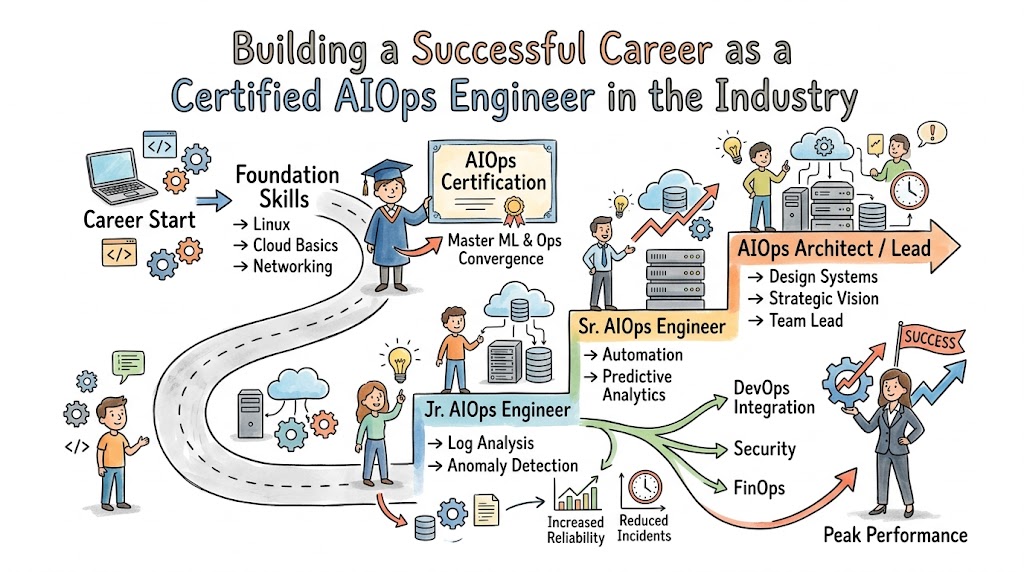
The current state of technology necessitates complex administration, and obtaining a Certified AIOps Engineer credential empowers you to master these complex environments. This guide targets software engineers and technical leaders who want to navigate the transition toward autonomous infrastructure and cloud-native platforms. Traditional monitoring methods often fail under the weight of massive telemetry data, making artificial intelligence an essential ally for production stability. You will find that this roadmap helps you evaluate the career impact and practical benefits of advanced operational automation. By exploring the resources at AIOpsSchool, you gain the insights necessary to lead digital transformation efforts within your organization.
What is the Certified AIOps Engineer?
The Certified AIOps Engineer program delivers a robust framework for applying machine learning to IT operations. It exists to bridge the gap between static monitoring scripts and dynamic, self-healing architectures. This designation prioritizes hands-on production experience over abstract concepts, ensuring that participants can manage real-world enterprise workloads. It mirrors the evolution of modern engineering by integrating predictive analytics directly into the software development lifecycle. Ultimately, this certification proves your ability to transform raw system data into actionable operational intelligence.
Who Should Pursue Certified AIOps Engineer?
Platform engineers, SREs, and cloud architects find this path particularly rewarding as they manage increasingly dense microservices. Security teams also utilize these skills to detect subtle anomalies that signal potential breaches or performance regressions. The program welcomes both rising engineers seeking a niche and veteran architects aiming to modernize their methodology. Companies across India and the global market actively hunt for talent capable of reducing manual intervention through algorithmic logic. Managers who want to optimize their team’s output should also pursue this to understand the future of technical leadership.
Why Certified AIOps Engineer is Valuable and Beyond
Enterprises continue to adopt hybrid cloud strategies, fueling a massive demand for professionals who can automate complex system observations. This certification ensures long-term career resilience because it focuses on universal data principles rather than a single vendor’s ecosystem. You stay relevant by mastering how to filter signal from noise, a skill that remains vital even as specific tools evolve. Moreover, implementing AIOps reduces “toil,” allowing you to focus on high-value innovation instead of repetitive maintenance tasks. Choosing this path represents a strategic investment in your professional longevity and earning potential.
Certified AIOps Engineer Certification Overview
AIOpsSchool delivers the training and hosts the assessment process through its specialized digital platform. The program features multiple tiers that move from fundamental data handling to complex system architecture. Candidates face rigorous evaluations that test their ability to deploy and maintain machine learning models in live environments. This structure guarantees that every certificate holder possesses the practical expertise required by high-growth tech firms. By focusing on ownership and accountability, the certification prepares you for the high-stakes reality of modern IT operations.
Certified AIOps Engineer Certification Tracks & Levels
The certification hierarchy includes foundation, professional, and advanced tiers to support continuous professional development. Foundation modules establish a baseline in data ingestion and basic alerting logic for those entering the field. Professional tracks allow for deeper specialization in areas like automated incident response or AI-driven security operations. Architects eventually reach the advanced levels, where they design massive, cross-functional autonomous systems. Each level aligns with specific career milestones, providing a clear path from individual contributor to strategic visionary.
Complete Certified AIOps Engineer Certification Table
| Track | Level | Who it’s for | Prerequisites | Skills Covered | Recommended Order |
| Operations | Foundation | Junior Engineers | General Cloud Knowledge | Logging, Basic AI Alerts | 1 |
| Engineering | Professional | SRE / DevOps Leads | 2+ Years Experience | ML Integration, RCA | 2 |
| Architecture | Advanced | Principal Architects | Professional Tier | System Design, Strategy | 3 |
| Specialized | Expert | Data & MLOps | Advanced Tier | Model Tuning, Scaling | 4 |
Detailed Guide for Each Certified AIOps Engineer Certification
Certified AIOps Engineer – Foundation Level
What it is
This entry-tier certification proves your grasp of how AI augments standard monitoring and logging workflows. It serves as the official starting point for any professional entering the world of automated operations.
Who should take it
Recent graduates and mid-level sysadmins transitioning to cloud roles should start here. It provides the vocabulary and conceptual clarity needed for more advanced technical discussions.
Skills you’ll gain
- Identification of key telemetry sources
- Setting up basic automated thresholds
- Understanding log patterns and structures
- Utilizing AI-assisted dashboarding
Real-world projects you should be able to do
- Connect a data stream to an AI monitoring tool
- Configure a basic anomaly detection alert for a web service
Preparation plan
- 7-14 Days: Study the core pillars of observability and AIOps terminology.
- 30 Days: Work through all guided labs focusing on data ingestion.
- 60 Days: Complete mock exams to ensure a high level of conceptual retention.
Common mistakes
- Focusing only on tools without learning the underlying data logic
- Neglecting the importance of data quality at the ingestion stage
Best next certification after this
- Same-track option: Professional AIOps Engineer
- Cross-track option: Cloud Associate
- Leadership option: Junior Team Lead
Certified AIOps Engineer – Professional Level
What it is
The professional level validates your ability to build and maintain intelligent automation within high-concurrency environments. It moves beyond monitoring into the realm of predictive action and automated recovery.
Who should take it
Experienced DevOps engineers and SREs who handle production environments daily should pursue this. It validates your capability to manage critical systems with minimal manual oversight.
Skills you’ll gain
- Training models for predictive scaling
- Automating root cause analysis for incidents
- Managing model lifecycle within CI/CD
- Designing noise-reduction strategies for alerts
Real-world projects you should be able to do
- Create a self-healing script that triggers based on AI predictions
- Implement a cluster-wide logging strategy using machine learning filters
Preparation plan
- 7-14 Days: Review the specific mathematical models used in anomaly detection.
- 30 Days: Practice complex deployments in a sandbox environment.
- 60 Days: Analyze enterprise-scale logs to test your diagnostic speed.
Common mistakes
- Failing to monitor the performance of the AI models themselves
- Over-automating without setting proper human-in-the-loop guardrails
Best next certification after this
- Same-track option: Advanced AIOps Architect
- Cross-track option: MLOps Specialist
- Leadership option: Engineering Manager
Choose Your Learning Path
DevOps Path
Professionals on this path integrate AI into the delivery pipeline to ensure faster, safer deployments. You will learn to use predictive analytics to spot potential bottlenecks before they impact the user experience. This specialization enables you to build smarter CI/CD flows that adjust automatically based on real-time feedback. By mastering these skills, you ensure that high-velocity development does not compromise system stability.
DevSecOps Path
This track focuses on using artificial intelligence to bolster infrastructure security and automate threat response. You will learn to identify irregular traffic patterns that signal a breach much faster than traditional signature-based methods. This path is essential for engineers working in environments where compliance and data protection are top priorities. It allows you to build a proactive security posture that evolves alongside emerging threats.
SRE Path
The SRE path emphasizes system reliability and the drastic reduction of operational “toil” through automation. You will master techniques for maintaining uptime by using AI to predict and prevent hardware or software failures. This specialization focuses on meeting strict Service Level Objectives while managing global-scale infrastructure. It empowers you to lead the transition from manual firefighting to algorithmic system management.
AIOps Path
This dedicated path focuses on the comprehensive application of AI across the entire IT operational spectrum. You will study everything from data collection and normalization to the deployment of advanced neural networks for operations. This track creates specialists who can unify fragmented monitoring tools into a single, intelligent control plane. It serves as the definitive route for those wanting to lead the autonomous operations revolution.
MLOps Path
Engineers here focus on the operational side of machine learning, ensuring that models perform reliably in production. You will learn to automate the retraining and deployment of AI assets to maintain their accuracy over time. This path bridges the gap between data science and traditional systems engineering, a critical need for AI-driven companies. It ensures that the business value of AI remains consistent despite changing data trends.
DataOps Path
The DataOps path focuses on the architecture and flow of the telemetry data that feeds AIOps systems. You will learn to build high-performance data pipelines that handle massive volumes of logs, metrics, and traces without latency. This specialization ensures that the intelligence layer always receives clean, high-quality data for its analysis. It is an ideal route for those who enjoy the engineering challenges of large-scale data management.
FinOps Path
This specialization uses AI to optimize cloud spending and ensure maximum efficiency for infrastructure investments. You will learn to use predictive models to find hidden costs and automate the right-sizing of cloud resources. This path is increasingly popular as companies seek to manage complex, multi-cloud budgets with greater precision. It allows you to prove the direct financial impact of your technical expertise.
Role → Recommended Certified AIOps Engineer Certifications
| Role | Recommended Certifications |
| DevOps Engineer | Foundation + Professional |
| SRE | Professional + Advanced |
| Platform Engineer | Professional + Advanced |
| Cloud Engineer | Foundation + Professional |
| Security Engineer | Professional (Security Focus) |
| Data Engineer | Professional (DataOps Focus) |
| FinOps Practitioner | Professional (FinOps Focus) |
| Engineering Manager | Foundation + Leadership Track |
Next Certifications to Take After Certified AIOps Engineer
Same Track Progression
Advancing within the AIOps hierarchy leads to the architect and expert levels. This progression focuses on the design of global, self-healing systems and the management of high-level AI strategies. You will move from implementing specific models to overseeing the entire intelligent infrastructure of an organization. This path typically culminates in senior technical leadership roles like Principal Engineer or System Architect.
Cross-Track Expansion
Broadening your skills involves taking your AI expertise into related fields like cybersecurity or data engineering. This strategy makes you a versatile asset who can solve problems across multiple technical domains simultaneously. By understanding how AI interacts with different layers of the stack, you increase your value to any high-growth organization. It provides a diversified professional foundation that protects against shifts in specific technology trends.
Leadership & Management Track
Moving into management requires a shift from technical execution to strategic planning and team development. Your background as a certified engineer will allow you to make informed decisions about AI investments and resource allocation. This track prepares you to lead technical departments through the complexities of digital transformation. It is the ideal path for those who want to influence the long-term direction of their organization’s technology.
Training & Certification Support Providers for Certified AIOps Engineer
DevOpsSchool
This institution provides deep technical training through hands-on labs that simulate real enterprise challenges. They focus on the integration of various automation tools to create a seamless operational workflow. Their courses help engineers build the practical skills required for the modern software delivery lifecycle.
Cotocus
This provider specializes in cloud-native technologies and focuses heavily on containerization and orchestration at scale. They offer specialized programs that help engineers manage high-density microservices environments using the latest automation techniques. Their training is designed for professionals working in fast-paced, high-growth technical sectors.
Scmgalaxy
This platform offers a vast array of resources, including community forums, detailed tutorials, and structured certification support. They emphasize the fundamentals of configuration management and source control as essential precursors to AIOps. Their practical approach helps engineers solve immediate production issues while building a long-term knowledge base.
BestDevOps
This organization offers comprehensive learning paths that guide professionals from basic concepts to advanced architectural design. They focus on delivering clear, actionable content that strips away marketing hype to reveal core technical truths. Their support systems ensure that candidates feel confident and prepared for their certification assessments.
devsecopsschool.com
This school focuses on the critical intersection of security and operations within the modern cloud environment. They teach students how to use AI for automated vulnerability scanning and real-time threat detection across the pipeline. Their programs are vital for engineers who need to ensure compliance in highly regulated industries.
sreschool.com
This provider focuses on the core principles of system reliability and the reduction of operational noise. They teach engineers how to use data-driven insights to maintain high availability for global web services. Their training is highly valued by organizations that prioritize uptime and consistent performance.
aiopsschool.com
This specialized school serves as the primary authority for artificial intelligence in the operational domain. They host the official curriculum for the AIOps certification and provide the most up-to-date resources in the field. Their focus remains on building the next generation of intelligent systems architects.
dataopsschool.com
This institution emphasizes the importance of data quality and pipeline resilience for modern AI systems. They teach the skills needed to manage the flow of information across complex, distributed infrastructure. Their training is essential for anyone who wants to ensure their AIOps tools receive reliable telemetry.
finopsschool.com
This organization focuses on the financial side of cloud operations, teaching engineers how to use AI for cost optimization. They provide the tools and knowledge needed to align technical infrastructure with business budgets and financial goals. Their certification is a major asset for those in cost-conscious enterprise environments.
Frequently Asked Questions (General)
- How difficult is the certification exam for a professional engineer?
The exam presents a moderate challenge because it tests both your theoretical understanding and your practical lab skills.
- How much time should I dedicate to studying for the foundation level?
Plan to spend roughly five to ten hours each week for one month to fully prepare for the exam.
- Are there any mandatory prerequisites before I can take the professional exam?
While not always strictly required, most successful candidates have at least two years of experience in cloud or DevOps roles.
- What is the return on investment for this specific certification track?
Certified engineers often report significant salary growth and increased interest from top-tier global technology and finance firms.
- In what sequence should I take the different certification levels?
Begin with the Foundation level to build your base, then progress to Professional and Advanced as you gain experience.
- Does the certification focus on a specific vendor or is it tool-agnostic?
The curriculum focuses on core principles and logic, ensuring your skills apply to any tool or cloud vendor.
- How often do I need to renew my certification to stay current?
You should expect to renew or update your certification every two to three years to keep pace with industry changes.
- Can a manager with a non-technical background pass the foundation exam?
Yes, if they invest time in learning the core concepts, a manager can pass to gain better strategic insight.
- What kind of lab environments are provided during the training phase?
Providers offer cloud-based sandboxes that allow you to experiment with AI tools in a safe, isolated environment.
- Is the certification recognized by major tech companies in India and abroad?
Major tech firms worldwide recognize this certification as a standard for expertise in modern, automated operational management.
- Are there community groups available for certified professionals to network?
Yes, most providers host alumni forums and LinkedIn groups where you can share insights and find job openings.
- Does the exam include multiple-choice questions or practical tasks?
The exam uses a hybrid format that includes both conceptual multiple-choice questions and practical, hands-on troubleshooting tasks.
FAQs on Certified AIOps Engineer
- How do I start my journey as a Certified AIOps Engineer today?Visit the official site to download the curriculum and begin reviewing the basic telemetry and logging concepts. You should also set up a local testing environment to practice the data ingestion techniques described in the foundation modules.
- Does this certification cover both supervised and unsupervised machine learning?The program includes both types of learning to ensure you can handle anomaly detection as well as predictive forecasting. You will learn to choose the right approach based on the specific operational data and goals of your organization.
- Can I use these skills in a traditional on-premises data center?The principles of AIOps apply to any infrastructure that generates logs and metrics, including traditional on-premises servers. You can use these automated techniques to modernize legacy systems and improve their reliability without moving entirely to the cloud.
- What programming languages are most useful for this certification track?Python remains the most important language due to its dominance in data science and its extensive automation libraries. Learning Bash and YAML will also help you manage the configurations and scripts required for modern operational pipelines.
- How does AIOps differ from standard DevOps or SRE roles?AIOps adds a layer of machine intelligence to existing practices to handle scales that exceed human capability. It enhances the work of DevOps and SRE teams by automating the discovery of patterns and root causes within massive datasets.
- Is there a focus on cost optimization within the curriculum?The advanced levels include specific modules on using AI to identify wasteful resources and predict future cloud spending patterns. This ensures that you can contribute to the financial health of your organization while maintaining high performance.
- What are the common tools taught during the certification process?You will gain experience with a wide range of industry-standard tools for log aggregation, metric monitoring, and incident management. The training focuses on how to integrate these tools into a unified, AI-driven operational framework.
- Are there any group discounts for enterprise engineering teams?Corporate training packages often provide discounted rates for teams looking to certify multiple engineers at the same time. You should reach out to the provider’s enterprise sales team to discuss custom schedules and bulk pricing options.
Final Thoughts: Is Certified AIOps Engineer Worth It?
Investing in this certification represents a smart move for any engineer who wants to lead in the age of automation. You gain a unique skill set that separates you from traditional operators who still rely on manual scripts and reactive troubleshooting. The transition to AI-driven infrastructure is inevitable, and being among the first to master it gives you a distinct market advantage. Beyond the technical knowledge, you develop a mindset focused on high-level system reliability and proactive problem-solving. This path offers a clear route to senior roles and ensures your skills remain relevant in a rapidly changing industry.



Leave a Reply
You must be logged in to post a comment.