Introduction
Navigating the intersection of finance and cloud engineering requires specialized expertise that goes beyond basic resource management. The Certified FinOps Professional program provides a robust framework for engineers and managers to bridge the gap between technical operations and fiscal accountability. This guide serves as a strategic resource for professionals within the DevOps, SRE, and platform engineering domains who seek to master cloud economics. By understanding these principles, individuals can drive organizational efficiency and make data-driven career decisions that align with modern enterprise demands. Working with FinOpsSchool allows practitioners to gain deep insights into cost optimization and collaborative governance.
What is the Certified FinOps Professional?
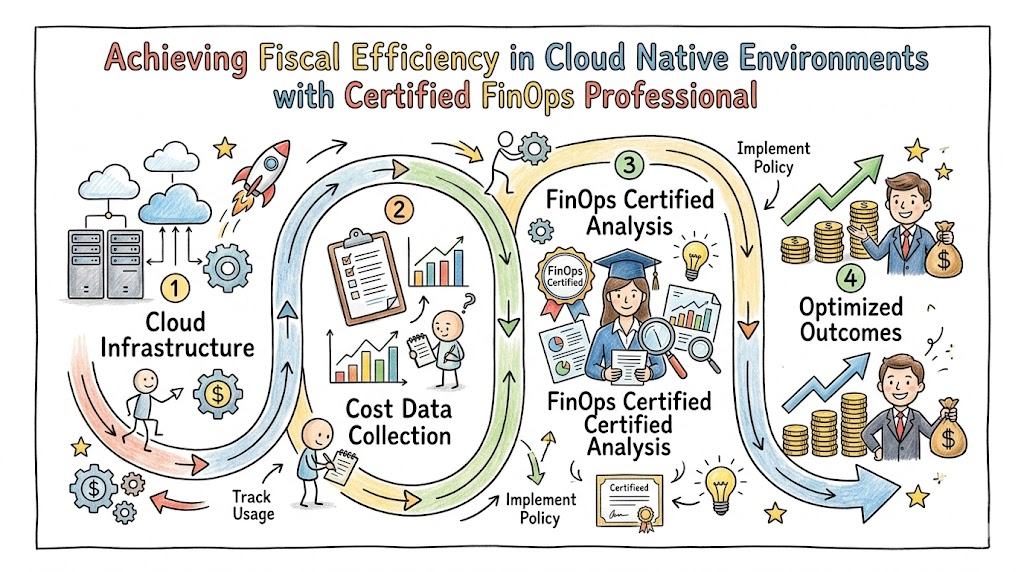
The Certified FinOps Professional represents a benchmark of excellence for those managing cloud spend in complex, high-scale environments. It exists to formalize the culture of accountability where engineering, finance, and business teams work in unison to optimize cloud value. Rather than focusing on theoretical cost-cutting, this designation emphasizes real-world application, such as unit economics and automated lifecycle management. It aligns with modern engineering workflows by integrating financial guardrails directly into the continuous delivery pipeline.
Who Should Pursue Certified FinOps Professional?
This certification is ideal for DevOps engineers, Site Reliability Engineers, and Cloud Architects who are responsible for infrastructure provisioning. Security and data professionals also benefit significantly, as they often manage high-cost clusters that require strict budgetary oversight. It is equally relevant for engineering managers who need to justify cloud investments to executive leadership. Whether you are a beginner in India or a veteran leader in a global tech hub, this path provides the necessary tools to manage cloud finances effectively.
Why Certified FinOps Professional is Valuable in the Future
As enterprises move from simple cloud migration to advanced cloud-native optimization, the demand for financial governance is skyrocketing. Mastering these skills ensures longevity in a career because while specific cloud tools may change, the fundamental need for cost efficiency remains constant. It helps professionals stay relevant by shifting their focus from merely “running” systems to “optimizing” them for business growth. The return on time invested is substantial, as organizations prioritize hiring those who can demonstrate a direct impact on the bottom line.
Certified FinOps Professional Certification Overview
The program is delivered via the official portal and hosted on the primary website. It utilizes a multi-tiered assessment approach that evaluates both foundational knowledge and the ability to apply FinOps principles to enterprise scenarios. The ownership of this certification ensures a standardized curriculum that reflects current industry best practices and cloud provider updates. Candidates engage with a structured learning path that covers the entire lifecycle of cloud financial management, from visibility to optimization and operation.
Certified FinOps Professional Certification Tracks & Levels
The certification structure is divided into foundation, professional, and advanced levels to accommodate different stages of a professional’s career. The foundation level introduces core concepts of cloud economics, while the professional level dives deep into implementation strategies for SRE and DevOps teams. Specialized tracks allow practitioners to focus on specific domains like container cost management or multi-cloud governance. These levels are designed to align with career progression, moving from individual contributors to strategic organizational leaders.
Complete Certified FinOps Professional Certification Table
| Track | Level | Who it’s for | Prerequisites | Skills Covered | Recommended Order |
| Core FinOps | Foundation | Beginners, Finance | Cloud Basics | Cost Allocation, Terminology | 1 |
| Cloud Engineering | Professional | SREs, DevOps | Foundation Cert | Automation, Unit Metrics | 2 |
| Strategic Lead | Advanced | Directors, Leads | Professional Cert | Governance, Policy Design | 3 |
| Data Analytics | Specialist | Data Engineers | Cloud Analytics | Granular Billing, Big Data | 2 |
Detailed Guide for Each Certified FinOps Professional Certification
Certified FinOps Professional – Foundation
What it is
This level validates a basic understanding of the FinOps framework and the ability to communicate between technical and finance teams effectively.
Who should take it
It is suitable for entry-level cloud engineers, finance associates, and procurement specialists who are new to cloud-specific financial models.
Skills you’ll gain
- Understanding the six FinOps principles.
- Navigating cloud billing dashboards.
- Identifying different types of cloud spend.
Real-world projects you should be able to do
- Create a basic cost allocation tag strategy for a startup.
- Generate a monthly cloud spend report for a small engineering team.
Preparation plan
- 7–14 days: Review official glossary and core principles daily.
- 30 days: Complete all practice assessments and attend foundational webinars.
- 60 days: Implement basic tagging in a sandbox environment to visualize data.
Common mistakes
- Overlooking the cultural aspect of FinOps.
- Memorizing terms without understanding the “why” behind cloud billing.
Best next certification after this
- Same-track option: Certified FinOps Professional – Practitioner level.
- Cross-track option: Cloud Provider Specific Practitioner.
- Leadership option: FinOps for Managers.
Certified FinOps Professional – Practitioner
What it is
This certification validates the ability to implement optimization strategies and manage the daily operations of a cloud financial program.
Who should take it
Middle-level engineers and cloud analysts who actively manage cloud resources and need to drive cost-saving initiatives.
Skills you’ll gain
- Advanced commitment technologies like RI and Savings Plans.
- Automated cost anomaly detection setup.
- Benchmarking and performance tracking.
Real-world projects you should be able to do
- Design a multi-account discount sharing strategy for an enterprise.
- Automate the shutdown of non-production environments using serverless functions.
Preparation plan
- 7–14 days: Focus on complex discount modeling and calculation logic.
- 30 days: Deep dive into cloud-native cost management tools.
- 60 days: Case study analysis of large-scale cloud migrations.
Common mistakes
- Neglecting the nuances of different cloud providers.
- Failing to account for hidden costs like data egress.
Best next certification after this
- Same-track option: Certified FinOps Professional – Advanced.
- Cross-track option: SRE Professional Certification.
- Leadership option: Cloud Business Lead.
Choose Your Learning Path
DevOps Path
Engineers following this path focus on integrating cost guardrails into the CI/CD pipeline. They learn to treat “cost” as a first-class metric alongside “uptime” and “performance.” This ensures that every code deployment is evaluated for its financial impact on the organization.
DevSecOps Path
This track emphasizes the intersection of security compliance and financial waste. Professionals learn how to identify “zombie” resources that pose both a security risk and a financial drain. It highlights how secure, streamlined environments are inherently more cost-effective.
SRE Path
Site Reliability Engineers use these certifications to balance system reliability with cost efficiency. They focus on defining Service Level Objectives that include cost-per-request metrics. This helps in maintaining high availability without over-provisioning expensive cloud resources.
AIOps Path
In this specialized route, professionals use machine learning models to predict future cloud spend. They focus on automated anomaly detection and proactive scaling based on historical usage patterns. It is about moving from reactive cost management to predictive optimization.
MLOps Path
Machine Learning Operations specialists focus on the high cost of GPU and TPU resources. They learn how to optimize training jobs and inference pipelines to prevent massive cloud bills. This path is crucial for organizations scaling AI initiatives.
DataOps Path
Data professionals concentrate on the costs associated with big data storage and processing. They learn to optimize data lakes, warehouse queries, and ETL pipelines. The goal is to ensure that data-driven insights do not come at a prohibitive price.
FinOps Path
This is the dedicated path for cloud financial managers who oversee the entire ecosystem. They focus on the cultural shift required to make FinOps a core part of the business. It involves high-level reporting and long-term strategic planning for cloud investments.
Role → Recommended Certified FinOps Professional Certifications
| Role | Recommended Certifications |
| DevOps Engineer | FinOps Practitioner, Cloud Specialist |
| SRE | FinOps Practitioner, SRE Professional |
| Platform Engineer | Advanced FinOps, Platform Architect |
| Cloud Engineer | FinOps Foundation, Cloud Associate |
| Security Engineer | FinOps Foundation, Security Specialist |
| Data Engineer | DataOps Specialist, FinOps Practitioner |
| FinOps Practitioner | Professional FinOps, Advanced FinOps |
| Engineering Manager | FinOps for Managers, Strategic FinOps |
Next Certifications to Take After Certified FinOps Professional
Same Track Progression
Once you master the professional level, the next step is moving toward organizational leadership within the domain. This involves learning how to build a FinOps Center of Excellence from the ground up. Deep specialization in a single cloud provider’s advanced billing tools can also set you apart as a subject matter expert.
Cross-Track Expansion
Broadening your skills into SRE or Platform Engineering allows you to apply financial principles to a wider technical landscape. Understanding how infrastructure as code affects cost can make you a more versatile architect. It allows you to build systems that are efficient by design rather than by correction.
Leadership & Management Track
Transitioning to leadership requires a focus on people and process rather than just tools. You might pursue certifications that focus on digital transformation and executive-level cloud strategy. This helps you bridge the gap between technical teams and the C-suite, effectively communicating value in business terms.
Training & Certification Support Providers for Certified FinOps Professional
DevOpsSchool
This provider offers extensive resources for those looking to integrate financial management into their existing DevOps practices. They focus on practical labs and real-world scenarios to ensure that students can apply what they learn immediately in a production environment.
Cotocus
A dedicated training partner that focuses on high-level cloud architecture and optimization. Their curriculum is designed for senior professionals who need to manage large-scale cloud budgets across multiple global regions efficiently and effectively.
Scmgalaxy
This community-driven platform provides a wealth of knowledge regarding software configuration and its impact on cloud costs. It is an excellent resource for engineers who want to understand the granular details of resource utilization and cost-saving automation.
BestDevOps
Focusing on elite engineering practices, this provider helps teams reach the highest levels of operational excellence. Their training modules emphasize the synergy between performance tuning and financial governance in modern cloud-native applications.
devsecopsschool.com
This institution bridges the gap between security, operations, and finance. They provide specialized training on how to maintain a secure posture while ensuring that security tools and logging do not lead to unexpected cloud bill spikes.
sreschool.com
For those focused on reliability, this school offers deep dives into how SRE principles can be applied to financial management. They teach how to build resilient systems that are also fiscally responsible through advanced monitoring and alerting.
aiopsschool.com
This provider focuses on the future of operations through the lens of artificial intelligence. Their training covers how to use AI to manage cloud complexity and automate the FinOps lifecycle for massive enterprise environments.
dataopsschool.com
Specializing in the data domain, this school helps data engineers manage the high costs of modern data stacks. Their curriculum focuses on optimizing storage and compute for large-scale analytics and data science projects.
finopsschool.com
The primary authority for these certifications, offering the most comprehensive and up-to-date curriculum available. They provide the official roadmap for anyone looking to become a recognized expert in the field of cloud financial management.
Frequently Asked Questions
- How difficult is the Certified FinOps Professional exam for a beginner?The exam is moderately challenging as it requires a shift in mindset from technical performance to financial accountability. Beginners should focus on learning the cloud billing models before attempting the professional level.
- How much time is required to prepare for the foundation level?Most professionals find that two to three weeks of consistent study are sufficient to grasp the core concepts. This includes reading the framework documentation and taking practice quizzes to familiarize yourself with the format.
- Are there any specific prerequisites for the professional certification?While not always mandatory, having a basic cloud certification from AWS, Azure, or GCP is highly recommended. Understanding how cloud resources are provisioned makes the financial concepts much easier to digest.
- What is the return on investment for this certification?Organizations are actively seeking professionals who can reduce cloud waste, often leading to salary increases and better job security. The ability to save a company thousands of dollars monthly is a powerful negotiation tool.
- Is this certification recognized globally by major tech companies?Yes, the framework is the industry standard used by Fortune 500 companies and major cloud providers worldwide. It is a highly respected credential in the DevOps and cloud engineering communities.
- Do I need to be an expert in math or finance to succeed?No, you only need a basic understanding of percentages and arithmetic. The focus is more on the logic of cloud consumption and the culture of accountability than on complex accounting.
- How often does the certification curriculum get updated?The content is updated regularly to reflect changes in cloud provider pricing models and new industry best practices. This ensures that your skills remain relevant in a fast-paced technological environment.
- Can I take the exam online from my home or office?Most certification paths offer proctored online exams that allow you to test from anywhere with a stable internet connection. This provides flexibility for working professionals in different time zones.
- What is the difference between the foundation and professional levels?The foundation level focuses on terminology and basic principles, whereas the professional level tests your ability to solve complex scenarios. The professional level is much more hands-on and practice-oriented.
- Does this certification cover multi-cloud environments?Yes, the principles taught are vendor-neutral and can be applied across AWS, Azure, Google Cloud, and even private cloud setups. This makes the knowledge highly transferable between different roles and companies.
- Are there recertification requirements to maintain the credential?Typically, you may need to renew your certification every couple of years or provide proof of continuing education. This ensures that practitioners are up to date with the latest cloud economic trends.
- Will this certification help me move into a management role?Absolutely, as it demonstrates your ability to think about engineering from a business and financial perspective. It is a key skill for anyone looking to transition from an individual contributor to a lead.
FAQs on Certified FinOps Professional
- What is the primary focus of this specific certification?It focuses on the lifecycle of cloud financial management, including visibility, optimization, and the cultural transformation required for success.
- How does this help in a DevOps environment specifically?It integrates cost as a metric in the delivery pipeline, allowing for “Cost as Code” and better automated governance.
- Is there a community for certified professionals to join?Yes, becoming certified usually grants access to global networks where practitioners share real-world cost-saving tactics and career advice.
- Does the course cover container-specific cost management?Advanced levels dive deep into Kubernetes cost allocation and how to manage shared resource expenses in microservices architectures.
- What tools will I learn to use during the training?You will gain exposure to cloud-native billing tools as well as third-party platforms used for advanced analytics and reporting.
- Can this certification be completed by non-technical finance staff?The foundation level is perfect for finance professionals, though higher levels require some understanding of cloud infrastructure.
- How does this certification address cloud waste?It teaches specific strategies for identifying orphaned resources, over-provisioned instances, and inefficient storage patterns to eliminate unnecessary spend.
- Is there a focus on unit economics in the curriculum?Yes, moving beyond total spend to understand the cost per customer or cost per transaction is a core advanced concept.
Final Thoughts: Is Certified FinOps Professional Worth It?
Investing in the Certified FinOps Professional designation is a strategic move for any modern technologist. The cloud is no longer a “new” technology; it is a mature utility where efficiency is the next major frontier. As companies move away from unlimited growth toward sustainable profitability, the engineers who can manage the bill will be the ones leading the departments. This path provides a clear, experience-driven framework that turns a technical worker into a business-aligned professional. It is not just about a certificate; it is about gaining a perspective that makes you indispensable to your organization.




Leave a Reply
You must be logged in to post a comment.