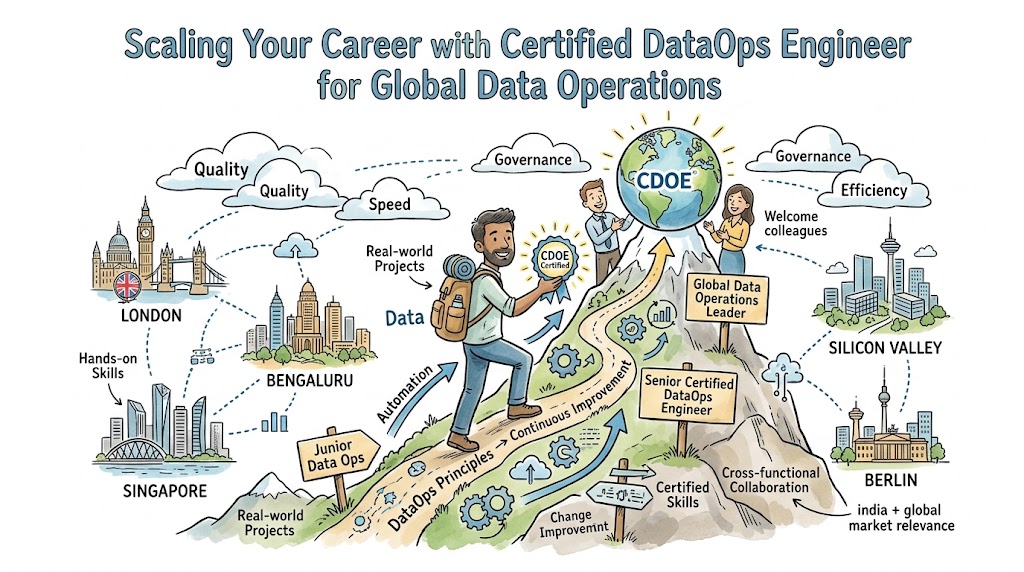
The CDOE – Certified DataOps Engineer serves as a critical benchmark for professionals aiming to bridge the gap between data engineering and operational excellence. This guide is specifically designed for software engineers, platform architects, and data leaders who need to navigate the complexities of automated data pipelines and cloud-native environments. As organizations scale, the need for disciplined lifecycle management of data becomes paramount, moving beyond simple ETL tasks toward robust, scalable systems. By following this roadmap at DataOpsSchool, engineers can make informed career decisions and align their technical growth with the evolving demands of modern enterprise infrastructure.
What is the CDOE – Certified DataOps Engineer?
The CDOE – Certified DataOps Engineer represents a shift from manual data handling to an automated, agile methodology inspired by DevOps principles. It exists to provide a structured framework for managing data flows with the same rigor used in software development, focusing on continuous integration and deployment of data models. Rather than focusing solely on theoretical data science, this certification emphasizes production-focused learning, ensuring that data stays reliable and accessible across the enterprise. It aligns perfectly with modern engineering workflows by integrating version control, automated testing, and monitoring into the very fabric of data management.
Who Should Pursue CDOE – Certified DataOps Engineer?
Data engineers, SREs, and cloud architects will find the most immediate benefit from pursuing this certification as it complements their existing infrastructure skills. Security professionals and data scientists also gain significantly by learning how to implement governance and privacy controls within automated pipelines. This path is suitable for beginners looking for a structured entry point, as well as experienced managers needing to oversee cross-functional technical teams. In both the Indian tech sector and the global market, these roles are becoming vital as companies transition toward becoming truly data-driven organizations.
Why CDOE – Certified DataOps Engineer is Valuable Today and Beyond
The demand for DataOps expertise is growing rapidly as enterprises realize that data quality is the biggest bottleneck in AI and analytics initiatives. Earning this certification ensures longevity in a career because it focuses on methodologies and architectural patterns rather than just fleeting toolsets. Organizations are increasingly adopting these practices to reduce cycle times and improve the reliability of their business intelligence platforms. Consequently, the return on time and career investment is high, as it positions professionals to lead high-impact projects that directly affect an enterprise’s bottom line.
CDOE – Certified DataOps Engineer Certification Overview
The program is delivered via the official DataOpsSchool portal and hosted on the DataOpsSchool website. It utilizes a multi-level assessment approach that combines technical exams with practical, project-based validations to ensure candidates can perform in real scenarios. The ownership and structure of the program are designed to mirror the actual lifecycle of a data project, from ingestion to consumption. Professionals can expect a clear progression from foundational knowledge to advanced architectural mastery, ensuring a comprehensive understanding of the ecosystem.
CDOE – Certified DataOps Engineer Certification Tracks & Levels
The certification is structured into foundation, professional, and advanced levels to accommodate different stages of a professional’s career. Specialized tracks allow engineers to lean into specific areas like DevOps integration, SRE for data platforms, or FinOps for managing cloud data costs. These levels provide a clear hierarchy for career progression, moving from individual contributors to senior architects. By following these tracks, a professional can build a specialized niche while maintaining a broad understanding of the entire data operations landscape.
Complete CDOE – Certified DataOps Engineer Certification Table
| Track | Level | Who it’s for | Prerequisites | Skills Covered | Recommended Order |
| Core DataOps | Foundation | Aspiring Data Engineers | Basic Programming | Pipeline Basics, Version Control | First |
| Engineering | Professional | SREs and Data Engineers | Foundation Level | Automation, CI/CD, Testing | Second |
| Architecture | Advanced | Technical Leads | Professional Level | Scaling, Governance, Security | Third |
| Specialized | Expert | Principal Engineers | Advanced Level | Multi-cloud, AI Integration | Final |
Detailed Guide for Each CDOE – Certified DataOps Engineer Certification
CDOE – Certified DataOps Engineer – Foundation
What it is
This certification validates a candidate’s understanding of the fundamental principles of DataOps, including basic pipeline orchestration and the importance of collaboration.
Who should take it
It is ideal for junior developers, data analysts, or recent graduates who want to establish a strong technical baseline in modern data management.
Skills you’ll gain
- Understanding of the DataOps manifesto and core values.
- Proficiency in basic Git workflows for data projects.
- Ability to identify bottlenecks in traditional data processing.
Real-world projects you should be able to do
- Setting up a basic automated data ingestion script.
- Configuring a simple monitoring dashboard for data flow.
Preparation plan
A 7-14 day strategy involves reviewing core definitions, while a 30-day plan allows for hands-on lab exercises in a sandbox environment.
Common mistakes
Candidates often focus too much on specific database syntax and neglect the overarching principles of process automation.
Best next certification after this
- Same-track: CDOE Professional
- Cross-track: DevOps Foundation
- Leadership: Agile Project Management
CDOE – Certified DataOps Engineer – Professional
What it is
This level focuses on the implementation of CI/CD for data and the automation of quality assurance within complex data environments.
Who should take it
Experienced data engineers and DevOps professionals who are responsible for building and maintaining production-grade data pipelines.
Skills you’ll gain
- Implementing automated testing for data quality.
- Managing infrastructure as code for data platforms.
- Advanced orchestration using containerization.
Real-world projects you should be able to do
- Building a full CI/CD pipeline for a Spark-based application.
- Implementing automated rollbacks for failed data deployments.
Preparation plan
A 30-day strategy is recommended for those with experience, while a 60-day plan allows for deep dives into orchestration tools and testing frameworks.
Common mistakes
Ignoring the security aspects of data transit and failing to account for data drift are frequent errors at this level.
Best next certification after this
- Same-track: CDOE Advanced
- Cross-track: Certified SRE
- Leadership: Engineering Lead Certification
Choose Your Learning Path
DevOps Path
The DevOps path focuses on the convergence of traditional application delivery and data infrastructure. Engineers learn to treat data pipelines as code, applying rigorous versioning and deployment strategies. This ensures that data updates do not break downstream applications or analytics. It is the perfect route for those coming from a software background.
DevSecOps Path
The DevSecOps path emphasizes the integration of security and compliance into every stage of the data lifecycle. Professionals focus on automated encryption, access control, and vulnerability scanning within the data pipeline. This path is crucial for industries with high regulatory requirements, such as finance and healthcare. It bridges the gap between data accessibility and data protection.
SRE Path
The SRE path is dedicated to the reliability, availability, and performance of data platforms. It applies Site Reliability Engineering principles like Error Budgets and Service Level Objectives to data systems. Engineers learn how to build self-healing pipelines and manage large-scale distributed systems. This ensures that data is always ready for business-critical decision-making.
AIOps Path
The AIOps path focuses on using artificial intelligence to enhance and automate IT operations and data management. It teaches engineers how to implement machine learning models to predict system failures and optimize resource allocation. This path is ideal for those looking to manage modern, complex cloud environments at scale. It transforms reactive monitoring into proactive system health management.
MLOps Path
The MLOps path centers on the operationalization of machine learning models and the data that feeds them. It covers the entire lifecycle from model training and versioning to deployment and monitoring in production. Professionals learn to manage the unique challenges of model drift and retraining. This is the essential path for organizations scaling their AI capabilities.
DataOps Path
The DataOps path remains the core focus for those dedicated purely to the flow and quality of enterprise data. It emphasizes the cultural and technical shifts needed to reduce the cycle time of data analytics. Engineers master the art of orchestrating diverse data sources into a unified, reliable stream. It is the backbone of any modern data-driven strategy.
FinOps Path
The FinOps path addresses the financial accountability of cloud-based data operations. It provides the tools and methodologies to track, analyze, and optimize the costs associated with massive data storage and processing. Engineers learn to balance technical performance with budgetary constraints. This path is vital for maintaining the economic sustainability of cloud-native platforms.
Role → Recommended CDOE – Certified DataOps Engineer Certifications
| Role | Recommended Certifications |
| DevOps Engineer | CDOE Professional |
| SRE | CDOE Advanced |
| Platform Engineer | CDOE Professional |
| Cloud Engineer | CDOE Foundation |
| Security Engineer | CDOE Professional |
| Data Engineer | CDOE Advanced |
| FinOps Practitioner | CDOE Foundation |
| Engineering Manager | CDOE Foundation |
Next Certifications to Take After CDOE – Certified DataOps Engineer
Same Track Progression
For those looking to deepen their specialization, moving toward Expert or Architect levels is the logical next step. This involves mastering complex multi-cloud data strategies and high-level system design. Deepening your expertise ensures you remain the primary authority on data infrastructure within your organization. It also opens doors to specialized consulting and high-level advisory roles.
Cross-Track Expansion
Broadening your skills into SRE or DevSecOps provides a more holistic view of the engineering ecosystem. By understanding how data interacts with security and reliability, you become a much more versatile professional. This expansion is highly valued in startup environments and large-scale platform engineering teams. It allows you to lead cross-functional initiatives that require a diverse technical background.
Leadership & Management Track
Transitioning into leadership requires a shift from technical execution to strategic oversight and team mentorship. Certifications in technical management or agile leadership help in managing the human and organizational aspects of DataOps. This track is designed for those who want to shape the future of their department’s engineering culture. It prepares you for roles such as Head of Data or VP of Engineering.
Training & Certification Support Providers for CDOE – Certified DataOps Engineer
DevOpsSchool
This provider offers extensive resources and structured bootcamps designed to help professionals master the intricacies of modern automation and infrastructure management across various technical domains and industries.
Cotocus
Focusing on practical implementation, this organization provides hands-on labs and real-world scenarios to ensure that candidates can apply their theoretical knowledge to production environments effectively.
Scmgalaxy
Known for its deep technical community, this platform offers a wealth of tutorials, forums, and expert-led sessions focusing on software configuration management and integrated delivery pipelines.
BestDevOps
This center provides targeted coaching and certification preparation materials that help engineers bridge the gap between legacy systems and modern cloud-native architectural patterns.
devsecopsschool.com
This specialized portal focuses on the integration of security into the DevOps lifecycle, providing engineers with the tools and mindsets needed to build secure-by-default systems.
sreschool.com
Dedicated to the principles of reliability engineering, this site offers training on how to maintain high availability and performance for complex, distributed enterprise applications.
aiopsschool.com
This platform provides cutting-edge training on utilizing artificial intelligence to automate and optimize IT operations, preparing professionals for the future of intelligent infrastructure management.
dataopsschool.com
As the primary host for DataOps certifications, this site offers the most comprehensive and direct path to mastering data lifecycle management and automated pipeline orchestration.
finopsschool.com
Focusing on the economic side of cloud computing, this provider offers essential training for professionals looking to master cloud financial management and cost optimization strategies.
Frequently Asked Questions
- How difficult is the CDOE – Certified DataOps Engineer exam?
The difficulty level is moderate to high, as it requires a solid understanding of both data engineering and DevOps automation principles.
- How much time is required to prepare for the certification?
Most professionals spend between 30 and 60 days preparing, depending on their existing experience with cloud tools and automation.
- Are there any specific prerequisites for the foundation level?
There are no formal prerequisites, but a basic understanding of programming and data structures is highly recommended for success.
- What is the return on investment for this certification?
The ROI is significant, often leading to better salary prospects and the ability to work on more advanced, high-visibility projects.
- Is the certification recognized globally?
Yes, the methodologies taught are based on industry-standard practices that are applicable in tech hubs all around the world.
- Do I need to know how to code?
Yes, a basic proficiency in languages like Python or SQL is necessary to complete the practical portions of the assessment.
- How long is the certification valid?
The certification is typically valid for two years, after which a renewal or advancement to a higher level is encouraged.
- Does it cover specific tools like Jenkins or Airflow?
While it focuses on principles, it uses popular tools like Airflow and Jenkins to demonstrate how to implement those principles.
- Can I take the exam online?
Yes, the program is designed to be accessible globally through an online proctored environment for maximum convenience.
- Is there a community or alumni network?
Yes, successful candidates gain access to a network of professionals and mentors who share insights and career opportunities.
- How does this differ from a standard Data Engineering certificate?
Standard certificates often focus on ETL and storage, while this focuses on the operational efficiency and automation of those processes.
- Is there a focus on cloud-native technologies?
Absolutely, as modern DataOps is almost inseparable from cloud environments and containerization technologies like Kubernetes.
FAQs on CDOE – Certified DataOps Engineer
- What specific data quality tools are covered in the curriculum?
The program covers a variety of open-source and enterprise tools focusing on automated validation, schema enforcement, and data profiling to ensure reliability.
- Does this certification help in transitioning from a DBA role?
It is an excellent path for DBAs looking to modernize their skills and move into the world of automated infrastructure and cloud data.
- How does DataOps integrate with existing Agile frameworks?
DataOps applies the iterative and collaborative nature of Agile specifically to the data lifecycle, ensuring faster feedback loops and continuous improvement.
- Is there a heavy focus on machine learning pipelines?
While the MLOps track is more specific, the core CDOE certification provides the foundational infrastructure skills required to support any ML initiative.
- Are hands-on labs included in the training support?
Most approved providers include extensive lab environments where you can build and break pipelines in a safe, real-world simulated setting.
- How does the certification address data governance?
It teaches how to bake governance and compliance directly into the automated pipeline, rather than treating them as an afterthought or manual check.
- Is this suitable for project managers in the data space?
Yes, it provides managers with the technical vocabulary and conceptual understanding needed to lead modern, high-performing engineering teams effectively.
- What is the focus on cost optimization in this program?
While FinOps is a specialized track, the core curriculum introduces the importance of resource efficiency and monitoring cloud spend during data processing.
Final Thoughts: Is CDOE – Certified DataOps Engineer Worth It?
Investing in the CDOE – Certified DataOps Engineer certification is a strategic move for any engineer who sees the direction the industry is heading. We are moving away from siloed data management toward a unified, automated approach where data is treated with the same respect as production code. This certification provides the structure and the validation needed to prove you can handle these modern challenges. It is not just about a title; it is about gaining a repeatable methodology that works in real enterprise environments. If you want to remain at the forefront of the engineering field, mastering these operations is a practical and necessary step for your long-term career.




Leave a Reply
You must be logged in to post a comment.