Introduction
A link between robust manufacturing processes and machine learning development is necessary in the current engineering environment. This guide explores the Certified MLOps Manager program, a specialized track designed for professionals navigating the complexities of scaling AI models. As organizations move beyond experimental data science into enterprise-grade deployment, understanding MLOps becomes essential for DevOps, SRE, and platform engineers. This certification helps technical leaders and practitioners master the lifecycle of machine learning systems within cloud-native environments. By reading this analysis, you will understand how to align your existing engineering skills with the specialized requirements of high-scale AI infrastructure. AIOpsSchool provides the framework needed to transition from traditional software delivery to automated, data-driven operational excellence.
What is the Certified MLOps Manager?
The Certified MLOps Manager represents a professional standard for individuals who oversee the deployment, monitoring, and governance of machine learning models. It exists because standard DevOps practices often fall short when dealing with the non-deterministic nature of data and model drift. This program emphasizes production-focused learning, moving beyond basic theory to address the actual challenges of model retraining pipelines and hardware acceleration. It aligns perfectly with modern engineering workflows by treating models as code and data as a first-class citizen in the CI/CD process. Enterprise practices now require this level of rigor to ensure that AI investments deliver consistent and reliable value in live environments.
Who Should Pursue Certified MLOps Manager?
Software engineers looking to pivot into the AI space and SREs responsible for the reliability of intelligent systems will find this program highly beneficial. Cloud professionals and data engineers who need to understand the operational side of the model lifecycle should also pursue this certification to broaden their impact. It serves beginners by providing a structured roadmap, while offering managers the technical vocabulary needed to lead specialized teams. In both the Indian market and the global tech sector, there is a massive talent gap for leaders who understand both the “ML” and the “Ops.” Technical leaders can use this knowledge to ensure their infrastructure supports the specific latency and throughput requirements of modern inference engines.
Why Certified MLOps Manager is Valuable and Beyond
The demand for MLOps expertise is growing rapidly as enterprise adoption of generative and predictive AI reaches a critical mass. This certification provides long-term career longevity because it focuses on the fundamental principles of automation and reliability that persist even as specific tools evolve. Professionals stay relevant by mastering the architectural patterns required to manage complex data lineages and distributed computing clusters. The return on time and career investment is significant, as companies are willing to pay a premium for managers who can reduce the time-to-market for AI products. Successfully navigating this track positions you as a high-value asset capable of leading the next wave of digital transformation.
Certified MLOps Manager Certification Overview
The program is delivered via the official training portal and hosted on the AIOpsSchool platform, ensuring a centralized and high-quality learning experience. It features multiple certification levels that cater to different stages of professional growth, focusing on practical assessment rather than just multiple-choice memory tests. The ownership of the program lies with industry experts who update the curriculum to reflect current enterprise standards in model governance. Structurally, the program balances technical deep dives with managerial oversight, ensuring candidates understand both the “how” and the “why” of MLOps. This approach ensures that the credential carries weight during technical interviews and internal promotion cycles.
Certified MLOps Manager Certification Tracks & Levels
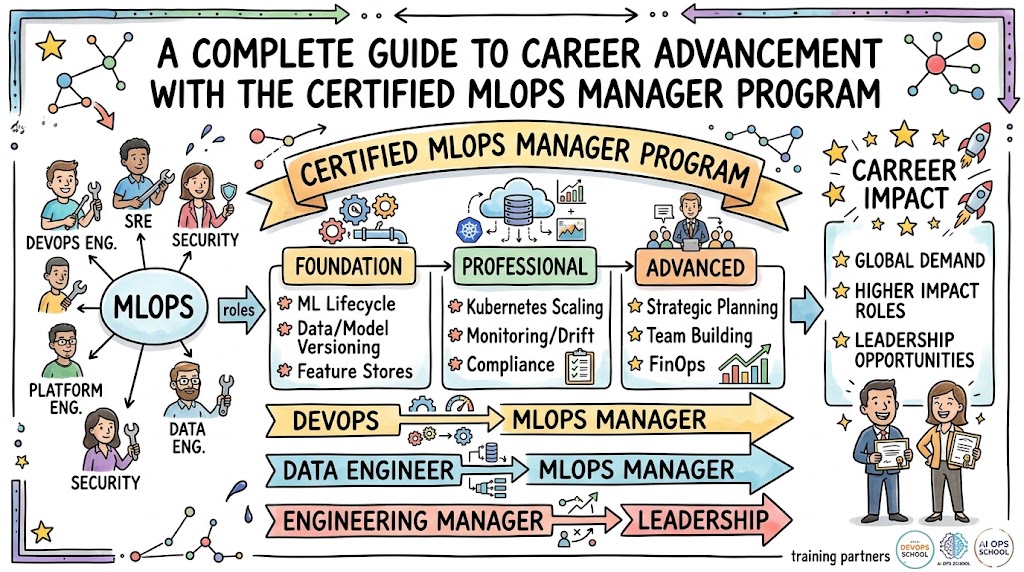
The certification structure follows a logical progression through foundation, professional, and advanced levels. The foundation level introduces core concepts like model versioning and basic pipeline automation, making it ideal for those new to the domain. Moving to the professional level, the focus shifts toward specialized tracks in SRE and DevOps, where candidates learn to manage scale and security for AI workloads. The advanced level is designed for aspiring architects and engineering managers who need to oversee entire MLOps ecosystems across an organization. These levels align with career progression, allowing a junior engineer to eventually grow into a principal or leadership role with a verified skill set.
Complete Certified MLOps Manager Certification Table
| Track | Level | Who it’s for | Prerequisites | Skills Covered | Recommended Order |
| Core Operations | Foundation | New MLOps Engineers | Basic DevOps knowledge | Versioning, Pipelines | 1 |
| Infrastructure | Professional | SREs & Cloud Engineers | Foundation Cert | Scaling, Monitoring | 2 |
| Governance | Professional | Data & Security Leads | Foundation Cert | Compliance, Data Drift | 3 |
| Leadership | Advanced | Engineering Managers | Professional Cert | Strategy, Team Building | 4 |
Detailed Guide for Each Certified MLOps Manager Certification
Certified MLOps Manager – Foundation
What it is
This level validates a fundamental understanding of the machine learning lifecycle and how it integrates with standard software development practices. It proves the candidate can navigate the basic terminology and tools required for model management.
Who should take it
It is suitable for junior DevOps engineers, data analysts, or traditional software developers who want to start their journey in AI operations. No deep prior experience in ML is required.
Skills you’ll gain
- Understanding the ML pipeline
- Basic model version control
- Introduction to feature stores
- CI/CD for machine learning
Real-world projects you should be able to do
- Set up a basic automated retraining pipeline.
- Version a simple model and its associated dataset.
Preparation plan
- 7-14 Days: Review core terminology and the ML lifecycle diagram.
- 30 Days: Hands-on practice with basic automation tools and versioning.
- 60 Days: Complete mock assessments and build a sample project.
Common mistakes
- Ignoring the importance of data quality.
- Treating ML models exactly like static software code.
Best next certification after this
- Same-track: Certified MLOps Manager – Professional
- Cross-track: SRE Foundation
- Leadership: Technical Team Lead Program
Certified MLOps Manager – Professional
What it is
This certification validates the ability to manage production-grade MLOps environments, focusing on scalability, monitoring, and security. It ensures the practitioner can handle complex deployments in cloud-native settings.
Who should take it
Mid-level engineers, SREs, and platform professionals with at least two years of experience in cloud infrastructure should pursue this track.
Skills you’ll gain
- Advanced model monitoring and observability
- Scaling inference engines on Kubernetes
- Implementing security in ML pipelines
- Managing model drift and retraining triggers
Real-world projects you should be able to do
- Deploy a high-availability model serving layer.
- Build a monitoring dashboard that detects performance degradation in real-time.
Preparation plan
- 7-14 Days: Deep dive into Kubernetes and container orchestration for ML.
- 30 Days: Implement advanced monitoring and alerting for model drift.
- 60 Days: Execute a full-scale deployment project and document the architecture.
Common mistakes
- Underestimating the cost of cloud resources for training.
- Neglecting the security of the data supply chain.
Best next certification after this
- Same-track: Certified MLOps Manager – Advanced
- Cross-track: DevSecOps Professional
- Leadership: Engineering Manager Certification
Choose Your Learning Path
DevOps Path
Engineers on this path focus on integrating machine learning into existing CI/CD workflows. They prioritize the automation of model builds and the seamless transition of code from development to production. The goal is to make ML deployments as reliable and frequent as standard software updates. This path is ideal for those who love building robust delivery pipelines.
DevSecOps Path
This track emphasizes the security of the entire ML lifecycle, including data privacy and model integrity. Practitioners learn to scan for vulnerabilities in model artifacts and secure the API endpoints used for inference. It is a critical path for industries like finance and healthcare where compliance is mandatory. You will ensure that AI systems are not just fast, but also safe.
SRE Path
SREs focus on the availability, latency, and performance of ML systems in a live environment. They apply software engineering discipline to solve operational problems, such as managing the high compute demands of GPU clusters. This path teaches you how to maintain five-nines of reliability for intelligent services. It is perfect for those who enjoy solving complex infrastructure puzzles.
AIOps Path
This path explores the use of artificial intelligence to improve IT operations, creating a feedback loop between ML and infrastructure. Candidates learn to use predictive analytics to prevent outages and automate incident response. It represents the intersection of data science and systems administration. This is the future of autonomous infrastructure management.
MLOps Path
The dedicated MLOps path dives deep into the specific needs of data scientists, such as experiment tracking and hyperparameter tuning. It focuses on creating a collaborative environment where models can be developed and deployed without friction. You will master the tools that allow teams to manage thousands of models simultaneously. This is the core track for the MLOps Manager.
DataOps Path
DataOps professionals ensure that the data feeding the ML models is clean, consistent, and delivered on time. They focus on the reliability of data pipelines and the governance of information across the enterprise. This path is essential for ensuring that the “Data” in Data Science is handled with engineering rigor. You will build the foundation upon which all AI is built.
FinOps Path
The FinOps path addresses the massive costs associated with training and running large-scale machine learning models. Practitioners learn to optimize cloud spend and attribute costs to specific projects or teams. This ensures that the organization’s AI initiatives remain profitable and sustainable. You will become the bridge between the engineering and finance departments.
Role → Recommended Certified MLOps Manager Certifications
| Role | Recommended Certifications |
| DevOps Engineer | MLOps Foundation + Professional |
| SRE | MLOps Professional + SRE Advanced |
| Platform Engineer | MLOps Foundation + Infrastructure Track |
| Cloud Engineer | MLOps Foundation + CloudOps Professional |
| Security Engineer | MLOps Foundation + DevSecOps Track |
| Data Engineer | MLOps Foundation + DataOps Professional |
| FinOps Practitioner | MLOps Foundation + FinOps Track |
| Engineering Manager | MLOps Foundation + Advanced Leadership |
Next Certifications to Take After Certified MLOps Manager
Same Track Progression
Once you master the management aspect, moving toward a “Principal MLOps Architect” role is the logical next step. This involves designing entire organizational frameworks for AI rather than just managing specific teams or pipelines. You will focus on enterprise-wide strategy and the long-term evolution of the tech stack. Deepening your knowledge in distributed systems will further solidify your expertise in this niche.
Cross-Track Expansion
Broadening your skills into DevSecOps or FinOps provides a more holistic view of the engineering ecosystem. Understanding how security and cost management impact MLOps allows you to make better architectural decisions. This cross-pollination of skills makes you a versatile leader who can solve problems across multiple departments. It is the best way to ensure you are never pigeonholed into a single specialty.
Leadership & Management Track
For those looking to move away from daily coding, transitioning into an executive role like Director of Platform Engineering is a viable path. This requires focusing on people management, budgeting, and aligning technical goals with business outcomes. Your technical background in MLOps will give you the credibility needed to lead high-performing teams. This track prepares you for the highest levels of technical organizational leadership.
Training & Certification Support Providers for Certified MLOps Manager
DevOpsSchool
This platform offers comprehensive training programs that cover the entire spectrum of modern IT operations and automation strategies. They focus on delivering hands-on experience through real-world scenarios, making them a preferred choice for professionals looking to upgrade their technical skills.
Cotocus
This provider specializes in high-end consulting and training for cloud-native technologies and site reliability engineering practices. Their curriculum is designed by industry veterans to ensure that students learn the most relevant and up-to-date tools used in the enterprise today.
Scmgalaxy
As a community-driven platform, this site provides a wealth of resources, tutorials, and certification guides for configuration management and DevOps professionals globally. It serves as a central hub for engineers looking to stay informed about the latest industry trends and best practices.
BestDevOps
This training provider focuses on career transformation by offering deep-dive courses into automation, security, and cloud infrastructure management. They emphasize practical projects that help candidates build a strong portfolio to showcase their expertise to potential employers in the tech industry.
devsecopsschool.com
This institution focuses specifically on the intersection of security and operations, providing specialized training for modern security engineers. Their courses ensure that security is integrated early in the development lifecycle, promoting a culture of proactive risk management and compliance.
sreschool.com
This school provides dedicated learning paths for site reliability engineers, focusing on the principles of scalability, availability, and incident response. Their training helps engineers move beyond traditional administration into a software-centric approach to managing large-scale, complex distributed systems.
aiopsschool.com
As the primary host for the MLOps Manager program, this site specializes in the fusion of artificial intelligence and IT operations. They offer cutting-edge certifications that prepare professionals for the future of automated, data-driven infrastructure management and model governance.
dataopsschool.com
This provider focuses on the discipline of data operations, teaching professionals how to manage the flow of information with engineering precision. Their curriculum covers data quality, pipeline automation, and governance, which are essential for any successful machine learning or analytics initiative.
finopsschool.com
This institution addresses the financial management of cloud resources, providing engineers and managers with the tools to control and optimize cloud spending. Their training ensures that technical teams can align their infrastructure choices with the organization’s financial goals and budgets.
Frequently Asked Questions (General)
- How difficult is the MLOps Manager certification?
The difficulty is moderate to high, as it requires a strong understanding of both software engineering and data science lifecycles. - How much time does it take to complete the training?
Most professionals complete the program within two to three months, depending on their existing experience with cloud tools and automation. - Are there any specific prerequisites for the foundation level?
No specific certifications are required, but a basic understanding of Linux, Git, and cloud computing is highly recommended for success. - What is the typical return on investment for this program?
Certified professionals often see significant salary increases and access to higher-level management roles within six months of completion. - Should I learn Data Science before MLOps?
You do not need to be a data scientist, but understanding how models are built will help you manage their deployment more effectively. - Is the certification recognized globally?
Yes, the curriculum is designed based on international enterprise standards, making it valid for roles in any country or tech hub. - Do I need to know how to code in Python?
Basic proficiency in Python is helpful since it is the primary language used for machine learning and many automation scripts. - Can I skip the foundation level?
If you have significant professional experience in MLOps, you may be able to challenge the professional level directly after an assessment. - Does the program cover specific cloud providers like AWS or Azure?
The core principles are cloud-agnostic, but the practical labs often utilize major providers to demonstrate real-world deployment scenarios. - How often is the certification content updated?
The curriculum is reviewed annually to ensure it includes the latest tools, security practices, and industry methodologies. - Is there a community or alumni network I can join?
Yes, students gain access to a professional network where they can share job leads, technical advice, and industry insights. - Are there mock exams available for practice?
The training platforms provide several practice assessments that simulate the actual certification environment to help you prepare.
FAQs on Certified MLOps Manager
- What is the core focus of the Certified MLOps Manager program?
It focuses on managing the end-to-end lifecycle of machine learning models, ensuring they are reliable, scalable, and secure in production environments. - How does this differ from a standard DevOps certification?
It specifically addresses challenges like data drift, model retraining, and specialized hardware management that are not covered in traditional DevOps. - What tools will I learn to use?
The program covers a variety of tools for experiment tracking, model serving, and pipeline orchestration commonly used in the industry. - Is this program suitable for people in leadership roles?
Yes, the manager track is specifically designed to help leaders oversee technical teams and align AI projects with business objectives. - Does the certification involve a practical project?
Yes, candidates must often complete a capstone project that demonstrates their ability to deploy and monitor a model in a live setting. - What industries value this certification the most?
FinTech, Healthcare, E-commerce, and any data-driven enterprise that relies on predictive analytics or AI-powered features for their business. - Will this help me move into a Chief Technology Officer role?
It provides the technical foundation in modern AI operations that is increasingly required for high-level executive leadership in tech companies. - How do I maintain my certification?
The program may require periodic continuing education credits or a renewal exam to ensure your skills stay current with evolving technology.
Final Thoughts: Is Certified MLOps Manager Worth It?
The industry is increasingly concentrating on how to make those models function dependably for the business, rather than just “creating models” as it has traditionally done. This accreditation offers the necessary structure to direct such transition. Following the newest trend is not as important as building a foundation of technical excellence that can be applied to today’s most cutting-edge technologies. The benefits of bridging the gap between operations and data science are significant in terms of effect and professional promotion for individuals who are prepared to put in the work. Take the initiative to demonstrate your knowledge and



Leave a Reply
You must be logged in to post a comment.