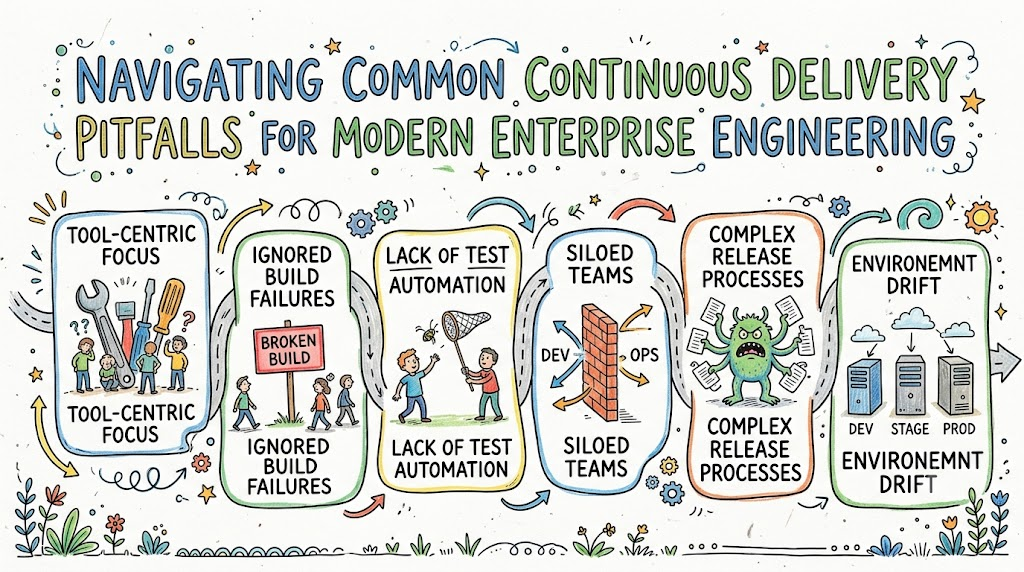
Modern software organizations constantly strive to deliver functional features to end-users rapidly, yet systemic delivery bottlenecks frequently obstruct progress. Adopting Continuous Delivery enables engineering departments to automate release workflows, reduce release friction, and maintain deployable software at every stage. Industry leaders such as Rajesh kumar emphasize that building a resilient deployment framework requires balancing automation tooling with rigorous operational discipline. When engineering teams establish well-governed release strategies, they minimize deployment risks and shorten release cycles effectively.
Implementing automated deployment pathways without proper architectural safeguards often creates a false sense of security for engineering leaders. Consequently, organizations face unexpected production downtime, severe deployment rollbacks, and team burnout caused by brittle pipeline setups. Addressing these operational blind spots early ensures that code changes transition from development to live customer environments smoothly and predictably.
Key Operational Concepts You Must Know
Automated Pipeline Observability
Maintaining deep visibility into your release pipelines is vital for diagnosing operational slowdowns and delivery bottlenecks. When automated steps fail silently or execute sluggishly, developer productivity drops and release schedules stall.
Implementing real-time dashboards and structured logging allows operations teams to track deployment frequency, pipeline duration, and failure rates accurately. Consequently, engineering managers can pinpoint failing stages swiftly, eliminate fragile build dependencies, and optimize release flow systematically.
Progressive Delivery Paradigms
Progressive delivery reduces release blast radiuses by exposing new software features to a small subset of live users before complete rollout. Techniques like canary deployments, blue-green environments, and feature flags allow teams to evaluate live system health under authentic network traffic.
If runtime errors occur during initial traffic routing, automated monitors trigger immediate rollbacks without impacting the broader customer base. This iterative approach bridges the gap between fast iteration and risk mitigation across critical production environments.
Immutable Infrastructure Provisioning
Configuring target deployment servers manually leads to environment drift and unexpected deployment failures. Conversely, immutable infrastructure ensures that operational environments are replaced entirely rather than updated in place.
By packaging applications into standardized container images and provisioning resources with code, teams ensure consistency across staging and production clusters. Therefore, your deployment pipeline runs predictably because the underlying infrastructure remains strictly identical at every stage.
Dynamic Configuration Governance
Separating configuration parameters from compiled software binaries prevents accidental exposure of sensitive keys and maintains deployment consistency. When application configurations are hardcoded into source repositories, updating environmental variables requires full, redundant rebuilds.
Modern deployment workflows inject environment-specific configurations at runtime through centralized key-management systems and secret stores. This practice protects confidential access tokens while allowing identical application packages to move safely across diverse deployment stages.
Platform Implementation vs. Culture — What’s the Real Difference?
| Continuous Delivery Dimension | Platform Implementation Focus | Cultural Practice Focus |
|---|---|---|
| Operational Priority | Deploying pipeline runners, secret managers, and cloud infrastructure. | Fostering collective ownership and psychological safety across teams. |
| Pipeline Failure Response | Triggering automated alerts and collecting error log telemetry. | Swarming to resolve broken builds immediately before resuming new tasks. |
| Deployment Governance | Enforcing automated gate checks and security scanning policies. | Encouraging open collaboration between developers, QA, and operations. |
| Evaluation Metrics | Tracking build runtimes, server utilization, and API response latencies. | Reviewing team feedback quality, change stability, and developer satisfaction. |
The Limits of Tool-Centric Implementations
Purchasing top-tier automation software and configuring complex pipeline scripts does not automatically resolve delivery dysfunction. If organizational workflows remain heavily siloed, teams will continue experiencing communication delays and finger-pointing during major outages.
Automating an uncoordinated development process simply accelerates the distribution of defective code into production. Thus, technical managers must design delivery systems that support developer workflows rather than creating bureaucratic deployment hurdles.
Embedding a Culture of Shared Quality
Sustainable continuous delivery demands an organizational environment where every team member actively protects production stability. Developers, security analysts, and system administrators must collaborate from early project architecture through long-term maintenance.
Furthermore, introducing blameless post-incident reviews encourages engineers to discuss technical failures openly and improve system resiliency. When teams take mutual responsibility for software delivery, deployment pipelines transform into empowering productivity drivers.
Real-World Use Cases of Modern Operations
High-Volume Financial Transaction Routing
Financial institutions manage complex distributed architectures that require continuous updates while maintaining zero transaction downtime. By leveraging isolated pipeline stages, banking platforms can safely validate security policies and compliance rules automatically.
For example, automated regression checks verify that ledger calculations, currency conversions, and user authentication remain secure after code modifications. Applying progressive rollout strategies ensures that new transaction engines run smoothly for selected accounts before broad enterprise activation.
Multi-Region Cloud SaaS Modernization
Global SaaS companies face unpredictable traffic variations and must deliver frequent platform enhancements across distributed regions. Utilizing automated delivery workflows allows these platforms to push regional updates sequentially to minimize international service disruptions.
If telemetry systems detect latency spikes in a specific geography, the delivery pipeline automatically rolls back the regional deployment. This systematic operational strategy protects global service availability while sustaining high-frequency feature releases for international users.
Common Mistakes in Operations Engineering
Building Artifacts Multiple Times
Recompiling source code across separate staging and production stages introduces severe version drift and operational confusion. When binaries are regenerated for each environment, teams cannot guarantee that production systems run the exact code tested in staging.
To eliminate this vulnerability, pipelines must compile an artifact once, store it securely, and promote that verified package across environments. This discipline ensures total parity throughout your validation stages and prevents unexpected production discrepancies.
Running Monolithic and Uncached Pipelines
Structuring deployment pipelines as single monolithic jobs causes prolonged execution times and frustrates developer velocity. When every code change triggers every linting, security, and end-to-end testing suite sequentially, developers wait hours for feedback.
Teams should modularize pipelines and implement aggressive dependency caching to slash execution runtimes. Running fast unit tests immediately upon merge and reserving heavier integration suites for release candidates optimizes feedback loops.
Tolerating Flaky and Ineffective Testing Suites
Permitting non-deterministic test cases to remain in the delivery pipeline undermines engineering confidence in automated validation gates. When tests intermittently fail without clear reasons, developers often bypass failures or rerun jobs repeatedly until they turn green.
This habit allows real functional bugs and performance regressions to slip into production undetected. Teams must quarantine flaky tests immediately and maintain rigorous test suites that produce consistent, trustworthy feedback.
How to Become an Operations Expert — Career Roadmap
Foundational Competencies
Aspiring operations specialists must develop a solid grasp of core computing principles and collaborative development practices. Begin by exploring system administration, version control architectures, and declarative deployment patterns.
- Source Control Architecture: Master branching patterns, trunk-based integration, and commit hygiene.
- System Administration: Learn core operating system internals, storage systems, and networking protocols.
- Scripting and Automation: Write functional scripts to automate repetitive system tasks and data parsing.
- Container Fundamentals: Understand container lifecycle management, image optimization, and multi-stage builds.
Advanced Pipeline and Infrastructure Engineering
Progressing to senior operational responsibilities requires expertise in distributed system architecture, pipeline optimization, and security governance. Focus on managing complex deployment lifecycles and standardizing automated delivery platforms.
- Infrastructure as Code: Provision cloud resources predictably using declarative configuration frameworks.
- Pipeline Modularization: Design reusable and parallelized pipeline templates to support multiple microservices.
- Security Automation: Embed static code analysis, vulnerability scanning, and secrets management into delivery gates.
- Production Telemetry: Configure centralized observability frameworks to track system health, deployment metrics, and error rates.
FAQ Section
- What is the most critical mistake organizations make when starting continuous delivery?
Organizations often attempt to automate broken, undocumented manual workflows without establishing a strong automated testing foundation first. Automation simply amplifies existing process defects unless teams standardize their building, testing, and merging practices early.
- How does rebuilding artifacts across environments damage software reliability?
Rebuilding binaries for each stage introduces dependency discrepancies and configuration drift between staging and production environments. Teams should build a deployable package once, store it in a secure registry, and promote the exact same artifact everywhere.
- Why are flaky automated tests dangerous in continuous delivery pipelines?
Flaky tests erode developer trust, causing teams to ignore pipeline warnings and rerun builds until they pass by chance. This dangerous habit allows genuine critical bugs to bypass automated gates directly into live production.
- Can continuous delivery succeed without implementing automated progressive rollouts?
While basic continuous delivery can function with standard deployments, progressive strategies like canary or blue-green releases drastically lower downtime risks. Without progressive delivery, bad deployments immediately affect all active users instead of a small test group.
- How can development teams keep their pipeline execution times short?
Teams can optimize execution speeds by caching external dependencies, running tests in parallel, and splitting monolithic pipelines into focused modular jobs. Running fast unit tests on every commit and reserving large regression suites for pre-release merges keeps feedback rapid.
Final Summary
Refining your continuous delivery strategy is essential for sustaining software reliability and rapid product evolution. By eliminating common pitfalls like artifact rebuilding, monolithic jobs, and unchecked flaky tests, organizations create dependable deployment systems. Moreover, combining modern automation infrastructure with a collaborative engineering culture guarantees that system quality remains a shared team priority.
Investing in pipeline observability, immutable configurations, and progressive deployment safeguards your production environments against unexpected outages. As your delivery workflows become faster and more predictable, your engineering teams can innovate with complete confidence. Ultimately, avoiding standard operational mistakes transforms continuous delivery from a technical headache into a core business asset.



Leave a Reply
You must be logged in to post a comment.