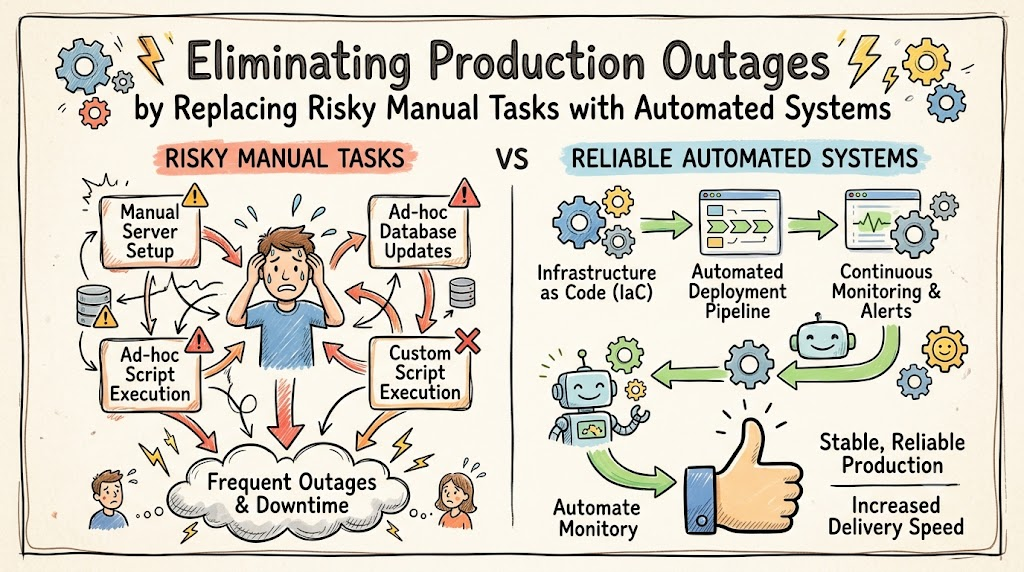
Manual deployment procedures continue to introduce severe operational vulnerabilities across enterprise software environments. Whenever engineers execute manual server commands or update configuration parameters by hand, human error inevitably disrupts production stability. Adopting automated release pipelines replaces unpredictable manual interventions with deterministic, repeatable deployment sequences. Industry authorities like Rajesh kumar emphasize that eliminating manual deployment handoffs establishes a dependable engineering baseline that guarantees operational resilience. When organizations replace ad-hoc release checklists with automated workflows, they drastically mitigate deployment risk while accelerating delivery cycles.
Relying on manual interventions during production rollouts creates severe operational bottlenecks and amplifies release friction. Team members experience substantial burnout during late-night deployment windows when complex release steps fail unexpectedly. Conversely, automated deployment systems systematically validate infrastructure prerequisites, execute schema migrations, and deploy application packages without human error. Transitioning away from error-prone human execution safeguards mission-critical systems and protects business continuity against avoidable operational downtime.
Key Operational Concepts You Must Know
Declarative Release Orchestration
Declarative release orchestration eliminates ambiguity by defining the exact target state of your application environment in code. Instead of executing procedural terminal commands manually, teams declare desired configurations inside version-controlled deployment manifests.
The automation platform continuously reconciles the live production environment with this declared specification. If configuration drift occurs, the automated orchestrator corrects system variances immediately without manual intervention. Consequently, this declarative methodology guarantees environmental consistency across every staging and production cluster.
Automated Smoke and Health Checks
Executing manual sanity testing after a complex release often leaves critical system components unverified. Automated pipelines immediately trigger synthetic user journeys and deep health check routines as soon as new binaries activate.
These automated verification suites query live endpoints, validate database connections, and evaluate background processing queues within seconds. Because these checks execute systematically without human bias, operations teams receive immediate confirmation regarding system health.
Automated Rollback Safeguards
When production errors surface during a manual deployment, engineers often scramble under intense pressure to restore previous application states. This frantic manual remediation frequently introduces secondary configuration mistakes that prolong system outages.
Automated release pipelines continuously monitor core performance metrics and trigger automated rollbacks if error thresholds exceed defined limits. Reverting to the last known healthy state takes seconds rather than hours, thereby minimizing downtime and shielding end-users from disruptions.
Policy Enforcement and Governance
Maintaining compliance standards manually across large-scale distributed architectures requires immense administrative effort and invites security oversights. Automated release platforms integrate policy-as-code frameworks directly into deployment pipelines.
Every release artifact must satisfy strict cryptographic signing requirements, vulnerability scans, and approval policies before advancing to production. This automated governance ensures strict regulatory compliance without forcing developers to navigate slow, bureaucratic review meetings.
Platform Implementation vs. Culture — What’s the Real Difference?
| Operational Dimension | Platform Implementation Focus | Cultural Practice Focus |
|---|---|---|
| Core Objective | Configuring automated tools, scripts, and deployment runners. | Establishing shared accountability for continuous production stability. |
| Outage Management | Executing automated rollbacks and collecting incident metrics. | Conducting blameless post-mortems to improve future deployment steps. |
| Deployment Execution | Automating release verification and environment provisioning. | Encouraging cross-functional trust between development and operations. |
| Quality Ownership | Enforcing automated gate checks and security scanners. | Prioritizing reliable engineering practices over rushed code delivery. |
Technical Automation Realities
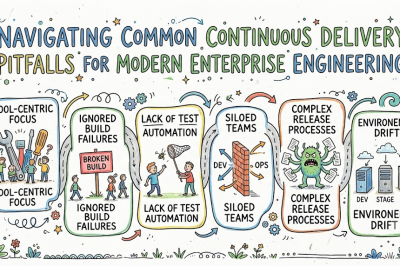
Deploying robust automation platforms provides the necessary tooling to streamline release activities across distributed environments. However, configuring sophisticated deployment pipelines without aligning team habits will not eliminate release risk.
Organizations often assume that investing in advanced pipeline orchestrators automatically solves foundational workflow deficiencies. If development teams continue writing brittle tests or bypassing deployment checks, automation merely distributes problematic changes faster.
Cultivating an Automation-First Mindset
True operational resilience requires cultivating an engineering culture where manual changes to production environments are strictly avoided. Engineers must treat release scripts with the same rigorous testing and review standards applied to primary application code.
Furthermore, fostering an open environment where engineers can discuss deployment failures transparently improves long-term system stability. When teams share mutual responsibility for deployment outcomes, automated pipelines evolve into collaborative productivity accelerators.
Real-World Use Cases of Modern Operations
Zero-Downtime Healthcare Portals
Healthcare organizations handle confidential patient information and require uninterrupted access to digital records around the clock. By implementing blue-green deployment pipelines, healthcare platforms can deploy critical security patches without taking servers offline.
The automated system provisions an identical production environment, executes automated verification tests, and switches user traffic seamlessly. If unexpected anomalies appear in the new environment, traffic shifts back instantly to the stable cluster without patient impact.
Global Financial Settlement Systems
Financial institutions process high-value transactions that demand flawless execution and complete regulatory auditability. Manual deployment practices introduce severe risks of data corruption and transactional discrepancies during ledger engine updates.
Automated release pipelines enforce strict cryptographic verifications and execute isolated database migrations before activating new transaction logic. This strict operational discipline ensures continuous transactional integrity while maintaining comprehensive audit trails for regulatory compliance.
Common Mistakes in Operations Engineering
Allowing Manual Out-of-Band Hotfixes
Applying direct manual hotfixes to live production servers during an outage undermines the integrity of your automated pipeline. When engineers modify production configurations manually, those changes remain undocumented in source control repositories.
Consequently, the next automated release will overwrite those manual fixes, causing the original issue to reappear unexpectedly. Teams must enforce a strict policy where every fix flows through the version-controlled deployment pipeline.
Overlooking Database Migration Automation
Automating application binary deployments while continuing to execute database schema updates manually creates severe release bottlenecks. When manual SQL scripts run asynchronously from application rollouts, schema mismatches trigger unexpected application crashes.
Operations teams must integrate database migration tools directly into their automated release workflows. Coupling code deployments with forward-compatible database migrations ensures smooth schema transitions and prevents database deadlocks.
Neglecting Pipeline Credential Rotation
Hardcoding privileged administrative credentials inside deployment scripts exposes enterprise infrastructure to catastrophic security vulnerabilities. When deployment credentials remain static, unauthorized actors who gain repository access can compromise entire cloud environments.
Engineering teams must adopt centralized secret management platforms that issue short-lived, dynamic credentials during deployment execution. This practice limits exposure windows and ensures strict role-based access control across all operational environments.
How to Become an Operations Expert — Career Roadmap
Mastering Fundamental Engineering Concepts
Aspiring release specialists must first develop deep competence in systems architecture, core networking, and automated scripting. Understanding how distributed systems communicate allows engineers to design resilient deployment workflows effectively.
- Operating System Internals: Master Linux process management, file permissions, and kernel tuning.
- Declarative Configuration: Understand how to define scalable environments using Infrastructure as Code principles.
- Modern Scripting Skills: Develop reusable automation routines using languages such as Python, Bash, or Go.
- Network Communication: Learn traffic routing, DNS management, and load balancing mechanisms.
Designing Advanced Deployment Frameworks
To achieve senior operational expertise, engineers must master sophisticated release strategies, observability frameworks, and container orchestration platforms. Focus on constructing resilient deployment architectures that minimize system blast radiuses.
- Container Orchestration: Deploy and manage distributed microservices using modern container platforms.
- Progressive Rollout Strategies: Implement canary releases, blue-green deployments, and dynamic feature flag controls.
- Pipeline Telemetry Integration: Configure end-to-end observability to track deployment velocity and error rates.
- Security Automation: Integrate static analysis, container image scanning, and compliance validation into pipeline gates.
FAQ Section
- How does release automation directly eliminate human error during deployments?
Release automation executes predefined, repeatable code sequences that eliminate manual terminal typing, missed configuration steps, and forgotten deployment procedures. The automated system follows identical validation rules for every single release cycle.
- Why is it critical to avoid manual hotfixes on production servers?
Manual hotfixes bypass version control systems, creating configuration drift between live servers and the code repository. The subsequent automated release will overwrite these manual changes, causing unexpected system regressions and downtime.
- What is the safest way to handle database schema updates during automated releases?
Teams should use automated database migration tools that apply backward-compatible schema changes prior to deploying updated application code. This technique prevents schema mismatches and allows application versions to interact safely with the database.
- Can small engineering teams benefit from adopting automated release workflows?
Small engineering teams save substantial developer hours by automating tedious, error-prone manual deployment tasks. It establishes robust engineering standards early, allowing small teams to scale software operations without expanding headcount.
- How do progressive release strategies minimize deployment blast radiuses?
Progressive release strategies expose new application versions to a tiny fraction of live user traffic before initiating full rollouts. Automated monitoring systems evaluate error rates and trigger instant rollbacks if issues occur, protecting the broader user base.
Final Summary
Replacing manual deployment workflows with automated release pipelines is fundamental to building resilient, scalable software systems. Eliminating error-prone human intervention prevents configuration drift, reduces production downtime, and accelerates delivery velocity. Furthermore, coupling declarative orchestration with automated rollbacks ensures that software releases remain predictable and secure.
Investing in mature release automation enables engineering organizations to transition from stressful deployment events to routine operational updates. As deployment pipelines become more dependable, technical teams can concentrate on building innovative features rather than troubleshooting outages. Ultimately, establishing robust release automation safeguards enterprise infrastructure and delivers continuous value to end-users.






Leave a Reply
You must be logged in to post a comment.