Introduction
Modern enterprises face increasing pressure to deliver software faster, maintain system reliability, improve security, and support continuous innovation. Traditional development and operations models often create communication gaps, slow releases, and operational bottlenecks that prevent organizations from responding quickly to market demands. This is where DevOps transformation becomes a strategic business initiative rather than just a technical improvement.
A complete DevOps transformation roadmap helps enterprise teams align people, processes, technology, and business objectives into a unified operating model. Instead of focusing only on automation tools, successful organizations build a culture of collaboration, accountability, continuous learning, and operational excellence. Industry experts such as Rajesh kumar have consistently emphasized that sustainable DevOps success comes from balancing technology implementation with organizational change.
This guide explains every major stage of a DevOps transformation journey, the operational principles behind successful implementations, common challenges enterprises face, and the practical steps required to build a high-performing operations culture. Whether your organization is starting its transformation or optimizing existing DevOps practices, this roadmap provides a structured approach to achieving long-term success.
Understanding Enterprise DevOps Transformation
DevOps transformation is the process of changing how software is planned, developed, tested, deployed, monitored, and maintained across an organization. It combines cultural change, process improvement, automation practices, and technology modernization to create a more efficient software delivery ecosystem.
Many organizations mistakenly assume DevOps is simply a collection of tools. In reality, tools only support the transformation. The true goal is creating a system where development teams, operations teams, security professionals, quality engineers, and business stakeholders work toward common objectives.
Enterprise transformation often begins with identifying existing challenges such as slow deployment cycles, manual operations, infrastructure inconsistencies, frequent production incidents, poor communication between departments, and lack of visibility into system performance. Once these issues are understood, organizations can develop a phased roadmap that introduces automation, collaboration frameworks, cloud adoption strategies, monitoring systems, and continuous improvement processes.
A successful transformation delivers measurable benefits including faster release cycles, reduced downtime, improved customer satisfaction, enhanced security posture, greater operational efficiency, and stronger business agility.
Why Enterprises Need a Structured DevOps Roadmap
Large organizations typically operate complex environments consisting of multiple applications, teams, technologies, and business units. Without a structured roadmap, transformation efforts can become fragmented and fail to produce meaningful results.
A roadmap provides direction, priorities, measurable milestones, and accountability. It ensures that every department understands its role in the transformation journey. Instead of implementing random tools or isolated automation projects, enterprises can focus on building a cohesive operating model.
A structured roadmap also reduces resistance to change. Employees understand the purpose behind new processes and technologies when leadership communicates a clear vision. Additionally, management can track progress using defined performance indicators such as deployment frequency, lead time, incident recovery time, system availability, and customer satisfaction metrics.
Most importantly, a roadmap helps organizations align DevOps initiatives with business goals. Every automation effort, infrastructure upgrade, or process improvement should contribute directly to organizational objectives such as revenue growth, operational efficiency, customer experience, or innovation acceleration.
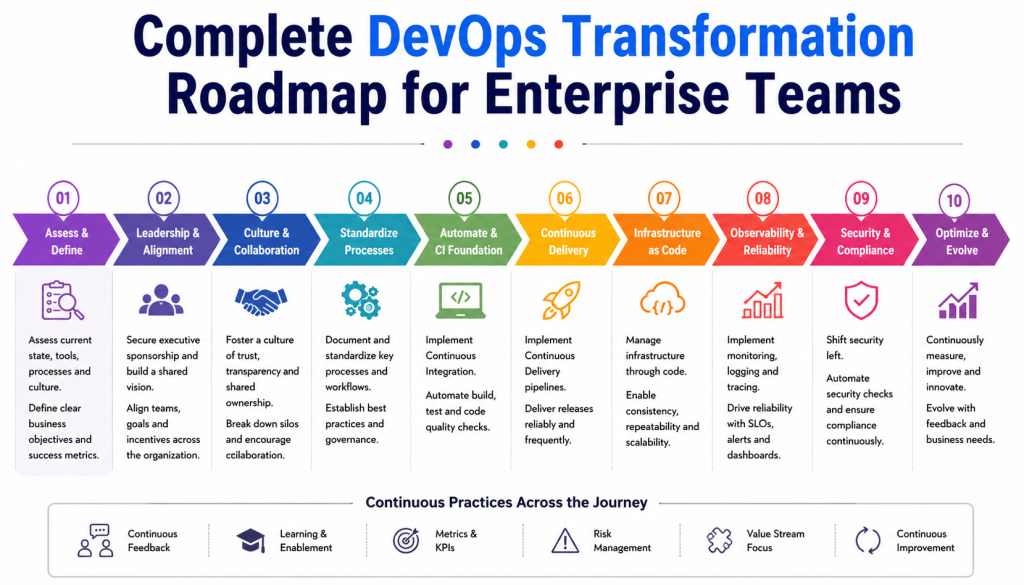
Phase 1: Assess Current State and Define Objectives
Before implementing new tools or processes, organizations must thoroughly assess their existing environment. This assessment provides a baseline for measuring transformation success.
The evaluation should examine development workflows, deployment processes, infrastructure management practices, monitoring capabilities, security controls, team structures, communication patterns, and organizational culture. Leaders should identify pain points, bottlenecks, inefficiencies, and operational risks affecting software delivery.
Stakeholder interviews often reveal valuable insights regarding collaboration challenges, approval delays, manual activities, and recurring operational issues. Technical assessments help identify legacy systems, infrastructure dependencies, and technology limitations.
Once the current state is understood, organizations can define clear objectives. These goals may include reducing deployment times, increasing release frequency, improving service availability, strengthening security controls, or enhancing customer experience.
Specific and measurable objectives create focus throughout the transformation journey and help leadership evaluate progress objectively.
Phase 2: Build Leadership Support and Organizational Alignment
DevOps transformation affects multiple departments and requires strong executive sponsorship. Without leadership support, transformation initiatives often lose momentum when challenges arise.
Executives must communicate the business value of DevOps and explain why transformation is necessary. Leadership should actively support cross-functional collaboration, resource allocation, training programs, and process improvements.
Organizational alignment involves bringing development, operations, security, quality assurance, compliance, and business teams together under shared goals. Teams should move away from isolated responsibilities and focus on collective outcomes.
Clear governance structures help coordinate transformation activities across departments. Steering committees, transformation offices, and DevOps champions can provide oversight and maintain momentum throughout the initiative.
When leadership demonstrates commitment and employees understand the broader vision, transformation efforts gain credibility and organizational support.
Phase 3: Establish a Collaborative DevOps Culture
Technology alone cannot solve operational problems caused by poor communication and organizational silos. Therefore, cultural transformation remains one of the most critical phases of a DevOps journey.
A collaborative culture encourages transparency, shared responsibility, continuous learning, and open communication. Teams work together to solve problems rather than assigning blame when incidents occur.
Organizations should encourage knowledge sharing through internal workshops, documentation programs, mentoring initiatives, and cross-functional projects. Regular meetings between development and operations teams improve understanding of business requirements and operational constraints.
Psychological safety is equally important. Employees should feel comfortable reporting issues, suggesting improvements, and discussing failures without fear of punishment. This environment promotes innovation and continuous improvement.
As collaboration improves, organizations often experience faster problem resolution, stronger team relationships, and better overall operational performance.
Phase 4: Standardize Processes and Workflows
Process standardization creates consistency across teams and environments. Without standard practices, organizations struggle to scale operations effectively.
Standardization should cover software development lifecycle activities including planning, coding, testing, deployment, monitoring, incident management, change management, and documentation. Clear workflows reduce confusion and improve operational predictability.
Teams should establish common coding standards, release procedures, deployment methodologies, security practices, and operational guidelines. Automated workflows can further enforce consistency while reducing manual errors.
Standardized processes also simplify onboarding for new employees because expectations and procedures are clearly documented. Furthermore, consistent workflows improve compliance management and audit readiness.
Organizations that successfully standardize processes typically experience improved efficiency, reduced operational risks, and greater scalability.
Phase 5: Implement Continuous Integration
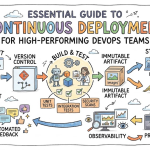
Continuous Integration serves as a foundation for modern DevOps practices. It enables teams to integrate code changes frequently into shared repositories while automatically validating those changes through testing and quality checks.
Developers commit code regularly, triggering automated build and testing processes. This approach identifies issues early in the development cycle, reducing the cost and complexity of fixing defects later.
Continuous Integration improves software quality by ensuring that code changes remain compatible with existing functionality. Automated testing provides rapid feedback, enabling developers to address problems immediately.
Additionally, CI pipelines create greater visibility into application health and development progress. Teams gain confidence in their codebase because every change undergoes consistent validation procedures.
As organizations mature their CI practices, they establish a reliable foundation for more advanced automation initiatives.
Phase 6: Implement Continuous Delivery and Deployment
Continuous Delivery extends Continuous Integration by preparing software for release at any time. Automated deployment pipelines move validated code through testing, staging, and production environments with minimal manual intervention.
This capability significantly reduces deployment risks while increasing release frequency. Instead of scheduling large, infrequent releases, organizations can deliver smaller updates more frequently.
Automated deployment pipelines ensure consistency across environments. Every release follows the same validation and deployment process, reducing configuration errors and operational inconsistencies.
Continuous Deployment takes automation even further by automatically releasing approved changes to production environments. Organizations adopting this approach must maintain strong testing, monitoring, and rollback capabilities.
Together, Continuous Delivery and Continuous Deployment accelerate innovation while improving operational reliability.
Phase 7: Infrastructure as Code Implementation
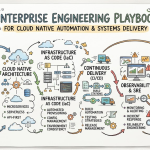
Infrastructure as Code enables organizations to manage infrastructure using version-controlled configuration files rather than manual provisioning processes.
This approach improves consistency, repeatability, and scalability across environments. Infrastructure configurations become transparent, auditable, and easy to reproduce.
Teams can deploy servers, networks, storage resources, security policies, and cloud services using automated provisioning workflows. This reduces human error and accelerates environment creation.
Infrastructure as Code also supports disaster recovery and business continuity initiatives. Organizations can quickly rebuild environments using predefined configurations when failures occur.
By treating infrastructure as software, enterprises achieve greater operational efficiency and maintain stronger control over complex technology environments.
Phase 8: Monitoring, Observability, and Reliability Engineering
Modern operations require comprehensive visibility into system performance, application behavior, user experience, and infrastructure health.
Monitoring solutions collect metrics, logs, events, and performance data from across the technology stack. These insights help teams identify issues before they affect customers.
Observability extends traditional monitoring by enabling deeper investigation into complex systems. Teams can understand why problems occur rather than simply detecting that problems exist.
Reliability engineering practices focus on maintaining service availability and performance through proactive monitoring, incident response planning, capacity management, and resilience engineering.
Organizations that invest in observability and reliability gain faster issue resolution capabilities, improved customer experiences, and stronger operational confidence.
Key Operational Concepts You Must Know
Operations excellence depends on understanding several foundational concepts that influence system reliability, scalability, and performance. Availability refers to the percentage of time services remain accessible to users. Reliability measures the consistency of service performance over time. Scalability describes the ability to handle increased workloads without degrading performance.
Automation eliminates repetitive manual tasks while improving consistency and efficiency. Incident management focuses on detecting, responding to, and resolving operational disruptions quickly. Capacity planning ensures infrastructure resources remain aligned with business demand.
Change management governs how modifications are introduced into production environments while minimizing risk. Configuration management maintains consistency across systems and environments. Service Level Objectives define measurable reliability targets that guide operational decision-making.
Understanding these concepts enables teams to build resilient systems, reduce operational risks, and create predictable service delivery models that support business growth.




Leave a Reply
You must be logged in to post a comment.