Introduction
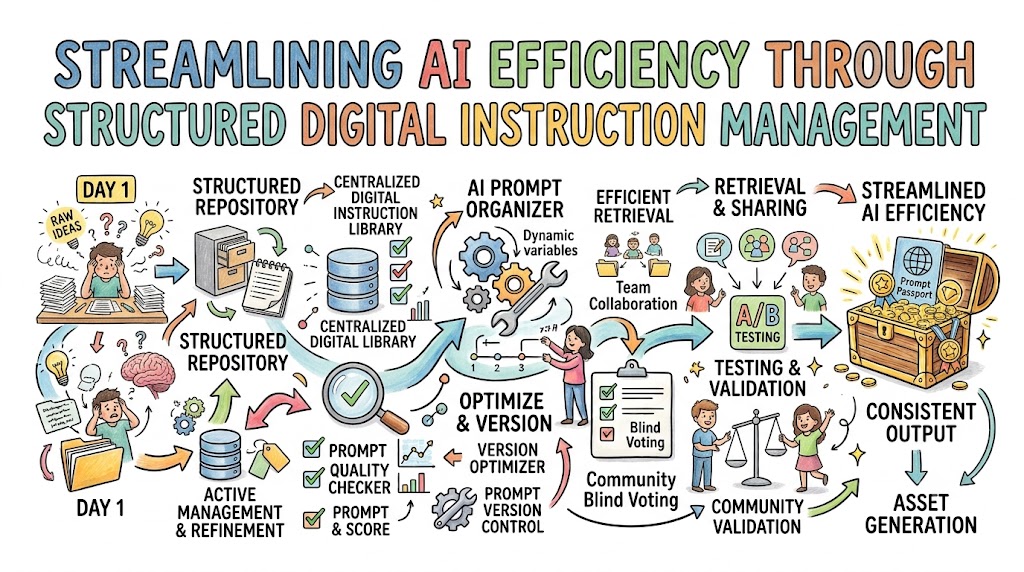
Elevating your performance with generative models requires converting raw text inputs into organized, repeatable digital assets. Scattering high-performing commands across random browser tabs, sticky notes, and messaging channels creates severe productivity bottlenecks. Constructing an accessible AI prompt library transforms quick, temporary instructions into permanent operational capital for long-term project execution. Additionally, adopting a disciplined workflow gives individuals and organizations total authority over their automated output quality. By systematically categorizing, optimizing, and evaluating your commands, you eliminate wasted effort and maximize value from modern intelligence tools.
Why Prompt Management Matters More Than Ever
Precise instructions dictate whether an artificial intelligence model delivers brilliant insights or useless responses. Relying on personal memory or disorganized text files causes severe quality drops and drains valuable working hours. Growing enterprises must enforce uniform execution standards across every department to maintain brand integrity and operational speed. Rebuilding previously successful inputs wastes creative energy and slows down project delivery schedules. Adopting a structured approach allows you to store, refine, and reuse top-performing text immediately. Ultimately, an organized framework protects your intellectual property while driving continuous output improvements across your entire organization.
Common Problems Faced by AI Users
Digital creators constantly encounter major operational friction when handling unorganized collections of inputs:
- Lost Assets: Locating effective commands from previous weeks often consumes hours of frustrating, manual searches.
- Duplicated Effort: Teammates regularly spend time crafting solutions that colleagues already perfected days earlier.
- Overwritten History: Modifying text without systematic tracking permanently destroys your highest-performing baseline versions.
- Inconsistent Execution: Unstructured inputs produce unpredictable model outputs, delaying deadlines and frustrating stakeholders.
Implementing a centralized management framework completely removes these friction points from your daily schedule.
What is Promptosia?
Promptosia functions as an integrated control center designed to organize, refine, and elevate your artificial intelligence workflows. Instead of burying high-performing commands inside endless chat logs, you store them safely inside an organized AI prompt library. Furthermore, the platform operates as a complete prompt engineering platform, supporting your work from raw concepts to finalized deployments. Dynamic tagging, automated evaluations, and performance metrics convert simple drafts into highly reliable digital assets. Whether you work independently or manage complex corporate projects, this platform keeps your operations aligned and productive.
What It Helps in Real Life
Immediate access to structured instruction sets reshapes daily productivity across diverse industries:
- Software Engineers: Developers instantly pull verified code-generation frameworks without scouring old repositories.
- Marketing Directors: Agencies produce brand-aligned campaign copy quickly across multiple marketing channels.
- Academic Researchers: Scholars execute complex data extraction routines with consistent, scientific accuracy.
- Corporate Managers: Executives standardize internal documentation procedures across every operational team.
Removing guesswork saves hundreds of administrative hours while elevating output quality across all projects.
What Makes a Modern AI Prompt Management Tool?
Modern solutions combine intelligent structural analysis, complete version history, and active team collaboration features. A flexible AI prompt organizer must offer dynamic tagging, customizable variables, and rapid search features. Additionally, automated enhancement modules convert vague ideas into crisp, powerful instructions effortlessly. Built-in side-by-side testing features let creators evaluate competing outputs under identical runtime conditions. Transparent quality scoring delivers immediate feedback on structural clarity, contextual completeness, and safety risks. Together, these tools form an agile ecosystem that maximizes your creative potential.
Building a Centralized AI Prompt Library
Creating a central repository forms the bedrock of sustainable digital asset management for forward-thinking professionals. Saving your top-performing commands in a single accessible hub constructs an organizational knowledge base over time. Moreover, custom metadata and descriptive category tags allow you to locate specific files in seconds. Creators bypass chaotic documents to work within a clean environment tailored for immediate execution. Over time, this central library becomes an invaluable company asset that accelerates team onboarding and maintains exceptional quality standards.
Promptosia as a Complete Prompt Engineering Platform
Approaching input creation as an end-to-end engineering discipline ensures consistently superior results across every application. Promptosia guides your text through every critical stage, including drafting, testing, optimizing, and sharing. Furthermore, an integrated AI prompt optimizer automatically enhances clarity, context parameters, and structural constraints. Creators compare competing variations under identical execution conditions to select the best phrasing scientifically. Reliable version tracking preserves every historical edit, enabling rapid rollbacks whenever necessary. This end-to-end approach transforms casual command writing into a predictable, scalable science.
Organizing Prompts Efficiently
Systematic organization becomes essential when managing hundreds of command files across varied project categories. Customizable tags, descriptive collections, and dynamic variable slots adapt a single template to endless practical uses. Furthermore, effective classification lets users sort items by objective, target audience, tone, or structural format instantly. Ditching loose spreadsheets removes operational delays and ensures every team member accesses the current master draft. Consequently, project execution becomes faster, cleaner, and significantly more dependable.
Improving Prompt Quality with AI
Refining basic inputs into high-yield instructions requires a clear understanding of language model behavior. Automated tools simplify this process by examining your initial drafts and inserting missing context, variables, and constraints. An active AI prompt optimizer converts simple text into structured, professional commands that generate superior outputs. Furthermore, guided feedback teaches creators how to construct better instructions independently over time. Integrating automated quality checks into daily routines eliminates ambiguity while maximizing return on technological investments.
Understanding Prompts with AI Prompt Analysis
Deep structural analysis explains why certain inputs yield brilliant answers while others produce confusing results. An advanced AI prompt analyzer inspects your command mechanics, evaluating variable bindings, tone parameters, target outputs, and core goals. Additionally, it checks functional intent and flags potential safety risks before execution. Understanding these technical elements helps creators refine their methods and fix subtle errors early. Consequently, your commands become resilient, flexible, and capable of generating accurate outputs consistently.
Measuring Prompt Effectiveness
Accurate evaluation requires objective performance metrics rather than arbitrary trial and error. Establishing standardized benchmarks allows you to measure how effectively an instruction fulfills its purpose across various tasks. Furthermore, systematic testing reveals how subtle phrasing tweaks affect output depth, logic, and formatting quality. Tracking performance metrics continuously allows creators to spot weak points and apply targeted adjustments with confidence. Ultimately, measuring effectiveness guarantees that your collection maintains exceptional standards as language models evolve.
Why Prompt Scoring Is Valuable
Objective scoring eliminates guesswork by rating command quality before you execute expensive model runs. A dedicated prompt quality checker evaluates clarity, context, output structure, reusability, and practical utility instantly. Receiving immediate numerical feedback allows creators to fix weaknesses before running time-consuming batch tasks. This proactive check saves processing tokens, preserves focus, and stops poor outputs from disrupting live pipelines. Consequently, quality scoring acts as an essential quality gate that admits only high-performing inputs into your active workspace.
Tracking Improvements with Prompt Version Control
Refining multi-step commands often requires small adjustments that can accidentally break previously working phrases. A dedicated prompt version control tool protects your progress by recording a complete log of every historical edit. Therefore, you can test experimental structures or new variables without risking your functional baseline. Reverting to an earlier version takes a single click if a new edit underperforms. This history tracking creates a safe testing space for continuous, risk-free innovation.
Community-Based Prompt Evaluation
Gathering community feedback reveals unique insights that single-user testing often misses over time. An interactive AI prompt testing tool lets creators evaluate competing outputs side by side within controlled environments. Furthermore, community voting systems reveal which phrasing styles produce superior results across diverse real-world applications. Interacting with active peers introduces new methods, fresh perspectives, and advanced structural ideas. As a result, shared evaluation accelerates skill development and elevates quality standards for everyone involved.
Reusable AI Prompt Templates Save Time
Rebuilding complex commands from scratch for routine tasks drains time and introduces unnecessary errors. Utilizing pre-built, reusable AI prompt templates allows creators to launch sophisticated tasks immediately with complete confidence. Furthermore, customizable variable fields let you adapt template frameworks to new project requirements in seconds. This template-based strategy standardizes work quality across entire groups while cutting preparation times dramatically. Building a deep library of reusable patterns lets you focus on strategic goals rather than repetitive typing.
Sharing and Collaborating on Prompts
Smooth collaboration spreads high-performing instructions across your entire group or public network instantly. Users generate digital passports for their commands, allowing teammates to view, adopt, or fork verified setups into personal spaces. Moreover, shared workspaces prevent duplicate efforts and ensure everyone uses the latest master files. Centralizing teamwork creates a fluid environment where members build upon successful ideas easily. Consequently, organizational productivity jumps while team managers maintain strict output controls across all channels.
Benefits for Different Types of Users
| Target Audience | Primary Advantage | Workflow Optimization |
|---|---|---|
| Content Creators | Unified Brand Tone | Rapid content generation using pre-scored brand templates. |
| Software Developers | Reliable Code Output | Version-controlled technical templates for multiple languages. |
| Business Executives | Operations Standardization | Centralized library ensuring consistent corporate reporting. |
| Research Analysts | High-Precision Data Mining | Structured extraction patterns with consistent formatting. |
Why Prompt Management Will Become Essential
As organizations integrate artificial intelligence deeper into daily routines, systematic command management becomes a critical operational requirement. Companies that ignore organization will suffer from fragmented knowledge, frequent errors, and lost billable hours. Conversely, teams that treat instructions as structured digital assets will expand production capacity seamlessly while keeping standards high. Furthermore, organizing, analyzing, and refining instructions rapidly will separate leading professionals from average performers in automated markets. Adopting systematic management today secures your competitive edge for future technological shifts.
Why Promptosia Is Worth Exploring
Promptosia provides an all-in-one ecosystem designed specifically to meet the evolving demands of modern artificial intelligence users. Unifying structured storage, automated evaluation, version control, and community testing inside one clean interface removes workflow delays. Furthermore, the system helps professionals transform simple ideas into reusable digital assets that yield long-term value. Exploring this integrated workspace elevates personal efficiency, simplifies group collaboration, and helps you master advanced prompt engineering seamlessly.
Frequently Asked Questions About Promptosia
- What primary workflow bottlenecks does Promptosia resolve for teams?
The platform organizes, evaluates, refines, and stores your top-performing commands inside a searchable, central workspace that eliminates messy notes.
- In what ways does the AI prompt optimizer upgrade basic text?
The optimizer inserts missing context, clear variables, structural rules, and goal parameters automatically to turn simple ideas into professional-grade instructions.
- Does the platform maintain historical edits for every command?
Built-in version control records every modification, allowing you to review changes, run performance tests, and restore prior drafts in one click.
- What structural elements does the Prompt DNA feature evaluate?
The tool analyzes target objectives, variable slots, tone specifications, target demographics, structural formats, and safety factors to ensure execution success.
- How does the quality checker rate prompt performance?
The scoring engine measures context, clarity, structural design, reusability, and utility, returning an immediate score alongside actionable enhancement recommendations.
- Can users compare competing command outputs directly?
Integrated side-by-side comparison features allow you to evaluate output variations under identical conditions to select the strongest phrasing.
- How do reusable templates eliminate repetitive work?
Dynamic input variables let you tailor master template files to new tasks in seconds without writing new instructions from scratch.
- Does the system support group collaboration and sharing?
Teams share verified commands, generate digital passports, fork public libraries, and manage shared workspaces to keep output quality consistent across departments.
- How does central storage stop redundant command creation?
Categorized collections and smart tagging let team members find existing solutions instantly instead of rebuilding tools that colleagues already created.
- Can creators distribute their prompt setups to the public?
Users publish top-performing instructions for the community to review, copy, fork, and grade, creating a collaborative environment for continuous learning.
Strategic Takeaways
Treating your instructions as structured digital tools unlocks scalable productivity gains across every generative application. Integrating an AI prompt management tool preserves your operational discoveries, prevents redundant typing, and raises work standards across all projects. Furthermore, deploying automated refinement, deep structural audits, real-time quality scores, and historical logs keeps your creative process moving forward continuously. Taking control of your prompt library today secures a permanent operational advantage in an increasingly automated professional landscape.




Leave a Reply
You must be logged in to post a comment.