Introduction
Modern software companies face constant pressure to deliver better products, release updates faster, maintain reliability, and keep customers satisfied. At the same time, technology environments continue to grow more complex. Organizations now manage cloud platforms, containers, microservices, automation pipelines, security controls, monitoring systems, and distributed teams. As a result, many companies struggle to balance speed, quality, security, and operational efficiency.
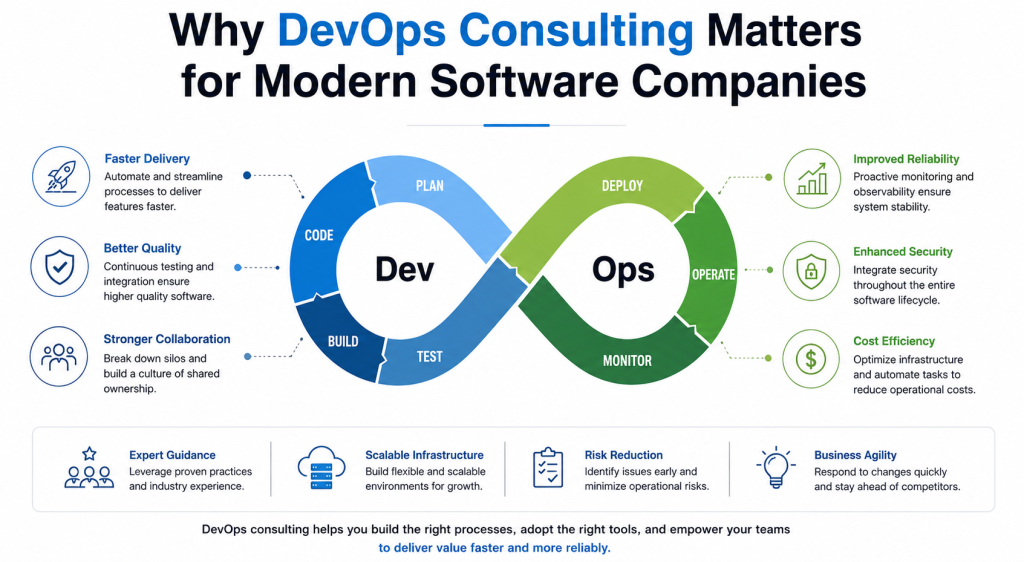
This is where DevOps consulting becomes valuable. DevOps consulting helps organizations improve collaboration between development and operations teams, automate repetitive work, optimize software delivery processes, and build reliable systems that support business growth. Instead of relying on trial and error, companies can benefit from expert guidance and proven implementation strategies.
Many organizations seek support from experienced professionals such as Rajeshkumar to evaluate existing processes, identify bottlenecks, implement automation, and establish modern operational practices that align with business goals.
DevOps consulting is not simply about introducing new tools. It is about creating an environment where people, processes, and technology work together effectively. The result is faster delivery cycles, improved software quality, stronger security, better customer experiences, and greater business agility.
In today’s competitive digital landscape, organizations that adopt modern operational practices often gain a significant advantage. They can respond quickly to market changes, reduce downtime, improve team productivity, and innovate more efficiently than competitors who rely on traditional approaches.
Understanding DevOps Consulting
DevOps consulting involves assessing, designing, implementing, and optimizing software delivery and operational processes. Consultants help organizations bridge gaps between teams, improve workflows, and adopt technologies that support continuous delivery and operational excellence.
Many organizations start their DevOps journey with enthusiasm but struggle during implementation. They may purchase modern tools without changing workflows. They may automate some tasks but leave major bottlenecks untouched. In other cases, teams may lack the skills required to operate modern infrastructure effectively.
A DevOps consultant provides direction, expertise, and practical solutions that reduce these risks.
Typical consulting activities include:
- Infrastructure assessment
- CI/CD implementation
- Cloud adoption strategies
- Monitoring and observability planning
- Security integration
- Automation design
- Container platform deployment
- Operational maturity assessments
- Team enablement and training
- Process optimization
These activities help organizations move from manual, slow, and error-prone operations toward scalable and automated environments.
Why Modern Software Companies Need DevOps Consulting
Faster Product Delivery
Customers expect rapid innovation. Organizations that release updates frequently can respond to market demands faster.
However, many companies still rely on manual deployment processes. These processes consume time and increase the likelihood of mistakes.
DevOps consultants help automate software delivery pipelines, enabling teams to build, test, and deploy applications efficiently. Automated workflows eliminate unnecessary delays and create a consistent release process.
As a result, organizations can release features faster while maintaining quality standards.
Improved Software Reliability
Application outages can damage customer trust and business reputation.
Modern systems consist of numerous interconnected services. Even a small failure can impact users significantly.
DevOps consulting introduces monitoring, alerting, logging, and incident management practices that improve system reliability. Teams gain visibility into system behavior and can identify issues before they become major problems.
Reliable systems contribute directly to customer satisfaction and business continuity.
Better Collaboration Across Teams
Traditional development and operations teams often work independently.
Developers focus on delivering features, while operations teams focus on stability. These competing priorities can create friction.
DevOps consulting promotes shared ownership and collaborative workflows. Teams work toward common objectives instead of isolated goals.
Improved communication leads to faster problem resolution, smoother releases, and stronger organizational alignment.
Enhanced Security
Security cannot be treated as an afterthought.
Modern organizations must protect applications, infrastructure, and customer data throughout the development lifecycle.
Consultants help integrate security controls into pipelines, infrastructure, and deployment processes. This approach ensures that security becomes a continuous practice rather than a final review step.
Organizations benefit from reduced risk and stronger compliance readiness.
Operational Scalability
As businesses grow, operational complexity increases.
Manual processes that work for small teams become difficult to manage at scale.
DevOps consulting introduces automation, standardization, and infrastructure management practices that support growth without proportional increases in operational effort.
Scalable operations allow organizations to expand efficiently.
The Business Value of DevOps Consulting
Reduced Operational Costs
Automation eliminates repetitive manual tasks.
When teams spend less time performing routine activities, they can focus on innovation and strategic work.
Reduced manual effort also decreases the likelihood of operational errors, which can be costly to resolve.
Organizations often achieve substantial savings through improved efficiency and resource utilization.
Faster Recovery from Failures
System failures are inevitable.
The difference between successful and unsuccessful organizations lies in how quickly they recover.
DevOps consultants help implement monitoring, alerting, automated recovery procedures, and incident response frameworks.
These capabilities reduce downtime and minimize business impact.
Improved Customer Experience
Customers expect applications to be available, responsive, and reliable.
Operational improvements directly affect user satisfaction.
Faster releases, fewer outages, and improved performance create better customer experiences.
Satisfied customers are more likely to remain loyal and recommend products to others.
Stronger Competitive Advantage
Organizations that deliver software efficiently gain a strategic advantage.
They can experiment faster, release features sooner, and respond to customer feedback more effectively.
DevOps consulting helps create operational capabilities that support continuous innovation.
Key Operational Concepts You Must Know
Automation
Automation is one of the most important principles in modern operations.
Manual tasks increase variability and introduce errors.
Automation creates consistency and improves efficiency.
Examples include:
- Automated testing
- Automated deployments
- Infrastructure provisioning
- Security scanning
- Monitoring setup
- Configuration management
Organizations that embrace automation typically achieve higher operational maturity.
Continuous Integration
Continuous Integration involves frequently merging code changes into a shared repository.
Each change triggers automated validation processes.
Benefits include:
- Faster feedback
- Earlier defect detection
- Improved code quality
- Reduced integration challenges
Continuous Integration helps teams maintain software stability throughout development.
Continuous Delivery
Continuous Delivery ensures software remains deployable at all times.
Automated pipelines validate changes and prepare releases.
Organizations gain flexibility because deployments can occur whenever business requirements demand them.
Infrastructure as Code
Infrastructure as Code allows teams to manage infrastructure through version-controlled definitions.
Instead of manually configuring servers, teams create reusable templates.
Benefits include:
- Consistency
- Repeatability
- Faster provisioning
- Better documentation
- Reduced configuration drift
Infrastructure becomes easier to manage and scale.
Monitoring and Observability
Monitoring helps teams understand system health.
Observability provides deeper insights into application behavior.
Key observability components include:
- Metrics
- Logs
- Traces
- Alerts
- Dashboards
These capabilities support proactive issue detection and faster troubleshooting.
Reliability Engineering
Reliability engineering focuses on system availability and performance.
Teams define service objectives and continuously improve operational resilience.
Reliability practices help organizations maintain customer trust.
Security Integration
Security should exist throughout the software lifecycle.
Modern operations incorporate:
- Vulnerability scanning
- Secret management
- Access control
- Compliance validation
- Security automation
This approach reduces risk while supporting development speed.
Platform Implementation vs. Culture — What’s the Real Difference?
Many organizations assume DevOps success depends primarily on technology platforms.
While technology plays an important role, culture often determines long-term outcomes.
Understanding the distinction between platform implementation and culture is critical.
What Is Platform Implementation?
Platform implementation focuses on technology adoption.
Examples include:
- CI/CD tools
- Container platforms
- Cloud services
- Monitoring systems
- Infrastructure automation
- Security tools
These technologies improve efficiency and enable modern operational capabilities.
However, tools alone cannot solve organizational challenges.
What Is Culture?
Culture represents how people work together.
It influences:
- Communication
- Accountability
- Collaboration
- Learning
- Decision making
- Problem solving
A strong culture encourages continuous improvement and shared responsibility.
Why Tools Alone Fail
Many organizations purchase sophisticated platforms but fail to achieve expected results.
Common reasons include:
- Resistance to change
- Lack of ownership
- Poor communication
- Limited training
- Misaligned goals
Without cultural transformation, technology investments often produce limited benefits.
The Ideal Balance
Successful organizations combine both elements.
| Platform Implementation | Cultural Transformation |
|---|---|
| Automation | Collaboration |
| CI/CD Pipelines | Shared Ownership |
| Cloud Infrastructure | Accountability |
| Monitoring Tools | Transparency |
| Security Platforms | Continuous Learning |
| Infrastructure as Code | Innovation Mindset |
Technology enables efficiency, while culture enables sustainability.
Both must evolve together.
Real-World Use Cases of Modern Operations
Large-Scale E-Commerce Platforms
E-commerce businesses experience fluctuating traffic levels.
During promotional events, demand can increase dramatically.
Modern operational practices help organizations:
- Scale automatically
- Monitor customer experiences
- Maintain availability
- Deploy updates safely
These capabilities protect revenue and customer satisfaction.
Financial Services Applications
Financial institutions require high reliability and security.
Operational improvements support:
- Secure deployments
- Compliance requirements
- Continuous monitoring
- Incident response
- Risk management
Strong operational foundations help maintain customer confidence.
Healthcare Technology Platforms
Healthcare systems manage critical information.
Downtime can affect patient services and operational workflows.
Modern operations help ensure:
- Availability
- Data protection
- Scalability
- Performance monitoring
- Secure infrastructure management
SaaS Companies
Software-as-a-Service providers depend on reliable delivery pipelines.
Modern operations enable:
- Frequent releases
- Rapid feature development
- Customer-focused improvements
- Automated testing
- Continuous monitoring
These practices support business growth and customer retention.
Media and Streaming Platforms
Media companies handle massive volumes of content and user traffic.
Operational excellence enables:
- Reliable streaming
- Performance optimization
- Infrastructure scalability
- Service monitoring
- Rapid issue resolution
These capabilities improve viewer experiences.
Common Mistakes in Operations Engineering
Focusing Only on Tools
Organizations often believe new tools will solve every problem.
In reality, processes and culture matter equally.
Technology should support operational objectives rather than become the objective itself.
Ignoring Documentation
Poor documentation creates knowledge gaps.
Teams struggle to troubleshoot systems when information is unavailable.
Comprehensive documentation improves operational consistency and onboarding efficiency.
Lack of Monitoring
Without visibility, teams cannot identify problems quickly.
Monitoring should be implemented from the beginning rather than after incidents occur.
Over-Automating Too Early
Automation delivers significant value, but organizations should understand processes before automating them.
Automating ineffective workflows simply accelerates inefficiency.
Poor Security Practices
Security gaps can lead to severe consequences.
Organizations should integrate security into development and operational workflows rather than treating it as a separate activity.
Weak Incident Management
Many teams respond to incidents inconsistently.
Effective incident management requires:
- Clear responsibilities
- Communication procedures
- Escalation paths
- Post-incident reviews
- Continuous improvement
Neglecting Training
Technology evolves continuously.
Teams require ongoing learning opportunities to remain effective.
Organizations that invest in skill development typically achieve stronger operational outcomes.
How to Become an Operations Expert — Career Roadmap
Operations engineering offers exciting opportunities for professionals interested in technology, automation, cloud platforms, and reliability.
A structured learning path helps accelerate career growth.
Step 1: Build Strong Technical Foundations
Learn core concepts including:
- Operating systems
- Networking
- Databases
- Programming
- Security fundamentals
- Cloud computing
These topics provide essential operational knowledge.
Step 2: Learn Automation
Automation skills are highly valuable.
Focus on:
- Scripting
- Configuration management
- Infrastructure automation
- Deployment automation
Automation expertise improves productivity and scalability.
Step 3: Understand Cloud Platforms
Cloud technologies power many modern applications.
Develop knowledge of:
- Compute services
- Storage services
- Networking
- Security controls
- Managed services
Cloud expertise expands career opportunities significantly.
Step 4: Master CI/CD Practices
Learn how software moves from development to production.
Key areas include:
- Build pipelines
- Testing automation
- Release automation
- Deployment strategies
These capabilities are fundamental to modern operations.
Step 5: Study Reliability Engineering
Reliability engineering focuses on maintaining system health.
Important topics include:
- Monitoring
- Alerting
- Incident response
- Capacity planning
- Performance optimization
Reliability expertise is highly valued across industries.
Step 6: Improve Security Knowledge
Security awareness strengthens operational effectiveness.
Learn about:
- Identity management
- Access controls
- Vulnerability management
- Security monitoring
- Compliance requirements
Security skills enhance professional credibility.
Step 7: Develop Communication Skills
Technical expertise alone is insufficient.
Operations professionals must communicate effectively with stakeholders, engineers, managers, and customers.
Strong communication improves collaboration and leadership potential.
Step 8: Gain Practical Experience
Hands-on experience accelerates learning.
Consider:
- Personal projects
- Open-source contributions
- Lab environments
- Internal initiatives
- Community participation
Practical exposure builds confidence and expertise.
Step 9: Learn Business Thinking
Operations decisions affect business outcomes.
Understand:
- Customer expectations
- Service quality
- Cost optimization
- Risk management
- Strategic objectives
Business awareness distinguishes senior professionals from purely technical practitioners.
Step 10: Pursue Continuous Learning
Technology changes rapidly.
Successful professionals continuously update their skills, explore emerging practices, and adapt to industry evolution.
Continuous learning supports long-term career growth.
FAQ Section
What is DevOps consulting?
DevOps consulting helps organizations improve software delivery, operational efficiency, automation, collaboration, security, and infrastructure management through expert guidance and implementation support.
Why do companies hire DevOps consultants?
Companies hire consultants to accelerate transformation efforts, solve operational challenges, reduce risk, improve reliability, and implement best practices more effectively.
Is DevOps consulting only for large enterprises?
No. Startups, mid-sized organizations, and large enterprises can all benefit from DevOps consulting depending on their operational goals and growth requirements.
How does DevOps consulting improve software delivery?
Consultants help automate testing, deployment, infrastructure management, and operational processes, resulting in faster and more reliable releases.
Does DevOps consulting require cloud adoption?
No. Although cloud platforms often support DevOps practices, organizations can implement DevOps principles in various infrastructure environments.
What skills are important for operations professionals?
Key skills include automation, cloud computing, networking, security, monitoring, scripting, problem solving, and communication.
How long does a DevOps transformation take?
The timeline varies based on organizational size, technical complexity, culture, and transformation goals. Successful transformation typically occurs as an ongoing improvement journey.
Can DevOps improve security?
Yes. Modern DevOps practices integrate security throughout the software lifecycle, helping organizations identify and address risks earlier.
Why is automation important in operations?
Automation reduces manual effort, improves consistency, minimizes errors, and enables teams to focus on higher-value activities.
What is the biggest challenge in DevOps adoption?
One of the biggest challenges is cultural change. Organizations often focus on tools while overlooking collaboration, ownership, and continuous improvement.
Final Summary
DevOps consulting plays a critical role in helping modern software companies achieve operational excellence. As technology environments become more complex, organizations need structured approaches that improve collaboration, automation, reliability, security, and scalability.
Successful DevOps transformation goes far beyond implementing tools. It requires aligning people, processes, and technology around shared objectives. Organizations that embrace this mindset often deliver software faster, recover from failures more efficiently, improve customer experiences, and strengthen their competitive position.
Key operational concepts such as automation, continuous integration, continuous delivery, observability, infrastructure as code, reliability engineering, and security integration provide the foundation for sustainable success. At the same time, cultural transformation remains equally important because technology alone cannot solve communication and collaboration challenges.
Real-world examples across e-commerce, healthcare, finance, media, and SaaS environments demonstrate how modern operational practices create measurable business value. However, organizations must avoid common mistakes such as overreliance on tools, weak monitoring, poor documentation, inadequate training, and delayed security integration.
For professionals seeking a rewarding technology career, operations engineering offers significant opportunities. By building technical expertise, automation skills, cloud knowledge, reliability practices, security awareness, and business understanding, individuals can develop into highly effective operations experts.




Leave a Reply
You must be logged in to post a comment.