Introduction
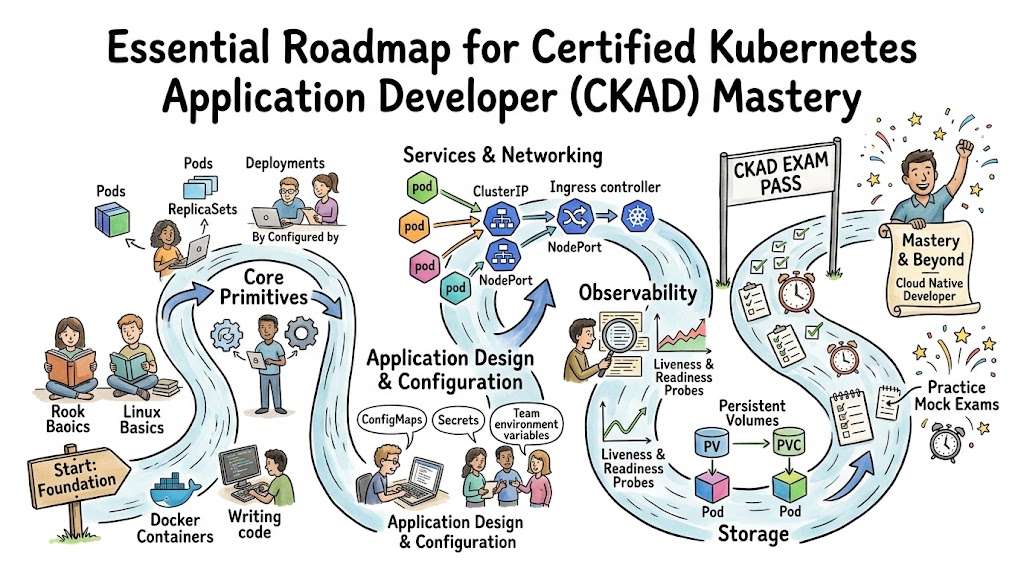
Modern software delivery relies heavily on container orchestration, and the Certified Kubernetes Application Developer (CKAD) stands as the definitive benchmark for this expertise. This guide targets ambitious developers and platform engineers who want to transition from traditional coding to cloud-native application design. By mastering the ability to configure and troubleshoot resources in live clusters, you secure your position in the high-growth fields of SRE and DevOps. DevOpsSchool provides the structured environment necessary for professionals to navigate this complex ecosystem and achieve career-defining milestones.
What is the Certified Kubernetes Application Developer (CKAD)?
The Certified Kubernetes Application Developer (CKAD) program serves as a rigorous, hands-on validation of an engineer’s ability to build and configure applications for the cloud. It moves away from theoretical memorization, instead requiring candidates to solve real-world problems in a live terminal. This credential exists to prove that a professional can handle the intricacies of pod design, networking, and storage within production-grade environments. Organizations value this certification because it guarantees that the holder understands the operational demands of scalable, distributed systems.
Who Should Pursue Certified Kubernetes Application Developer (CKAD)?
Software engineers and cloud practitioners who interact with containerized microservices daily will find the most value in this program. While developers form the core audience, SREs and security professionals also utilize this training to better understand application-layer interactions within a cluster. Engineering managers often pursue this certification to gain technical depth, allowing them to lead their teams with more practical insight. Whether you operate in the Indian tech market or on a global scale, this certification marks you as a competent cloud-native expert.
Why Certified Kubernetes Application Developer (CKAD) is Valuable and Beyond
The shift toward cloud-native architecture ensures that Kubernetes expertise remains a highly sought-after commodity in the job market. This certification offers lasting value because it focuses on core primitives that remain consistent across all major cloud providers. Professionals who earn this credential often see immediate returns on their time through increased efficiency and higher salary potential. By mastering these skills, you ensure your career remains resilient against the rapid turnover of specific software tools and proprietary platforms.
Certified Kubernetes Application Developer (CKAD) Certification Overview
The certification process takes place through the official training portal and the specific website mentioned in the introductory resources. Candidates face a performance-based assessment where they must execute tasks within a command-line interface under strict time limits. This practical ownership model ensures that the certification reflects true technical capability rather than just academic knowledge. It remains one of the most respected credentials in the industry because it directly mirrors the daily responsibilities of a professional application developer.
Certified Kubernetes Application Developer (CKAD) Certification Tracks & Levels
Professionals can navigate through various tracks ranging from entry-level foundations to specialized expert tiers. Initial levels focus on core concepts like deployment and resource management, while advanced tracks dive into security, observability, and cost-efficiency. These levels align perfectly with career progression, allowing an engineer to grow from a junior developer into a lead platform architect. Specialized tracks also cater to niche roles in FinOps or DataOps, ensuring everyone has a relevant learning path.
Complete Certified Kubernetes Application Developer (CKAD) Certification Table
| Track | Level | Who it’s for | Prerequisites | Skills Covered | Recommended Order |
| App Design | Associate | New Developers | Docker Basics | Pods, YAML, CLI | 1 |
| Core Dev | Professional | Full-stack Devs | Linux Skills | Deployments, Probes | 2 |
| Data Ops | Specialist | Data Engineers | CKAD Core | Statefulness, PVC | 3 |
| Governance | Expert | Leads / SREs | Advanced CKAD | Quotas, Security | 4 |
Detailed Guide for Each Certified Kubernetes Application Developer (CKAD) Certification
Certified Kubernetes Application Developer (CKAD) – Professional Tier
What it is
This certification confirms that an engineer possesses the skills to design and configure cloud-native applications from the ground up. It validates proficiency in managing resource requirements and configuring application security within a cluster.
Who should take it
Cloud developers and DevOps practitioners who have significant experience with container environments should attempt this exam. It suits those who want to demonstrate their ability to manage production workloads efficiently.
Skills you’ll gain
- Designing and deploying multi-container pods using sidecar patterns.
- Configuring application networking and service discovery.
- Implementing robust health checks and resource limits.
- Managing persistent data through volume orchestration.
- Troubleshooting application errors in real-time environments.
Real-world projects you should be able to do
- Architect a zero-downtime deployment pipeline for a microservices-based application.
- Implement a centralized configuration management system using ConfigMaps and Secrets.
- Optimize resource allocation for a cluster to reduce cloud infrastructure costs.
Preparation plan
- 7–14 Days: Review the curriculum and practice generating YAML templates using imperative commands.
- 30 Days: Solve complex lab scenarios daily and focus on high-speed troubleshooting techniques.
- 60 Days: Conduct full-length mock exams to build the stamina required for the two-hour testing window.
Common mistakes
- Failing to verify changes by checking pod status after running a command.
- Typing out full YAML files manually instead of using dry-run flags.
- Misunderstanding the scope of network policies when securing application traffic.
Best next certification after this
- Same-track option: Certified Kubernetes Administrator (CKA).
- Cross-track option: Certified Kubernetes Security Specialist (CKS).
- Leadership option: Cloud-Native Architecture Leadership.
Choose Your Learning Path
DevOps Path
The DevOps track bridges the gap between software creation and infrastructure management through continuous automation. Engineers learn to treat the entire application lifecycle as a programmable entity within the Kubernetes ecosystem. You will focus on building resilient CI/CD pipelines that deploy code safely and frequently to production clusters. This path suits those who enjoy optimizing workflows and improving team delivery speeds.
DevSecOps Path
This specialized track puts security at the center of the development process rather than treating it as a final step. You will learn to implement automated security checks, scan container images, and enforce rigid network isolation policies. It prepares professionals to handle the growing threats in cloud environments by building “defense in depth.” This path is critical for engineers working in regulated industries like finance or healthcare.
SRE Path
The SRE track focuses on maintaining system reliability and performance at scale through data-driven engineering. You will master observability tools to monitor application health and automate the response to system failures. This path emphasizes the reduction of “toil” through smart automation and the management of service level objectives. It is the ideal choice for those who thrive on solving complex stability problems.
AIOps Path
Engineers in the AIOps track utilize artificial intelligence to streamline and automate Kubernetes operations. You will explore how to use machine learning models to analyze logs and predict infrastructure bottlenecks before they happen. This path represents the future of automated system administration. It attracts professionals who want to lead the next wave of intelligent infrastructure management.
MLOps Path
The MLOps path focuses on the unique challenges of deploying machine learning workloads on containerized platforms. You will learn to manage the lifecycle of models, from training data pipelines to serving inference at scale. This track ensures that data scientists and engineers can collaborate effectively on a unified platform. It is essential for any organization looking to scale its AI capabilities.
DataOps Path
DataOps professionals focus on the reliability and speed of data delivery within Kubernetes clusters. You will learn to manage complex stateful applications like distributed databases and streaming platforms. This path addresses the specific storage and networking needs of data-intensive applications. It is perfect for engineers who want to specialize in high-performance data architecture.
FinOps Path
The FinOps track teaches engineers how to align cloud spending with business value through detailed resource monitoring. You will learn to identify wasted resources and implement quotas that keep infrastructure costs under control. This role is becoming vital as companies look to optimize their cloud budgets without sacrificing performance. It suits individuals who enjoy a mix of technical engineering and financial strategy.
Role → Recommended Certified Kubernetes Application Developer (CKAD) Certifications
| Role | Recommended Certifications |
| DevOps Engineer | CKAD, CKA, GitOps Certification |
| SRE | CKAD, Prometheus Specialist, CKA |
| Platform Engineer | CKAD, Terraform Associate, CKA |
| Cloud Engineer | CKAD, Cloud Provider Professional |
| Security Engineer | CKAD, CKS, Security+ |
| Data Engineer | CKAD, Data Architecture Cert |
| FinOps Practitioner | CKAD, Cloud Financial Management |
| Engineering Manager | CKAD, Agile Leadership |
Next Certifications to Take After Certified Kubernetes Application Developer (CKAD)
Same Track Progression
Deepening your Kubernetes knowledge often leads toward the administrative side of the technology. Pursuing the CKA allows you to understand how the cluster itself functions, from the control plane to worker node networking. This holistic view enables you to build more efficient applications because you understand the underlying constraints of the platform. Mastering both the developer and admin sides makes you a formidable technical asset.
Cross-Track Expansion
Branching out into security or infrastructure automation provides a more versatile skill set for modern roles. The CKS is the gold standard for those who want to specialize in securing containerized workloads. Alternatively, learning tools like Ansible or Terraform helps you manage the full stack of cloud resources. Diversifying your expertise ensures you can tackle any challenge in a hybrid cloud environment.
Leadership & Management Track
Moving into management requires a shift from writing code to guiding technical strategy and team growth. Leadership certifications help you understand how to implement DevOps cultures and manage large-scale digital transformations. You will focus on the business impact of technology choices and how to optimize team performance. This path prepares you for roles like CTO or Head of Platform Engineering.
Training & Certification Support Providers for Certified Kubernetes Application Developer (CKAD)
DevOpsSchool
This institution offers world-class training that emphasizes practical, hands-on experience over simple theory. Their expert instructors guide you through real-world scenarios that prepare you for the rigors of the CKAD exam. They maintain a high success rate by providing students with the exact tools and environments they will face during the assessment.
Cotocus
Providing high-end consulting and training, this company focuses on deep technical mastery for engineering teams. They tailor their programs to meet the needs of professionals who want to implement best practices in production. Their focus on architectural integrity sets them apart in the training space.
Scmgalaxy
This platform serves as a comprehensive hub for community knowledge and technical tutorials. It provides a wealth of free and premium resources that help engineers troubleshoot complex Kubernetes issues. Many professionals use this site as a primary reference during their preparation journey.
BestDevOps
Specializing in intensive bootcamps, this provider helps engineers gain critical skills in a very short amount of time. Their curriculum stays updated with the latest Kubernetes releases to ensure maximum relevance. They prioritize practical outcomes and immediate job readiness.
devsecopsschool.com
This portal focuses entirely on the intersection of security and modern operations. They provide specialized tracks that teach you how to bake security into every layer of your Kubernetes pods. It is the best resource for those looking to become security specialists.
sreschool.com
Targeting the needs of reliability engineers, this school teaches you how to keep clusters running under high pressure. Their training covers observability, incident management, and automated remediation. It provides the perfect foundation for anyone responsible for uptime.
aiopsschool.com
This school explores how artificial intelligence can simplify the management of complex distributed systems. They offer cutting-edge courses on using ML for log analysis and predictive maintenance. It is ideal for engineers who want to stay ahead of the automation curve.
dataopsschool.com
This provider specializes in the management of data workloads on containerized infrastructure. Their courses address the specific challenges of running databases and data pipelines on Kubernetes. They help data engineers master the cloud-native transition.
finopsschool.com
Focused on the financial side of the cloud, this school teaches you how to manage and optimize cluster costs. They provide the frameworks needed to implement cloud financial accountability within an engineering team. It is essential for budget-conscious organizations.
Frequently Asked Questions (General)
- Is the exam hard for a beginner?
Yes, beginners find the exam challenging because it requires hands-on speed and a deep understanding of Kubernetes primitives.
- How many hours should I study?
Most successful candidates spend approximately 100 hours practicing in a lab environment before attempting the test.
- Can I use a notepad during the exam?
The testing environment usually provides a built-in digital notepad for tracking your progress and saving snippets.
- Does the certification expire?
The credential remains valid for three years, after which you must renew it by passing the current exam version.
- What is the most important skill for the test?
Speed is the most critical factor, as you must solve many technical problems within a limited two-hour window.
- Should I learn Docker before Kubernetes?
Yes, understanding container fundamentals is essential because Kubernetes acts as an orchestrator for those containers.
- Is it okay to use the Kubernetes documentation?
You can access one tab of the official documentation during the exam, so knowing how to search it is vital.
- Does this help me get a job in the US or Europe?
This certification holds global recognition and significantly improves your chances of landing a role in international markets.
- Can I take the exam on a Mac or Windows?
You can use either operating system as long as you use a supported browser and meet the proctoring requirements.
- What happens if my internet disconnects?
The proctors usually allow you to reconnect and resume, but you should ensure a stable connection to avoid losing time.
- Do I need to be a coding expert?
You don’t need to be a senior developer, but you must be comfortable with YAML and basic application logic.
- How much does the exam cost?
The standard price is around $395, though discounts and bundles are often available during special promotions.
FAQs on Certified Kubernetes Application Developer (CKAD)
- Which version of Kubernetes will I use in the exam?
The exam environment typically uses one of the three most recent stable versions of Kubernetes.
- Is Vim the only editor available?
Vim is the standard, but most environments also include Nano for those who prefer a simpler text editor.
- Are there questions on cluster installation?
No, the developer exam focuses on using an existing cluster rather than setting up the control plane components.
- Do I need to learn about Helm charts?
Yes, the modern CKAD curriculum includes the deployment and management of applications using Helm.
- How do I practice for the performance-based format?
Using platforms like Minikube or Killercoda provides a similar environment to the actual exam for hands-on practice.
- What part of the syllabus is the most difficult?
Many candidates struggle with complex networking policies and multi-container pod configurations.
- Does the exam include questions on CRDs?
Basic knowledge of Custom Resource Definitions is helpful, but the focus remains on standard Kubernetes objects.
- Can I retake the test for free?
Most purchases from the official provider include one free retake if you do not pass on your first attempt.
Final Thoughts: Is Certified Kubernetes Application Developer (CKAD) Worth It?
Choosing to pursue this certification represents a serious commitment to your professional growth in the cloud-native landscape. It forces you to move beyond basic concepts and proves that you can handle the pressure of live environment troubleshooting. The industry continues to move toward Kubernetes as its standard operating system, making this expertise more valuable every day. While the path to mastery requires significant effort, the resulting career opportunities and technical confidence justify the investment. You will emerge not just with a certificate, but with the practical skills needed to lead in the modern engineering world.



Leave a Reply
You must be logged in to post a comment.