Introduction
Technology keeps pushing the limits of what computers can do. Scientists now explore new ways to process information and solve complex problems. Quantum computing stands at the center of this research.
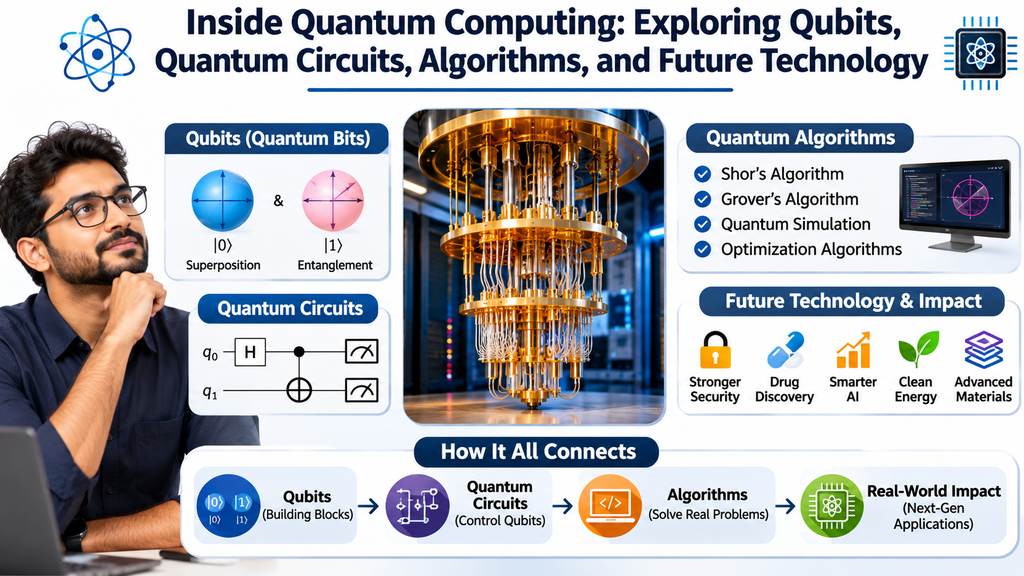
Unlike traditional computers, quantum computers use the principles of quantum physics. They work with qubits instead of ordinary binary bits. These special units introduce new possibilities through superposition, entanglement, and interference.
The subject connects mathematics, physics, software development, and cybersecurity. Understanding its foundations can help learners explore an important area of modern computer science. This guide takes you through its core concepts, practical examples, algorithms, industry research, and beginner learning methods.
1. Quantum Computing for Beginners: Discover a Different Computing Model
Quantum computing introduces a different way to represent and process information. It combines computer science with quantum mechanics to perform selected calculations.
A classical computer uses bits. Each bit represents either zero or one. A quantum computer uses qubits, which can represent combinations of basis states.
This difference allows quantum algorithms to approach certain problems through new mathematical methods.
Three Important Ideas Behind Quantum Computing
Superposition: A quantum system can occupy a combination of possible states. Quantum algorithms use this property to prepare and manipulate information.
Entanglement: Two or more qubits can share a connected quantum state. Their measurement results may show strong correlations.
Interference: Quantum operations change probability amplitudes. Algorithms use interference to strengthen useful outcomes and reduce unwanted ones.
Why Should Beginners Explore This Technology?
Quantum computing has important research applications in science and mathematics.
Researchers investigate quantum systems to model molecules, study materials, and explore selected optimization problems.
However, quantum computers do not replace classical systems. Their value depends on the problem, algorithm, and available hardware.
Beginners should first understand how quantum information works. This foundation makes advanced programming and algorithm design easier to follow.
2. What Is a Qubit? Learn How Quantum Computers Represent Data
A qubit is the smallest basic unit of quantum information. It serves a role similar to a classical bit, but it follows quantum mechanical rules.
A classical bit stores zero or one. A qubit can occupy a superposition of both computational basis states.
The Mathematical Representation of a Qubit
Quantum computing uses this expression to describe a pure qubit state:
[
|\psi\rangle=\alpha|0\rangle+\beta|1\rangle
]
Here, the symbols represent:
- (|0\rangle): Zero basis state.
- (|1\rangle): One basis state.
- (\alpha): Probability amplitude associated with zero.
- (\beta): Probability amplitude associated with one.
The amplitudes must satisfy this condition:
[
|\alpha|^2+|\beta|^2=1
]
Their squared magnitudes determine the measurement probabilities.
How Does a Qubit Behave During Measurement?
Suppose a qubit contains equal probabilities for zero and one.
An ideal measurement in the computational basis produces one of these values. Repeated experiments help us understand the probability distribution.
A measurement never reveals both classical results at the same time.
Different Ways to Build Physical Qubits
Research laboratories use different physical technologies to create qubits.
Examples include:
- Superconducting circuits.
- Trapped ions.
- Photonic systems.
- Neutral atoms.
- Semiconductor spin systems.
Each technology offers different engineering properties. Researchers continue to improve stability, control, and measurement accuracy.
3. Quantum Computing vs Classical Computing: Which System Serves Which Purpose?
Classical computers and quantum computers use different methods to process information.
Classical systems use binary operations. Quantum systems manipulate quantum states through quantum gates.
Understanding this difference helps people identify suitable applications for each technology.
Classical Computing in Everyday Life
Classical computers power many services that people use daily.
For example, an online payment system uses classical processors to validate transactions, update balances, and protect customer accounts.
Developers also use classical systems for:
- Website development.
- Database management.
- Cloud computing.
- Mobile applications.
- Business automation.
- Artificial intelligence.
These systems provide reliable performance for general computing tasks.
Quantum Computing for Specialized Problems
Quantum computers focus on selected calculations that may benefit from quantum algorithms.
Researchers investigate applications in quantum chemistry, scientific simulation, optimization, and mathematical research.
A quantum processor manipulates qubits through a sequence of operations. It then measures the system to produce classical results.
Understanding the Main Differences
| Feature | Classical Computing | Quantum Computing |
|---|---|---|
| Information unit | Bit | Qubit |
| Information states | 0 or 1 | Quantum states |
| Main operations | Logic gates | Quantum gates |
| Computing principles | Classical computation | Quantum mechanics |
| Everyday applications | Widely used | Specialized research and selected tasks |
| Major limitations | Computing resources | Noise and error correction |
Can Classical and Quantum Computers Work Together?
Yes. Hybrid computing connects both technologies.
A classical computer can prepare information and manage calculations. A quantum processor can handle a specific quantum operation. The classical system then analyzes the result.
This method gives researchers a way to combine existing computing resources with quantum hardware.
4. Quantum Circuits Tutorial: Understand How Quantum Programs Work
A quantum circuit represents the operations that a quantum computer performs.
Programmers use circuit diagrams to organize gates, control operations, and measurements. The sequence determines how the system changes from its starting state to its final result.
Main Components of a Quantum Circuit
Qubit wires: Horizontal lines represent quantum bits.
Quantum gates: Symbols on the wires represent operations.
Controlled operations: Connected gate symbols show relationships between qubits.
Measurements: Measurement operations convert quantum states into classical results.
Follow a Simple Circuit Workflow
- Initialize the qubits in suitable starting states.
- Apply the required quantum gates.
- Create superposition or entanglement when needed.
- Complete the circuit operations.
- Measure the qubits.
- Analyze the measurement results.
Build a Small Circuit With Qiskit
Python and Qiskit offer useful ways to explore quantum circuit construction.
Try this example:
from qiskit import QuantumCircuit

# Create two qubits and two classical bits
qc = QuantumCircuit(2, 2)

# Apply a Hadamard gate
qc.h(0)

# Apply a controlled-NOT gate
qc.cx(0, 1)

# Measure both qubits
qc.measure([0, 1], [0, 1])

# Print the quantum circuit
print(qc.draw())Code language: PHP (php)
This program prepares a Bell state.
The Hadamard gate creates superposition in the first qubit. The CNOT gate then entangles the two qubits.
An ideal circuit produces correlated measurement results. Repeated experiments should produce 00 and 11 with approximately equal probabilities.
What Can You Learn From This Program?
This example introduces circuit construction, quantum gates, entanglement, and measurement.
You can change the gate sequence and examine how the results change. This creates a useful starting point for practical quantum programming.
5. Quantum Gates Explained: Understand the Core Operations
Quantum gates change the states of qubits. They form the main operations inside quantum circuits.
Programmers combine different gates to create more advanced quantum algorithms.
Hadamard Gate (H)
The Hadamard gate creates an equal superposition from either computational basis state.
For example:
[
H|0\rangle=\frac{|0\rangle+|1\rangle}{\sqrt{2}}
]
Many quantum algorithms use this gate when they need to prepare superposition.
Pauli-X Gate
The Pauli-X gate swaps zero and one.
It performs a similar role to the NOT gate in classical computing.
Pauli-Y Gate
The Pauli-Y gate changes both the amplitude and phase structure of a qubit state.
It forms part of the Pauli gate family.
Pauli-Z Gate
The Pauli-Z gate changes the relative phase of the one component. It plays an important role in quantum interference.
CNOT Gate
The Controlled-NOT gate connects two qubits.
One qubit controls the operation. The second qubit receives an X operation when the control has value one in the computational basis.
Why Do Quantum Gates Matter?
A single gate performs a specific mathematical operation. A complete circuit combines multiple gates to achieve a larger computational goal.
Learning gate behavior helps developers understand quantum algorithms, circuit diagrams, and quantum state transformations.
6. Quantum Computing Algorithms Explained: Explore Important Methods
Quantum algorithms provide instructions for performing calculations with quantum systems.
They target specific mathematical problems. Some offer theoretical advantages over known classical approaches.
However, developers must evaluate actual resource requirements before claiming practical improvements.
Grover’s Algorithm
Grover’s algorithm addresses unstructured search.
It offers a quadratic query improvement over classical unstructured search. Researchers use it as an important example of quantum algorithm design.
Shor’s Algorithm
Shor’s algorithm tackles integer factorization and discrete logarithm problems.
It has major implications for some public-key cryptographic systems.
Quantum Phase Estimation
Quantum phase estimation calculates phase information associated with certain quantum operations.
It supports several important quantum algorithms.
Variational Quantum Eigensolver
VQE combines quantum circuits with classical optimization methods.
Researchers use it to investigate molecular energies and quantum chemistry problems.
Quantum Approximate Optimization Algorithm
QAOA explores selected optimization problems through parameterized quantum circuits.
The algorithm combines quantum operations with classical parameter adjustments.
How Should Developers Evaluate Quantum Algorithms?
Developers should examine:
- The problem that the algorithm solves.
- Its required circuit structure.
- The number of operations.
- Hardware error rates.
- Measurement requirements.
- Classical computing resources.
This approach provides a realistic picture of quantum performance.
7. Shor’s Algorithm Explained: The Quantum Challenge for Encryption
Shor’s algorithm demonstrates how quantum computers could affect certain mathematical problems that support digital security.
Mathematician Peter Shor developed an algorithm that solves integer factorization efficiently in theory with a suitable quantum computer.
Understanding Integer Factorization
Integer factorization means breaking a composite number into prime factors.
Consider this simple example:
[
33=3\times11
]
A small number creates an easy calculation. Very large numbers create much harder factoring problems for classical methods.
RSA uses the practical difficulty of factoring large composite numbers as part of its security design.
How Does Shor’s Algorithm Find Factors?
The algorithm transforms factorization into an order-finding problem.
Its main stages include:
Step 1: Select an appropriate input.
The algorithm chooses a value related to the target number.
Step 2: Construct a mathematical function.
It uses modular arithmetic to study a function’s periodic behavior.
Step 3: Apply quantum operations.
The quantum circuit performs the central order-finding calculation.
Step 4: Measure the quantum system.
Measurement provides information about the mathematical period.
Step 5: Use classical calculations.
Classical mathematics processes the results and calculates possible factors.
Why Should Organizations Understand This Algorithm?
A sufficiently powerful, fault-tolerant quantum computer could threaten RSA and some other public-key cryptographic methods.
Current quantum hardware does not provide a practical general ability to break large RSA keys with Shor’s algorithm.
However, organizations should prepare for long-term security changes.
8. Post-Quantum Cryptography Explained: Prepare for Quantum Security Risks
Quantum computing creates important challenges for digital security.
Some traditional public-key cryptographic methods rely on mathematical problems that sufficiently powerful quantum computers could solve more efficiently.
Post-quantum cryptography addresses this risk through algorithms designed to resist attacks from classical and quantum computers.
Why Does Post-Quantum Security Matter?
Businesses, governments, and individuals depend on digital encryption.
Sensitive information may need protection for many years. Attackers could collect encrypted information today and attempt to decrypt it later.
Security professionals therefore need long-term protection strategies.
Three Important NIST Standards
The US National Institute of Standards and Technology published three major post-quantum cryptography standards in August 2024.
FIPS 203 — ML-KEM
This standard defines a key-encapsulation mechanism. It helps two parties establish a shared secret key.
FIPS 204 — ML-DSA
This standard defines a digital signature algorithm. It supports identity verification and data integrity.
FIPS 205 — SLH-DSA
This standard defines another digital signature method using hash-based techniques.
NIST recommends that organizations begin planning and implementing their transition to quantum-resistant cryptography. It also continues research into additional standards.
How Can IT Teams Improve Their Security Preparation?
Organizations should:
- Identify existing encryption methods.
- Review certificates and digital signatures.
- Check software and hardware dependencies.
- Discuss post-quantum support with technology vendors.
- Test suitable cryptographic alternatives.
- Create a migration plan.
Post-quantum cryptography runs on classical computers. Organizations do not need quantum processors to adopt it.
9. Real-World Applications of Quantum Computing: Research Across Industries
Quantum computing attracts interest from researchers and technology companies.
They investigate whether quantum methods can improve selected scientific calculations and optimization tasks.
However, research potential does not always create immediate business value. Each application needs practical testing.
Chemistry and Drug Discovery
Researchers explore quantum simulation to investigate molecules and chemical interactions.
This work may help scientists understand molecular behavior and chemical reactions.
Material Science
Quantum computing research includes electronic structure calculations and material simulations.
Scientists explore whether quantum methods can provide better tools for studying complex physical systems.
Financial Services
Researchers investigate quantum algorithms for selected optimization and financial modeling problems.
They must compare these methods against classical approaches before claiming practical benefits.
Logistics and Supply Chain Management
Companies manage complex scheduling, routing, and resource allocation tasks.
Researchers explore quantum optimization techniques for selected planning challenges.
Artificial Intelligence
Quantum machine learning studies how quantum operations may support specific machine learning problems.
Researchers continue to investigate useful applications and practical limitations.
Energy Research
Scientists explore quantum simulation for chemical reactions and material properties related to energy research.
Potential areas include catalyst studies, battery materials, and advanced scientific models.
Cybersecurity
Quantum computing affects the future of encryption. Post-quantum cryptography helps organizations prepare for possible threats to current security systems.
10. How to Learn Quantum Computing: Follow a Clear Beginner Roadmap
You can start learning quantum computing through a practical and gradual approach.
Build your mathematical knowledge first. Then study quantum information, gates, circuits, and programming.
Step 1: Study Essential Mathematics
Start with:
- Algebra.
- Complex numbers.
- Vectors.
- Matrices.
- Linear algebra.
- Basic probability.
These topics help explain quantum state representations and circuit operations.
Step 2: Understand Quantum Physics
Explore superposition, entanglement, measurement, and interference.
Focus on their role in information processing.
Step 3: Learn Quantum Gates
Practice Hadamard, Pauli-X, Pauli-Y, Pauli-Z, and CNOT gates.
Understand how each gate changes a qubit’s state.
Step 4: Learn Python
Build basic Python skills before starting quantum programming.
Learn variables, functions, loops, and simple data structures.
Step 5: Start With Qiskit
Explore quantum circuit construction through Qiskit.
Build small programs and inspect their circuit diagrams.
Step 6: Experiment With Simulators
Use a quantum simulator to test superposition, entanglement, and measurement.
Compare results across repeated experiments.
Step 7: Study Quantum Algorithms
Explore Grover’s algorithm, Shor’s algorithm, and quantum phase estimation.
Learn what each algorithm does and why researchers study it.
Step 8: Create Practical Projects
Build beginner projects such as:
- A qubit state demonstration.
- A Bell-state circuit.
- A quantum gate experiment.
- A basic Grover search.
- A comparison of ideal and noisy circuits.
For more educational material, explore QuantumUting.com. The platform focuses on quantum computing fundamentals, programming, circuits, algorithms, and security.
Additional Section: Technical Barriers That Shape the Future of Quantum Computing
Quantum computing still needs major engineering improvements. Understanding these barriers helps readers evaluate the technology realistically.
Quantum Decoherence
Environmental interactions can damage quantum states. This process reduces the reliability of quantum information.
Gate and Measurement Errors
Quantum gates and measurements can produce errors. These errors affect the accuracy of circuit results.
Quantum Error Correction
Quantum error correction uses multiple physical qubits to protect logical information.
Researchers need additional qubits and careful control to build reliable logical qubits.
Hardware Complexity
Quantum processors require specialized environments and control systems.
Engineers must improve connectivity, stability, and measurement as processors grow.
Limited Practical Performance
A quantum algorithm must produce useful results with reasonable resources.
Researchers compare quantum performance against strong classical benchmarks to establish genuine advantages.
Frequently Asked Questions
1. Can quantum computing solve problems that classical computers cannot solve?
Quantum computing offers different ways to approach selected problems. Some quantum algorithms provide theoretical advantages over known classical methods. However, researchers must examine each problem carefully before claiming a practical quantum advantage.
2. Why does a quantum computer need qubits instead of bits?
Qubits follow quantum mechanical rules. They can occupy superpositions and share entangled states. These properties allow quantum algorithms to process selected problems through operations that classical binary systems do not directly reproduce.
3. Does superposition mean that a qubit stores two readable answers?
No. A qubit can occupy a combination of basis states, but measurement produces one classical result. Repeated measurements help researchers estimate the probability distribution of the quantum state.
4. What makes entanglement useful in quantum computing?
Entanglement creates correlations between qubits. Quantum algorithms use these relationships to prepare and manipulate complex quantum states. Entanglement also supports quantum information protocols and quantum communication research.
5. Can someone build quantum circuits using Python?
Yes. Python-based tools such as Qiskit help developers create quantum circuits, apply gates, and study measurements. Beginners can start with small experiments and later explore more advanced algorithms.
6. Why do quantum algorithms need measurements?
Measurement converts quantum information into classical results. Programmers use these results to estimate probabilities, extract useful information, and complete calculations that also involve classical processing.
7. How could Shor’s algorithm affect RSA security?
Shor’s algorithm could factor large integers efficiently on a sufficiently powerful fault-tolerant quantum computer. Since RSA depends on the difficulty of factorization, this development could threaten its security assumptions.
8. Is post-quantum cryptography another name for quantum encryption?
No. Post-quantum cryptography uses classical computing methods that aim to resist quantum attacks. Quantum cryptography uses quantum physical systems for security applications. These technologies have different goals and requirements.
9. Are quantum computers useful for artificial intelligence?
Researchers explore quantum machine learning and related methods. However, practical benefits remain problem-dependent. Developers must compare quantum approaches with established classical machine learning systems.
10. What is the best way to begin a quantum computing career?
Build skills in mathematics, programming, and quantum information. Practice circuit construction with Python and Qiskit. Then explore algorithms, hardware concepts, research papers, and practical projects to develop stronger technical knowledge.
Final Thoughts: Turning Quantum Curiosity Into Technical Knowledge
Quantum computing connects physics, mathematics, and programming in a unique way. Its core ideas explain how researchers can use qubits and quantum operations to explore selected computational problems.
The field also has important links with scientific research and cybersecurity. Applications in chemistry, materials, optimization, and quantum information continue to attract attention.
Still, engineers must solve hardware errors, decoherence, and scaling challenges before many applications can deliver dependable benefits.
A good learning strategy begins with mathematics and simple circuits. Explore quantum programming, examine measurement results, and compare different algorithms.
QuantumUting.com provides an educational starting point for readers who want to explore these subjects in greater depth. Build your understanding through practical experiments and consistent learning.