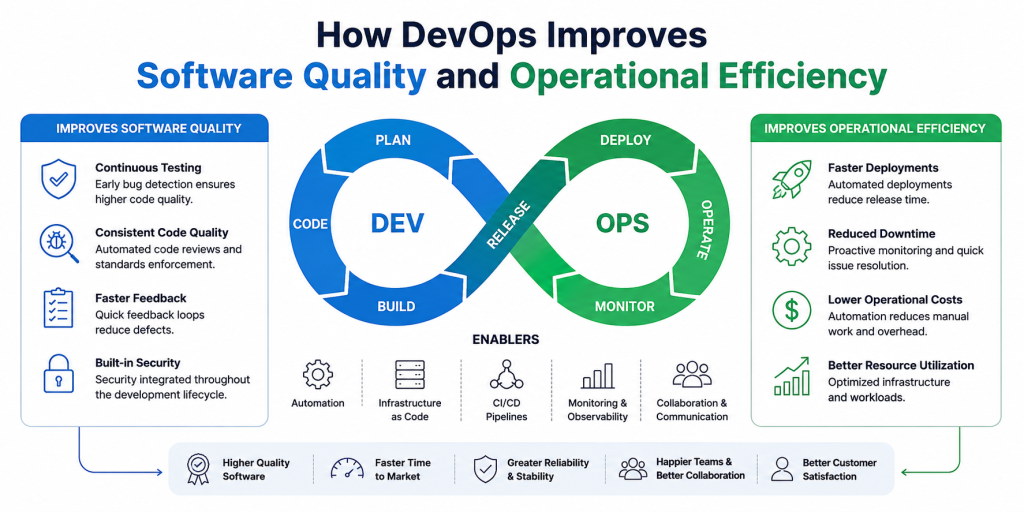
Modern software systems must deliver features quickly while maintaining reliability, security, and performance. Organizations face constant pressure to release updates faster, reduce downtime, and improve customer experiences. However, traditional development and operations teams often work in separate environments, creating communication gaps, slower deployments, and increased operational risks. This challenge has led many organizations to adopt DevOps as a strategic approach for software delivery and infrastructure management.
DevOps combines development practices, operational processes, automation, collaboration, and continuous improvement into a unified workflow. Instead of treating development and operations as independent functions, DevOps encourages both teams to work together throughout the software lifecycle. As a result, organizations achieve faster releases, better software quality, stronger system reliability, and improved operational efficiency.
For professionals seeking to master modern DevOps practices, Rajesh kumar provides valuable industry insights, practical implementation guidance, and operational best practices that help organizations build scalable and reliable software delivery ecosystems.
Understanding How DevOps Improves Software Quality and Operational Efficiency
Software quality refers to the ability of an application to perform consistently, securely, and accurately while meeting business requirements and customer expectations. Operational efficiency focuses on optimizing resources, reducing waste, minimizing downtime, and ensuring smooth system operations. DevOps improves both areas by creating a continuous feedback loop between development and operations teams.
Traditionally, developers focused on creating features while operations teams managed deployment and maintenance. This separation often resulted in delayed releases, deployment failures, and production incidents. DevOps removes these barriers by introducing collaboration, automation, monitoring, and shared responsibility. Teams can identify issues earlier, deploy updates more confidently, and maintain system stability without sacrificing innovation.
When organizations implement DevOps effectively, they create an environment where quality becomes part of every stage of development rather than a final checkpoint before deployment. Simultaneously, operational efficiency increases because automated workflows eliminate repetitive manual tasks and reduce human error.
Why Traditional Approaches Struggle in Modern Software Environments
Traditional software delivery models often rely on manual testing, manual deployments, lengthy approval processes, and isolated teams. While these approaches may work for smaller environments, they become increasingly difficult to manage as systems grow more complex.
Modern applications frequently operate across cloud platforms, microservices architectures, containers, APIs, and distributed environments. Managing these systems manually introduces delays and increases operational risks. Developers may release code that works in testing environments but fails in production because operational considerations were not included during development.
Additionally, operations teams often spend significant time troubleshooting issues, responding to incidents, and maintaining infrastructure instead of focusing on innovation. This creates bottlenecks that slow business growth and reduce customer satisfaction.
DevOps addresses these challenges through automation, standardized processes, continuous integration, continuous delivery, and enhanced communication. As a result, organizations can adapt more quickly to changing market demands while maintaining system reliability.
Core Principles That Drive DevOps Success
Successful DevOps implementations rely on several foundational principles that guide team behavior and operational practices.
Collaboration remains one of the most important principles. Development, operations, security, quality assurance, and business teams work together toward common objectives rather than pursuing isolated goals. Shared responsibility encourages accountability and reduces conflicts between departments.
Automation represents another critical principle. Organizations automate repetitive tasks such as testing, deployment, infrastructure provisioning, monitoring, and configuration management. This reduces manual effort while improving consistency and accuracy.
Continuous improvement also plays a significant role. Teams regularly evaluate processes, identify inefficiencies, and implement enhancements based on operational data and customer feedback. This mindset helps organizations remain competitive and adaptable.
Measurement and monitoring provide visibility into application performance, infrastructure health, deployment success rates, and user experiences. Data-driven decision-making allows teams to identify issues quickly and prioritize improvements effectively.
How DevOps Enhances Software Quality
Software quality improves significantly when DevOps practices become integrated into the development lifecycle. Rather than waiting until the final stages of development to identify defects, teams continuously evaluate quality throughout the entire process.
Automated testing enables organizations to verify application functionality every time code changes occur. Unit tests, integration tests, performance tests, and security assessments execute automatically within development pipelines. This approach identifies defects early when they are easier and less expensive to fix.
Continuous integration further strengthens quality by encouraging developers to merge code changes frequently. Smaller changes reduce complexity and make troubleshooting more manageable. Teams can detect compatibility issues quickly before they affect production environments.
Consistent deployment processes also improve quality. Automated deployment pipelines ensure that software moves through development, testing, staging, and production environments using standardized procedures. This consistency reduces deployment-related errors and increases confidence in release outcomes.
Monitoring solutions provide additional quality assurance by collecting real-time operational data. Teams can observe application behavior, identify performance bottlenecks, and respond proactively before customers experience significant issues.
How DevOps Improves Operational Efficiency
Operational efficiency improves when organizations eliminate unnecessary manual processes and optimize resource utilization. DevOps introduces automation and standardization that streamline operational activities across the entire technology stack.
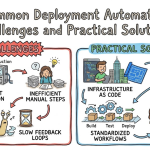
Infrastructure as Code enables teams to define infrastructure configurations through version-controlled files. Instead of manually creating servers, networks, and databases, organizations can provision resources automatically using predefined templates. This approach reduces deployment times while ensuring consistency across environments.
Automated monitoring reduces the workload associated with manual system observation. Operations teams receive alerts when performance thresholds exceed acceptable limits, allowing faster responses to potential issues.
Self-service platforms empower developers to access resources independently without waiting for manual operational approvals. This capability accelerates development cycles while reducing operational bottlenecks.
Incident management processes become more efficient because teams gain visibility into system behavior through centralized dashboards and logging solutions. Faster issue detection and diagnosis reduce downtime and improve service reliability.
Key Operational Concepts You Must Know
Understanding essential operational concepts helps professionals build strong foundations for DevOps success and operational excellence.
Continuous Integration
Continuous Integration involves regularly merging code changes into a shared repository. Automated testing validates these changes immediately, helping teams identify defects early and maintain code quality throughout development.
Continuous Delivery
Continuous Delivery ensures that software remains deployable at any time. Automated pipelines prepare applications for release while maintaining consistency across environments. Teams can deploy updates quickly and safely whenever business needs arise.
Infrastructure as Code
Infrastructure as Code allows organizations to manage infrastructure using configuration files rather than manual processes. This approach improves consistency, scalability, repeatability, and disaster recovery capabilities.
Monitoring and Observability
Monitoring tracks system metrics such as CPU usage, memory consumption, response times, and availability. Observability extends this capability by providing deeper insights into application behavior through logs, traces, and metrics.
Incident Management
Incident management focuses on detecting, responding to, and resolving operational disruptions. Effective incident processes minimize downtime and support continuous service availability.
Configuration Management
Configuration management ensures that systems maintain consistent settings across environments. Automated tools reduce configuration drift and improve operational stability.
Reliability Engineering
Reliability engineering focuses on designing systems that maintain acceptable performance levels under varying conditions. This discipline combines operational practices, automation, and risk management to improve service reliability.
Platform Implementation vs. Culture — What’s the Real Difference?
Many organizations assume that implementing DevOps tools automatically creates a successful DevOps environment. However, technology alone cannot deliver the full benefits of DevOps. Understanding the distinction between platform implementation and culture is essential.
Platform implementation focuses on technical capabilities. Organizations deploy automation tools, CI/CD pipelines, monitoring platforms, cloud services, container orchestration systems, and infrastructure management solutions. These technologies provide the foundation for modern software delivery.
However, culture determines how effectively teams use these technologies. DevOps culture emphasizes collaboration, transparency, accountability, knowledge sharing, and continuous improvement. Without cultural alignment, even advanced platforms may fail to produce meaningful results.
For example, a company may deploy sophisticated deployment automation tools while maintaining strict departmental silos. Developers and operations teams may continue blaming each other for failures rather than working together to solve problems. In such situations, technology investments deliver limited value.
Successful organizations combine both elements. They implement robust technical platforms while fostering a culture that encourages teamwork, learning, experimentation, and shared ownership of outcomes. This balanced approach creates sustainable operational improvements and long-term business value.
DevOps Automation and Its Impact on Business Performance
Automation represents one of the most transformative aspects of DevOps. By reducing manual intervention, organizations improve consistency, accelerate delivery, and minimize operational risks.
Automated testing enables rapid validation of application changes. Teams receive immediate feedback regarding code quality, functionality, and security vulnerabilities. Faster feedback loops support continuous improvement and reduce defect rates.
Deployment automation reduces release complexity. Instead of manually executing deployment procedures, organizations rely on repeatable workflows that produce consistent results. This approach minimizes downtime and deployment failures.
Infrastructure automation accelerates environment provisioning. Teams can create development, testing, and production environments within minutes rather than days or weeks. Faster provisioning improves agility and supports business growth.
Security automation further enhances operational efficiency. Automated vulnerability scanning, compliance verification, and policy enforcement help organizations maintain security standards without slowing development activities.
Real-World Use Cases of Modern Operations
Modern operations practices support a wide range of business scenarios across industries and technology environments.
E-Commerce Platforms
Online retailers depend on continuous availability and high performance. DevOps practices enable rapid feature releases, automated scaling, and proactive monitoring. During periods of increased demand, automated infrastructure adjustments maintain customer experiences without manual intervention.
Financial Services
Banks and financial institutions require secure, reliable, and compliant systems. DevOps supports faster software delivery while maintaining strict governance standards. Automated testing and monitoring reduce operational risks and improve service reliability.
Healthcare Systems
Healthcare organizations manage critical applications that support patient care and operational processes. DevOps improves system availability, accelerates software updates, and strengthens security controls while supporting regulatory requirements.
Software-as-a-Service Providers
SaaS providers frequently release new features and enhancements. Continuous delivery pipelines enable rapid deployments while maintaining application stability. Real-time monitoring helps teams identify issues before customers are affected.
Telecommunications
Telecommunications companies manage complex infrastructures supporting millions of users. Automation improves network operations, resource allocation, and service reliability while reducing operational overhead.
Cloud-Native Organizations
Organizations operating in cloud environments benefit significantly from Infrastructure as Code, automated scaling, and container orchestration. These capabilities support efficient resource management and faster service delivery.
Common Mistakes in Operations Engineering
Many organizations encounter challenges during operational transformation initiatives. Understanding common mistakes helps teams avoid costly setbacks.
One frequent mistake involves focusing exclusively on tools while ignoring cultural transformation. Technology alone cannot solve communication problems or create collaborative environments.
Another common issue is excessive automation without proper planning. Automating inefficient processes simply accelerates existing problems. Teams should optimize workflows before implementing automation.
Organizations often underestimate monitoring requirements. Without comprehensive visibility into applications and infrastructure, teams struggle to identify issues and evaluate performance effectively.
Poor documentation also creates operational challenges. Knowledge gaps increase dependency on individual team members and complicate incident response activities.
Some organizations neglect security integration during DevOps adoption. Security should remain a continuous component of development and operational processes rather than a separate final-stage review.
Finally, unrealistic expectations can undermine transformation efforts. DevOps adoption requires time, commitment, training, and continuous improvement. Sustainable progress delivers better results than rushed implementation efforts.
Measuring DevOps Success
Organizations must establish measurable objectives to evaluate DevOps effectiveness and identify opportunities for improvement.
Deployment frequency provides insight into delivery agility. Higher deployment frequencies often indicate streamlined development and release processes.
Lead time measures the duration between code creation and production deployment. Shorter lead times demonstrate efficient workflows and improved responsiveness.
Change failure rate evaluates deployment quality by measuring how frequently releases cause operational issues. Lower failure rates indicate stronger quality controls.
Mean Time to Recovery measures incident response effectiveness. Faster recovery times demonstrate operational resilience and efficient troubleshooting capabilities.
Customer satisfaction metrics provide valuable perspectives on service quality. Improvements in performance, reliability, and feature delivery often contribute to stronger customer experiences.
Operational efficiency metrics such as infrastructure utilization, automation coverage, and resource optimization further support continuous improvement initiatives.
How to Become an Operations Expert — Career Roadmap
Building expertise in modern operations requires a combination of technical knowledge, practical experience, and continuous learning.
Stage 1: Build Strong Foundations
Start by learning operating systems, networking fundamentals, system administration, cloud computing concepts, and scripting languages. Understanding these core areas creates a strong technical foundation.
Stage 2: Learn Automation Skills
Develop proficiency in automation tools, Infrastructure as Code platforms, configuration management solutions, and CI/CD technologies. Automation skills significantly increase operational effectiveness.
Stage 3: Master Cloud Technologies
Gain hands-on experience with cloud platforms, containerization, orchestration systems, and cloud-native architectures. Modern operations increasingly rely on cloud-based environments.
Stage 4: Develop Monitoring Expertise
Learn observability concepts, monitoring platforms, log analysis, performance tuning, and incident response practices. Visibility remains critical for operational success.
Stage 5: Strengthen Security Knowledge
Understand security fundamentals, vulnerability management, identity controls, compliance requirements, and secure development practices. Security expertise enhances professional value.
Stage 6: Improve Collaboration Skills
Technical expertise alone is insufficient. Effective communication, teamwork, leadership, and problem-solving skills contribute significantly to career growth.
Recommended Skill Development Areas
- Linux administration
- Networking fundamentals
- Cloud computing
- Infrastructure as Code
- CI/CD pipelines
- Container technologies
- Monitoring and observability
- Security operations
- Incident management
- Reliability engineering
- Automation scripting
- Performance optimization
Future Trends Shaping DevOps and Operations
The operational landscape continues evolving as organizations adopt new technologies and delivery models. Artificial intelligence increasingly supports monitoring, anomaly detection, predictive analytics, and automated incident response.
Platform engineering is becoming more prominent as organizations create internal developer platforms that simplify infrastructure management and application deployment. These platforms improve developer productivity while maintaining governance standards.
Security integration continues expanding through DevSecOps practices. Security controls become embedded throughout development and operational workflows rather than existing as separate processes.
Cloud-native architectures, serverless computing, and container ecosystems continue influencing operational strategies. Organizations seek greater scalability, flexibility, and efficiency through these technologies.
Observability capabilities also continue advancing. Enhanced visibility helps teams understand complex distributed systems and optimize performance more effectively.
FAQ Section
What is DevOps?
DevOps is a collaborative approach that combines development and operations practices to improve software delivery speed, quality, reliability, and operational efficiency.
How does DevOps improve software quality?
DevOps improves software quality through automated testing, continuous integration, continuous monitoring, standardized deployments, and faster feedback loops.
Why is automation important in DevOps?
Automation reduces manual effort, minimizes human error, accelerates deployments, improves consistency, and allows teams to focus on strategic initiatives.
Is DevOps only about tools?
No. While tools are important, DevOps primarily focuses on collaboration, culture, shared responsibility, automation, and continuous improvement.
What skills are required for a DevOps career?
Key skills include Linux administration, cloud computing, automation, scripting, CI/CD, monitoring, networking, security, and communication.
Can small organizations benefit from DevOps?
Yes. Organizations of all sizes can improve delivery speed, software quality, operational efficiency, and customer satisfaction through DevOps practices.
How does DevOps reduce downtime?
DevOps reduces downtime through automated testing, proactive monitoring, reliable deployment processes, faster incident response, and improved system visibility.
What is Infrastructure as Code?
Infrastructure as Code is the practice of managing infrastructure through version-controlled configuration files rather than manual provisioning processes.
How long does DevOps adoption take?
The timeline varies based on organizational complexity, culture, existing processes, and implementation goals. Successful adoption typically occurs through continuous improvement rather than a single project.
Is DevOps suitable for regulated industries?
Yes. Financial services, healthcare, government, and other regulated industries successfully use DevOps while maintaining compliance and security requirements.
Final Summary
DevOps has transformed the way organizations develop, deploy, and operate software systems. By bringing development and operations teams together, organizations eliminate traditional silos and create collaborative environments focused on shared outcomes. Through automation, continuous integration, continuous delivery, monitoring, Infrastructure as Code, and operational excellence practices, DevOps significantly improves software quality while enhancing operational efficiency.
Organizations that embrace DevOps achieve faster releases, fewer deployment failures, stronger reliability, improved customer experiences, and better resource utilization. However, long-term success requires more than technology implementation. Teams must also cultivate a culture of collaboration, accountability, learning, and continuous improvement.
As software environments become increasingly complex, DevOps remains a critical strategy for maintaining competitiveness and operational excellence. Professionals who develop expertise in automation, cloud technologies, observability, reliability engineering, and collaborative practices position themselves for successful careers in modern operations. By combining technical innovation with strong operational principles, DevOps enables organizations to deliver high-quality software efficiently, reliably, and at scale.






Leave a Reply
You must be logged in to post a comment.