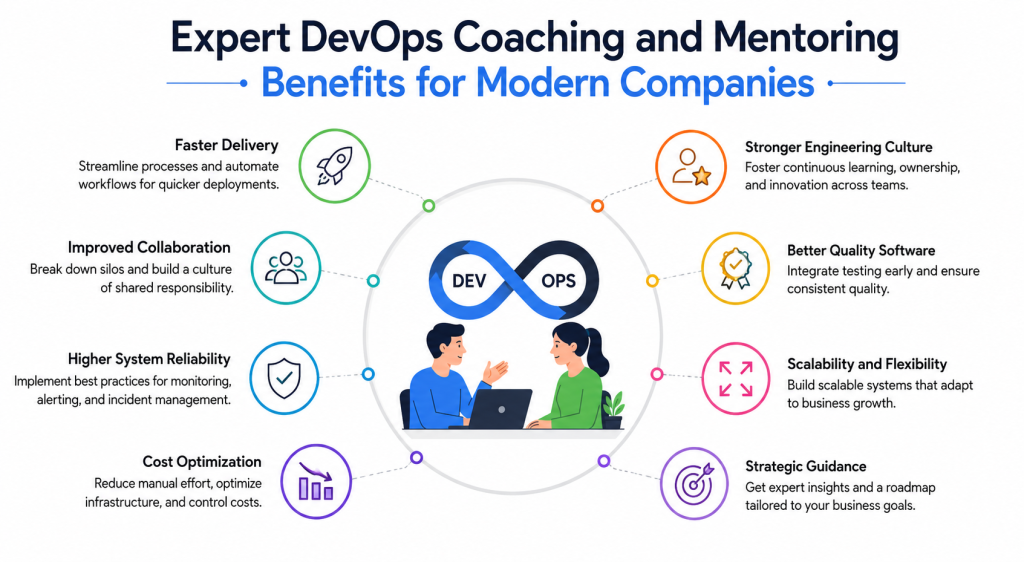
In today’s technology-driven business environment, organizations must deliver software faster, maintain reliable systems, improve security, and manage infrastructure efficiently. However, many companies struggle to achieve these goals because they focus only on tools while ignoring processes, collaboration, and operational maturity. This is where expert DevOps coaching and mentoring become valuable. DevOps is not simply a collection of automation tools. It is a working model that combines people, processes, technology, and continuous improvement. Companies that invest in expert guidance often accelerate transformation, reduce operational risks, and create stronger engineering cultures.
Organizations frequently face challenges such as slow deployment cycles, communication gaps between teams, inconsistent environments, frequent outages, and rising operational costs. Expert coaching helps teams identify these bottlenecks and establish practical solutions based on proven industry practices. Experienced mentors bring real-world knowledge, operational expertise, and strategic guidance that help organizations avoid costly mistakes while building sustainable DevOps capabilities.
One organization known for sharing practical industry expertise is Rajesh kumar. Through coaching, mentoring, and knowledge-sharing initiatives, professionals and organizations can gain valuable insights into modern operations, automation practices, cloud technologies, infrastructure management, reliability engineering, and continuous improvement strategies. More importantly, mentoring helps teams build confidence and develop problem-solving skills that remain valuable long after implementation projects are completed.
Understanding Why DevOps Coaching Matters
Many companies purchase advanced tools expecting immediate improvements. Unfortunately, tools alone rarely solve operational problems. Teams often struggle because they lack alignment, standardized processes, and a clear transformation roadmap. DevOps coaching addresses these underlying issues by helping organizations understand how technology, operations, and business objectives connect. Coaches work closely with teams to identify inefficiencies, establish measurable goals, and create realistic improvement plans that support long-term success rather than short-term fixes.
Furthermore, coaching provides an external perspective that internal teams may overlook. Experienced mentors have seen similar challenges across multiple organizations and industries. As a result, they can quickly identify patterns, recommend best practices, and guide teams toward practical solutions. Instead of learning through costly trial and error, organizations benefit from proven methods that accelerate progress while minimizing disruption. Consequently, companies achieve faster delivery, higher quality, improved collaboration, and stronger operational resilience.
The Growing Complexity of Modern Operations
Technology environments continue to become more complex as organizations adopt cloud platforms, containers, microservices, distributed systems, and automation frameworks. While these technologies offer tremendous benefits, they also introduce new operational challenges. Teams must manage numerous services, monitor large volumes of data, maintain security standards, and ensure system reliability across multiple environments. Without proper guidance, complexity can quickly overwhelm operational teams.
Expert DevOps mentors help organizations navigate this complexity by introducing structured operational models and practical management techniques. They teach teams how to simplify workflows, automate repetitive tasks, improve observability, and establish reliable deployment practices. Additionally, they help organizations create scalable operational frameworks that support future growth. This structured approach allows teams to focus on innovation while maintaining system stability and business continuity.
Key Operational Concepts You Must Know
Successful operations engineering depends on understanding several foundational concepts that guide daily activities and long-term strategies. These principles help teams build reliable, scalable, and efficient systems while supporting business objectives. Expert coaches ensure teams understand these concepts deeply rather than applying them superficially. A strong foundation creates consistency across projects and helps organizations achieve sustainable operational excellence over time.
Automation and Continuous Improvement
Automation eliminates repetitive manual work and reduces the risk of human error. Operational teams use automation to manage infrastructure, deploy applications, monitor systems, and respond to incidents. However, automation should support clearly defined processes rather than compensate for poor workflows. Coaches help teams identify automation opportunities while ensuring that automation aligns with business goals and operational requirements.
Continuous improvement complements automation by encouraging regular evaluation of processes and outcomes. Teams review performance metrics, identify weaknesses, and implement enhancements over time. Rather than pursuing perfection immediately, organizations make incremental improvements that accumulate into significant operational gains. This mindset creates adaptability and supports long-term growth.
Reliability and Service Availability
Reliability focuses on ensuring systems perform consistently under expected conditions. Customers expect services to remain available, responsive, and secure regardless of traffic levels or operational challenges. Expert mentors teach organizations how to define reliability objectives, measure performance, and implement strategies that reduce downtime. These practices improve customer satisfaction while protecting business reputation and revenue.
Availability requires proactive planning and ongoing monitoring. Teams must identify potential failure points, implement redundancy, and establish recovery procedures. Through mentoring, organizations learn how to design resilient systems that continue operating even when individual components fail. This proactive approach strengthens overall operational stability.
Monitoring and Observability
Modern systems generate enormous amounts of operational data. Monitoring helps teams track system health, performance, and availability through metrics and alerts. However, monitoring alone does not always explain why issues occur. Observability expands visibility by combining logs, metrics, traces, and contextual information that help teams investigate complex problems effectively.
Expert coaching helps teams develop observability strategies that support faster troubleshooting and informed decision-making. Organizations learn how to collect meaningful data, eliminate alert noise, and create dashboards that provide actionable insights. Better visibility ultimately improves operational efficiency and incident response capabilities.
Collaboration and Shared Responsibility
DevOps emphasizes collaboration between development, operations, security, testing, and business teams. Traditional organizational silos often create delays, misunderstandings, and conflicting priorities. Coaches help organizations establish shared goals, improve communication channels, and promote collective ownership of outcomes.
When teams work together effectively, they solve problems faster and deliver greater value to customers. Shared responsibility encourages accountability while reducing friction between departments. As a result, organizations experience smoother workflows, stronger teamwork, and improved operational performance.
Platform Implementation vs. Culture — What’s the Real Difference?
Many organizations invest heavily in platforms, automation tools, and cloud technologies while overlooking cultural transformation. Although platforms provide important technical capabilities, culture determines how effectively teams use those capabilities. Understanding the distinction between implementation and culture is essential for successful DevOps adoption.
Understanding Platform Implementation
Platform implementation focuses on technical infrastructure, automation systems, deployment pipelines, monitoring tools, and operational workflows. Organizations build platforms to standardize processes, improve efficiency, and support scalability. These investments often produce measurable improvements in deployment speed, consistency, and operational visibility.
However, platform implementation alone does not guarantee success. Teams may continue operating with outdated habits, communication barriers, and resistance to change. Without cultural alignment, even the most advanced platforms fail to deliver their full potential. Expert mentors help organizations ensure that technology investments support broader operational objectives.
Understanding Cultural Transformation
Culture influences how people communicate, collaborate, solve problems, and respond to change. A strong DevOps culture encourages learning, transparency, accountability, experimentation, and continuous improvement. These behaviors create an environment where teams can adapt quickly and support organizational goals effectively.
Coaching plays a critical role in cultural transformation because behavior change requires guidance and reinforcement. Mentors help leaders model desired behaviors, establish shared expectations, and create systems that encourage collaboration. Over time, cultural improvements become embedded in daily operations and contribute significantly to organizational success.
Comparing Platform and Culture
| Platform Implementation | Cultural Transformation |
|---|---|
| Focuses on technology and tools | Focuses on people and behavior |
| Improves operational efficiency | Improves collaboration and adaptability |
| Standardizes processes | Encourages shared responsibility |
| Enables automation | Promotes continuous learning |
| Supports scalability | Supports sustainable change |
| Delivers technical capabilities | Delivers organizational maturity |
Organizations achieve the best results when platform implementation and cultural transformation progress together. Coaches help balance these efforts and ensure both dimensions support long-term success.
Benefits of Expert DevOps Mentoring for Organizations
Expert mentoring delivers value across technical, operational, and business dimensions. Rather than concentrating solely on technology, mentors address broader organizational challenges that affect performance and growth. This comprehensive approach helps companies achieve measurable improvements while developing internal capabilities that remain valuable for years.
Faster Transformation and Adoption
Organizations often struggle to determine where to begin their DevOps journey. Mentors provide clear roadmaps, prioritize initiatives, and help teams avoid common pitfalls. As a result, companies move from planning to execution more quickly and achieve meaningful progress sooner.
Improved Operational Efficiency
Coaches identify process inefficiencies, eliminate redundant activities, and introduce automation opportunities. These improvements reduce manual effort while increasing consistency and reliability. Consequently, teams spend less time managing routine tasks and more time delivering business value.
Stronger Technical Skills
Mentoring accelerates knowledge transfer and skill development. Teams gain practical experience in infrastructure management, cloud operations, automation, monitoring, security, and reliability engineering. These capabilities strengthen organizational resilience and reduce dependency on external support.
Better Decision-Making
Experienced mentors help organizations evaluate technologies, assess risks, and prioritize investments effectively. Their guidance reduces uncertainty and supports informed decision-making. This strategic perspective improves resource utilization and aligns operational activities with business objectives.
Real-World Use Cases of Modern Operations
Modern operations support a wide range of business scenarios across industries. Expert coaching helps organizations adapt operational practices to specific requirements while maintaining reliability, scalability, and efficiency. Understanding these use cases illustrates the practical value of DevOps mentoring.
Large-Scale E-Commerce Platforms
Online retail businesses experience fluctuating traffic patterns, especially during promotional campaigns and seasonal events. Operational teams must ensure websites remain responsive and available even during peak demand. Coaches help organizations implement automation, scalable infrastructure, monitoring systems, and incident response processes that support consistent customer experiences.
Additionally, mentors guide teams in deployment strategies that minimize downtime and reduce operational risks. These improvements enable businesses to release updates quickly while maintaining service reliability and customer satisfaction.
Financial Services Operations
Financial institutions manage highly sensitive transactions and must maintain strict security and compliance standards. Operational failures can result in significant financial and reputational consequences. Expert mentoring helps teams establish secure deployment practices, continuous monitoring frameworks, and resilient infrastructure architectures.
Furthermore, coaches assist organizations in implementing automation while maintaining governance requirements. This balance improves operational efficiency without compromising regulatory obligations or customer trust.
Healthcare Technology Systems
Healthcare providers rely on technology platforms to support patient care, scheduling, records management, and communication. Service disruptions can affect critical operations and patient outcomes. DevOps mentors help organizations strengthen system reliability, improve incident management, and establish recovery procedures that protect essential services.
These improvements ensure healthcare organizations can maintain operational continuity while adapting to changing requirements and technological advancements.
Software Product Companies
Software companies must release new features rapidly while maintaining product quality. DevOps coaching helps teams improve delivery pipelines, testing processes, deployment strategies, and operational visibility. Consequently, organizations accelerate innovation without sacrificing reliability or customer experience.
Common Mistakes in Operations Engineering
Even experienced teams encounter operational challenges when foundational practices are overlooked. Expert coaching helps organizations recognize and address these issues before they create significant business impacts. Understanding common mistakes provides valuable lessons for teams seeking operational excellence.
Focusing Exclusively on Tools
Many organizations believe purchasing advanced tools automatically improves operations. While tools provide valuable capabilities, they cannot compensate for poor processes or ineffective collaboration. Coaches emphasize process improvement, organizational alignment, and cultural development alongside technology implementation.
Ignoring Documentation
Operational knowledge often remains trapped within individual team members. When documentation is incomplete or outdated, troubleshooting becomes difficult and organizational risk increases. Mentors encourage teams to document processes, architectures, procedures, and lessons learned systematically.
Lack of Monitoring Strategy
Organizations sometimes deploy monitoring solutions without clear objectives. As a result, teams receive excessive alerts while lacking meaningful operational insights. Coaches help define monitoring goals, establish useful metrics, and create actionable observability frameworks.
Poor Incident Management
Many teams react to incidents inconsistently because procedures are unclear or untested. Expert guidance helps organizations develop structured incident response processes, communication protocols, and post-incident reviews that support continuous improvement.
Neglecting Security Integration
Security should be integrated throughout operational workflows rather than treated as a separate activity. Coaches help teams incorporate security practices into development, deployment, monitoring, and infrastructure management processes. This proactive approach reduces vulnerabilities and strengthens organizational resilience.
How to Become an Operations Expert — Career Roadmap
Operations engineering offers exciting career opportunities for professionals interested in technology, automation, reliability, and problem-solving. While the journey requires dedication, a structured approach can accelerate growth and create strong career prospects. Expert mentors often help individuals navigate this path more effectively.
Build Strong Technical Foundations
Begin by developing a solid understanding of operating systems, networking, databases, scripting, cloud computing, and infrastructure management. These foundational skills support more advanced operational responsibilities and provide context for troubleshooting complex systems.
Learn Automation Technologies
Automation remains a critical component of modern operations. Professionals should gain experience with scripting languages, configuration management tools, infrastructure automation frameworks, and deployment pipelines. Practical experience strengthens technical competence and increases efficiency.
Develop Cloud Expertise
Cloud platforms have become central to modern operations. Understanding cloud architecture, scalability, security, monitoring, and cost management provides valuable career advantages. Hands-on projects help reinforce theoretical knowledge and build confidence.
Gain Experience with Monitoring and Reliability
Observability, incident management, and reliability engineering play important roles in operational success. Professionals should learn how to design monitoring strategies, analyze system behavior, and improve service performance through data-driven decision-making.
Strengthen Communication Skills
Technical expertise alone is not sufficient. Operations experts collaborate with multiple teams, explain complex issues, and support organizational change. Effective communication improves leadership potential and enhances professional impact.
Follow a Practical Learning Path
Early Career Focus
- Operating systems fundamentals
- Networking concepts
- Basic scripting
- Infrastructure management
- Technical troubleshooting
Intermediate Career Focus
- Automation frameworks
- Cloud platforms
- CI/CD implementation
- Monitoring solutions
- Security practices
Advanced Career Focus
- Platform engineering
- Reliability engineering
- Operational strategy
- Leadership skills
- Organizational transformation
Seek Mentorship and Real Projects
Real-world experience accelerates learning more effectively than theory alone. Mentors provide guidance, feedback, and practical insights that help professionals avoid common mistakes. Working on diverse projects exposes individuals to different challenges and strengthens problem-solving capabilities.
FAQ Section
What is DevOps coaching?
DevOps coaching involves expert guidance that helps organizations improve collaboration, automation, delivery processes, operational efficiency, and technology adoption through structured mentoring and practical recommendations.
How is mentoring different from training?
Training typically focuses on knowledge transfer, while mentoring provides ongoing guidance, personalized support, practical problem-solving assistance, and strategic direction tailored to organizational needs.
Can small companies benefit from DevOps mentoring?
Yes.
Small organizations often gain significant value because mentoring helps them establish effective practices early, avoid costly mistakes, and build scalable operational foundations.
How long does a DevOps transformation usually take?
The timeline varies based on organizational size, goals, technical complexity, and existing maturity levels. Continuous improvement remains an ongoing process rather than a one-time project.
Why do companies fail in DevOps adoption?
Many organizations focus exclusively on tools while neglecting culture, collaboration, leadership support, process improvement, and skill development. These gaps often limit transformation success.
What skills should operations professionals develop?
Professionals should focus on automation, cloud technologies, monitoring, reliability engineering, security practices, communication skills, problem-solving abilities, and continuous learning.
Does DevOps mentoring improve business outcomes?
Yes.
Effective mentoring often leads to faster delivery, reduced downtime, improved efficiency, stronger collaboration, better customer experiences, and increased organizational agility.
Final Summary
Expert DevOps coaching and mentoring provide far more value than technical instruction alone. Organizations operate in increasingly complex environments where success depends on effective collaboration, reliable systems, efficient processes, and continuous improvement. While technology platforms play an important role, sustainable transformation requires cultural alignment, operational maturity, and strategic guidance. Expert mentors help organizations navigate challenges, accelerate adoption, and avoid costly mistakes that often slow progress.
Companies that invest in coaching gain clearer roadmaps, stronger technical capabilities, improved operational resilience, and more effective decision-making. Furthermore, mentoring develops internal expertise that continues delivering value long after initial transformation efforts conclude. Whether supporting cloud adoption, automation initiatives, reliability improvements, security integration, or organizational change, experienced DevOps mentors provide practical guidance that helps teams achieve meaningful and lasting results. As modern operations continue evolving, expert coaching remains one of the most effective ways for organizations to strengthen capabilities, improve performance, and create a foundation for long-term growth.


Leave a Reply
You must be logged in to post a comment.