Introduction
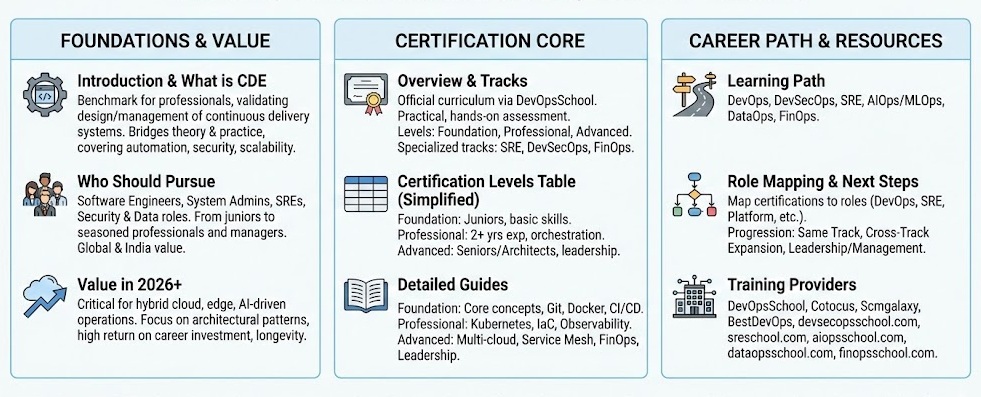
The Certified DevOps Engineer (CDE) designation has emerged as a critical benchmark for professionals navigating the complexity of modern software delivery. As organizations shift from isolated teams and manual operations to integrated, automated platforms, the role of DevOps has become central to business reliability and speed. Engineers are now expected to understand the entire delivery lifecycle, not just isolated tools or tasks.
This guide is written for software engineers, system administrators, SREs, platform engineers, cloud professionals, and technical leaders who want clarity about what Certified DevOps Engineer (CDE) truly represents. It is designed to help professionals move beyond basic tool execution and understand the engineering mindset required for production systems.
In today’s cloud-native and platform-engineering landscape, knowing how to configure infrastructure is no longer enough. Engineers must apply automation, security, scalability, and observability together as a system. This guide provides a structured way to evaluate Certified DevOps Engineer (CDE), understand its curriculum, and decide whether it aligns with your long-term career goals.
What is the Certified DevOps Engineer (CDE)?
Certified DevOps Engineer (CDE) is a professional certification that validates an engineer’s ability to design, automate, deploy, and operate software delivery systems in real production environments. It focuses on execution capability rather than theoretical familiarity with tools.
Unlike certifications that are tightly coupled to a specific cloud vendor, Certified DevOps Engineer (CDE) emphasizes DevOps principles that remain relevant across cloud, hybrid, and on-prem environments. The certification represents mastery of the intersection between development and operations, with emphasis on reliability, delivery speed, and operational stability.
At its core, Certified DevOps Engineer (CDE) bridges the gap between knowledge and production readiness. The curriculum covers version control, continuous integration, containerization, infrastructure as code, and observability. These areas mirror how modern engineering teams actually build and run systems at scale.
Who Should Pursue Certified DevOps Engineer (CDE)?
Certified DevOps Engineer (CDE) is suitable for a wide range of technical roles. Junior developers and system administrators can use it as a structured entry point into DevOps practices. Engineers transitioning from traditional operations into cloud-native roles also benefit significantly.
Site Reliability Engineers find the certification valuable for improving system reliability through automation and standardization. Security professionals can use it as a foundation for embedding security directly into CI/CD pipelines. Data engineers and MLOps practitioners benefit when building repeatable infrastructure for data pipelines and machine learning platforms.
For beginners, Certified DevOps Engineer (CDE) removes the confusion caused by tool overload. For experienced engineers and managers, it provides formal validation of practical expertise. The certification is relevant globally and holds strong value in India’s growing technology ecosystem, where demand for skilled DevOps professionals continues to exceed supply.
Why Certified DevOps Engineer (CDE) is Valuable in 2026 and Beyond
By 2026, enterprise systems are more distributed and complex than ever. Hybrid cloud models, edge deployments, and AI-driven platforms require engineers who can maintain consistency across environments. Certified DevOps Engineer (CDE) provides the foundational discipline needed to manage this complexity effectively.
The value of Certified DevOps Engineer (CDE) lies in its focus on enduring engineering patterns rather than short-lived tools. CI/CD design, infrastructure automation, and observability remain essential regardless of platform changes. Professionals trained in these principles adapt more easily as technology evolves.
Organizations increasingly seek engineers with depth in one discipline and working knowledge across the delivery pipeline. Certified DevOps Engineer (CDE) supports this “T-shaped” skill model, making it a strong investment for long-term career relevance, role mobility, and compensation growth.
Certified DevOps Engineer (CDE) Certification Overview
The Certified DevOps Engineer (CDE) program is delivered through the official curriculum available on
the Certified DevOps Engineer course page
and is hosted on
the DevOpsSchool platform.
The certification follows a structured progression from foundational DevOps concepts to advanced architectural practices. It is maintained by experienced industry practitioners and updated to reflect real production challenges rather than academic models.
Assessment is practical and scenario-driven, often involving labs or project-based evaluation. This ensures that certification holders can perform DevOps tasks in production environments, not just describe them. The program evolves through industry feedback, keeping it relevant and applicable.
Certified DevOps Engineer (CDE) Certification Tracks & Levels
Certified DevOps Engineer (CDE) is divided into three main levels aligned with career growth. The Foundation level introduces DevOps principles, automation basics, and essential tooling. The Professional level focuses on orchestration, CI/CD design, and infrastructure automation. The Advanced level addresses architecture, optimization, and large-scale transformation.
In addition to core levels, specialization tracks allow professionals to align learning with specific roles. These include SRE for reliability-focused engineers, DevSecOps for security integration, and FinOps for cloud cost governance. This modular structure allows highly customized learning paths.
Complete Certified DevOps Engineer (CDE) Certification Table
| Track | Level | Who it’s for | Prerequisites | Skills Covered | Recommended Order | Official Link |
|---|---|---|---|---|---|---|
| Core DevOps | Foundation | Junior Engineers, Students | Basic Linux & Coding | Git, Docker, CI/CD basics | 1 | View Course |
| Core DevOps | Professional | Engineers with 2+ years experience | CDE Foundation or equivalent | Kubernetes, Terraform, Jenkins | 2 | View Course |
| Core DevOps | Advanced | Senior Engineers, Architects | CDE Professional | Service Mesh, Scalability, IaC | 3 | View Course |
| SRE Track | Professional | Ops & Reliability Engineers | System administration experience | SLOs, SLIs, Error Budgets | Parallel | View Course |
| Security Track | Professional | Security Engineers | Security fundamentals | Secrets, SAST/DAST, Compliance | Parallel | View Course |
Detailed Guide for Each Certified DevOps Engineer (CDE) Certification
Certified DevOps Engineer (CDE) – Foundation
What it is
This certification validates understanding of DevOps fundamentals, cultural principles, and basic automation workflows. It establishes a solid baseline for modern software delivery practices.
Who should take it
Graduating students, junior developers, system administrators, and non-DevOps engineers seeking transition into automation-focused roles.
Skills you’ll gain
- Git-based version control
- Docker container fundamentals
- Basic CI/CD pipeline creation
- DevOps lifecycle understanding
Real-world projects you should be able to do
- Dockerize a multi-tier application
- Build a basic CI pipeline
- Manage Git workflows
Preparation plan
7–14 days: Core concepts and Git/Docker basics
30 days: CI/CD labs and automation exercises
60 days: End-to-end deployment project
Common mistakes
Over-focusing on tools while ignoring DevOps principles and collaboration.
Best next certification after this
Same-track: CDE Professional
Cross-track: Certified SRE Professional
Leadership: DevOps Team Lead Certification
Certified DevOps Engineer (CDE) – Professional
What it is
Validates the ability to manage production-grade DevOps systems at scale, with emphasis on orchestration and infrastructure automation.
Who should take it
Mid-level engineers managing deployment pipelines and production infrastructure.
Skills you’ll gain
- Kubernetes operations
- Terraform and Ansible
- Monitoring and observability
- Secrets management
Real-world projects you should be able to do
- Run a production Kubernetes cluster
- Automate cloud provisioning
- Implement blue-green deployments
Preparation plan
7–14 days: Kubernetes and Terraform deep dive
30 days: Multiple infrastructure projects
60 days: Production troubleshooting scenarios
Common mistakes
Ignoring state management and real incident simulations.
Best next certification after this
Same-track: CDE Advanced
Cross-track: Certified DevSecOps Professional
Leadership: Engineering Manager Track
Certified DevOps Engineer (CDE) – Advanced
What it is
Validates architectural thinking, multi-cloud design, and organizational-scale DevOps leadership.
Who should take it
Senior engineers, architects, and technical leads.
Skills you’ll gain
- Multi-region architectures
- Service Mesh implementation
- FinOps and cost optimization
- Large-scale migrations
Real-world projects you should be able to do
- Disaster recovery design
- Multi-cluster service mesh
- Cloud cost optimization audit
Preparation plan
7–14 days: Architecture patterns review
30 days: Enterprise design documentation
60 days: Advanced topics and peer review
Common mistakes
Over-engineering without operational awareness.
Best next certification after this
Same-track: Cloud Architect certifications
Cross-track: Certified MLOps Engineer
Leadership: CTO / VP Engineering programs
Choose Your Learning Path
DevOps Path
Focuses on end-to-end delivery automation, fast feedback loops, and developer productivity.
DevSecOps Path
Integrates security into CI/CD pipelines, compliance automation, and container security.
SRE Path
Treats operations as software, emphasizing reliability, observability, and incident response.
AIOps / MLOps Path
Addresses infrastructure automation for machine learning and AI-driven platforms.
DataOps Path
Applies DevOps practices to data pipelines, analytics, and data engineering.
FinOps Path
Focuses on cloud cost control, accountability, and financial optimization.
Role → Recommended Certified DevOps Engineer (CDE) Certifications
| Role | Recommended Certifications |
|---|---|
| DevOps Engineer | CDE Foundation, CDE Professional |
| SRE | CDE Professional, Certified SRE Professional |
| Platform Engineer | CDE Professional, CDE Advanced |
| Cloud Engineer | CDE Foundation, Cloud Associate Certs |
| Security Engineer | CDE Foundation, Certified DevSecOps Professional |
| Data Engineer | CDE Foundation, Certified DataOps Professional |
| FinOps Practitioner | CDE Foundation, Certified FinOps Professional |
| Engineering Manager | CDE Foundation, DevOps Leadership Track |
Final Thoughts: Is Certified DevOps Engineer (CDE) Worth It?
Certified DevOps Engineer (CDE) is not valuable because of the certificate itself, but because of the discipline it builds. DevOps is no longer optional infrastructure work; it is core engineering responsibility. This certification provides a structured way to develop that capability.
If you are looking for instant results without effort, this certification is not the answer. But if you want a principled, experience-driven path to becoming a reliable engineer in 2026 and beyond, Certified DevOps Engineer (CDE) is a strong foundation. Learn the principles, apply them in real systems, and let the career growth follow naturally.
📞 Call to Action & Contact Details
End the article with the following contact information:
📞 USA: +1 (469) 756-6329
📞 India: +91 99057 40781
✉️ Email: Contact@DevOpsSchool.com





Leave a Reply
You must be logged in to post a comment.