Introduction
As digital landscapes expand, technical leaders increasingly rely on Certified AIOps Manager to navigate the complexities of modern infrastructure. This guide assists professionals in transitioning from traditional manual monitoring to advanced, data-driven operational strategies. By following this roadmap, engineers can effectively implement machine learning to enhance system reliability and performance. AIOpsSchool provides the specialized training necessary to master these autonomous workflows in a competitive market. Readers will discover how this certification empowers them to make informed career decisions and lead intelligent platform engineering initiatives.
What is the Certified AIOps Manager?
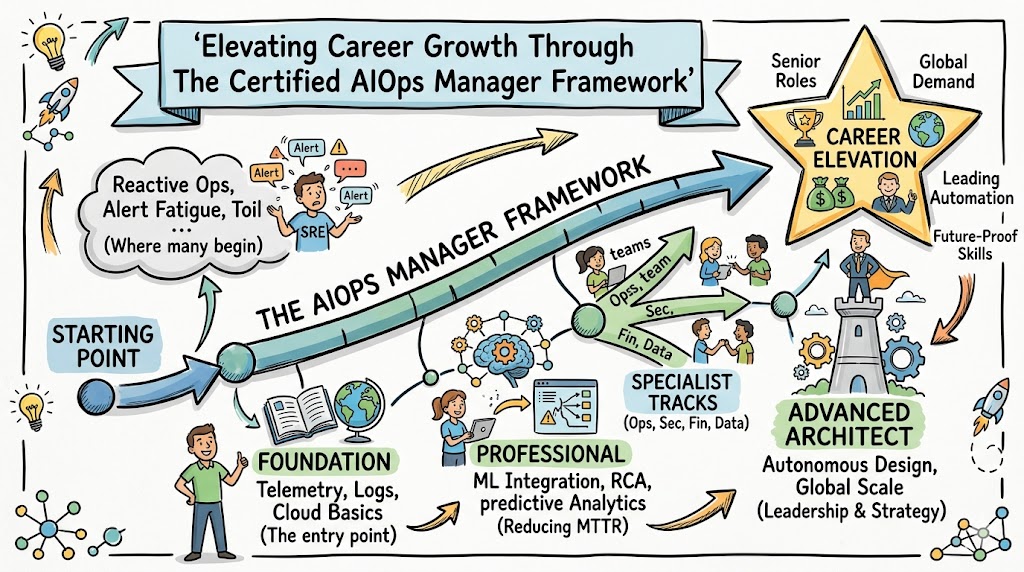
The Certified AIOps Manager represents a shift toward algorithmic management of enterprise-scale technology stacks. This program exists because human operators cannot process the massive volume of telemetry generated by modern cloud-native environments. It emphasizes practical, production-ready skills over abstract theory, ensuring that graduates can handle real-world outages. By aligning with current industry practices, the curriculum teaches professionals to build systems that learn from data to prevent downtime. This credential validates an engineer’s ability to automate complex root cause analysis and event correlation.
Who Should Pursue Certified AIOps Manager?
Site Reliability Engineers, DevOps practitioners, and platform architects find this certification particularly valuable for their career advancement. Technical leads and engineering managers in India and globally use these skills to transition their organizations toward proactive operations. Security professionals and data engineers also benefit by learning how AI integrates with their respective domains to provide a unified view of system health. Beginners with foundational cloud knowledge can use this path to gain a competitive edge in the job market. Ultimately, any professional responsible for maintaining high-availability digital services will find these modules essential.
Why Certified AIOps Manager is Valuable and Beyond
The rapid adoption of distributed systems ensures a long-term demand for leaders who understand intelligent automation. This certification offers professional longevity because it focuses on core architectural logic rather than fleeting software trends. It helps engineers remain relevant by providing the tools to manage increasingly complex systems with greater efficiency and lower costs. The return on investment remains high as companies prioritize candidates who can demonstrably reduce alert fatigue and operational toil. Mastering these algorithmic approaches secures your place at the forefront of the next generation of IT infrastructure.
Certified AIOps Manager Certification Overview
Candidates access the program through the official site and complete their training via the hosting platform. This certification utilizes a hands-on assessment strategy to confirm that participants can apply AI solutions to actual infrastructure challenges. It covers critical areas such as data ingestion, noise reduction, and predictive analytics for capacity planning. Industry experts designed the ownership and structure of the course to mirror the pressures of a live production environment. Engineers who complete this program possess a verified ability to design and maintain autonomous operational frameworks.
Certified AIOps Manager Certification Tracks & Levels
The curriculum follows a structured progression through foundation, professional, and advanced levels to support various career stages. The foundation level introduces core telemetry concepts, while the professional level focuses on model deployment and incident lifecycle automation. Advanced tracks cater to those designing global, self-healing architectures for large enterprises. Specialization paths like FinOps or SecOps allow professionals to tailor their learning to specific business objectives. This tiered approach ensures a clear and logical path for career growth within the field of intelligent operations.
Complete Certified AIOps Manager Certification Table
| Track | Level | Who it’s for | Prerequisites | Skills Covered | Recommended Order |
| Operations | Foundation | Junior Engineers | Basic Linux | Data Ingestion | 1 |
| Management | Professional | Senior Engineers | 3+ Years Experience | ML Integration | 2 |
| Architecture | Advanced | Principal Leads | Professional Level | Autonomous Design | 3 |
| Optimization | Specialist | Cost Analysts | Cloud Billing | Predictive FinOps | 4 |
Detailed Guide for Each Certified AIOps Manager Certification
Certified AIOps Manager – Foundation
What it is
This level validates a candidate’s understanding of how artificial intelligence simplifies basic IT monitoring and data collection. It serves as a starting point for those entering the field of automated operations.
Who should take it
New graduates and junior system administrators who want to build a career in intelligent infrastructure should begin here. It requires a baseline familiarity with cloud environments and command-line tools.
Skills you’ll gain
- Understanding the difference between monitoring and observability
- Mastering log aggregation and normalization
- Identifying basic system anomalies using data
- Learning the foundational AIOps lifecycle
Real-world projects you should be able to do
- Setup a centralized dashboard that highlights performance outliers across a small cluster.
- Configure automated alerts that filter out repetitive, non-actionable system notifications.
Preparation plan
- 7 Days: Focus on the core terminology and the primary business value of AIOps.
- 30 Days: Practice using open-source observability platforms to visualize system telemetry.
- 60 Days: Deepen your knowledge of statistical methods used for identifying system errors.
Common mistakes
Many candidates try to rush into complex machine learning models without first understanding the basics of data quality. Others fail to distinguish between simple automation and true AI-driven insights.
Best next certification after this
- Same-track option: Certified AIOps Manager – Professional.
- Cross-track option: Cloud Practitioner Exam.
- Leadership option: Project Management Fundamentals.
Certified AIOps Manager – Professional
What it is
The professional level confirms an engineer’s ability to implement and manage machine learning workflows for high-scale incident response. It focuses on reducing MTTR through algorithmic intervention.
Who should take it
Senior DevOps engineers and SREs responsible for mission-critical systems find this certification most relevant. It targets those who lead operational strategy.
Skills you’ll gain
- Advanced event correlation and noise reduction
- Automated root cause analysis implementation
- Predictive maintenance for hardware and software
- Integrating AIOps platforms with corporate ITSM tools
Real-world projects you should be able to do
- Build an automated system that correlates thousands of alerts into a few critical incidents.
- Develop a predictive model that anticipates resource exhaustion hours before it occurs.
Preparation plan
- 7 Days: Review complex incident management case studies and architectural patterns.
- 30 Days: Work extensively in lab environments to integrate ML models with telemetry streams.
- 60 Days: Run full simulations of system failures to test automated recovery and RCA logic.
Common mistakes
Candidates often struggle with the technical debt of legacy systems during integration. Some also fail to properly tune their models, leading to excessive false positives.
Best next certification after this
- Same-track option: Certified AIOps Manager – Advanced.
- Cross-track option: Certified MLOps Professional.
- Leadership option: Engineering Management Certification.
Choose Your Learning Path
DevOps Path
Professionals on this path integrate AI into continuous delivery pipelines to ensure high-quality software releases. They use intelligent feedback loops to catch performance regressions before code reaches production. This strategy speeds up development cycles while maintaining a highly stable environment for users.
DevSecOps Path
The security track focuses on using machine learning for real-time threat detection and automated response. Engineers learn to identify subtle shifts in user behavior that might indicate a security breach. This ensures that protection evolves as quickly as the infrastructure it secures.
SRE Path
Reliability engineers use this track to eliminate manual toil through advanced algorithmic solutions. They focus on maintaining strict service level objectives by automating recovery procedures and capacity planning. This path is vital for managing the uptime of global, high-traffic applications.
AIOps Path
This specific track dives deep into the underlying data science that powers operational platforms. Participants master the algorithms used for clustering, regression, and pattern recognition in IT data. It prepares specialists to build the core automation engines for their organizations.
MLOps Path
Focusing on the intersection of data science and engineering, this path ensures that AI models are deployed reliably. Engineers learn to manage the lifecycle of models, including monitoring for drift and retraining in production. This role is essential for AI-driven companies.
DataOps Path
DataOps specialists manage the health and flow of information that feeds artificial intelligence engines. They ensure that telemetry data remains accurate, timely, and secure as it moves through the enterprise. This foundation is critical for any successful AIOps implementation.
FinOps Path
Cost management experts use AI to forecast spending and optimize cloud resource usage. They implement automated governance that adjusts infrastructure based on predicted demand and budget constraints. This path drives significant financial efficiency in large-scale cloud environments.
Role → Recommended Certified AIOps Manager Certifications
| Role | Recommended Certifications |
| DevOps Engineer | Professional Level, DevOps Specialty |
| SRE | Professional Level, SRE Track |
| Platform Engineer | Advanced Level, Architecture Track |
| Cloud Engineer | Foundation Level, Operations Track |
| Security Engineer | Professional Level, SecOps Track |
| Data Engineer | Professional Level, DataOps Track |
| FinOps Practitioner | Specialist Level, FinOps Track |
| Engineering Manager | Professional Level, Management Track |
Next Certifications to Take After Certified AIOps Manager
Same Track Progression
Specializing further involves moving into architectural leadership roles where you design global operational frameworks. You will oversee the deployment of autonomous systems that span multiple cloud providers and on-premise data centers. This progression establishes you as a primary expert in the field.
Cross-Track Expansion
Broadening your expertise into areas like Kubernetes or advanced machine learning makes you a more versatile professional. Understanding how AI interacts with various technology stacks allows you to solve multifaceted organizational problems. This strategy ensures you stay competitive as industry demands shift.
Leadership & Management Track
Moving into management requires balancing technical depth with strategic thinking and team mentorship. You will use your expertise to guide large engineering departments through digital transformation and automation initiatives. This track leads directly to executive positions like CTO or VP of Engineering.
Training & Certification Support Providers for Certified AIOps Manager
DevOpsSchool
This provider helps engineers adopt the cultural and technical changes required for modern automation. They focus on delivering practical training that improves the entire software delivery lifecycle.
Cotocus
This organization specializes in teaching complex engineering concepts for enterprise implementation. Their training helps professionals build and maintain high-performance systems in real-world production environments.
Scmgalaxy
As a primary resource for configuration management, this platform offers deep insights into software supply chain security. They focus on the reliability and consistency of modern build processes.
BestDevOps
This group maintains high standards for DevOps training by focusing on the latest industry trends. Their programs prepare students for the challenges of fast-paced, global technology companies.
devsecopsschool.com
This portal focuses on the essential integration of security into the development workflow. They provide the training needed to create resilient systems that are secure by design.
sreschool.com
Dedicated to Site Reliability Engineering, this school teaches the principles of building scalable systems. Their curriculum emphasizes software engineering solutions for traditional operational challenges.
aiopsschool.com
This is the primary destination for the Certified AIOps Manager program and specialized AI training. They provide the specific framework needed to master data science for IT operations.
dataopsschool.com
This provider focuses on the operational health of data pipelines across the enterprise. They teach students how to manage the information that fuels modern artificial intelligence.
finopsschool.com
Dedicated to cloud financial management, this school helps professionals optimize their cloud spend. They provide the data-driven strategies needed to align technical costs with business objectives.
Frequently Asked Questions (General)
- How much effort does the Certified AIOps Manager require?
Most candidates spend 40 to 60 hours in focused study and hands-on practice to pass the exam. - Does the program offer a practical lab environment?
Yes, the professional and advanced levels include access to labs where you solve real infrastructure problems. - Can I take the exam online?
The certification process typically includes secure, proctored online exams that you can take from any location. - Is a background in data science necessary?
While helpful, the course teaches you the specific machine learning concepts needed for IT operations from scratch. - How does this certification help with alert fatigue?
It teaches specific algorithms to correlate related events, which drastically reduces the number of notifications engineers receive. - What is the passing criteria for the certification?
Candidates must usually achieve a score of 70% or higher to demonstrate proficiency in the subject matter. - Are there group discounts for corporate teams?
Most training providers offer customized packages for companies looking to certify their entire engineering department. - Is the curriculum updated for new cloud technologies?
The program undergoes regular reviews to ensure it reflects the latest updates in cloud-native and AI tools. - Does the certification focus on a specific vendor?
The core principles remain vendor-neutral, although labs often use popular tools like Prometheus and ELK. - Will I receive a digital badge after passing?
Yes, graduates receive a verifiable digital badge to display on their professional profiles and resumes. - Can I start with the specialist tracks?
It is generally recommended to complete the foundation or professional levels before moving into specialized tracks like FinOps. - Is there an emphasis on automated remediation?
Yes, a major part of the professional curriculum focuses on building systems that fix issues without human intervention.
FAQs on Certified AIOps Manager
- Which machine learning models does the course emphasize?
The curriculum focuses on clustering for event correlation, regression for capacity forecasting, and neural networks for complex anomaly detection.
- How does the course handle data privacy in AIOps?
You will learn techniques for anonymizing telemetry data to ensure compliance with global privacy regulations while maintaining model accuracy.
- What is the focus of the capacity planning module?
It teaches you how to use historical performance data to predict exactly when you will need more infrastructure resources.
- Does the program cover open-source AIOps tools?
The training includes extensive modules on integrating open-source observability stacks with custom machine learning scripts for maximum flexibility.
- How does the certification address root cause analysis?
You learn to build dependency maps that the AI uses to trace failures back to their primary source automatically.
- Are there prerequisites for the management track?
The management track usually requires several years of experience in a lead role or a professional-level certification.
- What is the role of natural language processing here?
The course covers how NLP can analyze log messages and support tickets to identify recurring themes and issues.
- Is the exam based on multiple-choice questions only?
The exam combines multiple-choice questions with scenario-based performance tasks to ensure a well-rounded assessment of your skills.
Final Thoughts: Is Certified AIOps Manager Worth It?
Pursuing the Certified AIOps Manager credential is a definitive way to lead the next era of technical operations. As systems outgrow human capacity, the engineers who can harness machine learning will become the most sought-after leaders in the industry. This program provides a clear, practical bridge from traditional troubleshooting to the world of autonomous, self-healing infrastructure. It empowers you to stop reacting to fires and start building the intelligent platforms that define modern business success. For anyone serious about a high-level career in cloud and DevOps, this certification represents the ultimate competitive advantage.