Introduction
The modern technology landscape relies heavily on the ability to process and analyze massive datasets efficiently. Consequently, the AWS Certified Data Engineer – Associate has emerged as a critical credential for professionals aiming to validate their expertise in data orchestration and storage. This guide serves as a comprehensive roadmap for engineers, architects, and managers who want to understand the strategic value of this certification. By pursuing this path at DevOpsSchool, professionals gain the skills needed to build robust data pipelines that power AI, machine learning, and business intelligence. This article explores how this certification bridges the gap between traditional data warehousing and modern, cloud-native data operations.
What is the AWS Certified Data Engineer – Associate?
The AWS Certified Data Engineer – Associate represents a specialized validation of an individual’s ability to implement and manage data-related AWS services. It exists because organizations now require engineers who can move beyond theoretical knowledge into production-focused implementation. Specifically, it focuses on the practical aspects of data ingestion, transformation, and storage within the AWS ecosystem. This certification aligns perfectly with modern engineering workflows by emphasizing automation, security, and scalability. Therefore, it proves that a professional can handle the complexities of real-world data environments while maintaining cost-efficiency and performance.
Who Should Pursue AWS Certified Data Engineer – Associate?
Data professionals, cloud engineers, and SREs will find immense value in this certification. Moreover, software engineers looking to pivot into data-heavy roles can use this as a foundational pillar for their career transition. Beginners gain a structured path to learning complex services, while experienced engineers can formalize their existing skills. In the context of the Indian and global markets, this credential is highly sought after by enterprise companies and startups alike. Managers also benefit from this knowledge as it helps them lead technical teams more effectively by understanding the underlying architecture of data platforms.
Why AWS Certified Data Engineer – Associate is Valuable and Beyond
The demand for skilled data engineers continues to grow as enterprises adopt cloud-native strategies. Consequently, holding this certification ensures that your skills remain relevant despite the rapid evolution of individual tools. It emphasizes core principles of data architecture that are transferable across various specialized roles. Furthermore, the return on time investment is significant because it directly impacts your ability to architect high-performance systems. Organizations prioritize hiring certified professionals to reduce project risks and ensure that their data infrastructure follows best practices for security and compliance.
AWS Certified Data Engineer – Associate Certification Overview
The program is delivered via the official training modules and hosted on the primary AWS ecosystem platform. It utilizes a rigorous assessment approach that evaluates both theoretical understanding and practical problem-solving capabilities. The ownership of the certification lies with AWS, ensuring that the content is always updated to reflect the latest service enhancements. Typically, the structure includes a series of domains covering data ingestion, transformation, orchestration, and security. Candidates must demonstrate proficiency in selecting the right tool for specific data workloads to pass the examination successfully.
AWS Certified Data Engineer – Associate Certification Tracks & Levels
The certification ecosystem generally follows a progression from foundational knowledge to professional mastery. While this specific associate level focuses on core implementation, it sets the stage for advanced specializations in Big Data and Machine Learning. Specialization tracks allow professionals to align their learning with specific career goals such as DataOps or FinOps. As a result, engineers can build a modular career path that scales with their experience. Moving through these levels ensures a deep understanding of how data flows through various architectural layers in an enterprise environment.
Complete AWS Certified Data Engineer – Associate Certification Table
| Track | Level | Who it’s for | Prerequisites | Skills Covered | Recommended Order |
| Cloud Core | Foundational | Beginners | Basic IT knowledge | Cloud concepts, Security | First |
| Data Engineering | Associate | Developers/Data Engineers | 1 year AWS experience | Ingestion, Transformation | Second |
| Data Analytics | Specialty | Senior Architects | Associate certification | Complex Analytics, EMR | Third |
| Machine Learning | Specialty | ML Engineers | Associate certification | SageMaker, Modeling | Optional |
Detailed Guide for Each AWS Certified Data Engineer – Associate Certification
AWS Certified Data Engineer – Associate – [Associate Level]
What it is
This certification validates a candidate’s ability to perform data engineering tasks including data collection, storage, and transformation. It confirms that the professional understands how to leverage AWS services to build scalable data pipelines.
Who should take it
It is ideal for mid-level engineers who have at least one year of hands-on experience with AWS services. Similarly, it suits professionals transitioning from on-premises data warehousing to cloud environments.
Skills you’ll gain
- Designing and maintaining production-ready data pipelines.
- Implementing data transformation logic using AWS Glue and EMR.
- Configuring data lifecycle policies for cost optimization in S3.
- Ensuring data security through IAM and encryption at rest.
Real-world projects you should be able to do
- Building a serverless ETL pipeline using AWS Lambda and Athena.
- Migrating a large-scale SQL database to Amazon Redshift.
- Implementing real-time stream processing with Amazon Kinesis.
- Setting up a centralized data lake with AWS Lake Formation.
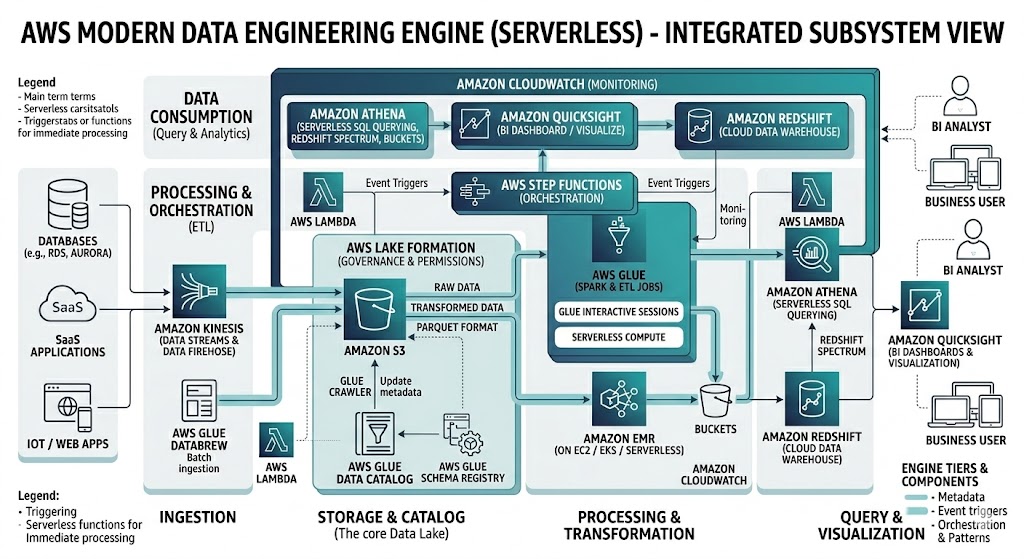
[Architecture Diagram: AWS Data Engineering Pipeline on White Background]
Preparation plan
- 7–14 days: Review official exam guides and focus on core services like S3, Glue, and Redshift.
- 30 days: Engage in hands-on labs and build small-scale data ingestion projects.
- 60 days: Take multiple practice exams and dive deep into data security and monitoring aspects.
Common mistakes
- Underestimating the importance of data security and governance policies.
- Focusing too much on theory without doing enough hands-on lab exercises.
- Neglecting to learn the nuances of cost-optimization for data storage.
Best next certification after this
- Same-track option: AWS Certified Data Analytics – Specialty.
- Cross-track option: AWS Certified DevOps Engineer – Professional.
- Leadership option: AWS Certified Solutions Architect – Professional.
Choose Your Learning Path
DevOps Path
Professionals in this path focus on automating the deployment of data infrastructure. Furthermore, they integrate data pipelines into continuous integration and delivery cycles. Consequently, this ensures that data models and schemas are updated without manual intervention. This path requires a strong grasp of Infrastructure as Code and monitoring tools.
DevSecOps Path
This track prioritizes the security of data at every stage of the lifecycle. Engineers learn to implement automated compliance checks and encryption protocols within the data pipeline. Additionally, they focus on auditing access patterns and protecting sensitive information from unauthorized leaks. As a result, the data environment becomes both agile and secure.
SRE Path
Site Reliability Engineers focus on the availability and latency of data platforms. They implement robust error-handling mechanisms and ensure that data pipelines can scale automatically during peak loads. Moreover, they use observability tools to track the health of data services. This results in a highly resilient data infrastructure that meets strict service level objectives.
AIOps / MLOps Path
This path bridges the gap between data engineering and machine learning model production. Engineers learn how to feed cleaned, transformed data into training environments consistently. In addition, they manage the lifecycle of models and ensure that data drift is monitored effectively. Consequently, organizations can deploy AI solutions with greater confidence and speed.
DataOps Path
DataOps is a collaborative methodology that improves communication between data providers and consumers. Professionals in this path focus on data quality, testing, and rapid delivery of data insights. Specifically, they use version control for data pipelines to ensure reproducibility. This leads to a culture of continuous improvement within the data team.
FinOps Path
FinOps practitioners focus on the financial accountability of cloud data spend. They analyze usage patterns to identify underutilized resources and suggest more cost-effective storage classes. Furthermore, they implement tagging and budgeting alerts to prevent unexpected costs. As a result, the organization can maximize the business value of every dollar spent on data.
Role → Recommended AWS Certified Data Engineer – Associate Certifications
| Role | Recommended Certifications |
| DevOps Engineer | Associate + Solutions Architect |
| SRE | Associate + SysOps Administrator |
| Platform Engineer | Associate + Developer Associate |
| Cloud Engineer | Associate + Cloud Practitioner |
| Security Engineer | Associate + Security Specialty |
| Data Engineer | Associate + Data Analytics Specialty |
| FinOps Practitioner | Associate + Cloud Practitioner |
| Engineering Manager | Associate + Solutions Architect |
Next Certifications to Take After AWS Certified Data Engineer – Associate
Same Track Progression
Deep specialization involves moving toward the Data Analytics Specialty or the Database Specialty. These certifications dive deeper into complex query optimization and large-scale data warehousing techniques. By mastering these, you become the primary authority on data architecture within your organization. Consequently, you can lead large-scale digital transformation initiatives.
Cross-Track Expansion
Skill broadening allows you to explore the DevOps or Solutions Architect Professional tracks. This expansion helps you understand the broader cloud ecosystem beyond just data. Similarly, it enables you to design end-to-end systems where data is just one component of a larger application. This versatility makes you a more valuable asset in multi-disciplinary teams.
Leadership & Management Track
Transitioning to leadership requires a focus on high-level architecture and business strategy. Certifications like the Solutions Architect Professional or specialized management training are ideal here. You will focus on ROI, team building, and long-term technology roadmaps. As a result, you move from individual contribution to strategic decision-making roles.
Training & Certification Support Providers for AWS Certified Data Engineer – Associate
DevOpsSchool
This provider offers a comprehensive ecosystem for learners focusing on data and cloud engineering. They provide hands-on training that mimics real-world production environments, which is essential for passing the AWS Certified Data Engineer – Associate. Additionally, their community-driven approach allows students to interact with industry experts and peers. The curriculum is designed to be practical, ensuring that students can apply their knowledge immediately. Furthermore, they offer extensive resources including study guides and practice exams to build confidence. Therefore, it remains a top choice for professionals seeking career advancement.
Cotocus
This organization focuses on high-end consulting and technical training for enterprise clients. They specialize in helping teams adopt modern data practices through structured workshops and certification paths. Specifically, their approach to the AWS Certified Data Engineer – Associate involves deep-dive sessions into architectural patterns. They emphasize the integration of data engineering with existing business processes. Moreover, their trainers are active practitioners who bring current industry insights into the classroom. Consequently, students receive a balanced education of theory and practice.
Scmgalaxy
As a long-standing player in the configuration management and DevOps space, this site provides excellent supplemental materials. They offer a wealth of blogs, tutorials, and community forums that support the AWS Certified Data Engineer – Associate journey. Specifically, they focus on the automation aspects of data engineering, such as using Jenkins or GitLab for pipeline orchestration. Their resources are particularly helpful for engineers who want to understand the “how-to” of technical implementations. Additionally, the platform serves as a hub for networking with other data professionals.
BestDevOps
This platform is dedicated to sharing best practices and curated content for cloud certifications. They provide a streamlined learning experience for those targeting the AWS Certified Data Engineer – Associate. Their content is often broken down into digestible modules that focus on exam-specific domains. Furthermore, they highlight common pitfalls and offer strategies to overcome difficult exam questions. The site is a valuable resource for candidates who prefer a self-paced learning environment. As a result, many engineers use this site as their primary study companion.
devsecopsschool.com
This provider focuses specifically on the intersection of development, security, and operations. For the AWS Certified Data Engineer – Associate, they emphasize the importance of data governance and security protocols. Their training covers how to protect data at rest and in transit using AWS native tools. Additionally, they teach students how to automate security audits within the data pipeline. This specialized focus is crucial in an era of increasing data privacy regulations. Consequently, their graduates are well-prepared for high-stakes security roles.
sreschool.com
This school focuses on building resilient and scalable systems, which is a core component of modern data engineering. Their training for the AWS Certified Data Engineer – Associate highlights observability and reliability. Students learn how to build pipelines that can automatically recover from failures. Moreover, they emphasize the use of monitoring tools to ensure data consistency across distributed systems. This approach ensures that data engineers can maintain high availability for critical business intelligence platforms. Therefore, it is ideal for engineers with a reliability mindset.
aiopsschool.com
As AI becomes more integrated into business, this school provides the necessary bridge between data and machine learning. Their curriculum for the AWS Certified Data Engineer – Associate includes modules on preparing data for AI workloads. They teach how to build scalable features and manage data versioning for model training. Furthermore, they explore the use of automated insights to improve data pipeline performance. This forward-looking approach prepares students for the next wave of technological innovation. Consequently, it is a great choice for future-focused engineers.
dataopsschool.com
This provider focuses entirely on the DataOps methodology, making them a perfect fit for this certification. They teach how to apply agile principles to the data lifecycle, ensuring faster and more reliable delivery. For the AWS Certified Data Engineer – Associate, they emphasize collaboration and continuous integration. Their labs focus on building automated test suites for data quality. Additionally, they cover the orchestration of complex data workflows using tools like Airflow or Step Functions. This ensures that graduates can manage complex data ecosystems with ease.
finopsschool.com
This school addresses the critical need for cost management in the cloud. Their training for the AWS Certified Data Engineer – Associate includes detailed lessons on storage optimization and compute efficiency. Students learn how to analyze their AWS bill and identify areas where data costs can be reduced. Specifically, they focus on the financial implications of different architectural choices. This knowledge is highly valued by managers and executives who want to control cloud spending. As a result, this training provides a unique competitive edge.
Frequently Asked Questions (General)
- How difficult is the AWS Certified Data Engineer – Associate exam?
The exam is moderately challenging and requires a solid understanding of AWS data services and architectural best practices. - What is the recommended experience level for this certification?
It is generally recommended to have at least one year of hands-on experience with the AWS platform. - How long does the certification remain valid?
The certification is valid for three years, after which you must recertify to maintain your status. - Are there any mandatory prerequisites for this exam?
There are no formal prerequisites, but having the Cloud Practitioner knowledge is highly beneficial. - What is the cost of the associate-level exam?
The standard price for an AWS Associate-level exam is 150 USD, plus applicable taxes. - Can I take the exam online from my home?
Yes, AWS offers proctored online exams that you can take from any location with a stable internet connection. - What is the passing score for the exam?
The passing score is typically 720 out of 1000, using a scaled scoring model. - How many questions are on the exam?
The exam usually consists of 65 questions, including multiple-choice and multiple-response formats. - What happens if I fail the exam?
You must wait 14 days before you are eligible to retake the exam, and you must pay the full fee again. - Does this certification help with salary increases?
Many professionals report significant salary growth and better job opportunities after obtaining this credential. - How should I schedule my study time?
Consistency is key; aim for at least 5-10 hours of study per week over two to three months. - Are practice exams useful for preparation?
Practice exams are essential for understanding the question format and identifying your weak areas.
FAQs on AWS Certified Data Engineer – Associate
- Which AWS services are most emphasized in this certification?
Core services like AWS Glue, Amazon S3, Redshift, and Athena are central to the exam domains. - Does the exam cover real-time data processing?
Yes, it includes questions on Amazon Kinesis and AWS Lambda for streaming data workloads. - How much coding is required for the exam?
While deep coding isn’t the focus, you should understand Python or SQL for data transformation logic. - Is data security a major part of the exam?
Security is a standalone domain, focusing on IAM, encryption, and VPC security for data services. - Does the certification cover data lake concepts?
AWS Lake Formation and the concept of centralized data governance are heavily featured. - How does this differ from the Data Analytics Specialty?
This associate exam focuses more on the engineering and plumbing rather than advanced visualization or complex analytics. - Is knowledge of Amazon EMR required?
You should understand how EMR fits into big data processing and when to choose it over Glue. - Can this certification help me move into an AI/ML role?
Absolutely, as data engineering is the foundation upon which all successful ML models are built.
Final Thoughts: Is AWS Certified Data Engineer – Associate Worth It?
Investing time and resources into the AWS Certified Data Engineer – Associate is a strategic move for any serious technologist. In a world where data is the most valuable asset, the ability to architect the systems that handle it is a recession-proof skill. This certification does more than just add a badge to your profile; it forces you to master the nuances of cloud-native data architecture. Consequently, you become better equipped to solve complex business problems and drive innovation. Whether you are an individual contributor or a technical leader, the knowledge gained here will serve as a permanent foundation for your career. Focus on the practical implementation, stay curious about new service updates, and use this path to reach your professional goals.







Leave a Reply
You must be logged in to post a comment.