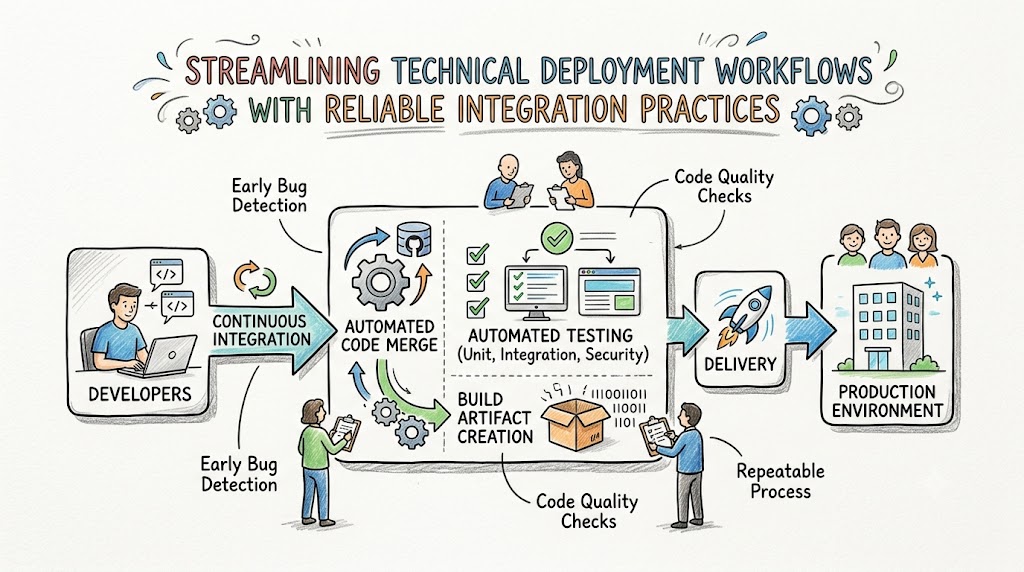
Modern engineering teams encounter massive technical challenges when attempting to merge frequent code changes into a single development environment. Consequently, implementing a robust framework of validation standards becomes an absolute necessity to prevent production bugs from disrupting user experiences. Continuous Integration best practices serve as the vital infrastructure that transforms uncoordinated, isolated coding habits into a highly predictable delivery engine. By adopting automated verification early, your engineering department dramatically accelerates feature delivery while establishing an ironclad layer of code quality assurance. Experienced industry veterans like Rajesh kumar emphasize that configuring clean, highly optimized pipeline workflows remains the fastest path to eliminating technical debt. When your team fully embraces these structured operational habits, your software delivery system shifts from a source of anxiety into a competitive strategic advantage.
Transitioning to advanced deployment practices ensures that every single code contribution triggers an immediate, multi-layered verification pipeline automatically. Therefore, developers receive rapid, highly actionable feedback on whether their newly introduced logic breaks existing product features or compromises data security. This consistent cycle of micro-validations completely eliminates the traditional headaches associated with complex, manual end-of-month code releases. Furthermore, it creates a transparent engineering workspace where pipeline metrics actively drive technical alignment across the entire organization. Ultimately, mastering these fundamental optimization strategies directly unlocks peak deployment velocity, reduces developer friction, and guarantees an incredibly stable software application environment.
Key Operational Concepts You Must Know
Automated Pipeline Validation
Constructing a highly automated testing structure represents the absolute core of modern deployment engineering architecture. To begin with, your system must execute lightweight unit tests immediately to verify basic code components before compiling larger software frameworks. Following this, automated security analysis tools must scan code configurations to detect active vulnerabilities and hardcoded credentials instantly.
Moreover, performance testing stages must evaluate system latency and memory consumption parameters before allowing code progression to secondary environments. This multi-tiered gatekeeping strategy prevents problematic code mutations from advancing further down the release line, saving hours of manual review. Consequently, developers operate with complete technical clarity because the validation system flags structural errors minutes after a code push.
Mainline Development Alignment
Maintaining a single, highly integrated mainline repository branch acts as the absolute baseline for smooth continuous integration workflows. Team members must abandon long-lived feature branches, which inevitably result in massive, painful merge conflicts that stall product development. Instead, engineers must integrate their work directly into the central mainline trunk multiple times throughout the working day.
In addition, small and frequent code merges provide the entire development team with complete visibility into the evolving software architecture. This high level of transparency allows developers to resolve minor overlapping code changes immediately before they compound into massive roadblocks. As a result, maintaining an updated master branch guarantees that the entire engineering department stays completely synchronized at all times.
Immutable Artifact Packaging
Once the automated integration system successfully compiles the codebase, it must immediately package the output into an unchangeable binary artifact. These standardized packages must be securely stored in a centralized artifact repository, ensuring identical deployment states across all staging environments. Because you build the distribution package exactly once, you remove the classic risk of encountering unexpected configuration bugs in production.
Furthermore, secure artifact management allows continuous deployment orchestration tools to fetch verified application images instantly during a system rollout. This highly reliable approach establishes a predictable, error-free path for software promotions from early testing environments straight to live servers. Therefore, locking down your compiled binaries remains an indispensable prerequisite for maintaining total system consistency across your enterprise infrastructure.
Platform Implementation vs. Culture — What’s the Real Difference?
| Operational Aspect | Platform Implementation Focus | Cultural Practice Focus |
| Primary Objective | Deploying automated pipeline runners, servers, and cloud clusters. | Establishing shared team accountability and operational transparency. |
| Core Activities | Writing complex configuration scripts and managing build environments. | Promoting blameless incident reviews and continuous pipeline learning. |
| Success Metrics | High pipeline execution speed, uptime, and system throughput. | Minimized developer burnout, elevated trust, and rapid communication. |
| Failure Resolution | Rewriting broken pipeline logic and updating software integrations. | Investigating systemic workflow gaps to prevent future code regression. |
Infrastructure Tooling Reality
Configuring state-of-the-art automated build servers and enterprise cloud systems is vital, yet tooling alone cannot mend flawed development habits. For instance, launching incredibly expensive testing platforms without cultural alignment merely automates poor code architecture and flawed logic at a faster rate. Engineering teams often fall into the trap of believing that premium pipeline software licenses will magically erase delivery delays.
Instead, technical leadership must actively ensure that your automated platforms directly mirror the practical, everyday needs of your engineering staff. If a continuous integration pipeline feels overly complex or takes an hour to complete, developers will bypass the system entirely. Successful platform implementation requires constant optimization to keep automated checks incredibly fast, highly accessible, and genuinely helpful for software creators.
Shared Pipeline Ownership
A mature engineering culture demands that every individual software developer takes deep personal responsibility for the collective health of the pipeline. When an automated build fails, team members must immediately pause feature creation to fix the broken mainline branch together. This collaborative attitude effectively dismantles the traditional, counterproductive walls separating isolated software developers from active system infrastructure operators.
Moreover, nurturing an organizational climate of psychological safety allows engineers to acknowledge mistakes openly during constructive post-mortem reviews. When software professionals do not fear retribution for broken pipelines, they innovate with greater freedom and exchange critical technical insights. Ultimately, an advanced automation platform can only thrive when the entire team practices collective stewardship over system quality and deployment health.
Real-World Use Cases of Modern Operations
High-Volume Cloud Architecture
Massive cloud applications managing millions of global user requests require seamless, ongoing feature updates without experiencing any system downtime. By leveraging highly optimized integration pipelines, cloud native enterprises can deploy code modifications to live environments dozens of times daily. For example, if an engineer refactors a data-processing microservice, automated scripts immediately validate system performance under heavy simulated loads.
Consequently, this continuous automated vetting completely protects the live application infrastructure from experiencing unexpected memory leaks or database connection drops. Additionally, rapid automated validation allows product managers to safely experiment with user experience alterations using targeted canary deployment methodologies. Fast, micro-scale deployments ensure that the underlying cloud architecture remains thoroughly secure, resilient, and highly adaptable to customer demands.
Enterprise Supply Chain Networks
Global supply chain management software relies on massive, deeply interconnected database networks that require extreme transaction precision and zero latency. By implementing decoupled, micro-frontend system architectures, developers can modify individual shipping modules without impacting the overarching logistics platform. Continuous integration pipelines run strict validation tests, API contract checks, and schema verification processes on every single code commit.
Therefore, a minor system update inside the warehouse inventory tracking service will never accidentally destabilize the global shipping billing engine. This isolated validation pathway minimizes operational blast radiuses, allowing massive enterprise organizations to modernize legacy components while preserving operational stability. As a result, supply chain providers achieve the perfect balance between agile feature creation and dependable system-wide predictability.
Common Mistakes in Operations Engineering
Tolerating Broken Builds
Allowing a failed automated pipeline notification to remain ignored for hours is an incredibly destructive anti-pattern in software engineering. When development teams begin tolerating a red, broken pipeline indicator, notification fatigue sets in, causing engineers to ignore critical alerts. Consequently, secondary development errors pile rapidly on top of the initial broken build, transforming debugging into an absolute nightmare.
To halt this operational decline, engineering teams must implement a firm policy stating that a broken mainline branch stops all development. Fixing the integration pipeline must immediately become the top collective priority for the entire engineering staff on duty. Keeping your automated pipeline consistently green ensures that the central repository stays in a permanently healthy, deployable state for production.
Superficial Testing Protocols
Relying on an integration pipeline that contains only superficial, low-quality test cases creates a highly dangerous false sense of security. If your automated testing framework fails to simulate real-world user workflows, catastrophic bugs will effortlessly bypass security gates into production. Developers will look at a green, passing pipeline dashboard with empty satisfaction while end-users suffer from broken application functionalities.
Therefore, engineering departments must continually expand their automated testing matrices to evaluate edge cases, database interactions, and API security parameters. You must also regularly review the validity of your test assertions to guarantee they evaluate true application health rather than checking boxes. Broad, meaningful test parameters remain the solitary method for ensuring exceptional code quality at blistering software deployment speeds.
How to Become an Operations Expert — Career Roadmap
Mastering Core Essentials
To launch a successful career as an elite systems and operations engineer, you must first master foundational infrastructure concepts. Devote serious energy to understanding complex version control mechanics, branching strategies, interactive rebasing, and parallel repository management workflows. Additionally, acquire deep proficiency in an versatile programming language like Python or Go to build custom pipeline automation tools easily.
- Advanced Git Control: Master repository management, branch protection strategies, cherry-picking, and clean commit history curation.
- Linux Infrastructure Administration: Understand kernel performance tuning, process isolation, storage optimization, and system network troubleshooting protocols.
- Automation Scripting Expertise: Develop the capability to write clean, reusable shell scripts to orchestrate complex data processing tasks.
- Network Protocol Fundamentals: Grasp how proxy servers, DNS routing, secure transport layers, and cloud load balancers interact globally.
Architecting High-Velocity Systems
After mastering foundational systems engineering concepts, focus your efforts on designing highly scalable, secure continuous integration architectures. Study how to construct containerized pipeline build nodes using Docker to ensure your test runners remain entirely uniform across workloads. Furthermore, master advanced build caching techniques to reduce complex application compilation times from thirty minutes down to seconds.
- Infrastructure as Code: Utilize modern configuration frameworks to provision, update, and manage global cloud infrastructure programmatically.
- Container Orchestration Design: Build highly optimized, minimalist application container images to isolate dependencies and streamline infrastructure footprints.
- SecOps Pipeline Integration: Embed automated static code analysis, dependency vulnerability checking, and secure cryptographic key management into pipelines.
- Observability Matrix Configuration: Build distributed tracing systems, aggregated logging pipelines, and real-time monitoring dashboards to observe infrastructure health.
FAQ Section
- How long should a standard continuous integration pipeline take to execute completely?
An optimized continuous integration pipeline should ideally finish running within ten minutes to maintain a fast feedback loop for developers. If pipelines take longer, developers lose focus and begin context switching, which severely damages overall engineering productivity and focus.
- What is the difference between feature flags and branch-based development integration?
Feature flags allow developers to merge incomplete features into the main branch while keeping the new code hidden from users. Branch-based development relies on isolating code in separate repository branches until the entire feature is ready, which increases merge conflict risks.
- How do you handle flaky tests that randomly fail within an automated integration pipeline?
Flaky tests must be quarantined immediately from the primary build pipeline to prevent developers from losing trust in automated alerts. Once isolated, the engineering team must investigate, rewrite, and stabilize the test before reintegrating it into the main validation suite.
- Should database migration scripts be executed automatically inside a continuous integration pipeline?
Yes, database migrations should be integrated and tested automatically against staging databases within the pipeline to verify schema compatibility. Testing data migrations early prevents catastrophic database lockups or data corruption issues from occurring during live production application rollouts.
- Can legacy monolithic applications be transitioned effectively into automated integration workflows?
Yes, legacy monoliths can be transitioned by breaking down the application build process into smaller, independent automated steps over time. Teams can start by automating basic compilation and unit tests before tackling more complex end-to-end integration testing architectures.
Final Summary
Adopting modern continuous integration best practices completely revolutionizes how software engineering teams design, validate, and ship exceptional technology products. By embedding automated gatekeepers, maintaining a clean mainline branch, and prioritizing rapid feedback, you effectively destroy traditional software engineering bottlenecks. This operational shift not only guards your live production systems against unstable code but also elevates developer morale across the organization.
Investing the necessary engineering hours to cultivate a pristine automation ecosystem yields incredible long-term business and technical dividends. As your development pipelines become increasingly predictable, your business gains the agility required to outpace competitors and delight customers instantly. Ultimately, prioritizing continuous integration builds a rock-solid foundation where rapid software innovation and flawless system stability exist in perfect harmony.



Leave a Reply
You must be logged in to post a comment.