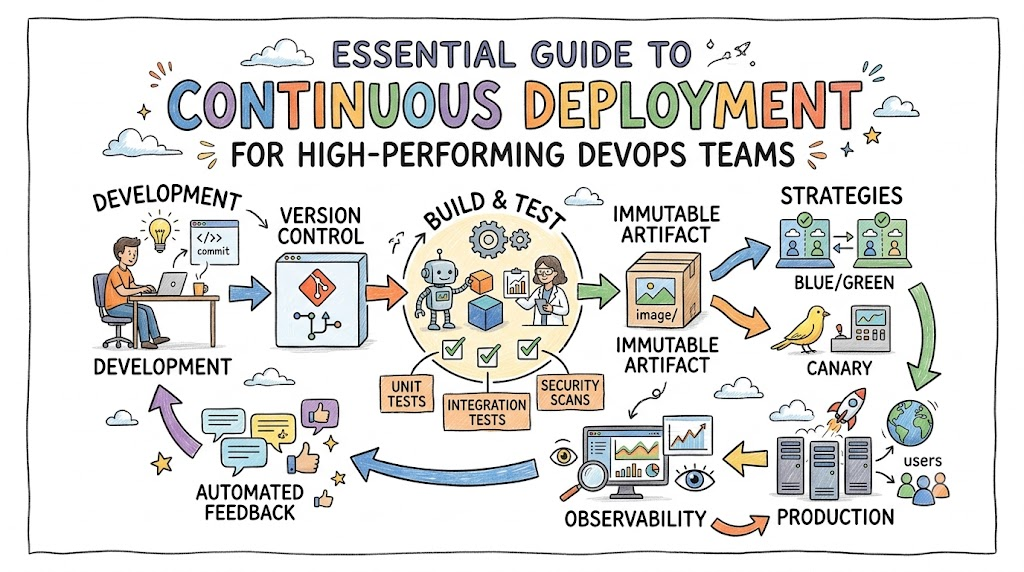
Modern software organizations face non-stop pressure to roll out features rapidly while keeping their systems reliable and secure. Consequently, manual release cycles often cause friction between developers who want to ship code and operations teams who demand absolute stability. Continuous deployment directly resolves this friction by automating the journey of code from a developer’s machine straight to end users. In this framework, every change that clears every quality gate deploys directly into live environments without human handoffs. Industry mentors like Rajesh kumar emphasize that continuous deployment transforms software releases from risky, high-stress events into predictable background routines. By embracing end-to-end automation, teams eliminate deployment anxiety, shorten delivery timelines, and deliver ongoing value to users.
Adopting continuous deployment demands much more than writing a couple of deployment scripts; it requires complete operational discipline. Specifically, your team must treat code, configurations, infrastructure, and automated validation tests as an integrated software delivery engine. Because every validated change reaches production automatically, automated tests act as the ultimate gatekeepers of your platform’s stability. Furthermore, automated release mechanisms like canary deployments and health monitors verify that every new rollout performs smoothly in production. Ultimately, continuous deployment removes bureaucratic hurdles, accelerates feedback loops, and allows engineering teams to focus on solving core user problems.
Automated Deployment Strategies
Modern teams eliminate service downtime and user disruption during updates by using progressive deployment techniques. Instead of updating every production server at once, these strategies roll out changes incrementally while monitoring live traffic metrics. Consequently, if an issue appears, the blast radius stays confined to a tiny fraction of users.
- Blue-Green Deployments: Maintain two identical production environments where one runs live traffic while the other receives updates before an instant router switch.
- Canary Releases: Route a small percentage of real user traffic to the updated build before exposing the change to the entire user base.
- Rolling Updates: Incrementally replace running instances of an application with new instances across clusters without shutting down the overall service.
- Feature Flagging: Decouple technical code deployment from business feature release, letting you toggle capabilities on or off at runtime.
The Automated Testing Safety Net
Continuous deployment operates safely only when supported by a rigorous, layered automated testing safety net. Because no human manually approves production releases, your test suite must catch regressions, security flaws, and performance drops instantly. Therefore, running multiple testing layers in parallel gives developers fast, dependable validation.
- Unit Testing: Validate isolated functions, algorithms, and business logic instantly during the earliest phase of the pipeline.
- Contract and Integration Testing: Ensure that different microservices, databases, and third-party APIs communicate smoothly without unexpected payload breaks.
- End-to-End Synthetic Scenarios: Simulate real user workflows to verify that critical paths like payments and logins execute seamlessly.
- Static and Dynamic Security Scans: Analyze code patterns and runtime behaviors to detect known vulnerabilities, misconfigurations, and leaked credentials.
Infrastructure as Code and GitOps
Treating infrastructure as versioned, declarative code forms the bedrock of reliable continuous deployment systems. Rather than configuring servers manually through cloud consoles, engineers define environments using declarative configuration files. This setup guarantees that staging and production environments stay completely consistent, preventing frustrating drift issues.
- Declarative Declarations: Define desired system states using code repositories so tools can automatically converge live infrastructure to match.
- Pull-Based Synchronization: Run GitOps operators inside your clusters that continuously pull approved updates directly from Git.
- Audit Trails and Reproducibility: Track every infrastructure modification through commit histories to know exactly who changed what and when.
- Automated Environment Provisioning: Spin up temporary, ephemeral preview environments on demand so teams can test pull requests under real conditions.
Telemetry and Automated Remediation
Deploying software directly to live users requires real-time observability across your entire infrastructure. Because changes deploy continuously, operations teams rely on telemetry data to understand how updates impact runtime performance. If an anomaly occurs, automated systems should trigger instant rollbacks before users notice a widespread outage.
- Distributed Tracing: Follow individual requests as they travel across complex microservice boundaries to uncover latency bottlenecks instantly.
- Real-Time Error Budget Tracking: Measure service-level objectives to confirm that continuous releases do not degrade baseline system reliability.
- Synthetic Monitoring Probes: Continuously send simulated user transactions through live systems to spot service degradation before real customers do.
- Automated Rollback Triggers: Configure deployment pipelines to automatically revert to the previous stable release when error thresholds are exceeded.
Key Operational Concepts You Must Know
Build Artifact Immutability
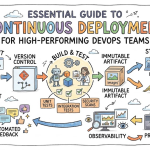
A golden rule of continuous deployment is that your delivery pipeline must compile and package an artifact only once. Specifically, the identical binary, container image, or package that passes unit and integration tests must advance through staging and directly to production. When teams recompile code for separate environments, they introduce subtle build differences that can trigger catastrophic production defects.
Instead, pipelines should externalize all environment variables, credentials, and configuration files away from the core compiled artifact. This ensures that the code running in production is pixel-by-pixel identical to the version that passed all automated testing stages. Consequently, you remove environmental ambiguity, simplify debugging, and ensure complete confidence during every single production release.
Decoupling Deployment from Release
High-performing organizations intentionally separate technical deployment from feature releases to reduce production risk. A deployment involves pushing compiled code to servers and running it silently behind the scenes without exposing it to customers. In contrast, a release happens when product managers turn on that capability for end users using feature flags.
By separating these two activities, engineering teams can safely deploy code changes to production multiple times a day without impacting user experiences. Furthermore, decoupling releases allows business stakeholders to coordinate feature launches, perform internal dogfooding, and run A/B experiments safely. This separation keeps deployments routine and stress-free while giving product teams fine-grained control over customer feature rollouts.
Automated Rollback Mechanisms
In an environment where code ships directly to production, relying on human engineers to diagnose and fix broken deployments is far too slow. Instead, your deployment system must feature automated rollback mechanisms that react instantly to system distress. The moment error rates exceed predefined limits, orchestrators like Kubernetes should automatically switch traffic back to the previous stable build.
Designing zero-friction rollbacks requires maintaining backwards compatibility across application components, especially database schemas. For instance, teams use expanding-and-contracting database migration patterns to ensure older application versions can still interact with updated database structures safely. By making rollback routines an automated default, you maintain high uptime and preserve customer trust even when an unexpected defect appears.
Platform Implementation vs. Culture — What’s the Real Difference?
| Operational Dimension | Platform Implementation Focus | Cultural Practice Focus |
|---|---|---|
| Core Goal | Setting up automation pipelines, tools, and servers. | Fostering shared ownership and blameless collaboration. |
| Pipeline Failure Response | Triaging pipeline error logs and adjusting build scripts. | Halting feature work collectively to repair broken builds. |
| Change Management | Automating gates, container checks, and deployment triggers. | Normalizing frequent, tiny pull requests over giant releases. |
| System Visibility | Building real-time dashboards and tracking telemetry metrics. | Reviewing incidents through blameless post-mortem learning. |
Tooling Realities and Automation Traps
Many organizations purchase cutting-edge continuous deployment platforms expecting them to solve deep engineering bottlenecks instantly. However, deploying modern pipeline tools without solid underlying practices simply helps teams push broken code to production faster. Tooling serves as an execution engine, but it cannot fix brittle architectures, flaky test suites, or poor architectural designs.
Engineering leaders must therefore design automated pipelines that simplify daily workflows for developers rather than slowing them down. If a continuous deployment pipeline takes forty-five minutes to run or fails randomly, engineers will naturally seek workarounds. The most effective platform implementations focus on speed, reliability, and clear feedback loops that developers love to use every day.
Nurturing a Resilient Engineering Mindset
True continuous deployment requires an organizational culture where teams genuinely prioritize long-term platform stability over raw feature output. When a pipeline failure occurs, developers must feel empowered to stop writing new code and restore the build immediately. This shared dedication ensures the main repository branch stays deployable at all times, preventing massive backlogs of untested changes.
Furthermore, organizations must create an environment of psychological safety where team members discuss production incidents openly without fear of finger-pointing. Blameless post-mortem meetings treat every unexpected outage as an opportunity to reinforce pipeline safety checks and improve automation. When an engineering culture embraces collective responsibility, continuous deployment turns into a sustainable, empowering, and high-velocity workflow.
Real-World Use Cases of Modern Operations
Global On-Demand Ride Platforms
Global ride-hailing and delivery platforms process millions of real-time passenger, driver, and location updates every minute. To maintain service reliability while launching iterative improvements, these platforms use continuous deployment pipelines powered by intelligent canary analysis. Engineers push code updates that automatically deploy to isolated geographic regions or single-digit percentages of active drivers.
Real-time telemetry systems monitor driver dispatch latency, GPS accuracy, and payment transaction success rates to evaluate the health of the update. If the canary environment shows even a minor spike in failed bookings, the deployment pipeline immediately rolls back the change. This fine-grained, automated validation allows global platforms to ship hundreds of production updates daily without disrupting millions of active users.
High-Scale Streaming Media Infrastructures
Popular media streaming providers handle massive worldwide viewing traffic that spikes sharply during major live entertainment events. These platforms cannot afford maintenance windows or unexpected downtime, so they rely on continuous deployment paired with automated blue-green environments. When engineers build updates for recommendation algorithms or streaming protocols, the pipeline provisions isolated infrastructure to test performance against mirrored production traffic.
Once synthetic loads confirm that the update handles real-world streaming demands gracefully, the router shifts live viewer traffic instantly. Meanwhile, the previous environment stays on standby, ready to handle traffic immediately if unexpected runtime issues emerge. By using continuous deployment, media streaming services ship product innovations constantly while keeping video playback seamless for viewers worldwide.
Common Mistakes in Operations Engineering
Tolerating Flaky and Inconsistent Tests
One of the most dangerous operational traps in continuous deployment is tolerating automated tests that fail intermittently without clear reasons. When engineering teams ignore flaky tests, developers lose trust in the automated testing suite and bypass crucial safety checks. Consequently, team members start hitting re-run buttons blindly, hoping tests turn green on the next pass instead of investigating root causes.
This careless habit allows genuine regressions and race conditions to slip past the automated safety net directly into production. Teams must treat test flakiness as a top-priority engineering bug that requires immediate remediation or removal. Keeping your automated testing matrix completely dependable is the only way to safeguard your live systems under continuous deployment.
Overlooking Database Migration Coupling
Another common mistake occurs when teams tightly couple relational database schema updates to application code rollouts within a single deployment step. If an application update changes a database table structure destructively, rolling back the application becomes virtually impossible if the build fails. When the application reverts, the older code crashes immediately because the underlying database schema has already changed.
To avoid this painful operational deadlock, teams must adopt non-destructive, phased database migration patterns. You should always introduce new database columns or tables long before deploying application code that depends on them. Once the updated code runs reliably in production, you can safely remove deprecated database elements through a separate, subsequent deployment.
How to Become an Operations Expert — Career Roadmap
Mastering Fundamental Engineering Concepts
To build a successful career as an operations specialist, you must first develop a deep understanding of core computing fundamentals. Start by mastering operating system principles, Linux administration, and network protocols like TCP/IP, DNS, and HTTP/S. Concurrently, build strong scripting abilities in languages like Python, Go, or Bash to automate everyday operational workflows.
- Linux Deep Dive: Learn how to manage kernel parameters, troubleshoot networking stacks, and analyze process resource limits.
- Modern Version Control: Master advanced Git workflows, interactive rebasing, branch management, and repository automation.
- Scripting for Automation: Write modular scripts to automate system management, test runs, and data processing routines.
- Core Networking: Study how load balancers, reverse proxies, and TLS handshakes direct and secure internet traffic.
Designing Modern Deployment Architectures
Once you master the fundamentals, focus your professional development on containerization, scalable orchestrators, and declarative deployment patterns. Learn how to configure container runtimes like Docker and manage multi-node production clusters with tools like Kubernetes. From there, master cloud-native configuration methods, telemetry systems, and GitOps workflows to design resilient delivery pipelines.
- Containerization at Scale: Package microservices into minimal, secure, and reproducible container images that run identically anywhere.
- Kubernetes Orchestration: Build automated rolling updates, canary rollouts, horizontal autoscaling, and service meshes for microservices.
- Infrastructure Orchestration: Write declarative Infrastructure as Code using modern tools to manage cloud environments across providers.
- Observability Engineering: Set up open-source metric gathering, centralized logging, and tracing frameworks to track production health.
FAQ Section
- What is the difference between continuous delivery and continuous deployment?
Continuous delivery automatically builds, tests, and prepares every code change for production, but a human must manually approve the final release step. Continuous deployment removes that manual approval gate entirely, meaning every change that clears automated tests deploys directly to production users.
- How do teams handle production database migrations in continuous deployment?
Teams manage database migrations by splitting changes into safe, non-breaking steps using the expand-and-contract migration strategy. First, you add the new database structure without altering existing tables so both older and newer application versions function normally. Once the updated code deploys and proves stable, you run a final cleanup migration to deprecate old database fields.
- What happens if a critical bug slips into production through the automated pipeline?
When a critical defect slips through, automated health checks and telemetry monitors detect the anomaly and initiate an immediate rollback to the previous stable build. In addition, developers use feature flags to disable broken capabilities instantly without waiting for a new deployment cycle to complete.
- Can legacy monolithic applications adopt continuous deployment successfully?
Yes, monolithic applications can adopt continuous deployment, but the transformation requires comprehensive automated test suites and fast build systems. Teams usually break the monolith’s deployments into smaller, incremental changes while gradually decoupling tightly connected modules into independent microservices.
- How long should an automated continuous deployment pipeline take to run?
An ideal continuous deployment pipeline should complete its build, testing, and deployment stages within ten to twenty minutes. Keeping execution times short gives developers fast feedback on their changes, prevents development bottlenecks, and keeps the deployment pipeline running smoothly.
Final Summary
Implementing continuous deployment transforms software delivery from a slow, error-prone manual task into an automated, predictable business advantage. By validating code through robust automated tests, keeping artifacts immutable, and using gradual rollout strategies, organizations can deploy updates safely multiple times a day. This automated workflow removes operational bottlenecks, empowers developers to innovate quickly, and shortens the time required to deliver customer value.
However, building a successful continuous deployment workflow involves far more than simply stitching together modern CI/CD tools. Organizations must build a supportive culture that values shared operational ownership, blameless learning, and rapid feedback loops. When you combine resilient automation pipelines with an empowered engineering mindset, your organization can deliver high-quality software to end users reliably, securely, and without downtime.





Leave a Reply
You must be logged in to post a comment.