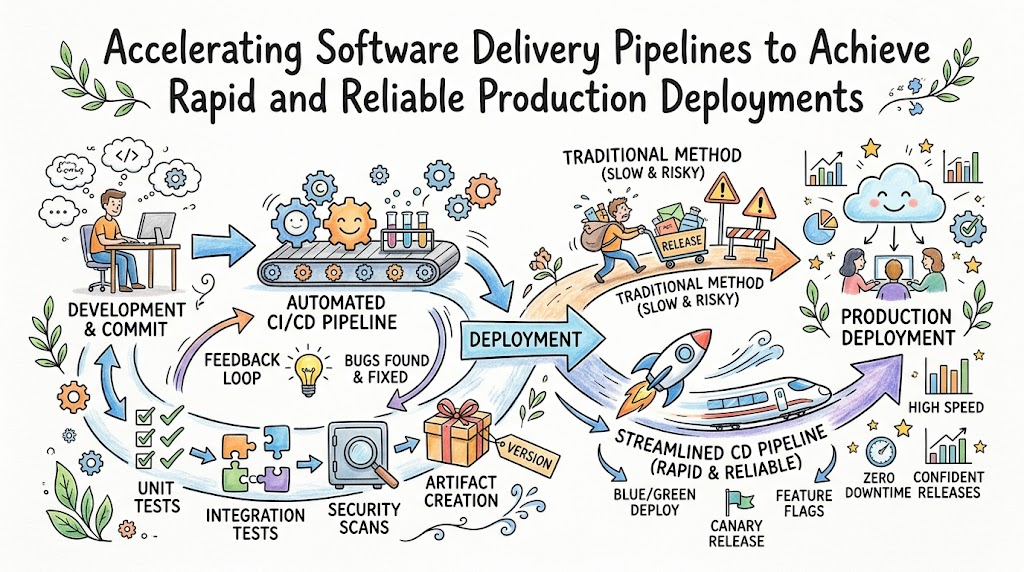
Modern engineering organizations face relentless pressure to deliver new software capabilities quickly without compromising system stability. Consequently, traditional manual deployment workflows create massive friction, introducing human errors and unacceptably long release cycles. Continuous Delivery (CD) solves this challenge directly by automating the entire release path from code validation to production rollout. By creating standardized, repeatable pipelines, teams eliminate manual intervention, enforce rigorous quality gates, and ensure every commit is production-ready. Industry leaders like Rajesh kumar emphasize that release automation fundamentally transforms how engineering departments deliver digital value to end users. When you implement reliable delivery pipelines, your organization eliminates risky midnight deployments and replaces them with routine, push-button releases.
Transitioning to automated delivery guarantees that software changes flow smoothly through multi-stage validation environments without operational bottlenecks. Therefore, development teams gain rapid feedback on infrastructure performance, application reliability, and end-user experience before reaching real customers. This systematic workflow eliminates the anxiety of high-risk quarterly releases by turning deployments into small, frequent, and easily reversible events. Furthermore, automated pipelines establish complete visibility across every staging environment, ensuring absolute consistency from development to production. Ultimately, mastering continuous delivery accelerates overall business agility, minimizes production downtime, and empowers teams to ship dependable software with total confidence.
Continuous Delivery Core Mechanisms
Continuous delivery relies on automated stages that package, configure, and release applications without manual tampering. Whenever a developer merges code, the deployment pipeline retrieves verified artifacts and automatically prepares them for target environments. This eliminates configuration drift and ensures complete environment parity.
Additionally, sophisticated deployment patterns like blue-green deployments and canary releases allow organizations to route traffic gradually to new versions. Because traffic shifts in controlled increments, operations teams observe system behavior and roll back instantly if unexpected errors occur.
Automated Environment Provisioning
Modern delivery systems utilize infrastructure as code to spin up and tear down testing environments on demand. This approach guarantees that every test runs in an environment identical to production, eliminating subtle runtime discrepancies.
Moreover, ephemeral test environments save significant cloud infrastructure costs because they automatically terminate once the automated validation suite finishes execution. Consequently, development teams test complex distributed architectures without waiting for shared staging environments to become available.
Progressive Delivery Strategies
Progressive delivery introduces fine-grained controls over feature visibility through dynamic feature flags and canary traffic shifting. By decoupling software deployment from actual feature activation, product managers decide exactly when users experience new capabilities.
Furthermore, monitoring tools track key telemetry metrics during rollout phases, automatically halting deployments if error rates spike. As a result, software failures remain contained to a tiny fraction of users without disrupting the entire platform.
Key Operational Concepts You Must Know
Immutable Infrastructure Deployments
Treating production servers as immutable components prevents gradual configuration drift and unverified manual hotfixes across environments. When you deploy updates, the pipeline launches entirely new instances with pre-configured images rather than modifying existing servers in place.
Consequently, rollback procedures become straightforward because reverting to the previous state only requires re-pointing your load balancer to the older instance pool. This clean strategy ensures that every server runs an identical, auditable configuration that you can reproduce on demand.
Automated Rollback Mechanisms
Designing rapid, automated rollback triggers forms an essential safety net for high-velocity software delivery pipelines. If health checks fail or database errors increase post-release, the delivery engine automatically reverts traffic to the previous stable release.
Because automation handles the mitigation instantly, incident recovery takes seconds instead of requiring frantic manual debugging during an outage. Therefore, engineering teams experiment boldly, knowing that the automated safety protocols will safeguard user experience continuously.
Comprehensive Pipeline Observability
High-performing delivery pipelines generate granular telemetry regarding build durations, deployment frequencies, and pipeline failure rates. Monitoring these operational metrics highlights internal process bottlenecks and shows where teams spend unnecessary time during validation.
In addition, centralized log aggregation across deployment runners allows engineers to diagnose failed release steps immediately. Tracking delivery metrics continuously turns deployment performance into an actionable, data-driven engineering initiative.
Platform Implementation vs. Culture — What’s the Real Difference?
| Operational Dimension | Platform Implementation Focus | Cultural Practice Focus |
|---|---|---|
| Primary Goal | Installing automated deployment tools and configuring cloud targets. | Establishing shared ownership of production health and reliability. |
| Pipeline Governance | Setting up automated security scans and deployment approval gates. | Trusting engineers with deployment authority and transparent peer reviews. |
| Incident Response | Triggering automated rollbacks and executing disaster recovery scripts. | Conducting blameless retrospectives to fix systemic pipeline issues. |
| Team Interaction | Handing off deployable artifacts through automated ticketing webhooks. | Collaborating cross-functionally between development, QA, and operations. |
The Limits of Tooling Alone
Installing advanced deployment engines will not solve delivery bottlenecks if team workflows remain fragmented and siloed. For instance, if developers toss untested code over the wall expecting the pipeline to catch everything, build failures will skyrocket.
Instead, engineering teams must view automation as a tool that amplifies existing disciplined practices rather than a silver bullet. A successful implementation requires aligning pipeline configurations with actual developer needs so automation reduces friction rather than adding administrative complexity.
Nurturing a High-Trust Mindset
A resilient delivery culture encourages small, frequent production releases rather than stockpiling massive batches of code. When engineers know they have automated safety nets, they deploy code confidently without fear of severe operational backlash.
Moreover, transparent collaboration between operations and software engineers ensures that pipeline standards remain practical and effective. Organizations that cultivate open communication, psychological safety, and shared accountability achieve the highest software delivery velocity and stability.
Real-World Use Cases of Modern Operations
Scalable Cloud Microservices Architecture
Cloud-native organizations manage hundreds of distinct microservices that require independent, fast-paced deployment cycles. Automated delivery pipelines enable each microservice to deploy autonomously without waiting for monolithic synchronization or scheduled maintenance windows.
Consequently, a team working on user authentication can ship performance optimizations without affecting the payment processing microservice. This structural independence accelerates feature rollout speed dramatically while keeping the blast radius of any individual defect minimal.
Multi-Region Global Content Distribution
Global digital services must deliver seamless software updates across multiple geographic regions while ensuring zero platform downtime. Continuous delivery pipelines orchestrate rolling multi-region updates, deploying to one geographic availability zone at a time to monitor localized performance.
Therefore, if network latency increases in a specific region during rollout, the automated pipeline isolates the issue and prevents global impact. This automated geographic orchestration allows distributed applications to maintain continuous uptime and exceptional performance for millions of worldwide users.
Common Mistakes in Operations Engineering
Bypassing Quality Gates Under Pressure
Skipping automated integration tests or security scans to meet aggressive deadlines creates technical debt that inevitably causes catastrophic production failures. When teams disable pipeline stages to push emergency patches, they introduce unverified dependencies and vulnerabilities directly into production.
To maintain system integrity, teams must treat pipeline checks as non-negotiable requirements regardless of release urgency. If a deployment is truly an emergency, your pipeline should execute fast enough that bypassing safety checks is entirely unnecessary.
Overcomplicating Pipeline Logic
Building excessively complex deployment workflows with fragile custom scripts creates maintenance nightmares that confuse developers. When pipeline configurations become too convoluted, diagnosing a simple deployment failure requires hours of specialized troubleshooting.
Instead, engineering teams should design clean, modular pipelines utilizing standardized templates and declarative configuration files. Keeping deployment workflows simple, visible, and well-documented ensures that every engineer can understand, maintain, and improve the release process.
How to Become an Operations Expert — Career Roadmap
Mastering Automation and Infrastructure
Aspiring operations specialists must develop deep expertise in declarative infrastructure provisioning and cloud networking principles. Focus on building modular environments that deploy automatically through version-controlled templates.
- Infrastructure as Code: Learn to manage cloud infrastructure using clean, declarative configuration definitions.
- Continuous Integration Tools: Master automated build runners, artifact generation, and pipeline scripting logic.
- Container Orchestration: Gain proficiency in managing container runtimes, cluster networking, and service discovery.
- Configuration Management: Automate server state configuration to eliminate manual administration tasks across environments.
Advanced Release Engineering Leadership
Progressing to senior operations roles requires mastering modern deployment patterns, progressive rollout strategies, and holistic system reliability. Develop the ability to architect self-healing systems that withstand unexpected operational failures automatically.
- Progressive Rollout Architectures: Implement dynamic canary deployments, blue-green environments, and feature flag management.
- Telemetry and Observability: Build end-to-end monitoring pipelines tracking application performance, tracing, and log metrics.
- Security Automation: Embed automated vulnerability scanning and secret rotation directly into delivery workflows.
- Disaster Recovery Strategy: Architect resilient multi-region failover routines and automated database rollback mechanisms.
FAQ Section
- How does continuous delivery differ from continuous deployment?
Continuous delivery automatically ensures that every code change is fully tested and ready for production, but the final deployment trigger can remain a manual business decision. Continuous deployment removes the manual step entirely, pushing every validated change directly to production without human intervention.
- What are the prerequisites for implementing a continuous delivery pipeline?
Your team needs comprehensive automated testing suites, a reliable version control system, and automated build processes in place. Without strong automated testing, deploying continuously introduces significant stability risks to production environments.
- How do continuous delivery pipelines handle database migrations safely?
Teams utilize backward-compatible database migration scripts that allow both old and new application versions to function simultaneously. By decoupling schema updates from application deployments, pipelines update databases without causing table locks or service downtime.
- Why are small, frequent deployments safer than large periodic releases?
Small deployments contain fewer code modifications, making it significantly easier to identify bugs and understand the root cause of an unexpected failure. Consequently, troubleshooting is fast, and rolling back a small change carries minimal operational risk.
- Can legacy monolithic applications use automated delivery pipelines?
Yes, monolithic architectures benefit greatly from automated build and deployment pipelines by reducing manual packaging and rollout effort. While deployment times might be longer than with microservices, automation still eliminates human error and accelerates release cadence.
Final Summary
Implementing automated continuous delivery fundamentally modernizes software development by transforming releases into routine, low-stress operational events. By automating testing stages, environment provisioning, and deployment routing, engineering teams eliminate human error and shorten release cycles from months to hours. This streamlined approach ensures that software products remain consistently stable, auditable, and deployable at any given moment.
Furthermore, cultivating a culture that embraces continuous delivery aligns engineering velocity with broader business objectives. Organizations can test new ideas rapidly, address customer feedback instantly, and outpace market competitors without jeopardizing platform reliability. Prioritizing automated deployment pipelines creates an agile, resilient engineering ecosystem where high delivery speed and exceptional software quality reinforce one another continuously.




Leave a Reply
You must be logged in to post a comment.