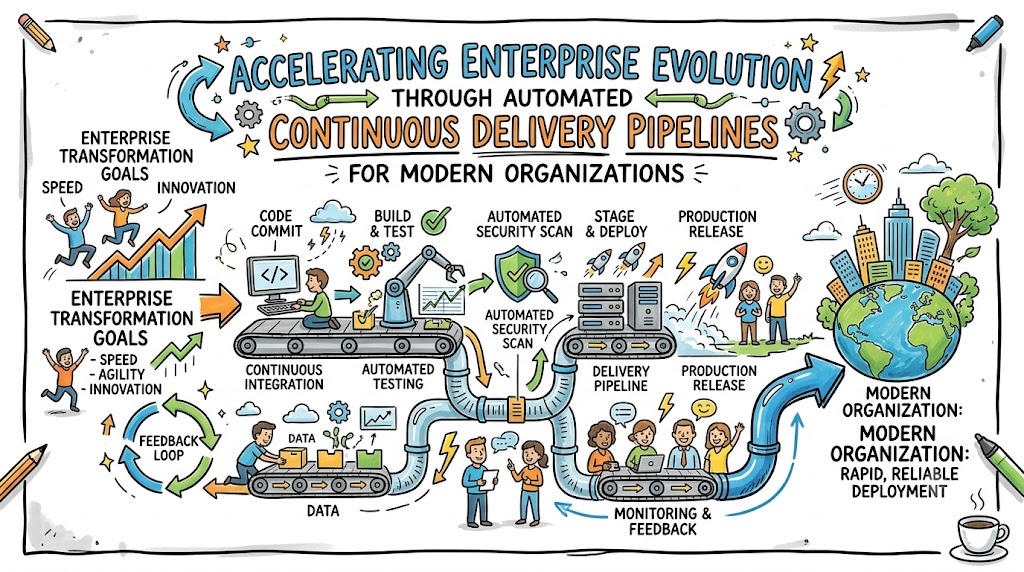
Modern enterprises pursue digital transformation to remain adaptable, enhance client experiences, and outpace market competitors. However, adopting cloud platforms or modernizing user interfaces achieves very little if software releases remain trapped in slow manual release cycles. Continuous Delivery resolves this operational bottleneck by automating the entire pathway from code commit to production-ready software. Through automated test suites and standardized deployment scripts, engineering departments validate and stage new capabilities continuously. Distinguished technology specialists such as Rajesh kumar demonstrate that automated delivery pipelines convert strategic business visions into tangible, customer-facing features rapidly. When enterprises embrace this discipline, digital transformation shifts from a high-risk initiative into an ongoing operational reality.
Furthermore, implementing continuous delivery establishes tight feedback loops between business leaders, technical teams, and active end users. As a result, organizations stop betting their success on unpredictable annual releases and instead ship low-risk micro-updates reliably. This steady cadence minimizes downtime, accelerates time-to-market, and exposes hidden product bugs long before they disrupt consumer workflows. In addition, teams spend far less time firefighting deployment crises and dedicate their energy toward creating business value. Ultimately, establishing predictable automated pipelines allows companies to innovate confidently and realize the full promise of modernization.
Foundations of Modern Delivery Systems
Automated Environment Provisioning
Modern delivery pipelines require target environments that mirror live production setups with precise accuracy. Therefore, teams utilize code-driven provisioning templates to spin up staging clusters, mock databases, and networking rules on demand. When your deployment script controls environment parameters directly, you eliminate confusing configuration drift across development stages entirely.
Furthermore, ephemeral test environments ensure that every single release candidate undergoes validation in a pristine, uncontaminated workspace. Consequently, quality assurance teams bypass the delays of waiting for shared test servers to become free. Once automated validation passes, the pipeline safely destroys the temporary environment to optimize enterprise cloud costs.
Continuous Configuration Management
Managing dynamic application variables across multiple deployment zones represents a vital requirement for delivery resilience. Specifically, centralizing your secrets, API keys, and system flags outside application source code guarantees consistent binaries across deployments. Because you compile your software packages only once, your teams simply inject specific configurations as the artifact advances.
Moreover, centralizing configuration updates enables rapid operational adjustments without forcing complete application recompilation. If a third-party service provider shifts an endpoint URL, administrators adjust the configuration registry instantly. As a result, applications adapt to runtime changes while preserving package integrity across every release tier.
Deployment Pipeline Visibility
Transparent telemetry across the deployment lifecycle empowers cross-functional teams to identify structural bottlenecks effortlessly. For example, real-time dashboards display artifact compilation duration, test execution success rates, and staging readiness indicators clearly. Because developers observe each pipeline milestone directly, they instantly understand where unexpected delivery stalls happen.
In addition, comprehensive visibility builds deep trust between developer groups, security auditors, and release managers. Stakeholders review automated audit trails that verify who initiated changes and which automated tests passed successfully. Therefore, pipeline visibility turns complex operational compliance into an effortless, transparent routine.
Progressive Traffic Routing
Safeguarding the end-user experience demands advanced traffic management techniques that replace blunt, high-risk system updates. By employing canary rollouts, teams expose fresh software builds to a minuscule fraction of actual production traffic initially. The deployment engine watches performance indicators closely, measuring system latency and exception counts in real time.
If an anomaly surfaces, automated routing rules instantly redirect live user traffic back toward the previous stable build. Conversely, if telemetry reveals stable performance and zero errors, the system gradually directs all production traffic to the new build. Consequently, enterprises ship aggressive architectural enhancements while shielding their broader consumer base from runtime regressions.
Key Operational Concepts You Must Know
Automated Testing Matrices
A thorough automated testing matrix stands as the foundational pillar of any reliable continuous delivery ecosystem. To start, unit tests verify core business logic, while integration test suites validate cross-service communication routines. Immediately after, automated security scanning and performance benchmarking confirm that code modifications remain performant and compliant.
Moreover, end-to-end user experience suites simulate real customer actions to catch workflow regressions early. This systematic testing gauntlet prevents defective code commits from reaching staging clusters or impacting real business transactions. Consequently, engineering teams move forward rapidly because automated assertions validate operational resilience at every step.
Immutable Infrastructure Artifacts
Creating immutable deployment artifacts ensures that software packages remain entirely identical from initial build through production deployment. Teams compile code binaries and wrap dependencies into standardized containers precisely once inside the pipeline. Because engineers avoid manual updates on active servers, they eliminate configuration discrepancies between testing environments and production.
Furthermore, immutable artifacts dramatically streamline disaster recovery and rollback procedures across distributed infrastructures. When an unexpected operational disruption occurs, automated controllers deploy previous, verified artifact versions without lengthy troubleshooting delays. As a result, maintaining consistent binary versions across environments guarantees predictable application performance.
Single Branch Version Discipline
Maintaining a disciplined version control routine serves as the primary collaborative anchor for modern software engineering. Developers frequently integrate their localized code updates into the main repository branch to avoid messy integration collisions. Because team members address small merge differences daily, large code merges disappear completely from the engineering roadmap.
Additionally, version control records provide an immutable audit ledger of every modification made across enterprise systems. This operational clarity allows developers to track down faulty logic regressions quickly and revert broken commits effortlessly. Therefore, short-lived feature branches keep engineering organizations aligned, productive, and focused on shared delivery goals.
Platform Implementation vs. Culture — What’s the Real Difference?
| Operational Dimension | Platform Implementation Focus | Cultural Practice Focus |
|---|---|---|
| Primary Driver | Provisioning CI/CD tooling, cloud runners, and pipelines. | Cultivating cross-functional accountability and blameless collaboration. |
| Daily Operations | Writing automation scripts and configuring cluster servers. | Reviewing telemetry, resolving feedback loops, and learning. |
| Performance Measures | Execution speed, build pass ratios, and server uptime. | Psychological safety, low developer burnout, and team alignment. |
| Incident Response | Patching pipeline code and rolling back containers. | Conducting blameless post-mortems to refine operational workflows. |
Technical Architecture Realities
Setting up automated orchestration platforms is an indispensable technical milestone, yet software platforms alone cannot fix dysfunctional engineering practices. For instance, configuring high-end pipeline engines without team consensus merely automates problematic coding behaviors at higher velocity. Organizations frequently assume that purchasing enterprise developer suites will instantly resolve their deployment friction and communication roadblocks.
Instead, engineering leaders must design technical platforms that genuinely integrate with daily developer workflows. If a validation system takes hours to execute or demands excessive configuration overhead, developers naturally construct informal workarounds. Successful platform implementations prioritize developer experience, ensuring that automated verification tools feel empowering, speedy, and genuinely protective.
Nurturing an Experimental Mindset
Achieving sustainable delivery excellence requires an organization-wide cultural evolution centered on collective system ownership. When an automated build fails, team members must halt auxiliary tasks and work together to repair the pipeline immediately. This shared responsibility eliminates historical friction between software developers writing features and operations teams defending system stability.
Furthermore, fostering psychological safety encourages engineers to take measured technical risks and share retrospective insights openly. When engineers do not fear reprimand for pipeline breaks, they document lessons learned and enhance automated tests collaboratively. Ultimately, sophisticated automation tools deliver transformative business agility only when powered by a transparent, cooperative engineering culture.
Real-World Use Cases of Modern Operations
Global Financial Services Transformation
A multinational banking institution struggled with protracted quarterly update cycles, which repeatedly delayed critical regulatory compliance features. Consequently, the organization decomposed its monolithic account settlement architecture into decoupled microservices backed by automated delivery pipelines. Every code adjustment triggered automated cryptographic validations, regulatory rule checks, and stress testing against synthetic financial transaction streams.
- Outcome Achieved: Release frequency surged from four seasonal launches per year to hundreds of verified updates each month.
- Risk Reduction: Zero-downtime deployment pipelines cut critical transaction processing incidents by over eighty percent.
- Compliance Velocity: Security audit preparations transitioned from tedious multi-week audits into automated, on-demand compliance reports.
Scaled Retail E-Commerce Platforms
A digital retail conglomerate faced repeated website outages and degraded checkout experiences during high-volume consumer shopping weekends. To resolve this instability, engineering leaders incorporated continuous delivery pipelines equipped with automated blue-green environment switching. Whenever developers rolled out updated product catalog services, the platform verified system health silently before shifting user traffic over.
- Rapid Feedback: Engineers gathered immediate telemetry on shopping cart checkout latency and database connection saturation.
- Resilient Rollbacks: The delivery platform rolled back unstable product recommendation scripts automatically whenever error thresholds exceeded zero percent.
- Feature Experimentation: Marketing departments introduced experimental user interface layouts seamlessly using targeted runtime feature flags.
Common Mistakes in Operations Engineering
Tolerating Broken Build Notifications
Allowing automated pipeline failure alerts to remain unaddressed for days is one of the most destructive habits in software operations. When engineering teams ignore red build dashboards, notification fatigue sets in and obscures genuinely catastrophic defects. Consequently, subsequent developers build on broken dependencies, creating a web of secondary bugs that requires immense effort to unwind.
To eliminate this operational hazard, organizations must implement a strict policy where broken pipelines take priority over all development tasks. Repairing the mainline branch immediately protects the entire development group from wasting time debugging phantom issues. Keeping pipeline validation permanently operational ensures that the repository remains ready for safe production deployment at any moment.
Neglecting Database Migration Automation
Many organizations invest heavily in automating application logic delivery while leaving database schema changes to dangerous manual processes. When engineers execute database scripts manually during production deployments, human errors cause data corruption and system crashes. Furthermore, decoupling application code from underlying database schemas creates synchronization nightmares during emergency rollbacks.
Therefore, development teams must treat database migrations as first-class citizens within the continuous delivery pipeline. Utilizing version-controlled migration scripts ensures that database schemas evolve smoothly alongside application binaries across environments. In addition, adopting backward-compatible schema expansion techniques guarantees that system rollbacks remain completely painless.
How to Become an Operations Expert — Career Roadmap
Mastering Foundational Systems
Embarking on a career in modern delivery engineering requires building deep expertise in operating system internals and automation scripting. First, develop an intimate understanding of Linux memory management, shell scripting, networking sockets, and process isolation techniques. In addition, master a scalable programming language like Go or Python to build custom pipeline utilities and integrations easily.
- Linux Fundamentals: Gain proficiency in bash scripting, network troubleshooting, and process scheduling mechanics.
- Source Control Mastery: Learn complex Git workflows, trunk-based branching models, and interactive history rebasing.
- Scripting Competence: Write clean, modular automation routines to parse logs, manage files, and interact with APIs.
- Networking Principles: Understand DNS routing, reverse proxies, TLS handshake mechanics, and TCP/IP fundamentals.
Engineering Scalable Delivery Pipelines
After mastering operating system foundations, advance toward designing resilient continuous delivery architectures and cloud infrastructure frameworks. Focus on mastering container platforms and container orchestration engines to package applications consistently across disparate platforms. Additionally, study infrastructure-as-code principles to manage and provision secure cloud environments programmatically.
- Container Orchestration: Package distributed applications using Docker and orchestrate workloads across production Kubernetes clusters.
- Infrastructure Automation: Define cloud resources declaratively using modern infrastructure-as-code tools to maintain environment consistency.
- Telemetry and Alerting: Configure distributed tracing systems, metrics dashboards, and proactive alerting frameworks to monitor pipelines.
- Security Automation: Embed static application security testing, vulnerability container scanning, and secrets management into automated builds.
FAQ Section
- How does continuous delivery differ fundamentally from continuous deployment?
Continuous delivery automates the testing and preparation of code releases, leaving the final production release as an informed business decision. Continuous deployment removes that final manual checkpoint, pushing every passing code change directly into live production environments automatically.
- Why is automated continuous delivery critical for long-term digital transformation?
Digital transformation requires organizations to adapt rapidly to evolving market demands, competitive pressures, and shifting consumer expectations. Continuous delivery provides the automated operational foundation that makes agile adaptation predictable, measurable, and safe across enterprise systems.
- What initial steps should legacy organizations take when building automated pipelines?
Organizations should begin by establishing reliable version control practices and introducing automated unit testing for core business components. Once teams trust their automated test suite, they can automate artifact builds and stage incremental deployments safely.
- Can continuous delivery pipelines handle complex database schema modifications securely?
Yes, teams manage database changes safely by integrating automated migration scripts directly alongside application code in the pipeline. Using evolutionary database design techniques ensures that schema expansions maintain backward compatibility with preceding application versions during updates.
- How does continuous delivery enhance overall application security?
Automated pipelines integrate automated static code analysis, third-party dependency scanning, and compliance checks directly into every build run. Consequently, security vulnerabilities are surfaced and remediated during early development stages long before code ever reaches production.
Final Summary
Modernizing enterprise software architectures without continuous delivery pipelines is like engineering a high-speed vehicle without reliable steering controls. By standardizing automated testing, building immutable artifacts, and uniting cross-functional teams around frequent commits, organizations mitigate release risks permanently. This operational framework transforms software releases from stressful midnight ordeals into quiet, non-disruptive daytime routines.
Investing the resources required to build a resilient continuous delivery culture pays compounding dividends across the entire organization. Engineering teams gain the agility to ship experimental features rapidly and resolve defects within minutes of discovery. Ultimately, continuous delivery unlocks the genuine promise of digital transformation by aligning technical execution with long-term strategic growth.