Practical Engineering Foundation
Enterprises routinely encounter severe delivery roadblocks when attempting to merge aggressive product ambitions with unyielding system reliability. Consequently, visionary technology leaders continually seek dependable methods to align rapid software releases with operational resilience. Creating a direct bridge between strategic business aims and daily engineering workflows resolves these chronic delivery bottlenecks.
Therefore, cross-functional teams eliminate deep-seated architectural friction rather than applying brittle emergency patches. This pragmatic focus guarantees predictable rollout schedules, rock-solid cloud infrastructure, and elastic application networks that handle massive user workloads effortlessly.
Eliminating Technical Friction to Accelerate Velocity
Antiquated software stacks monopolize critical engineering resources through unending patch cycles and frequent service disruptions. As an unavoidable outcome, release velocity plummets, which tests user patience and stalls major commercial deliverables. When software developers dedicate whole development cycles to extinguishing operational fires, core product innovation halts completely.
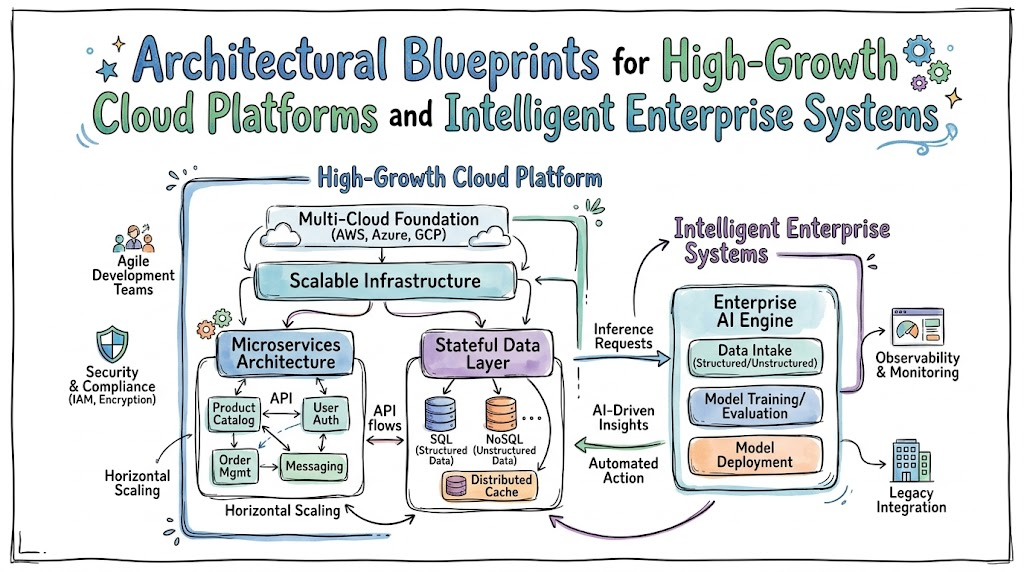
In addition, fragmented developer tooling intensifies operational silos across corporate divisions. Progressive organizations overcome these barriers by revamping their core software architecture. Constructing decoupled, modular services provides enterprises the operational adaptability to absorb traffic surges and introduce competitive capabilities with complete confidence.
Transitioning Intelligent Models into Critical Workflows
Algorithmic intelligence has evolved beyond isolated lab prototypes to anchor mission-critical operational systems. Forward-thinking companies embed real-time machine learning pipelines directly into customer interactions, core transaction workflows, and automated decision engines. Achieving operational stability requires immaculate data governance, low-latency API layers, and thorough system observability.
Collaborating with an established AI Software Development Company enables businesses to roll out production algorithms reliably. Once engineering departments operationalize machine intelligence accurately, they eradicate manual data entry errors, accelerate strategic business decisions, and establish an enduring competitive advantage.
Delivering Tangible Results with Generative Systems
Modern enterprises deploy sophisticated language systems to streamline intricate knowledge workflows and extract decisive corporate insights. Instead of displacing staff, these automated platforms amplify everyday employee output across technical and business units. By engaging targeted Generative AI Development Services, companies launch domain-adapted language models, autonomous agents, and contextual discovery tools.
Accordingly, customer support departments resolve user inquiries much faster, while software engineers automate repetitive documentation duties. Continuous evaluation loops and high-performance vector databases preserve operational accuracy across all enterprise deployments.
Constructing Tailored Systems for Unique Operational Needs
Standard off-the-shelf software inevitably restricts business growth because it enforces rigid, generic operational logic. As workflows grow in complexity, third-party software licenses fail to accommodate distinct enterprise needs. Contracting an experienced Custom Software Development Company empowers businesses to build tailored web ecosystems, native mobile apps, and robust microservices.
Consequently, technical teams retain sovereign command over proprietary databases, security barriers, and user journeys. Tailor-made software connects directly with internal datastores, completely bypassing the functional roadblocks imposed by standardized marketplace options.
Designing High-Scale Multi-Tenant SaaS Frameworks
Creating an enterprise subscription solution demands disciplined design decisions during initial blueprinting cycles. Software engineers must prioritize strict data isolation, elastic scaling, and continuous deployment workflows. Partnering with a proven SaaS Product Development Company guarantees that your minimum viable product launches on battle-tested operational patterns.
Furthermore, dynamic tenant provisioning and granular resource tracking prevent costly operational overhead as the user base expands. Product teams rapidly roll out new features while maintaining exceptional platform responsiveness and uncompromising privacy across every enterprise account.
Managing Cloud Infrastructure Without Configuration Drift
Uncontrolled cloud migrations trigger disorganized infrastructure configurations, security oversights, and runaway hosting expenses. In contrast, comprehensive Cloud Consulting Services help enterprises establish disciplined landing zones across AWS, Azure, and Google Cloud environments.
Applying consistent infrastructure-as-code practices and resource rightsizing gives technical directors total visibility over computing expenses. Modern container clusters automatically absorb volatile traffic peaks without requiring frantic manual operational fixes.
| Strategic Domain | Technical Target | Commercial Return |
|---|---|---|
| System Governance | Strict RBAC rules and unified IAM policies | Prevents configuration drift and blocks privilege abuse |
| Spending Optimization | Workload rightsizing and reserve capacity | Cuts expenditure on unused virtual machines |
| Container Runtimes | Managed Kubernetes backends | Delivers rapid auto-scaling during unexpected traffic surges |
Shortening Release Cycles with Modernized DevOps
Disconnected software engineers and system operators trigger frequent deployment roadblocks and catastrophic system outages. By adopting expert DevOps Consulting Services, enterprises fuse build pipelines, integration testing, and production provisioning into reliable automated pipelines.
In addition, GitOps workflows ensure that every operational change remains transparent, versioned, and instantly reproducible. Engineers deploy feature releases several times daily with absolute confidence, while automated security checks block code regressions before they ever impact end users.
- Continuous integration runners thoroughly evaluate code changes before pull request approval.
- Version-controlled declarations manage application servers, network interfaces, and storage mounts reliably.
- Automated static vulnerability scanners intercept security risks during initial development phases.
Protecting Platform Uptime with Site Reliability Engineering
Unforeseen system failures destroy consumer trust and degrade enterprise brand reputation. As an effective countermeasure, disciplined SRE Consulting Services introduce realistic Service Level Objectives and actionable error budgets to manage deployment velocity intelligently.
Rather than diagnosing incidents after disastrous failures happen, site reliability teams configure deep observability agents and auto-remediation routines. System operators pinpoint resource bottlenecks immediately, resolving potential disruptions before end users ever notice degraded platform responsiveness.
Boosting Engineering Throughput via Internal Platforms
Application developers waste valuable time provisioning sandbox servers, configuring secrets, and troubleshooting build runners. Specialized Platform Engineering Services eliminate these productivity sinks by designing organized Internal Developer Platforms.
With intuitive self-service consoles and pre-vetted scaffolding, engineers launch fully compliant cloud environments within minutes. This deliberate approach cuts cognitive load dramatically, empowering software engineers to concentrate on building revenue-generating products instead of configuring cloud resources.
Aligning Technical Modernization with Commercial Priorities
Digital architecture updates crumble whenever engineering roadmaps diverge from commercial objectives. For this reason, focused Digital Transformation Consulting ties platform modernizations directly to key performance metrics and customer satisfaction targets.
By strategically decoupling fragile monolithic services and transitioning toward distributed event-driven systems, businesses unlock true organizational agility. This conscious engineering strategy allows business leaders to exploit fast-moving market opportunities without jeopardizing system performance.
Preparing Internal Personnel for Next-Generation Cloud Systems
AI coding engines generate syntax rapidly, but dedicated human professionals must still direct high-level architecture, network security, and enterprise domain design. Investing in Corporate DevOps Training provides developers and system administrators with deep hands-on expertise across Kubernetes clusters, deployment pipelines, and cloud governance frameworks.
Consequently, internal technical teams maintain advanced cloud ecosystems self-sufficiently without ongoing reliance on external third parties. Building these internal competencies guarantees lasting digital innovation across the entire enterprise ecosystem.
Delivering Strategic Technical Execution for Expanding Enterprises
Operating distributed architectures demands a reliable technical partner who values concrete business results over vague marketing buzzwords. Cotocus operates as an agile extension of internal technical teams, providing holistic guidance from initial architectural blueprints to high-scale production rollouts.
Whether your business needs advanced deep learning pipelines, resilient distributed databases, or streamlined continuous delivery pipelines, experienced engineers deliver battle-tested architectures. Companies eliminate dangerous technical debt, tighten security postures, and expand customer-facing applications with total confidence.
Frequently Asked Questions About Cotocus
- What specific consulting capabilities does Cotocus offer enterprise leaders?
The engineering practice delivers end-to-end technical execution covering machine learning platforms, bespoke application development, multi-tenant SaaS engineering, cloud infrastructure strategies, automated delivery pipelines, and site reliability engineering.
- How does the technical team execute enterprise generative AI projects?
Engineers construct production-ready architectures that integrate commercial and open foundation models, contextual vector databases, automated retrieval pipelines, and strict safety validation filters.
- Can the engineering team overhaul legacy infrastructure without causing operational downtime?
Engineers apply phased strangler-fig migration patterns and progressive component decoupling, maintaining full operational availability while sunsetting antiquated systems.
- Which data governance standards protect corporate proprietary data during AI projects?
Specialists implement isolated private cloud networks, automated data tokenization, fine-grained access boundaries, and encrypted communication tunnels to safeguard proprietary data assets.
- Which primary cloud platforms do the consultants work with?
Architects design, optimize, and maintain hybrid and multi-cloud solutions on Amazon Web Services, Microsoft Azure, and Google Cloud Platform.
- How does platform engineering remove developer bottlenecks inside an organization?
Platform engineers design automated self-service portals that let developers provision databases, compute environments, and delivery runners instantly using pre-approved compliance templates.
- Does the team assist early-stage companies with MVP development?
Specialists partner closely with startup founders to scope project requirements, engineer scalable system architectures, and deliver production-ready software efficiently.
- What foundational practices govern site reliability engineering operations?
Engineers define quantifiable uptime metrics, actionable error budgets, full-stack distributed tracing, and automated incident recovery mechanisms.
- Can the organization develop hands-on corporate technical training for our staff?
Instructors deliver practical workshops tailored to your operational stack, training internal teams on container management, automated deployment pipelines, and cloud defense.
- What steps initiate an engineering partnership with the firm?
Clients start by scheduling an initial architectural review with technical leaders to evaluate platform challenges, set strategic objectives, and map out project milestones.
Long-Term Value and Growth
Navigating modern software complexity requires modular application design, continuous platform observability, and automated deployment architectures. By dismantling foundational engineering bottlenecks, businesses minimize costly operational downtime and construct durable digital assets.
Pairing strict engineering discipline with continuous internal training ensures that your technical infrastructure scales cleanly alongside business expansion. Solid, field-tested engineering patterns transform complex technical hurdles into scalable operational strengths.



Leave a Reply
You must be logged in to post a comment.