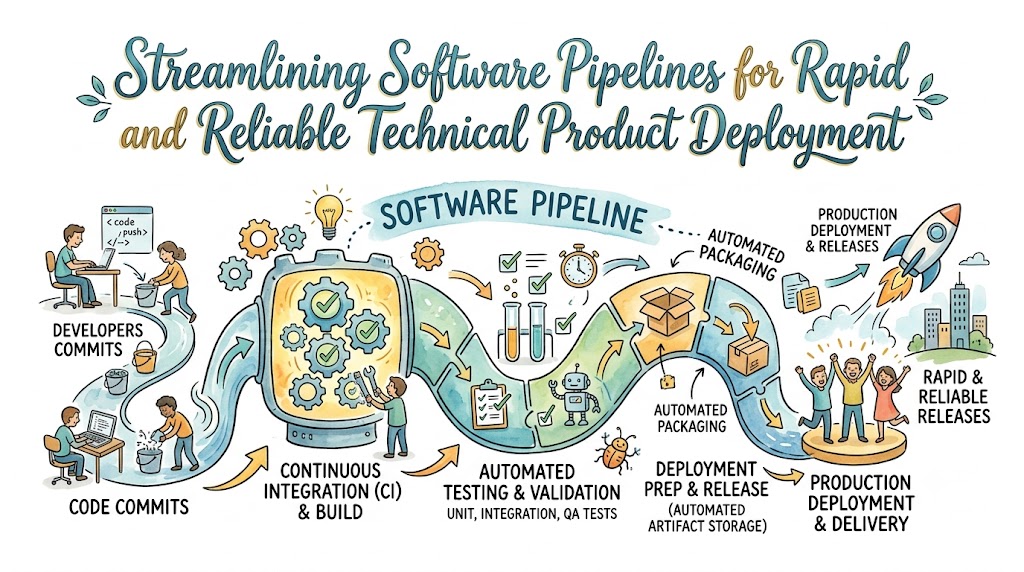
Modern software development demands a flawless balance between rapid feature delivery and ironclad codebase stability. In the fast-paced ecosystem of DevOps, engineering teams constantly struggle with fragmented code changes that trigger integration bottlenecks and delayed releases. This is exactly where Continuous Integration steps in, acting as the operational heartbeat that unifies developer contributions smoothly. By automating the build, test, and merge cycles, organizations can eliminate human error, pinpoint bugs immediately, and keep their repositories in a deployable state. Industry authorities like Rajesh kumar emphasize that choosing the right automation framework is the single most critical factor in achieving true pipeline velocity. When teams leverage powerful automation engines, they effectively transform siloed coding practices into a high-performance delivery machine.
Transitioning to an automated integration workflow ensures that every single code commit undergoes rigorous, instant verification. Consequently, developers receive rapid feedback on their pull requests, allowing them to fix flaws before they compound into massive engineering hurdles. This continuous cycle of code validation drastically mitigates the anxiety typically associated with production rollouts and software launches. Furthermore, it embeds high quality directly into the daily development workflow rather than treating it as a rushed checklist at the end of a sprint. Ultimately, mastering these automated orchestration platforms accelerates market delivery, optimizes engineering resources, and guarantees highly stable software performance.
Key Operational Concepts You Must Know
Automated Testing Matrix
Building a highly resilient automation pipeline requires the deployment of a comprehensive, multi-layered testing matrix. To begin with, isolated unit tests run instantly to validate the exact logic of individual code blocks and functions. Following this, broader integration tests execute automatically to ensure that decoupled microservices and database modules communicate flawlessly without errors.
Moreover, advanced security scanners and performance profiling tools run inside the environment to intercept vulnerabilities before compilation concludes. This structured approach acts as an unyielding gatekeeper, preventing flawed or insecure code from ever advancing to downstream staging environments. As a absolute result, engineering teams gain complete confidence because the automated pipeline identifies regressions long before manual QA analysis begins.
Shared Version Control Systems
A centralized version control system serves as the foundational single source of truth for all modern engineering operations. Developers must regularly merge their feature branches into a shared main branch, which effectively prevents isolated development silos from forming. Because team members commit code updates frequently throughout the day, merge conflicts become small, easily manageable adjustments instead of overwhelming technical challenges.
In addition, comprehensive version control tracking provides an immutable audit trail of every modification made to the system files over time. This transparency allows engineering leads to pinpoint exactly when a bug was introduced and safely revert problematic changes within seconds. Consequently, maintaining a clean, frequently refreshed mainline branch keeps the entire distributed engineering department perfectly synchronized.
Continuous Artifact Management
Once the integration pipeline successfully compiles the source files and validates the test suites, it packages the code into immutable artifacts. These compiled binaries are immediately stored in secure, centralized artifact repositories, ensuring that identical packages move across all validation environments. Because you compile an application artifact exactly once, you eliminate the unpredictable risks associated with environment-specific configuration discrepancies.
Furthermore, robust artifact management allows modern deployment engines to pull verified software packages instantly whenever a production rollout is triggered. This predictable practice establishes a highly reliable promotional pathway for applications migrating from local development workstations straight to production clusters. Therefore, tracking your compiled binaries guarantees that the software validated in staging behaves perfectly for your end-users.
Platform Implementation vs. Culture — What’s the Real Difference?
| Operational Aspect | Platform Implementation Focus | Cultural Practice Focus |
|---|---|---|
| Primary Objective | Deploying automation software, plug-ins, and infrastructure. | Shifting team behavior toward collective code accountability. |
| Core Activities | Writing pipeline scripts, configuring servers, and nodes. | Encouraging open communication, transparency, and shared learning. |
| Success Metrics | Build execution speeds, server uptime, and tool efficiency. | Reduced developer burnout, high trust, and low turnover rates. |
| Failure Resolution | Patching system configurations and updating broken tools. | Conducting blameless post-mortems to improve future processes. |
Tooling Deployment Realities
Provisioning a state-of-the-art automation infrastructure is undeniably critical, but software tools alone cannot salvage a broken engineering process. For instance, installing advanced orchestration servers and massive build clusters without cross-team alignment simply accelerates the creation of low-quality code. Organizations frequently make the mistake of believing that purchasing premium enterprise software licenses will automatically cure their delivery delays.
Instead, engineering managers must ensure that the automated platform directly aligns with the daily operational habits of the development staff. If a deployment pipeline is frustratingly slow or overly complex, developers will inevitably find creative ways to bypass the system. Excellent platform implementation requires ongoing maintenance to ensure that automated builds remain fast, predictable, accessible, and genuinely helpful.
Cultivating Shared Responsibility
A healthy, mature automation culture demands that every software developer feels personally accountable for the structural integrity of the pipeline. When an automated build fails, the entire team must prioritize fixing the main branch rather than ignoring the notification. This collaborative approach effectively breaks down the traditional walls separating feature developers from the operations teams who manage production environments.
Moreover, fostering an environment of psychological safety allows developers to own up to mistakes and participate openly in post-mortem evaluations. When engineers do not fear administrative punishment for accidental build failures, they innovate much faster and share technical insights freely. Ultimately, an automated platform thrives only when the human organization embraces a deep sense of collective code ownership.
Real-World Use Cases of Modern Operations
High-Frequency E-Commerce Updates
Enterprise e-commerce networks experience massive transactional traffic spikes and require rapid feature rollouts to maintain a competitive industry advantage. By utilizing automated orchestration tools, online shopping platforms can safely deploy new code changes multiple times throughout the day. For example, if a developer modifies the checkout digital interface, automated scripts immediately verify that payment gateways remain active.
Consequently, this instant validation prevents catastrophic cart abandonment errors that directly result in lost company revenue and damaged brand trust. Additionally, automated pipelines enable seamless blue-green deployments, allowing business teams to test new promotional tools on live traffic safely. Fast, secure code iterations ensure that the global e-commerce engine remains highly performant, secure, and responsive to consumer trends.
Financial Technology Microservices
Fintech processing applications demand absolute computational precision, strict security protocols, and zero downtime because they manage sensitive financial transactions continuously. By breaking down large monolithic architectures into containerized microservices, engineering teams can update individual banking modules independently and safely. Automated validation pipelines run strict compliance checks, code vulnerability scans, and ledger balance simulations on every single code commit.
Therefore, a software update pushed to the foreign currency exchange module will never accidentally compromise the security of the user login system. This isolated pipeline structure limits the blast radius of errors, enabling financial companies to innovate rapidly while complying with international regulations. As a direct result, modern fintech systems achieve the perfect equilibrium between agile delivery speeds and rock-solid architectural reliability.
Common Mistakes in Operations Engineering
Ignoring Broken Pipelines
Allowing a broken pipeline notification to sit unaddressed for hours is one of the most toxic operational anti-patterns an engineering team can adopt. When team members tolerate a failing build status, they quickly develop alert fatigue and overlook critical warnings on subsequent code pushes. Consequently, new code modifications accumulate on top of the original failure, making eventual debugging work incredibly complex and time-consuming.
To prevent this systemic degradation, teams must enforce a strict policy where a broken main branch halts all other non-essential feature development. Repairing the integration pipeline must immediately become the top priority for the available engineering minds on that product line. Keeping the validation sequence consistently functional ensures that the main repository remains constantly ready for emergency production hotfixes.
Insufficient Test Coverage
Relying on an automated pipeline that only executes a small handful of basic unit tests creates a highly dangerous illusion of security. If your automated testing scripts do not evaluate realistic user behaviors, broken logic will easily bypass the system into production. Developers might feel satisfied seeing a fast, green validation checkmark, but real-world users will quickly encounter breaking application bugs.
Therefore, engineering teams must continuously expand their testing profiles to include regression suites, end-to-end user flows, and API stress testing. You must also regularly audit your test suites to ensure your checks genuinely validate system health rather than simply satisfying metric quotas. Comprehensive, meaningful test coverage remains the only reliable way to guarantee stellar code quality while maintaining blazing delivery speeds.
How to Become an Operations Expert — Career Roadmap
Foundational Skill Acquisition
To build a successful career as an operations expert, you must first master the core principles of version control and operating systems. Dedicate substantial time to studying advanced branching models, complex conflict resolution, and how Unix environments handle system processes under high stress. Additionally, learn a highly versatile programming language like Python or Go to build custom automation tooling and data management scripts.
- Version Control Expertise: Master advanced Git workflows, interactive rebasing, repository hooks, and history management.
- Linux Infrastructure Administration: Understand kernel networking parameters, standard file structures, and advanced process monitoring.
- Automation Scripting Proficiency: Develop clean, maintainable infrastructure automation code to eliminate manual task execution.
- Core Network Infrastructure: Gain a deep understanding of DNS routing, load balancing configurations, and TLS/SSL security certificates.
Advanced Pipeline Architecture
Once you command the foundational skills, focus your energy on architecting scalable, containerized, and secure continuous integration pipelines. Learn how to configure cloud-native build agents that scale dynamically based on the volume of incoming developer code commits. Furthermore, explore advanced pipeline caching techniques to dramatically reduce build processing execution times from hours down to just minutes.
- Infrastructure as Code: Master enterprise orchestration tools to provision and version physical infrastructure using declarative files.
- Container and Orchestration Design: Build secure, minimal container images and manage them efficiently across compute clusters.
- Pipeline Security Hardening: Integrate secret management vaults to protect sensitive database passwords and API keys from exposure.
- System Observability Implementations: Configure comprehensive monitoring, log aggregation, and alerting dashboards to track pipeline stability.
FAQ Section
- What is the primary role of an automation engine like Jenkins in a DevOps workflow?
An automation engine acts as the central orchestrator that automatically detects code commits, builds the software application, and runs extensive testing suites. It bridges the gap between writing code and deploying products by ensuring every single change is systematically validated before moving forward.
- How do automated pipelines help minimize merge conflicts for large development teams?
Automated pipelines encourage developers to integrate their code changes into the central main branch multiple times a day instead of waiting weeks. This constant integration keeps individual code deltas small, making conflicts easy to isolate, understand, and resolve before they disrupt other engineers.
- Can legacy monolithic applications be integrated into modern automated testing pipelines?
Yes, legacy systems can absolutely be retrofitted into automated validation pipelines by wrapping their compilation and testing steps into automated scripts. While breaking the monolith into microservices offers greater speed, automating the legacy build process still drastically reduces manual verification errors.
- What metrics should engineering leaders track to measure the efficiency of their pipelines?
Engineering leaders should closely track build duration times, pipeline success rates, deployment frequencies, and the average time taken to repair broken builds. Monitoring these key metrics helps identify performance bottlenecks, optimize computing resource allocations, and improve overall developer experience.
- How does continuous integration improve security compliance within software organizations?
Continuous integration strengthens security by automatically running static application security testing tools and vulnerability scanners directly inside the build pipeline. This automated verification catches flawed dependencies, outdated libraries, and accidental secret exposures long before the application ever reaches a production server.
Final Summary
Embracing automated integration pipelines completely transforms the way modern engineering teams design, validate, and deliver software products to market. By identifying bugs early, validating every commit, and maintaining a healthy mainline branch, you effectively eliminate costly product delivery bottlenecks. This strategic operational framework not only immunizes your production systems against breaking bugs but also significantly improves developer morale by removing deployment chaos.
Investing the necessary time and engineering resources to build a mature culture centered around automated validation yields tremendous long-term business dividends. As your development pipelines become increasingly fast, stable, and predictable, your organization can pivot instantly to address evolving customer expectations. Ultimately, prioritizing continuous integration establishes a world-class technical foundation where rapid innovation and flawless product quality live together seamlessly.