The enterprise technology landscape has undergone a monumental shift. The initial wave of “AI hype” has cleared, leaving behind a strict mandate for one specific thing: proven business ROI. Organizations are no longer content to merely purchase software licenses or call API endpoints; they demand that complex data systems and agentic AI models integrate directly into their deeply nested, historically messy business workflows.
This structural evolution has pushed a highly specialized, elite role straight into the tech industry’s spotlight: The Forward Deployed Engineer (FDE).
Once a proprietary operational secret popularized by firms like Palantir, the FDE has emerged as one of the fastest-growing and highest-leverage career tracks in modern software. Job openings for FDE positions scaled an unprecedented 800% over the last 18 months alone.
Whether you are a traditional software engineer mapping out an impactful career pivot, a hiring manager scaling a deployment division, or an operator seeking to master this ecosystem, this guide serves as the definitive global standard on the FDE career track.
1. Demystifying the Role: What is an FDE?
To truly grasp the day-to-day reality of a Forward Deployed Engineer, it is best to break down the compound title itself:
- Forward Deployed: Borrowed directly from military terminology, this signifies being stationed on the front lines. You leave the isolated comfort of internal engineering headquarters to deploy into the client’s ecosystem. You work directly alongside their operators, navigating their data friction, strict compliance boundaries, and legacy infrastructure.
- Engineer: This is the most crucial element. An FDE is not an account manager, a high-level consultant, or a pre-sales specialist. FDEs are elite, hands-on-keyboard software engineers. They architect systems, refactor production systems, debug pipeline failures, and ship production-grade code daily.
The Operational Mission
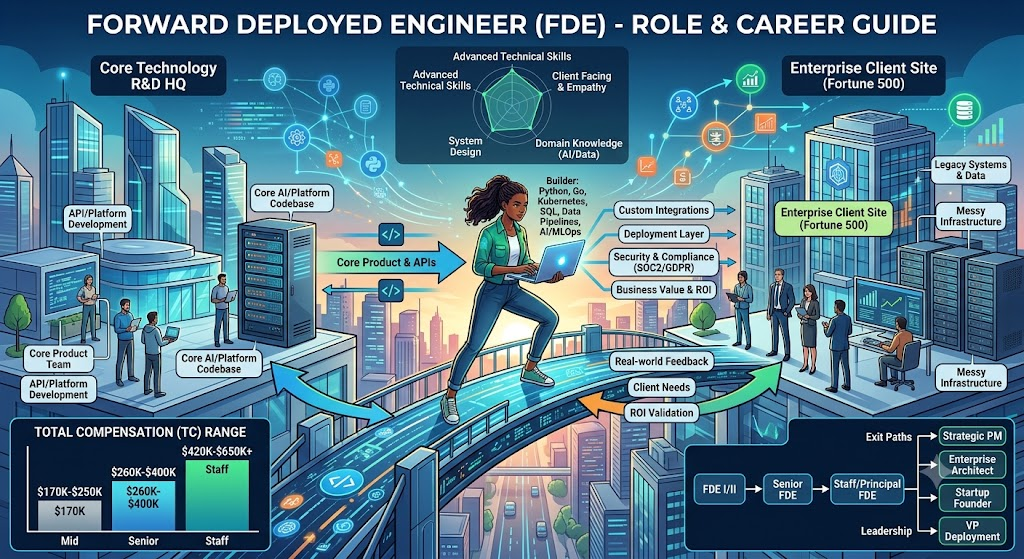
An FDE acts as the human engineering bridge between a technology company’s core platform and a customer’s chaotic operational reality.
Imagine an AI research lab building an industry-leading large language model (LLM) or orchestration engine. A multinational investment bank wants to adopt it, but their actual data is fragmented across isolated on-premise servers, restricted mainframes, and complex regulatory environments. The core engineers back at headquarters cannot stop their product roadmap to spend six months refactoring one bank’s custom database pipelines.
The FDE solves this exact problem. They embed with the client, unpack their complex architecture, build the custom data-ingestion layers, secure the infrastructure, and ensure the product realizes multi-million-dollar utility.
Code snippet
graph TD
    A[Core Platform R&D Team] -->|Core API / Foundation Engine| B(Forward Deployed Engineer)
    C[Enterprise Client Infrastructure] -->|Legacy Stacks & Isolated Data| B
    B -->|Custom Orchestration & Security Layer| D[Client Production Launch]
    D -->|Real-world Stress-Tests & Edge Cases| B
    B -->|Field Insights & Scalable Patches| A
2. Structural Comparisons: FDE vs. The Tech Ecosystem
Because the FDE role sits at the intersection of product engineering, infrastructure design, and customer relations, it is easily confused with adjacent tech roles. Let us establish clear boundaries.
Architectural Breakdown
| Functional Metric | Forward Deployed Engineer (FDE) | Core Software Engineer (SWE) | Solutions Engineer / Architect | Technical Consultant |
| Code Execution | Production-grade customer layers, data pipelines, model alignment. | Core product features, platform scalability, base APIs. | Proof-of-Concepts (PoCs), pre-sales demos, lightweight scripts. | Configuration, vendor tooling setups, basic scripts. |
| Customer Interface | Extremely High. Immersed directly with client engineers and leadership. | Extremely Low. Interacts almost exclusively with internal teams. | High. Deep involvement during sales cycles and technical discovery. | High. Delivers high-level status updates and configurations. |
| Code Ownership | Deployment wrappers, data transformation pipelines, edge-case hotfixes. | Central product codebase, internal infrastructure libraries. | Standalone sandbox demos and transient code scripts. | Client configuration files and third-party scripts. |
| Core Success Metric | Production Go-Live, system adoption, and customer retention. | Feature velocity, system uptime, and test coverage. | Customer acquisition, technical validation speed, and sales win rates. | Billable hours delivered, basic setup milestone completion. |
The Separation Principle: If a position transitions away from writing production code, or focuses primarily on pitching a product rather than engineering its integration layer, it is not an FDE track. FDEs live and die by their terminal and git commits.
3. The Core Lifecycle of an FDE Engagement
The workflow of an FDE is dynamic, moving through a clear lifecycle across every enterprise client deployment.
Code snippet
graph LR
    A[Phase 1: Discovery] --> B[Phase 2: Heavy Engineering]
    B --> C[Phase 3: Hardening]
    C --> D[Phase 4: Synthesis]
Code language: CSS (css)
Phase 1: Discovery & System Auditing
An FDE maps the customer’s technical environment. They perform deep architectural audits to uncover system constraints: Where are the primary data bottlenecks? What are the network latency boundaries? What security and compliance guardrails (e.g., SOC2, HIPAA, GDPR) must be strictly enforced?
Phase 2: Heavy Engineering & Integration
The FDE builds the actual infrastructure required to connect the company’s product to the client’s internal ecosystem. This includes:
- Designing fault-tolerant ETL pipelines to ingest, sanitize, and format messy real-world data streams.
- Containerizing core applications to deploy seamlessly within highly restrictive cloud or hybrid environments.
- Building specialized orchestration layers (such as agentic multi-step workflows or custom middleware solutions).
Phase 3: Production Hardening & Optimization
Once the application goes live, the FDE hardens the system against real-world failure. They configure deep monitoring, build telemetry, eliminate system latency, and squash production bugs that appear only under true enterprise scale.
Phase 4: Productization & Feedback Synthesis
This phase represents an FDE’s hidden leverage. Instead of building one-off custom solutions indefinitely, a top-tier FDE identifies recurring friction points across multiple clients. They synthesize these findings and work directly with the Core Product Team back at headquarters to turn custom client fixes into permanent, out-of-the-box product features.
4. The Modern FDE Skill Matrix
To survive and excel on the engineering front lines, an FDE must possess a unique combination of hard systems engineering expertise and advanced consultative intuition.
Hard Technical Skills
- Polyglot Programming & System Design: Complete fluency in modern backend ecosystems. Python is the definitive standard for data manipulation and AI orchestration, accompanied by Go, Java, or Rust for heavy systems-level performance, and TypeScript for full-stack interface adjustments.
- Data Architecture & Processing: Advanced comprehension of distributed data engines (e.g., Apache Spark), database optimization patterns (SQL vs. NoSQL, analytical OLAP vs. transactional OLTP), and modern data vector structures.
- Cloud, DevOps, & Containerization: Total mastery of Docker, Kubernetes, and major cloud providers (AWS, GCP, Azure). An FDE must understand Infrastructure as Code (IaC) via tools like Terraform, as they are regularly required to deploy complex software into completely unfamiliar network topologies.
- The Modern AI/Agentic Layer: For engineers deploying AI platforms, expertise has moved beyond calling simple APIs. FDEs must master Retrieval-Augmented Generation (RAG) optimization, vector database indexing, multi-agent frameworks, and AI observability architectures to trace and evaluate model workflows in real-time.
Advanced Behavioral Skills
- High-Empathy Communication: The ability to explain deep technical system trade-offs to a client’s non-technical executives while maintaining absolute technical respect when debating with the client’s senior architects.
- Comfort with Ambiguity: Client codebases are rarely documented correctly and are often plagued by tech debt. An FDE must remain completely unfazed when walking into a completely blind engineering ecosystem.
- Calm Under Pressure: When a production system managing multi-million-dollar transactions experiences a critical failure, the FDE provides steady, clear technical leadership to systematically resolve the crisis.
5. Global Compensation Landscape & Market Value
Because FDEs possess a highly sought-after combination of technical expertise and business acumen, their market value has skyrocketed. They directly influence enterprise account execution and contract renewals, meaning they command premium compensation packages that frequently outperform traditional engineering ladders.
Total Compensation (TC) Market Benchmarks
| Seniority Tier | Base Salary Range | Variable/Equity Component | Total Compensation Expectations |
| FDE I / II (Mid-Level) | $140,000 – $185,000 | $30,000 – $65,000 | $170,000 – $250,000 |
| Senior FDE | $185,000 – $240,000 | $75,000 – $160,000 | $260,000 – $400,000 |
| Staff / Principal FDE | $240,000 – $310,000 | $180,000 – $340,000+ | $420,000 – $650,000+ |
The Value Factor: Why is compensation so high? A core software engineer builds tools that incrementally optimize a product for a broad user base. A single FDE, however, can unblock, stabilize, or expand a $15 million enterprise contract simply by architecting a custom integration that no one else could figure out.
6. The FDE Career Trajectory: Where Does It Lead?
The Forward Deployed track offers an incredibly dynamic career path, exposing engineers to a wide variety of business models and complex technical architectures in a fraction of the time seen in traditional software roles.
Code snippet
graph TD
    A[FDE I / II] --> B[Senior FDE]
    B --> C[Staff / Principal FDE]
    C --> D[VP / Global Head of FDE]
    B --> E[Exit: Strategic Product Manager]
    C --> F[Exit: Enterprise Architecture Lead / CTO]
    C --> G[Exit: Tech Co-Founder / CEO]
Code language: CSS (css)
Vertical Growth Inside the Track
- FDE I / II: Focuses on writing reliable integration code, configuring pipelines based on established design patterns, and executing pre-scoped deployment milestones.
- Senior FDE: Exercises end-to-end technical ownership over massive enterprise accounts. They design the custom orchestration strategies, lead client-facing workshops, and supervise junior deployment engineers.
- Staff / Principal FDE: Detects macro trends across dozens of client deployments globally. They design standard reference architectures, create reusable developer tools that simplify future deployments, and heavily influence the core R&D product roadmaps.
- VP / Global Head of Forward Deployment: Operates as an executive leader, scaling global deployment organizations, engineering team allocations across strategic accounts, and aligning engineering execution with global go-to-market strategies.
High-Leverage Exit Trajectories
Should an FDE choose to pivot away from the deployment track, their unique hybrid skill set makes them highly competitive candidates for premium tech positions:
- Strategic Product Management (PM): Because FDEs spend years observing exactly how enterprise customers use—and break—software, they possess the practical user empathy and technical depth needed to make exceptional product leaders.
- Enterprise Architecture / Office of the CTO: The broad pattern recognition gained from auditing dozens of different enterprise technology stacks makes former FDEs uniquely qualified to steer high-level digital transformations and corporate architectural strategies.
- Technology Co-Founder / Startup CEO: Building a successful tech company requires an individual to build solid software and communicate effectively with paying customers simultaneously. This dual mastery is exactly what the Forward Deployed track builds by design.


Leave a Reply
You must be logged in to post a comment.