Introduction
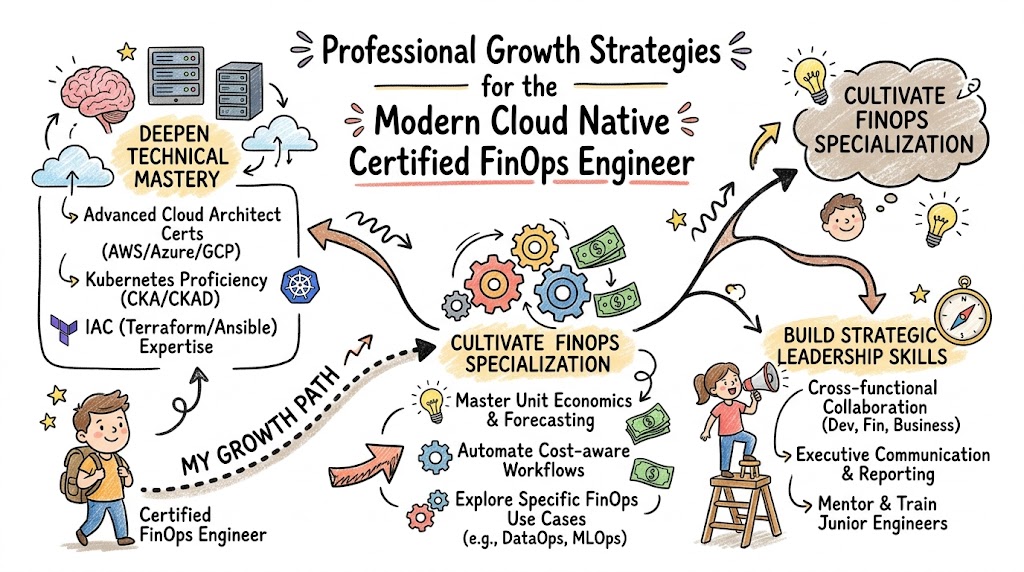
Modern cloud environments demand a sophisticated approach to cost management that goes beyond traditional budgeting. This guide specifically targets professionals looking to master the Certified FinOps Engineer designation, providing a roadmap for navigating the intersection of finance and engineering. As organizations scale their cloud infrastructure, the need for individuals who can balance performance with fiscal responsibility has skyrocketed. By following this path at FinOpsSchool, engineers and managers can gain the technical depth required to drive significant architectural changes that optimize spend. This comprehensive manual helps you evaluate the curriculum, understand the global market demand, and determine which certification level aligns with your current career trajectory in platform engineering.
What is the Certified FinOps Engineer?
The Certified FinOps Engineer represents a shift from theoretical cost-cutting to technical cloud financial management. This program exists because standard DevOps practices often overlook the granular financial impact of infrastructure decisions, leading to “cloud bill shock.” It focuses on production-ready skills, teaching engineers how to automate cost visibility and implement rightsizing at the code level. Unlike general business courses, this certification aligns directly with modern engineering workflows by treating cost as a primary non-functional requirement. Enterprises now prioritize these skills to ensure their cloud-native architectures remain sustainable and profitable over the long term.
Who Should Pursue Certified FinOps Engineer?
Site Reliability Engineers and DevOps professionals are the primary candidates for this certification because they directly control the levers of cloud consumption. Cloud architects and platform engineers also benefit significantly, as it allows them to design cost-aware systems from the inception phase. Security and data professionals find value here by learning how to account for the massive egress and storage costs associated with modern analytics. Engineering managers and technical leaders in both India and global markets should pursue this to bridge the communication gap between finance teams and developers. Even beginners looking to enter the cloud ecosystem can use this to differentiate themselves in a competitive job market.
Why Certified FinOps Engineer is Valuable in and Beyond
The demand for cloud financial expertise is growing faster than the supply of qualified engineers, ensuring long-term career longevity. As enterprises move past initial cloud migration, they enter an era of optimization where efficiency becomes the ultimate competitive advantage. Mastering these principles helps professionals remain relevant even as specific cloud tools or providers change, because the logic of value-based engineering is universal. The return on time and career investment is substantial, often leading to specialized roles with higher compensation and greater organizational influence. Companies are rapidly adopting these frameworks to transform their IT departments from cost centers into value drivers.
Certified FinOps Engineer Certification Overview
The program is delivered via the official portal and hosted on the Website name. It utilizes a practical assessment approach that moves beyond simple multiple-choice questions to validate real-world technical competency. The certification structure is designed to be cumulative, ensuring that candidates first master the vocabulary before moving into complex automation and policy-driven governance. Ownership of the certification rests with a recognized body that updates the curriculum regularly to reflect changes in cloud billing APIs and industry standards. This structured approach ensures that a certified individual can immediately contribute to an enterprise-level cloud financial management team.
Certified FinOps Engineer Certification Tracks & Levels
The certification path starts with the Foundation level, which establishes a baseline for understanding the three phases of the cloud cost lifecycle. Moving to the Professional level, the focus shifts toward implementation, requiring candidates to demonstrate how to integrate financial data into CI/CD pipelines. The Advanced level is reserved for those who can architect multi-cloud governance frameworks and lead organizational culture shifts. Specialization tracks allow professionals to lean into DevOps-focused automation or SRE-focused performance-cost trade-offs. These levels are strategically aligned with career progression, moving from individual contributor tasks to high-level strategic leadership roles.
Complete Certified FinOps Engineer Certification Table
| Track | Level | Who it’s for | Prerequisites | Skills Covered | Recommended Order |
| Core Engineering | Foundation | Aspiring Engineers | Basic Cloud Knowledge | Cost Allocation, Visibility | 1 |
| Core Engineering | Professional | SREs, DevOps | Foundation Cert | Automation, Unit Metrics | 2 |
| Strategy | Advanced | Architects, Leads | Professional Cert | Governance, Multi-cloud | 3 |
| Operations | Specialty | Data/Fin Analysts | Basic Finance | Forecasting, Showback | Optional |
Detailed Guide for Each Certified FinOps Engineer Certification
Certified FinOps Engineer – Foundation
What it is
This certification validates a foundational understanding of the principles and terminology required to participate in a cloud financial management team. It ensures you understand how cloud billing differs from traditional data center procurement.
Who should take it
It is suitable for junior cloud engineers, finance associates, and procurement specialists who are new to the cloud-native ecosystem. It serves as an entry point for anyone needing a common language for cost discussions.
Skills you’ll gain
- Mastery of the Inform, Optimize, and Operate phases.
- Ability to map cloud tags to business units and cost centers.
- Understanding of shared cost allocation and unblended rates.
Real-world projects you should be able to do
- Create a basic cloud cost visibility dashboard for a small team.
- Identify orphaned resources and unattached storage volumes.
Preparation plan
- 7–14 days: Intensive study of the official practitioner guide and core terminology.
- 30 days: Practical exploration of cloud billing consoles and practice exams.
- 60 days: Deep dive into case studies and organizational change management strategies.
Common mistakes
Candidates often underestimate the importance of the cultural elements, focusing too much on the technical tools rather than the collaborative process between departments.
Best next certification after this
- Same-track option: Certified FinOps Engineer – Professional
- Cross-track option: Cloud Practitioner (AWS/Azure/GCP)
- Leadership option: Project Management Professional (PMP)
Certified FinOps Engineer – Professional
What it is
This level validates the ability to implement and automate FinOps practices within an engineering organization. It focuses on the “how” of technical cost optimization and policy enforcement.
Who should take it
Intermediate to senior DevOps engineers and SREs who are responsible for infrastructure efficiency should pursue this level. It is for those who need to build automated guardrails.
Skills you’ll gain
- Building automated rightsizing scripts and scheduling.
- Implementing “Cost as Code” within Terraform or CloudFormation.
- Calculating unit economics for specific microservices.
Real-world projects you should be able to do
- Automate the shutdown of non-production environments after hours.
- Build a notification system that alerts developers of cost anomalies in real-time.
Preparation plan
- 7–14 days: Review of advanced billing APIs and programmatic discount models.
- 30 days: Hands-on lab work creating automation scripts for resource management.
- 60 days: Implementing a pilot program for cost optimization in a test environment.
Common mistakes
Focusing solely on cost-cutting without considering the performance impact or developer experience is a frequent error at this level.
Best next certification after this
- Same-track option: Certified FinOps Engineer – Advanced
- Cross-track option: Certified Kubernetes Administrator (CKA)
- Leadership option: Engineering Manager Certification
Choose Your Learning Path
DevOps Path
This path emphasizes integrating financial feedback loops directly into the software development lifecycle. You will learn to use plugins and APIs to show developers the cost of their infrastructure changes during the pull request phase. The goal is to move “cost” to the left, making it a design consideration rather than an afterthought. This ensures that every deployment is fiscally sound from day one.
DevSecOps Path
In this track, you connect the dots between resource security and resource efficiency. Often, a misconfigured or insecure resource is also an expensive one, such as an open storage bucket or an unthrottled API. You will learn how to write policies that enforce both security standards and budget constraints simultaneously. This holistic approach protects the organization from both data breaches and financial leaks.
SRE Path
Site Reliability Engineers focus on the trade-offs between system availability, performance, and cost. This path teaches you how to incorporate “cost” into your Service Level Objectives (SLOs) and Error Budgets. You will learn to identify when the cost of additional redundancy exceeds the business value of that uptime. This creates a more balanced and sustainable approach to system reliability.
AIOps Path
This specialization focuses on using machine learning models to predict future cloud spend and detect anomalies that humans might miss. You will learn how to feed historical billing data into AI engines to create more accurate budgets and forecasts. This path is essential for large-scale environments where manual cost tracking is no longer feasible. It enables proactive rather than reactive financial management.
MLOps Path
Machine learning workloads are notoriously expensive due to high GPU and data processing requirements. This track teaches you how to optimize the training and deployment of models to keep research and development costs under control. You will learn about spot instance usage for training and efficient model serving architectures. This ensures that your AI initiatives remain viable and don’t drain the company’s resources.
DataOps Path
Data pipelines often involve massive egress fees and storage costs that can spiral out of control quickly. This path focuses on the financial management of big data ecosystems like Snowflake, Databricks, or Hadoop clusters. You will learn how to implement lifecycle policies for data and optimize query performance to reduce compute costs. This is critical for organizations that rely heavily on data-driven decision-making.
FinOps Path
This is the core path for those who want to dedicate their careers specifically to the discipline of Cloud Financial Management. It covers everything from executive reporting and stakeholder management to deep technical optimization. You will learn how to build a FinOps Center of Excellence (CoE) that serves the entire organization. This path prepares you for roles like FinOps Director or Head of Cloud Optimization.
Role → Recommended Certified FinOps Engineer Certifications
| Role | Recommended Certifications |
| DevOps Engineer | Certified FinOps Engineer (Professional), CKA |
| SRE | Certified FinOps Engineer (Professional), Chaos Engineering |
| Platform Engineer | Certified FinOps Engineer (Advanced), Terraform Associate |
| Cloud Engineer | Certified FinOps Engineer (Foundation), AWS/Azure Architect |
| Security Engineer | Certified FinOps Engineer (Foundation), CISSP |
| Data Engineer | Certified FinOps Engineer (Professional), Big Data Specialty |
| FinOps Practitioner | Certified FinOps Engineer (Advanced), Cloud Digital Leader |
| Engineering Manager | Certified FinOps Engineer (Foundation), ITIL |
Next Certifications to Take After Certified FinOps Engineer
Same Track Progression
Deep specialization involves moving toward the Advanced levels of the FinOps framework. This includes mastering multi-cloud billing nuances and complex commitment-based discounts like Savings Plans and Reserved Instances across different providers. You should focus on becoming an expert in the “Operate” phase, where the focus is on continuous improvement and culture.
Cross-Track Expansion
To broaden your impact, consider certifications in Cloud Architecture or Container Orchestration. Understanding the underlying technology (like Kubernetes or Serverless) more deeply allows you to find more sophisticated optimization opportunities. Being able to speak both the language of the CFO and the Lead Architect makes you an invaluable asset to any enterprise.
Leadership & Management Track
If you aim for leadership, look toward IT Governance or Project Management certifications. Transitioning to a leadership role in FinOps requires the ability to influence C-suite executives and change organizational behavior. Mastering the soft skills of negotiation and strategic planning will help you move from technical execution to organizational strategy.
Training & Certification Support Providers for Certified FinOps Engineer
DevOpsSchool
This provider offers extensive resources for professionals looking to master the intersection of DevOps and cloud financial management. They focus on providing practical, hands-on labs that simulate real-world production environments, ensuring students can apply what they learn immediately. Their curriculum is updated frequently to keep pace with the rapidly evolving cloud landscape, making them a reliable choice for technical training.
Cotocus
Known for their specialized approach to cloud-native technologies, this organization provides targeted coaching for engineers seeking to validate their FinOps skills. They emphasize the importance of automation and policy-driven governance, helping students build the technical guardrails necessary for modern cloud environments. Their trainers are often industry veterans who bring years of practical experience to the classroom.
Scmgalaxy
As a community-driven platform, they offer a wealth of knowledge regarding configuration management and how it relates to cost optimization. Their resources help engineers understand the importance of versioning infrastructure to track changes that impact the cloud bill. They provide a supportive environment for learners to share experiences and best practices in the realm of financial engineering.
BestDevOps
This training center focuses on delivering high-quality education for various cloud and DevOps certifications, including financial management tracks. They provide a structured learning path that guides students from foundational concepts to advanced technical implementation. Their focus is on ensuring that candidates not only pass the exam but also gain a deep understanding of the subject matter.
devsecopsschool.com
This platform specializes in the integration of security and operations, with a strong focus on how these disciplines intersect with cloud costs. They teach students how to identify “expensive” security flaws and how to optimize resource usage without compromising the organization’s security posture. Their approach is holistic, treating cost, security, and performance as equally important pillars.
sreschool.com
Focused on reliability and performance, this provider helps Site Reliability Engineers understand the financial implications of their system designs. They offer modules on how to include cost as a metric in observability dashboards and how to manage error budgets with financial constraints. This training is essential for SREs who want to take full ownership of their service’s health.
aiopsschool.com
This organization provides training on using artificial intelligence to manage and optimize IT operations. They specifically cover how machine learning can be used to forecast cloud spend and detect anomalies in billing data. Their courses are designed for engineers who want to stay at the forefront of automated infrastructure management.
dataopsschool.com
Specializing in the data lifecycle, this provider teaches engineers how to manage the significant costs associated with big data and analytics. They focus on optimizing storage, compute, and egress for large-scale data pipelines. Their training is crucial for organizations that need to scale their data operations without breaking the budget.
finopsschool.com
As a dedicated resource for the FinOps community, they offer the most direct and comprehensive training for the Certified FinOps Engineer designation. They host the official certification programs and provide a wide array of resources for practitioners at all levels. Their focus is entirely on the discipline of cloud financial management and its practical application in the enterprise.
Frequently Asked Questions (General)
- How difficult is the certification exam for a technical person?The exam is moderately difficult as it requires a mix of technical cloud knowledge and an understanding of financial accounting principles.
- How long does it typically take to prepare for the foundation level?Most professionals with basic cloud experience can prepare for the foundation level within two to four weeks of consistent study.
- Are there any specific prerequisites before I can take the professional exam?Usually, you are expected to have a foundational certification or a significant amount of hands-on experience in cloud operations.
- What is the return on investment for this specific certification?Engineers with these skills often see a significant salary increase and are eligible for specialized roles that are in high demand.
- Should I take this before or after a cloud architect certification?It is often beneficial to have a basic cloud architect certification first to understand the services you will be optimizing.
- Does this certification cover multiple cloud providers like AWS and Azure?Yes, the core principles are cloud-agnostic and apply to all major providers, though specific examples may use AWS, Azure, or GCP.
- How often do I need to renew my certification status?Typically, these certifications remain valid for two to three years, after which you may need to retake the exam or earn continuing education credits.
- Is this certification recognized by major enterprises globally?Yes, it is increasingly becoming a standard requirement for cloud teams in Fortune 500 companies and large-scale startups.
- Can a non-technical manager benefit from this certification?Absolutely, the foundation level is specifically designed to help managers understand the technical language used by their engineering teams.
- Do I need to know how to code to pass the professional level?While deep coding isn’t always required, understanding scripts and automation logic is highly beneficial for the professional and advanced tracks.
- Are there practice exams available to help me prepare?Yes, the official portal and various training providers offer practice tests that simulate the actual exam environment.
- Will this certification help me if my company is still on-premises?While focused on the cloud, the principles of resource efficiency and financial accountability are valuable in any IT environment.
FAQs on Certified FinOps Engineer
- What specific technical skills are tested in the Certified FinOps Engineer program?Candidates are tested on their ability to use cloud billing APIs, implement tagging strategies, and use automation tools for rightsizing.
- How does this certification differ from a standard Cloud Practitioner exam?Standard cloud exams focus on service features, while this focuses specifically on the financial management and optimization of those services.
- Is the exam proctored online or do I need to visit a center?The exam is typically available through online proctored platforms, allowing you to take it from the comfort of your home or office.
- What are the passing scores required for the various levels?Passing scores vary by level but generally fall between 70% and 80% to ensure a high standard of competency.
- Does the program include hands-on labs with real cloud accounts?Yes, the professional and advanced levels often include lab components where you must solve optimization problems in a live environment.
- Can I skip the foundation level and go straight to professional?It is usually recommended to follow the sequence, but some providers allow candidates with extensive experience to jump to higher levels.
- How does the certification address multi-cloud and hybrid-cloud scenarios?The curriculum includes specific modules on normalizing data across different providers and managing costs in a hybrid infrastructure.
- Are there community groups available for certified individuals?Yes, becoming certified usually grants you access to exclusive forums and networking groups where practitioners share real-world advice.
Final Thoughts: Is Certified FinOps Engineer Worth It?
In an era where cloud costs are under intense scrutiny, the Certified FinOps Engineer designation is a powerful differentiator for any technical professional. It moves you from being a person who simply builds systems to someone who builds efficient, sustainable business assets. The shift in mindset—viewing cost as a technical metric similar to latency or uptime—is what the industry needs right now. If you want to elevate your career and have a seat at the table where strategic business decisions are made, this path is highly recommended. It provides a structured way to gain skills that are both rare and in high demand across the global tech landscape.




Leave a Reply
You must be logged in to post a comment.