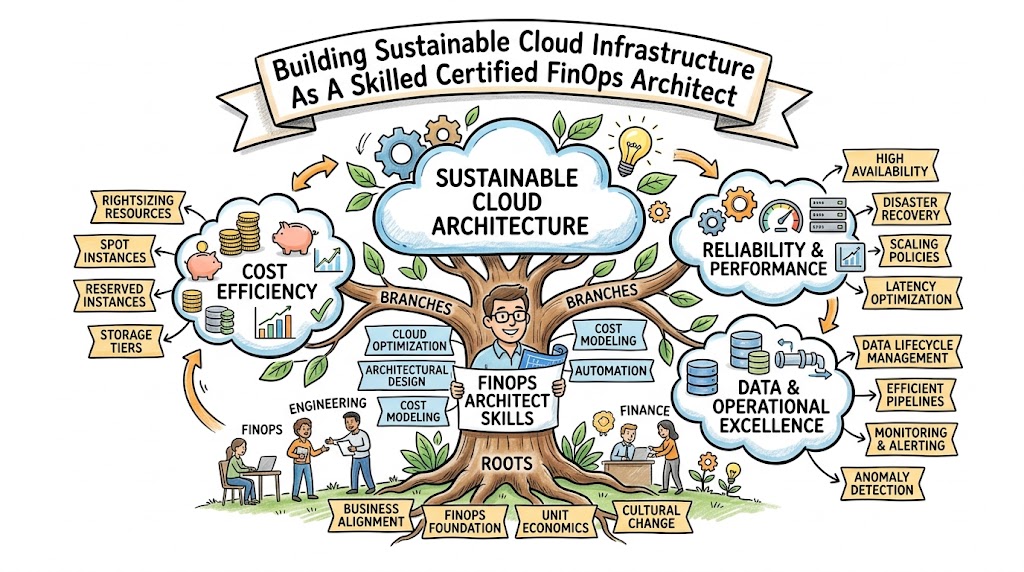
Effective cloud cost management requires more than just basic budgeting; it demands a deep architectural understanding of how cloud resources consume capital. This guide addresses professionals aiming to master the Certified FinOps Architect designation, offering a clear roadmap for engineers and managers navigating the intersection of finance and cloud engineering. As organizations scale their digital footprints, the ability to design cost-efficient systems becomes a core competency for modern SRE and DevOps practitioners. This comprehensive overview helps you evaluate the curriculum, understand the technical requirements, and decide how this credential fits into your long-term career trajectory at FinOpsSchool.
What is the Certified FinOps Architect?
The Certified FinOps Architect represents a shift from reactive cost-cutting to proactive, architecture-driven financial accountability. It exists to bridge the gap between high-level financial goals and the granular technical decisions made by cloud engineers every day. Instead of focusing solely on theoretical frameworks, this program emphasizes production-focused learning and technical optimization.
By aligning with modern enterprise practices, it teaches engineers how to bake fiscal responsibility into the software development lifecycle. This ensures that every architectural choice, from instance selection to data transfer patterns, is made with both performance and price in mind.
Who Should Pursue Certified FinOps Architect?
This certification is designed for a broad spectrum of technical professionals including Cloud Architects, Site Reliability Engineers (SREs), and Platform Engineers. It is equally valuable for experienced DevOps practitioners who need to justify infrastructure spend and Engineering Managers who oversee large-scale cloud budgets.
Beginners find a structured path to understanding cloud economics, while senior professionals gain the framework needed to lead enterprise-wide FinOps transformations. Given the global shift toward cloud efficiency, this program is highly relevant for professionals in India and international markets where cloud waste is a primary board-level concern.
Why Certified FinOps Architect is Valuable and Beyond
The demand for FinOps expertise continues to grow as enterprises realize that moving to the cloud does not automatically result in savings. Professionals who hold this architect-level knowledge possess a longevity that transcends specific cloud providers or temporary tooling trends.
Acquiring these skills ensures that you stay relevant in an era where “efficiency-first” is the new mandate for engineering teams. The return on investment for this certification is reflected in higher-level strategic roles and the ability to drive significant bottom-line impact for your organization.
Certified FinOps Architect Certification Overview
The program is delivered via the official curriculum and is hosted on the FinOpsSchool platform. It utilizes a practical assessment approach that values hands-on ownership and the ability to solve complex, real-world financial engineering problems.
The structure is designed to move professionals through various levels of competency, ensuring that the certification is not just a badge but a validation of technical skill. It focuses on the mechanics of cloud billing, the architecture of cost-effective systems, and the culture of shared accountability.
Certified FinOps Architect Certification Tracks & Levels
The certification hierarchy typically begins with a foundation level to establish a common language and set of principles. As practitioners progress to the professional and advanced levels, the focus shifts toward complex multi-cloud environments and advanced automation.
Specialization tracks allow SREs to focus on cost-aware reliability, while DevOps tracks might emphasize integrating cost metrics into CI/CD pipelines. This alignment ensures that your learning path directly supports your current job function and your next career move.
Complete Certified FinOps Architect Certification Table
| Track | Level | Who it’s for | Prerequisites | Skills Covered | Recommended Order |
| Core FinOps | Foundation | New Practitioners | Cloud Basics | Unit Economics, Tagging | 1st |
| Architecture | Professional | Cloud Architects | 2+ Years Cloud Exp | Scaling, RI/SP Planning | 2nd |
| Engineering | Advanced | SREs/DevOps | 5+ Years Tech Exp | Cost Automation, Tooling | 3rd |
Detailed Guide for Each Certified FinOps Architect Certification
Certified FinOps Architect – Foundation Level
What it is
This entry-level certification validates a professional’s understanding of basic FinOps principles and the lifecycle of cloud cost management. It ensures a baseline level of literacy regarding cloud billing and organizational accountability.
Who should take it
Software engineers, finance associates, and project managers who are new to cloud financial management should start here. It is ideal for those needing to understand the “why” behind FinOps.
Skills you’ll gain
- Mapping cloud spend to business units.
- Understanding cloud billing data structures.
- Implementing basic tagging and labeling strategies.
Real-world projects you should be able to do
- Create a basic cloud spend dashboard for a single team.
- Identify orphaned resources and unattached storage volumes.
Preparation plan
- 7–14 days: Review official terminology and core principles.
- 30 days: Explore cloud provider billing consoles and pricing calculators.
- 60 days: Deep dive into case studies and organizational culture shifts.
Common mistakes
Many candidates focus too much on specific tool features rather than the underlying FinOps culture and lifecycle phases.
Best next certification after this
- Same-track: Professional FinOps Architect
- Cross-track: DevOps Practitioner
- Leadership: FinOps Certified Professional
Certified FinOps Architect – Professional Level
What it is
This certification validates the ability to design complex cloud architectures that are inherently cost-optimized. It focuses on strategic commitment coverage and architectural tradeoffs.
Who should take it
Senior Cloud Engineers and Solutions Architects who are responsible for large-scale infrastructure design should pursue this level.
Skills you’ll gain
- Advanced Reserved Instance and Savings Plan modeling.
- Designing for spot instance utilization.
- Analyzing data transfer costs across regions.
Real-world projects you should be able to do
- Design a multi-region architecture with optimized egress costs.
- Implement an automated rightsizing workflow for Kubernetes clusters.
Preparation plan
- 7–14 days: Focus on advanced discount mechanisms and commitment strategies.
- 30 days: Perform architectural reviews of existing cloud deployments.
- 60 days: Master the mathematical models behind cloud unit economics.
Common mistakes
Candidates often struggle with the complex math involved in calculating unit costs for shared resources.
Best next certification after this
- Same-track: Advanced FinOps Engineer
- Cross-track: Site Reliability Engineer
- Leadership: Engineering Director (FinOps Focus)
Choose Your Learning Path
DevOps Path
In the DevOps path, the focus remains on integrating financial feedback loops into the deployment process. Engineers learn to treat “cost” as a first-class metric alongside performance and security. This path emphasizes the creation of “cost-aware” pipelines that alert developers to the financial impact of their code changes before they reach production. It is essential for teams looking to automate cost governance.
DevSecOps Path
The DevSecOps path combines cost optimization with security compliance and risk management. Professionals learn how security configurations, such as high-retention logging or expensive firewall rules, impact the cloud bill. By understanding these trade-offs, architects can design systems that are both secure and fiscally responsible. This ensures that security remains affordable even as the threat landscape expands.
SRE Path
Site Reliability Engineers use this path to balance the “Error Budget” with the actual financial budget. This involves understanding the cost of high availability and making informed decisions about redundancy versus expense. SREs learn to optimize cloud resources for both reliability and cost-efficiency. This path is critical for maintaining uptime without over-provisioning infrastructure.
AIOps Path
The AIOps path leverages machine learning to predict cloud spend and identify anomalies in real-time. Practitioners focus on using AI tools to automate the rightsizing of resources based on historical usage patterns. This path is ideal for those managing massive, fluctuating workloads that are impossible to optimize manually. It represents the future of automated cloud financial management.
MLOps Path
In the MLOps path, the challenge is managing the high costs associated with GPU instances and large datasets. Engineers learn how to optimize training jobs and model deployment for cost without sacrificing performance. This path addresses the unique financial hurdles of the machine learning lifecycle. It is a vital track for data science teams operating at scale.
DataOps Path
The DataOps path focuses on the financial implications of data storage, processing, and movement. Architects learn to choose the right storage tiers and processing engines based on the lifecycle of the data. This path is designed to prevent “data swamps” from becoming financial burdens. It is essential for organizations dealing with petabyte-scale data lakes.
FinOps Path
The pure FinOps path is dedicated to the practitioners who manage the overall strategy, governance, and culture. It focuses on the communication between finance, procurement, and engineering departments. This path emphasizes reporting, forecasting, and the implementation of organizational change. It is the backbone of any successful FinOps adoption within an enterprise.
Role → Recommended Certified FinOps Architect Certifications
| Role | Recommended Certifications |
| DevOps Engineer | FinOps Associate, Professional Cloud Developer |
| SRE | FinOps Professional, Site Reliability Associate |
| Platform Engineer | FinOps Architect, Infrastructure Specialist |
| Cloud Engineer | FinOps Associate, Cloud Solutions Architect |
| Security Engineer | FinOps Specialist, Cloud Security Professional |
| Data Engineer | DataOps FinOps, Big Data Architect |
| FinOps Practitioner | Professional FinOps, Advanced FinOps Architect |
| Engineering Manager | FinOps Leadership, IT Financial Management |
Next Certifications to Take After Certified FinOps Architect
Same Track Progression
Deepening your specialization in FinOps involves moving toward advanced certifications that cover niche areas like multi-cloud governance or cloud-native cost management. This ensures you remain the subject matter expert for your organization’s financial engineering strategies.
Cross-Track Expansion
Broadening your skills by pursuing SRE or Security certifications allows you to see the bigger picture. Understanding how cost impacts reliability and security makes you a more versatile architect capable of leading cross-functional teams.
Leadership & Management Track
For those looking to move into management, focusing on certifications that cover business strategy and organizational leadership is key. This helps you transition from being a technical implementer to a strategic decision-maker who influences the entire company’s cloud spend.
Training & Certification Support Providers for Certified FinOps Architect
DevOpsSchool
This provider offers extensive training programs that focus on the practical application of DevOps and FinOps methodologies. Their curriculum is designed for working professionals who need to balance their learning with a full-time career. They emphasize hands-on labs and real-world scenarios to ensure students can apply what they learn immediately.
Cotocus
This organization provides specialized consulting and training services aimed at enterprise-level transformations. They focus on the integration of various “Ops” disciplines to create a cohesive engineering culture. Their approach is highly collaborative, often working directly with teams to solve specific architectural challenges related to cost and performance.
Scmgalaxy
As a long-standing community and training hub, this provider offers a wealth of resources for software configuration and lifecycle management. Their FinOps training is grounded in the reality of continuous integration and delivery. They provide a supportive environment for engineers looking to expand their technical toolkit with financial engineering skills.
BestDevOps
This provider focuses on delivering high-quality, practical training for the modern cloud era. Their programs are updated frequently to reflect the latest changes in cloud provider billing and tooling. They aim to produce engineers who are not only technically proficient but also financially aware of their infrastructure choices.
devsecopsschool.com
This platform focuses specifically on the intersection of security and development within the DevOps lifecycle. Their training helps professionals understand how to build secure systems that do not break the bank. They emphasize the importance of “shifting left” for both security and cost considerations.
sreschool.com
Dedicated to the discipline of Site Reliability Engineering, this provider helps engineers build systems that are both reliable and efficient. Their FinOps-related content focuses on the cost of reliability and how to manage it effectively. This is a go-to resource for SREs looking to improve their architectural skills.
aiopsschool.com
This school addresses the emerging field of AI-driven operations. Their training covers how to use automation and machine learning to optimize infrastructure and predict costs. It is ideal for engineers looking to stay at the cutting edge of cloud management technology and automated governance.
dataopsschool.com
Focused on the data lifecycle, this provider teaches engineers how to manage large-scale data environments efficiently. Their curriculum includes deep dives into the costs of data processing and storage. They help data professionals become more aware of the financial impact of their architectural decisions.
finopsschool.com
As a primary host for FinOps certifications, this site provides the official framework and resources needed to master cloud financial management. Their focus is entirely on the FinOps lifecycle and creating a community of practice. It is the central authority for anyone serious about becoming a Certified FinOps Architect.
Frequently Asked Questions
- How difficult is the Certified FinOps Architect exam?
The difficulty is moderate to high, as it requires a blend of technical cloud knowledge and financial literacy. - What is the typical time commitment for preparation?
Most professionals spend between 30 to 60 days preparing, depending on their existing cloud experience. - Are there any specific prerequisites for the foundation level?
While there are no hard prerequisites, a basic understanding of cloud services and billing is highly recommended. - What is the return on investment for this certification?
Professionals often see increased salary potential and opportunities for more senior, strategic roles within their organizations. - Does the certification focus on a specific cloud provider like AWS or Azure?
No, the principles are designed to be cloud-agnostic, though examples from major providers are frequently used. - In what order should I take the certifications?
It is recommended to start with the Foundation, followed by Professional, and then the Advanced level. - Is there a hands-on component to the exam?
The architect-level exams often include scenario-based questions that test your ability to apply concepts to real-world problems. - How long does the certification remain valid?
Most certifications in this field are valid for two to three years, after which recertification is required to ensure skills remain current. - Can managers benefit from this technical certification?
Yes, it provides managers with the technical vocabulary and framework needed to lead engineering teams effectively. - Are there community resources available for study?
Yes, platforms like FinOpsSchool offer forums, study groups, and documentation to assist candidates. - How does this certification differ from a standard Cloud Architect cert?
This certification specifically prioritizes financial efficiency and unit economics over general infrastructure design. - Is this program recognized globally?
Yes, the framework is based on industry standards used by major enterprises worldwide, including those in India.
FAQs on Certified FinOps Architect
- What specific architectural patterns does the Certified FinOps Architect cover?
The curriculum focuses on patterns for scalability, serverless cost models, and multi-region data egress optimization to ensure minimal financial waste. - How does this certification handle the concept of “Unit Economics”?
It teaches you how to calculate the cost of a single business transaction, allowing for more accurate forecasting and value measurement. - Does the exam cover automated remediation for cost spikes?
Yes, it explores the use of policy-as-code and automated scripts to identify and stop runaway cloud costs before they escalate. - Is there a focus on Kubernetes cost management?
Given the industry’s shift toward containers, the program includes significant content on managing and allocating costs within shared Kubernetes clusters. - How are “Commitment Discounts” covered in the professional level?
Architects learn to model and manage complex portfolios of Reserved Instances and Savings Plans to maximize discount coverage across the organization. - Does the certification address the cultural side of FinOps?
Absolutely, it provides strategies for breaking down silos between engineering and finance teams to foster a culture of shared responsibility. - What is the role of “Tagging and Labeling” in the curriculum?
It is treated as the foundational metadata layer required for accurate cost allocation and visibility across all cloud resources. - How does an architect evaluate “Build vs. Buy” from a FinOps perspective?
The program provides a framework for analyzing the total cost of ownership for custom-built solutions compared to third-party managed services.
Final Thoughts: Is Certified FinOps Architect Worth It?
Investing your time in the Certified FinOps Architect designation is a strategic move that aligns your technical skills with the financial realities of modern business. In an environment where cloud budgets are under constant scrutiny, the ability to architect for efficiency is as valuable as the ability to architect for performance. This certification does not just add a line to your resume; it changes how you approach engineering by making you an advocate for sustainable growth. If you are looking to elevate your career from a technical executor to a business-aligned leader, mastering these principles is an essential step. It provides the clarity and authority needed to drive real impact in any cloud-native organization.






Leave a Reply
You must be logged in to post a comment.