Introduction
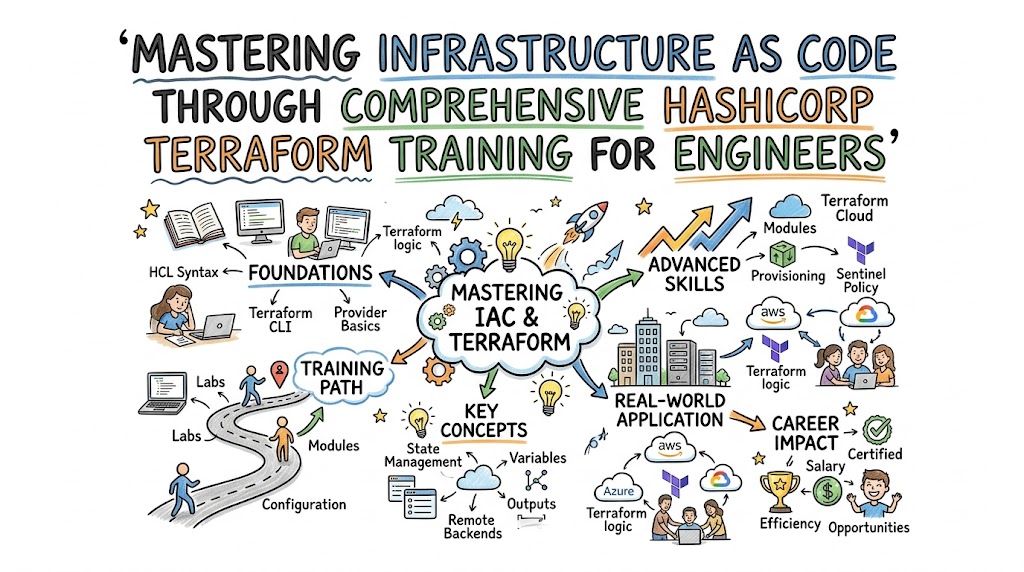
Modern cloud architecture demands a transition from manual clicks to automated, repeatable processes. This Hashicorp Terraform training equips technical professionals with the power to define and deploy complex environments across multiple providers through a single workflow. Whether you work in platform engineering or security, mastering this tool ensures your skills remain relevant in an industry that increasingly prioritizes automation over traditional administration. By engaging with this guide, you will understand how to navigate the DevOpsschool ecosystem to build a resilient career path in the global cloud market.
What is the Hashicorp Terraform training?
This training serves as a technical deep dive into the world of declarative infrastructure management. It moves beyond basic syntax to teach engineers how to manage the entire lifecycle of a resource through code. Participants learn how to utilize a unified configuration language to talk to various APIs, ensuring that production environments remain consistent and predictable. The program bridges the gap between manual resource tagging and enterprise-grade automation, aligning perfectly with the high-speed requirements of modern software delivery.
Who Should Pursue Hashicorp Terraform training?
Systems administrators, cloud architects, and site reliability engineers stand to gain the most from this curriculum. However, the program also offers immense value to security analysts who need to enforce compliance through code and data engineers who must manage ephemeral compute clusters. Managers who oversee technical teams also benefit from understanding the underlying logic of infrastructure automation. Global organizations and local tech firms in India specifically seek out professionals who can demonstrate these competencies to reduce operational overhead.
Why Hashicorp Terraform training is Valuable and Beyond
Industry leaders continue to adopt this tool because it offers unmatched flexibility across different cloud vendors. Since many companies now utilize hybrid or multi-cloud strategies, the ability to manage everything via a single toolset provides incredible career security. You invest your time into a skill that does not expire when a specific cloud provider changes its interface. This training ensures that you can move between projects and companies with a portable skill set that drives immediate business value.
Hashicorp Terraform training Certification Overview
The certification process takes place through the and remains hosted on [Website name]. Candidates undergo a rigorous assessment that evaluates their ability to write, maintain, and troubleshoot infrastructure code in real-world scenarios. The structure focuses on practical application, moving from individual resource management to complex, modular architectures. Successfully completing this program signals to employers that you possess a verified level of operational excellence.
Hashicorp Terraform training Certification Tracks & Levels
The curriculum breaks down into several tiers, starting with foundational concepts for newcomers and progressing toward advanced orchestration for senior leads. Students can choose specialization tracks that align with their specific job functions, such as security-focused infrastructure or cost-optimized cloud management. These levels provide a logical ladder for career growth, helping an engineer transition from a junior practitioner to a principal architect. Each level builds upon the last, ensuring a solid grasp of both the CLI and the broader ecosystem.
Complete Hashicorp Terraform training Certification Table
| Track | Level | Who it’s for | Prerequisites | Skills Covered | Recommended Order |
| Cloud Operations | Associate | DevOps Beginners | Cloud Basics | HCL Syntax, State, CLI | 1 |
| Scalable Architecture | Professional | Senior DevOps | Associate Level | Modules, Workspaces | 2 |
| Policy & Security | Specialist | Security Engineers | Professional Level | Sentinel, RBAC | 3 |
| Enterprise Strategy | Expert | Principal Engineers | 5+ Years Experience | Private Registry, Scaling | 4 |
Detailed Guide for Each Hashicorp Terraform training Certification
Hashicorp Terraform training – Associate Certification
What it is
This entry-level certification confirms your ability to handle basic automation tasks using the open-source version of the tool. It validates that you understand how to initialize directories, plan changes, and apply them safely to a live environment.
Who should take it
Developers and junior operations staff who want to formalize their knowledge should target this level. It serves as the perfect starting point for anyone looking to enter the world of infrastructure as code without prior specialized experience.
Skills you’ll gain
- Defining resources using HashiCorp Configuration Language.
- Managing local and remote state files effectively.
- Implementing variables and outputs to create dynamic code.
- Troubleshooting common configuration errors and provider issues.
Real-world projects you should be able to do
- Provision a secure virtual private cloud with multiple subnets.
- Build a load-balanced web server cluster across two availability zones.
- Store sensitive state files in an encrypted remote backend.
Preparation plan
- 7–14 days: Learn the basic CLI commands and resource types.
- 30 days: Build three different small-scale projects to understand state management.
- 60 days: Study advanced functions and prepare for the specific exam format through practice tests.
Common mistakes
- Storing the state file on a local machine instead of a shared backend.
- Forgetting to run a plan before applying changes to production.
- Using hardcoded strings instead of utilizing reusable variables.
Best next certification after this
- Same-track option: Terraform Professional.
- Cross-track option: Certified Kubernetes Administrator (CKA).
- Leadership option: HashiCorp Certified Vault Associate.
Choose Your Learning Path
DevOps Path
Professionals on this path focus on merging infrastructure code with application delivery pipelines. You will learn to trigger environment updates automatically whenever a developer pushes new code to a repository. This creates a seamless flow where the hardware and software evolve together in a single, unified lifecycle.
DevSecOps Path
The security path emphasizes the integration of automated “guardrails” into your deployment process. You will master the art of writing policies that automatically reject any infrastructure that does not meet safety standards. This ensures that your organization remains compliant without slowing down the development team.
SRE Path
Site Reliability Engineers use this training to build self-healing systems that prioritize uptime. On this track, you focus on state consistency and disaster recovery, ensuring that you can recreate an entire global infrastructure from code in the event of a catastrophic failure.
AIOps Path
This track explores how artificial intelligence can analyze infrastructure logs to suggest optimizations. You will learn to build flexible environments that respond to AI-driven insights, allowing your systems to scale or shrink based on predicted demand rather than simple metrics.
MLOps Path
Machine learning operations require specific, high-performance environments that can be difficult to manage manually. This path teaches you how to provision the complex GPU clusters and data storage systems necessary for training and deploying large-scale models with total consistency.
DataOps Path
Data engineers utilize these skills to treat their data warehouses and processing pipelines like software products. You will learn to automate the setup of data platforms, ensuring that your analytics team always works on a stable, version-controlled foundation.
FinOps Path
The financial operations path focuses on using automation to drive down cloud costs. You will learn how to inject cost-estimation tools into your workflow so that every engineer understands the financial impact of their infrastructure choices before they hit “apply.”
Role → Recommended Hashicorp Terraform training Certifications
| Role | Recommended Certifications |
| DevOps Engineer | Associate & Professional |
| SRE | Associate & SRE Path |
| Platform Engineer | Professional & Expert |
| Cloud Engineer | Associate Level |
| Security Engineer | DevSecOps Specialty |
| Data Engineer | DataOps Path |
| FinOps Practitioner | FinOps Path |
| Engineering Manager | Associate (Overview) |
Next Certifications to Take After Hashicorp Terraform training
Same Track Progression
Once you master the fundamentals, you should pursue professional-grade certifications that cover enterprise features. This includes learning how to manage large teams, utilize private registries, and coordinate complex workspaces across global regions. Deepening your expertise in one tool makes you the go-to expert for your organization.
Cross-Track Expansion
Infrastructure represents only one layer of the modern stack, so expanding into container management is a natural next step. Earning a Kubernetes certification alongside your automation skills makes you a versatile “full-stack” operator. Combining these disciplines allows you to manage everything from the virtual machine to the running container.
Leadership & Management Track
If you aspire to lead engineering teams, your focus should shift toward governance and strategy. Certifications in this track help you understand how to build a “Cloud Center of Excellence” that empowers other engineers. You will learn how to set the high-level standards that keep the entire company moving fast and staying secure.
Training & Certification Support Providers for Hashicorp Terraform training
DevOpsSchool
This organization provides a comprehensive blend of theory and heavy hands-on lab work. Their instructors prioritize real-world troubleshooting, ensuring that students can handle actual production crises, not just pass a multiple-choice test. They offer tailored mentorship that helps bridge the gap between classroom learning and career advancement.
Cotocus
Cotocus delivers specialized training programs that cater specifically to corporate teams undergoing digital transformation. They focus on the practical integration of automation tools within existing legacy environments. Their approach ensures that large-scale migrations remain stable and predictable throughout the transition.
Scmgalaxy
As a community-driven platform, Scmgalaxy offers an incredible wealth of free tutorials, guides, and open-source contributions. It serves as an excellent resource for self-starters who want to supplement their formal training with community wisdom. Their forums provide a space for engineers to solve niche problems collectively.
BestDevOps
BestDevOps focuses on career-centric learning paths that map directly to high-paying job roles in the industry. They provide students with a curated set of templates and best practices that they can immediately apply in their professional lives. Their exam preparation modules consistently produce high pass rates.
devsecopsschool.com
This provider focuses exclusively on the security aspects of the automation lifecycle. They teach you how to build “unbreakable” infrastructure by integrating automated vulnerability scanning and policy enforcement. It is an essential resource for those working in highly regulated industries.
sreschool.com
Sreschool focuses on the reliability and observability of automated systems. Their curriculum teaches you how to ensure your code leads to a stable, performant user experience. They specialize in the “ops” side of the house, focusing on uptime and incident management.
aiopsschool.com
Aiopsschool leads the way in teaching engineers how to apply machine learning to operations. They offer unique insights into how automated infrastructure can become “intelligent” and self-correcting. Their courses are perfect for those looking to stay on the cutting edge of tech.
dataopsschool.com
This site bridges the gap between big data and automated operations. They teach data professionals how to apply DevOps principles to ensure data flows smoothly from source to consumer. This training reduces the manual effort required to maintain complex data ecosystems.
finopsschool.com
Finopsschool focuses on the intersection of cloud engineering and corporate finance. They provide the tools and knowledge necessary to ensure that automation leads to savings rather than unexpected bills. It is a vital resource for anyone tasked with managing large cloud budgets.
Frequently Asked Questions (General)
- Does this exam require prior coding experience?No, you only need to understand basic logic and command-line operations, as the configuration language is designed for clarity and simplicity.
- Can I use a single certification to work on AWS and Azure?Yes, the primary advantage of this training is that the skills you learn apply to any cloud provider that has an available API.
- How many hours should I study each week?Most successful candidates dedicate roughly five to ten hours per week over a two-month period to ensure they master the practical labs.
- Will I receive a digital badge upon completion?Yes, you will receive a verified digital credential that you can display on your professional profiles to attract recruiters.
- Is there a retake policy if I fail the first time?The provider usually allows for a retake after a short waiting period, though policies can vary depending on the specific exam version.
- How much weight do recruiters give to this specific certification?Recruiters view this as a “gold standard” for cloud automation, often using it as a primary filter for DevOps and SRE positions.
- What is the cost of the official exam?While prices fluctuate, the exam generally costs around $70 USD, making it one of the most affordable high-value certifications available.
- Do I need to renew my status regularly?You must renew your certification every two years to ensure your knowledge keeps pace with the rapid evolution of the software.
- Are the questions based on memory or logic?The exam focuses heavily on logic and your ability to interpret configuration blocks to predict their outcome in a real environment.
- Can I take the exam from my home?Yes, most providers offer a proctored online option that allows you to complete the test from your own office or home.
- Does the training cover Terraform Cloud or just the CLI?Comprehensive programs usually cover both the open-source CLI and the collaborative features found in the Cloud and Enterprise versions.
- Is it helpful for a software developer to learn this?Absolutely, as modern developers are increasingly responsible for their own deployment environments and “You build it, you run it” cultures.
FAQs on Hashicorp Terraform training
- How does terraform init differ from other commands?It prepares your working directory by downloading the necessary provider plugins.
- What is the purpose of the State file?It acts as a source of truth that maps your code to real-world resources.
- Can I use loops in my infrastructure code?Yes, the training teaches you how to use count and for_each for repetitive tasks.
- What happens if I delete a resource manually?The next “plan” will detect the drift and propose recreating the resource to match your code.
- Is the configuration language case-sensitive?Yes, accuracy in naming and syntax is vital for the tool to function correctly.
- Can I use modules from the public registry?Yes, the training shows you how to leverage pre-built community modules to save time.
- What is a “Provider”?It is the plugin that allows the tool to interact with a specific service like AWS.
- Does it support rolling updates?Yes, you can configure lifecycle rules to ensure updates happen without causing application downtime.
Final Thoughts: Is Hashicorp Terraform training Worth It?
Taking the leap into automated infrastructure management is the smartest decision a modern engineer can make. I have seen countless professionals transform their careers by moving away from manual configurations and embracing the power of code. This training does not just teach you a tool; it gives you a new way of thinking about stability, scalability, and speed. While the learning curve exists, the rewards in terms of salary, job satisfaction, and professional respect are immense. If you want to sit at the heart of the DevOps movement, mastering this discipline is your non-negotiable first step toward that goal.



Leave a Reply
You must be logged in to post a comment.