Introduction
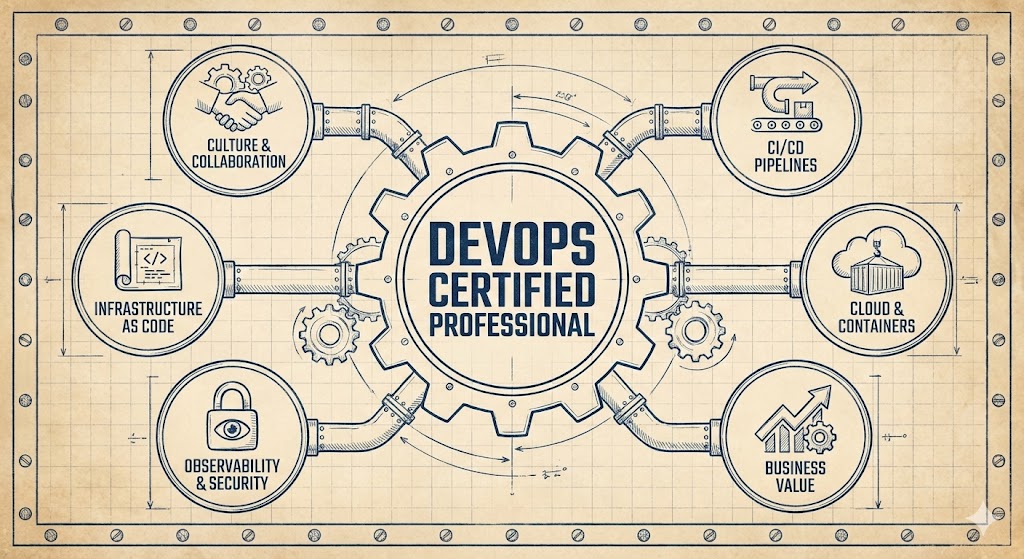
DevOps Certified Professional (DCP) is a role-driven certification designed for engineers and leaders working with real production systems. This guide is written for professionals who want clarity before investing time and effort. It explains what DevOps Certified Professional (DCP) truly covers, how challenging it is, and where it fits in modern DevOps and platform engineering careers delivered through DevOpsSchool. As cloud-native architectures and automation become standard across enterprises, understanding end-to-end delivery has become essential. This guide helps you evaluate whether DCP aligns with your career direction and long-term learning goals.
What is the DevOps Certified Professional (DCP)?
DevOps Certified Professional (DCP) represents practical, hands-on competence in building, operating, and improving software delivery systems. It exists to bridge the gap between theoretical DevOps understanding and real production responsibility. The certification emphasizes workflows, automation discipline, reliability engineering, and operational decision-making. Instead of being tool-centric, it focuses on problem-solving across environments. This approach makes it applicable to startups, enterprises, and multi-cloud organizations alike.
Who Should Pursue DevOps Certified Professional (DCP)?
DevOps Certified Professional (DCP) is suitable for software engineers transitioning into DevOps or platform roles. SREs, cloud engineers, and infrastructure professionals benefit from its systems-oriented view. Security, data, and FinOps practitioners gain value through automation and cross-team delivery alignment. Beginners can start with the foundation level, while experienced engineers use it to formalize experience. The certification is relevant for both Indian and global engineering roles.
Why DevOps Certified Professional (DCP) is Valuable in 2026 and Beyond
DevOps Certified Professional (DCP) remains relevant because it prioritizes principles over temporary tools. Organizations increasingly demand speed, reliability, cost awareness, and security together. DCP prepares professionals to adapt as platforms, clouds, and tooling evolve. It delivers long-term career returns by improving judgment rather than just certification count. Its value grows as systems become more complex.
DevOps Certified Professional (DCP) Certification Overview
DevOps Certified Professional (DCP) is delivered via and hosted on. The certification follows a structured progression aligned with real engineering responsibilities. Assessments are scenario-driven and focus on applied understanding. The program emphasizes professional readiness over exam memorization. Its structure mirrors real-world career growth.
DevOps Certified Professional (DCP) Certification Tracks & Levels
DevOps Certified Professional (DCP) consists of foundation, professional, and advanced levels. Each level increases system scope and decision ownership. Tracks include DevOps, SRE, DevSecOps, FinOps, AIOps, and DataOps. Candidates may specialize deeply or expand across tracks. This flexibility supports varied career paths.
Complete DevOps Certified Professional (DCP) Certification Table
| Track | Level | Who it’s for | Prerequisites | Skills Covered | Recommended Order | Official Link |
|---|---|---|---|---|---|---|
| DevOps | Foundation | Entry practitioners | Linux, Git basics | CI/CD, cloud basics | 1 | DevOps Certified Professional |
| DevOps | Professional | Working engineers | Pipeline exposure | Automation, releases | 2 | DevOps Certified Professional |
| SRE | Professional | Reliability roles | Monitoring basics | SLOs, incidents | 2 | DevOps Certified Professional |
| DevSecOps | Professional | Security engineers | AppSec knowledge | Policy, shift-left | 2 | DevOps Certified Professional |
| FinOps | Professional | Cost owners | Cloud billing | Optimization | 2 | DevOps Certified Professional |
| Platform | Advanced | Senior engineers | Multi-system experience | Platform design | 3 | DevOps Certified Professional |
Detailed Guide for Each DevOps Certified Professional (DCP) Certification
DevOps Certified Professional (DCP) – Foundation
What it is
Validates core DevOps knowledge required for modern delivery teams.
Who should take it
Beginners, junior engineers, and professionals shifting into DevOps roles.
Skills you’ll gain
- CI/CD fundamentals
- Basic infrastructure automation
- Cloud service understanding
Real-world projects you should be able to do
- Build simple pipelines
- Automate application deployments
- Provision basic cloud resources
Preparation plan
7–14 days for concepts
30 days with labs
60 days for confidence
Common mistakes
- Tool memorization
- Skipping hands-on practice
Best next certification after this
- Same-track: Professional
- Cross-track: SRE
- Leadership: Entry-level management learning
DevOps Certified Professional (DCP) – Professional
What it is
Validates real-world DevOps execution and delivery ownership.
Who should take it
Engineers managing pipelines, releases, and production reliability.
Skills you’ll gain
- Advanced automation
- Release governance
- Observability practices
Real-world projects you should be able to do
- Design resilient delivery pipelines
- Implement rollback strategies
- Troubleshoot production failures
Preparation plan
7–14 days for gap analysis
30 days for scenario practice
60 days for system simulations
Common mistakes
- Ignoring failure paths
- Overreliance on tools
Best next certification after this
- Same-track: Advanced
- Cross-track: DevSecOps
- Leadership: Platform ownership
DevOps Certified Professional (DCP) – Advanced / Platform
What it is
Validates platform ownership and architectural decision-making.
Who should take it
Senior engineers, architects, and technical leads.
Skills you’ll gain
- Platform governance
- Developer enablement
- Cost and risk balancing
Real-world projects you should be able to do
- Build internal developer platforms
- Define operational guardrails
- Enable multi-team delivery
Preparation plan
7–14 days for architecture review
30 days for design scenarios
60 days for platform prototypes
Common mistakes
- Overengineering
- Ignoring adoption challenges
Best next certification after this
- Same-track: Specialized tracks
- Cross-track: FinOps
- Leadership: Engineering management
Choose Your Learning Path
DevOpsSchool
DevOpsSchool provides a comprehensive ecosystem for learners aiming to master the DCP curriculum through instructor-led training and real-world projects. Furthermore, they focus on delivering hands-on experience by using industry-standard tools and environments that mirror actual production settings accurately. Therefore, the trainers bring years of practical experience, ensuring that students learn how to solve real problems rather than just passing an exam. Moreover, they offer extensive support through community forums and dedicated lab assistants to guide you through every challenge. Consequently, this commitment to practical education makes them a preferred choice for many corporate training programs in India and abroad. Ultimately, their structured approach helps students build confidence and technical depth simultaneously while preparing for the competitive market.
Cotocus
Cotocus specializes in high-end technical consulting and training, particularly for advanced engineering certifications for enterprise clients. Furthermore, they offer tailored programs that cater to the specific needs of businesses and experienced professionals who want to level up quickly. Therefore, their methodology emphasizes deep-dive technical sessions and architectural discussions that go beyond the basics of simple tool usage. Moreover, they provide excellent post-training support to help candidates implement what they have learned in their respective workplaces effectively. Consequently, this focus on long-term skill retention distinguishes them as a premium training provider in the technology space. Ultimately, many senior engineers choose Cotocus for their career advancement due to the high caliber and expertise of their specialized instructors.
Scmgalaxy
Scmgalaxy serves as a massive knowledge hub and training provider for the global community through its extensive digital library. Furthermore, they offer various tutorials, videos, and practice labs that support the DCP learning path for students at all levels. Therefore, their training programs are known for being accessible and highly detailed, covering everything from configuration to complex orchestration. Moreover, they foster a vibrant community where professionals can share insights and troubleshoot common technical issues together in real-time. Consequently, this community-driven approach ensures that the learning material remains updated with the latest industry trends and tool updates. Ultimately, they provide a cost-effective way for individual learners to gain deep technical knowledge and industry recognition for their skills.
BestDevOps
BestDevOps focuses on delivering high-quality, streamlined training for busy professionals who need to gain certifications without disrupting their work schedules. Furthermore, they offer flexible learning options, including weekend batches and self-paced modules, all aligned with the DCP requirements perfectly. Therefore, their curriculum is designed to be concise yet thorough, focusing on the most critical skills required by the job market today. Moreover, they provide mock exams and interview preparation sessions to help candidates succeed in their career transitions with confidence. Consequently, this results-oriented approach makes them a popular choice for engineers looking for a direct and efficient path to certification. Ultimately, they consistently produce high success rates among their graduates who enter the professional field with total confidence.
devsecopsschool.com
devsecopsschool.com functions as a dedicated platform for engineers who want to specialize in the intersection of security and modern automation. Furthermore, they provide the specific training required for the security specialization, focusing on automated testing and continuous compliance. Therefore, their labs include hands-on exercises with tools like SonarQube, Vault, and various container security scanners used in production. Moreover, they emphasize the cultural shift needed to integrate security into the development process seamlessly without slowing down delivery speeds. Consequently, this specialization makes them the go-to resource for security professionals looking to modernize their skill sets for the cloud. Ultimately, their curriculum ensures that security becomes an enabler of speed rather than a bottleneck in the delivery pipeline.
sreschool.com
sreschool.com focuses exclusively on the principles and practices of Site Reliability Engineering for platform and operations professionals. Furthermore, they provide the necessary training for the operations specialization, covering topics like error budgets, toil reduction, and advanced monitoring. Therefore, their programs are designed to teach engineers how to build systems that can withstand production pressures and scale efficiently. Moreover, they use real-world incident scenarios to help students develop strong troubleshooting and system design skills that apply immediately. Consequently, this specialized focus is invaluable for those looking to work in high-scale environments like those found in major tech firms. Ultimately, they bridge the gap between traditional operations and modern software engineering through deep technical immersion and mastery.
aiopsschool.com
aiopsschool.com addresses the emerging need for artificial intelligence in IT operations through specialized training and innovative learning modules. Furthermore, they provide specialized training for the intelligence specialization, teaching students how to use machine learning to improve monitoring and incident management. Therefore, their curriculum covers data science fundamentals tailored for operations professionals, including anomaly detection and predictive maintenance strategies. Moreover, they help engineers understand how to manage the lifecycle of AI models within a modern framework effectively. Consequently, this unique training path prepares professionals for the future of automated operations driven by artificial intelligence and big data analysis. Ultimately, it is an excellent choice for those looking to stay at the cutting edge of technological innovation.
dataopsschool.com
dataopsschool.com provides targeted training for managing data pipelines using automation methodologies for data engineers and architects. Furthermore, they support the specialization by focusing on data quality automation, versioning, and continuous integration for data workflows. Therefore, their programs are essential for data engineers who want to bring more agility and reliability to their data platforms. Moreover, they provide hands-on experience with modern data tools and orchestration frameworks used in large-scale data processing. Consequently, this specialized training helps organizations treat their data as a product with a defined and automated delivery lifecycle. Ultimately, it ensures that data teams can meet the high demands of modern analytics and business intelligence across the entire enterprise.
finopsschool.com
finopsschool.com focuses on the financial management side of cloud computing for practitioners and engineering managers. Furthermore, they provide the training required for the cost optimization specialization, teaching professionals how to optimize cloud costs through technical and cultural changes. Therefore, their curriculum covers cloud billing architectures, cost allocation strategies, and waste reduction techniques that save organizations significant money. Moreover, they help bridge the communication gap between engineering and finance teams through a shared language and common goals. Consequently, this specialized knowledge is becoming increasingly important as companies look to control their growing cloud expenditures in a volatile market. Ultimately, by completing this training, professionals demonstrate their ability to deliver high-performance systems that remain economically efficient.
Role → Recommended DevOps Certified Professional (DCP) Certifications
| Role | Recommended Certifications |
| DevOps Engineer | DCP Foundation, DCP Professional |
| SRE | DCP Professional, DCP SRE Specialist |
| Platform Engineer | DCP Professional, DCP Master |
| Cloud Engineer | DCP Foundation, Cloud Provider Basics |
| Security Engineer | DCP DevSecOps Specialist |
| Data Engineer | DCP DataOps Specialist |
| FinOps Practitioner | DCP FinOps Specialist |
| Engineering Manager | DCP Foundation, DCP Leadership |
Frequently Asked Questions (General – 12 Questions)
1. How difficult is DevOps Certified Professional (DCP)?
The difficulty depends on the level you attempt. Foundation is approachable for motivated beginners, while Professional and Advanced levels require hands-on production experience. Questions test judgment, not memorization. If you have worked with CI/CD, cloud, or operations, the challenge feels realistic rather than overwhelming.
2. How much time is needed to prepare?
Preparation time varies by background. Beginners usually need 45–60 days. Working DevOps engineers often prepare in 20–30 days. Senior engineers may need less time but should focus on scenario-based revision. Consistent daily practice matters more than long study hours.
3. Are there strict prerequisites to start DCP?
There are no formal mandatory prerequisites. However, basic knowledge of Linux, Git, cloud platforms, and application delivery helps significantly. Without this foundation, candidates may struggle with applied scenarios. Self-assessment before starting improves success rate.
4. Is DevOps Certified Professional (DCP) vendor neutral?
Yes. The certification focuses on concepts, workflows, and outcomes rather than specific tools. This makes learning transferable across cloud providers and environments.
5. How does DCP help career growth?
DCP strengthens problem-solving language during interviews and performance reviews. It helps professionals move from task execution to system ownership.
6. Is hands-on experience mandatory to pass?
Hands-on practice is essential. Real-world labs and exposure significantly improve success.
7. Can engineering managers or leads pursue DCP?
Yes. Advanced levels especially benefit managers overseeing platforms.
8. Is DCP relevant outside India?
Yes. Practices apply globally across enterprises.
9. Does the certification expire or require renewal?
Skills require continuous refresh as DevOps evolves.
10. Is this certification theoretical or practical?
It is strongly practical and scenario-driven.
11. Can freshers or students attempt DCP?
Freshers may start with Foundation if they have lab exposure.
12. How should ROI be measured after certification?
ROI appears as better ownership, faster problem-solving, and role growth.
FAQs on DevOps Certified Professional (DCP)
1. Does DevOps Certified Professional (DCP) focus more on tools or practices?
It prioritizes practices and decision-making over tools.
2. Will DCP help in cloud-native and Kubernetes-heavy environments?
Yes, it aligns strongly with cloud-native platforms.
3. Are exams based on real-world scenarios?
Yes, scenarios reflect production challenges.
4. Can DCP replace years of experience?
No, but it accelerates maturity.
5. How does DCP compare to cloud-provider certifications?
It complements them by focusing on systems thinking.
6. Is DCP suitable for long-term platform engineering roles?
Yes, especially for platform ownership.
7. Does the certification help in interviews and system design rounds?
Yes, it improves structured explanations.
8. Should DCP be pursued early or later in a career?
Best taken when you can apply learning in real systems.
Final Thoughts: Is DevOps Certified Professional (DCP) Worth It?
DevOps Certified Professional (DCP) is ideal for professionals seeking real capability rather than surface-level credentials. It demands effort but builds lasting engineering judgment. The certification aligns with modern system realities. For long-term growth in DevOps, SRE, or platform engineering, DCP delivers durable value.



Leave a Reply
You must be logged in to post a comment.