1. Introduction: Why Security Matters in Quantum Computing
Quantum computing creates new opportunities for research and technology development. It also introduces security questions that organisations should understand before adopting related services.
Quantum computers process information differently from classical computers. Their capabilities may affect some cryptographic methods that protect digital information today.
However, quantum computing does not automatically break every encryption system. The impact depends on the algorithm, hardware capabilities, available resources, and cryptographic method.
Organisations should prepare by understanding two important areas.
First, they need to protect their quantum computing environments. This includes cloud accounts, development tools, experiment data, and access permissions.
Second, they need to understand post-quantum cryptography. This field develops cryptographic methods designed to resist attacks from both classical and quantum computers.
Technology professionals can benefit from training in these areas. Developers, cloud engineers, security specialists, architects, and IT managers all have different responsibilities.
This guide explains ten important training and technology areas through the perspective of security, risk management, and responsible implementation.
2. Understand the Security Foundations of Quantum Computing
Before selecting a training programme, understand the main security concepts.
2.1 Classical cryptography and quantum computing
Many digital systems use cryptographic algorithms to protect information.
These algorithms support activities such as secure communication, digital signatures, authentication, and data protection.
A sufficiently capable fault-tolerant quantum computer could threaten some widely used public-key cryptographic systems.
For example, Shor’s algorithm provides a theoretical method for factoring large integers and solving discrete logarithm problems efficiently on a suitable quantum computer.
This does not mean today’s quantum computers can immediately break modern encryption at scale.
2.2 Understand post-quantum cryptography
Post-quantum cryptography, also called PQC, develops cryptographic algorithms that can resist known attacks from quantum and classical computers.
These algorithms run on classical computers. They do not require a quantum computer.
Organisations should understand this distinction when planning security upgrades.
2.3 Learn about quantum key distribution
Quantum key distribution uses quantum communication principles to help establish shared cryptographic keys.
It is different from post-quantum cryptography.
PQC protects information through mathematical algorithms. Quantum key distribution uses quantum communication methods and requires suitable communication infrastructure.
2.4 Identify security risks
Common areas for review include:
- Weak access controls.
- Exposed cloud credentials.
- Unprotected research data.
- Poor dependency management.
- Insecure application interfaces.
- Missing audit records.
- Uncontrolled cloud spending.
- Inadequate incident procedures.
A clear risk assessment helps teams prioritise their work.
3. Quantum Cloud Computing Training
Quantum cloud computing training helps professionals understand how to use remote quantum computing environments.
Security should form part of this learning process.
3.1 Understand cloud account security
A cloud-based quantum environment may contain projects, credentials, experiment configurations, and execution records.
Protect these resources with appropriate identity and access management.
Avoid sharing account credentials between team members.
3.2 Apply least-privilege access
Give each user only the permissions required for their responsibilities.
For example, a learner may need permission to execute experiments but not manage billing or change account-wide security settings.
Review permissions when project responsibilities change.
3.3 Protect experiment data
Research data may contain valuable business or scientific information.
Define where data can be stored and who can access it.
Use suitable encryption and retention controls based on organisational requirements.
3.4 Monitor cloud activity
Maintain records of important actions.
Review experiment submissions, account changes, permission updates, and resource consumption.
Monitoring helps teams identify unexpected activity.
3.5 Practise secure cloud workflows
Create a small training environment with separate development and testing access.
Document the permissions and execution process.
Practical project: Prepare a secure cloud experiment environment with role-based access, protected credentials, and basic activity records.
4. Quantum Computing Certification Course
A quantum computing certification course can help professionals understand the technical foundations of quantum computing.
Security-focused learners should look for programmes that explain cryptographic risks and the relationship between quantum computing and cybersecurity.
4.1 Study the core concepts
Start with qubits, superposition, entanglement, gates, measurement, and quantum circuits.
These topics help learners understand the technology behind quantum algorithms.
4.2 Learn the security implications
Study how quantum algorithms relate to classical cryptographic systems.
Understand why some public-key algorithms face potential quantum threats.
Also learn why symmetric encryption and cryptographic hash functions require a different analysis.
4.3 Explore practical security exercises
A useful assignment might ask learners to compare a classical cryptographic workflow with a post-quantum cryptographic workflow.
The exercise should explain the algorithms, their intended purpose, and relevant implementation considerations.
4.4 Verify course quality
Review the syllabus, instructor background, practical assessments, and credential issuer.
A private course certificate does not automatically establish external accreditation.
Practical project: Prepare a short report explaining how quantum computing may affect selected cryptographic methods.
5. QuantumOps Certification
QuantumOps certification may refer to a specific branded learning or credential programme related to quantum computing operations.
Its content and recognition depend on the issuer. Confirm the syllabus, practical assessment, and credential status before relying on it professionally.
Operational knowledge is important because security depends on how teams manage their computing environments.
5.1 Secure development workflows
Use controlled source repositories.
Review code changes before merging them into shared projects.
Keep credentials and sensitive configuration values outside source code.
5.2 Manage dependencies
Quantum applications rely on programming frameworks and external packages.
Record package versions and review updates before applying them.
Avoid installing unverified packages in sensitive environments.
5.3 Maintain operational records
Document experiment submissions, execution failures, configuration changes, and access events.
These records can help teams investigate unexpected behaviour.
5.4 Prepare incident procedures
Define what employees should do when credentials become exposed or an account shows unusual activity.
Include reporting responsibilities and recovery steps.
Practical project: Create a quantum workflow security checklist covering credentials, dependencies, permissions, and incident reporting.
6. Qiskit Programming Course
A Qiskit programming course can help developers understand quantum circuit construction and execution.
Security professionals can also use this knowledge to understand the software components involved in quantum applications.
6.1 Learn circuit development
Study how to create quantum circuits and apply gates.
Understand how measurement operations produce classical results.
Start with small examples before moving to advanced algorithms.
6.2 Understand software dependencies
Quantum development frameworks depend on software packages.
Keep track of the versions used in each project.
Test updates in a development environment before introducing them into shared workflows.
6.3 Protect application configuration
Do not hardcode API credentials or other sensitive values.
Use suitable secret-management methods for the execution environment.
Separate application configuration from circuit logic.
6.4 Apply secure coding practices
Validate user inputs.
Handle execution errors carefully.
Avoid exposing sensitive information through application logs.
Use code reviews and automated tests where appropriate.
6.5 Create a security-aware project
Build a small circuit application.
Add input validation, controlled configuration, and clear error handling.
Document the dependencies and execution settings.
Practical project: Develop a Qiskit application with secure configuration handling and documented software dependencies.
7. AWS Braket Training
AWS Braket training helps professionals explore quantum experiments through a managed cloud environment.
Security-conscious learners should understand the responsibilities involved in accessing and managing cloud resources.
7.1 Learn account permissions
Understand how cloud identities and permissions control access to services.
Use separate permissions for users who develop experiments and those who manage infrastructure.
7.2 Protect credentials
Do not store access credentials in source files or public repositories.
Use the recommended authentication and secret-management methods for the environment.
7.3 Understand data handling
Review how experiment inputs, execution records, and outputs are stored.
Apply suitable access and retention policies.
7.4 Monitor resource consumption
Cloud experiments can involve costs.
Set appropriate usage controls and review resource activity.
Unexpected resource consumption may indicate configuration problems or unauthorised use.
7.5 Practise secure experiment execution
Prepare a small experiment and document the identity, permissions, execution target, and data flow.
Practical project: Create a cloud experiment checklist covering authentication, permissions, data handling, and resource monitoring.
8. Quantum Computing for Software Engineers
Quantum computing for software engineers combines traditional software development with quantum programming and security awareness.
Developers need to protect both the classical application and its connection to quantum execution services.
8.1 Understand the application structure
A quantum-enabled application may contain:
- A user interface.
- A classical backend.
- Input validation.
- A quantum circuit module.
- A cloud execution service.
- Result processing.
- Data storage.
Each component needs suitable security controls.
8.2 Protect application interfaces
Use authentication and authorisation for protected operations.
Validate incoming requests.
Apply appropriate rate limits to prevent uncontrolled service usage.
8.3 Secure application data
Identify sensitive information before storing or processing it.
Limit access to experiment results and input datasets.
Avoid including credentials or sensitive data in diagnostic logs.
8.4 Test failure conditions
Check what happens when an execution service becomes unavailable.
Test invalid inputs, expired credentials, failed jobs, and unexpected responses.
The application should handle failures without exposing sensitive details.
8.5 Build a secure application prototype
Create an application that accepts input, prepares a circuit, and submits an experiment.
Add input validation, controlled credentials, error handling, and basic logging.
Practical project: Develop a small quantum application with documented security controls and failure-handling procedures.
9. Quantum Computing Architecture Course
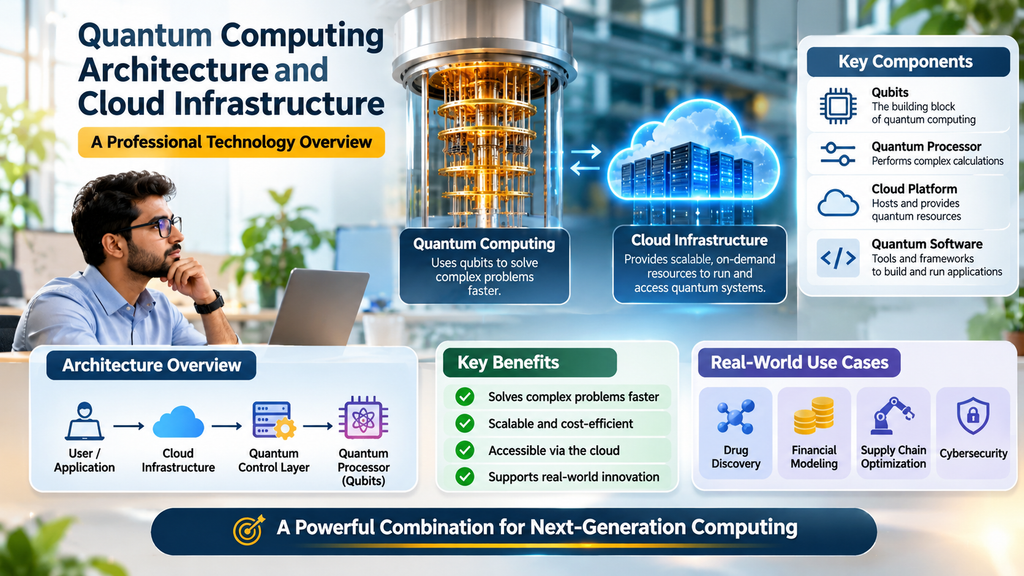
A quantum computing architecture course helps professionals design systems that connect classical applications, quantum services, and security controls.
Architects should consider security throughout the system design process.
9.1 Identify the architecture layers
A typical quantum-enabled system may include:
- User interfaces.
- Classical application services.
- Data processing components.
- Quantum circuit modules.
- Cloud execution services.
- Simulators or physical hardware.
- Result storage.
- Monitoring and reporting.
Each component has different security requirements.
9.2 Design identity and access controls
Define which users and services can access each component.
Separate development, testing, and production permissions.
Avoid giving every application component unrestricted access.
9.3 Secure communication
Review how application components communicate.
Use appropriate secure communication methods.
Protect service credentials and validate connections to external services.
9.4 Include monitoring
Record important events across the application.
Monitor authentication failures, permission changes, execution errors, and unusual resource consumption.
9.5 Prepare an architecture security review
Create a diagram that identifies components, data flows, access boundaries, and external dependencies.
Use it to discuss potential security weaknesses.
Practical project: Design a quantum-enabled application architecture with documented access controls, data flows, and monitoring requirements.
10. Hybrid Quantum Classical Computing Training
Hybrid quantum classical computing training helps professionals understand systems that combine classical processing with quantum execution.
Security teams should review both sides of these workflows.
10.1 Understand the hybrid process
A hybrid workflow may use classical processing to prepare inputs and update algorithm parameters.
A quantum circuit then executes and returns measurement results.
The classical application analyses those results and may initiate another execution.
10.2 Protect the classical components
Secure the application that prepares data and manages the workflow.
Validate inputs and control access to processing services.
Protect configuration files and execution credentials.
10.3 Review quantum execution access
Ensure that only authorised users and applications can submit experiments.
Monitor job submissions and resource consumption.
10.4 Protect experiment records
Record the circuit version, parameters, execution settings, and output.
Apply suitable storage and access controls.
10.5 Test the complete workflow
Test input validation, execution failures, incomplete results, and recovery procedures.
Practical project: Build a hybrid workflow and prepare a security review covering classical processing, quantum execution, and result storage.
11. Quantum Computing Consulting Services
Quantum computing consulting services can help organisations assess security, infrastructure, and technical readiness.
Consultants may support architecture reviews, risk assessments, training plans, and proof-of-concept projects.
11.1 Identify the organisation’s objectives
Understand why the organisation wants to explore quantum computing.
Identify whether the goal involves research, application development, cloud experimentation, or cryptographic readiness.
11.2 Assess the current environment
Review existing infrastructure, cloud services, software dependencies, access controls, and data handling.
Identify areas that require further investigation.
11.3 Evaluate cryptographic exposure
Organisations should understand where they use cryptographic algorithms.
Identify important systems, data lifetimes, third-party dependencies, and upgrade requirements.
This helps security teams plan their post-quantum cryptography transition.
11.4 Create a practical action plan
Prioritise security improvements based on business impact and technical requirements.
Assign responsibilities and define review milestones.
11.5 Prepare an assessment report
Include the scope, findings, limitations, recommendations, and next steps.
Clearly separate confirmed issues from potential future risks.
Practical project: Prepare a quantum readiness assessment covering infrastructure, cryptographic dependencies, and workforce skills.
12. Quantum Computing for IT Managers
Quantum computing for IT managers focuses on governance, investment planning, security readiness, and workforce development.
Managers should understand how quantum-related risks affect organisational technology decisions.
12.1 Identify important organisational systems
List systems that handle sensitive information.
Identify where encryption, digital signatures, authentication, and secure communication are used.
12.2 Understand cryptographic migration
Some organisations need to prepare for future post-quantum cryptography requirements.
Migration may involve applications, network infrastructure, certificates, third-party services, and embedded devices.
Managers should support an inventory and planning process rather than treating migration as a single software update.
12.3 Establish security responsibilities
Assign responsibility for cryptographic inventories, risk assessments, vendor reviews, and implementation planning.
Coordinate security, infrastructure, application, and procurement teams.
12.4 Set realistic budgets
Consider the costs of assessment, testing, software changes, employee training, and vendor support.
Prioritise critical systems and avoid unnecessary technology purchases.
12.5 Measure progress
Useful indicators include:
| Indicator | Purpose |
|---|---|
| Cryptographic inventory coverage | Measures identified systems |
| Critical system assessment | Tracks security review progress |
| Access review completion | Checks permission governance |
| Dependency review coverage | Tracks software supply-chain checks |
| Training completion | Measures employee learning |
| Migration readiness | Tracks planned upgrade activities |
| Open security findings | Shows unresolved risks |
Practical project: Create a management report that tracks quantum-related security readiness and planned improvements.
13. Understanding Post-Quantum Cryptography Readiness
Post-quantum cryptography deserves attention from organisations that depend on long-term information security.
The transition requires planning because cryptographic systems often have many dependencies.
13.1 Create a cryptographic inventory
Identify where cryptography appears in the organisation.
Review applications, network connections, certificates, authentication systems, databases, and third-party products.
Record the algorithms and protocols where known.
13.2 Identify critical information
Some information needs protection for many years.
Examples may include confidential business records, sensitive research, financial information, and personal information.
Consider how long the information must remain protected.
13.3 Review vendor readiness
Ask technology providers about their post-quantum cryptography plans.
Understand product support, upgrade requirements, compatibility, and implementation responsibilities.
Do not rely only on general marketing statements.
13.4 Test migration requirements
Test updated cryptographic methods in controlled environments.
Review compatibility with applications, network equipment, and external services.
Check performance and operational requirements.
13.5 Create a migration plan
Prioritise critical systems.
Assign owners and define implementation stages.
Keep records of decisions, testing, and unresolved dependencies.
14. Practical Security Projects for Learners
Practical exercises help professionals apply security knowledge.
The following projects can suit different experience levels.
14.1 Project One: Secure quantum development environment
Objective: Prepare a development environment with controlled access.
Steps:
- Create a dedicated project environment.
- Separate configuration from source code.
- Protect credentials.
- Review package dependencies.
- Document user permissions.
- Prepare a basic security checklist.
Deliverable: An environment setup document and security checklist.
14.2 Project Two: Quantum application security review
Objective: Review the security of a small quantum application.
Steps:
- Identify the application components.
- Map data movement.
- Review authentication.
- Validate user inputs.
- Check error handling.
- Review logging.
- Document findings.
Deliverable: A short application security assessment.
14.3 Project Three: Post-quantum readiness inventory
Objective: Understand how an organisation can identify cryptographic dependencies.
Steps:
- List important applications.
- Identify where cryptography is used.
- Record known algorithms and protocols.
- Identify critical data.
- Review vendor dependencies.
- Prepare migration priorities.
Deliverable: A sample cryptographic inventory and readiness report.
14.4 Project Four: Cloud security monitoring
Objective: Create a basic monitoring plan for a quantum cloud environment.
Steps:
- Identify important cloud resources.
- Review account permissions.
- Record important activities.
- Monitor execution usage.
- Define unusual activity.
- Prepare incident response instructions.
Deliverable: A cloud monitoring and incident checklist.
15. Common Quantum Computing Security Mistakes
15.1 Assuming quantum computers break all encryption
Quantum computing affects cryptographic algorithms differently.
Understand the specific algorithm and threat model before making security claims.
15.2 Confusing PQC with quantum key distribution
PQC uses mathematical algorithms that run on classical computers.
Quantum key distribution uses quantum communication methods.
They solve related but different security problems.
15.3 Ignoring traditional cloud security
Quantum experiments still depend on accounts, credentials, storage, and application services.
Apply established cloud security practices.
15.4 Storing credentials in source code
Hardcoded credentials can expose accounts and services.
Use appropriate secret-management methods.
15.5 Ignoring third-party dependencies
External packages and services can introduce security risks.
Review dependencies and update them through controlled processes.
15.6 Treating future threats as immediate incidents
Prepare for future cryptographic changes without making unsupported claims about current quantum hardware capabilities.
Use evidence-based risk assessments.
16. Frequently Asked Questions
16.1 What is quantum cloud computing training?
It teaches professionals to develop and execute quantum experiments through cloud-based services. Security-focused learning can also cover account permissions, credentials, data handling, and monitoring.
16.2 Who should take a quantum computing certification course?
Developers, researchers, students, cloud engineers, and cybersecurity professionals can consider it. The programme should match their technical background and career objectives.
16.3 What is QuantumOps certification?
It may refer to a branded training or credential programme related to quantum computing operations. Its exact content and recognition depend on the issuing organisation.
16.4 Why is a Qiskit programming course useful?
It helps developers understand quantum circuit development, simulation, execution, and measurement. These skills also help security professionals understand quantum software environments.
16.5 What does AWS Braket training teach?
It can introduce learners to managed quantum experiments, simulators, supported hardware, execution workflows, and cloud resource management.
16.6 How does quantum computing affect software engineers?
It introduces new programming concepts and execution models. Engineers can use their existing software skills while learning quantum circuits, algorithms, and secure application integration.
16.7 Why is a quantum computing architecture course important?
It helps architects understand how quantum services connect with classical applications, cloud infrastructure, storage, and security controls.
16.8 What is hybrid quantum classical computing training?
It teaches how classical processing and quantum execution work together. Security reviews should cover both components and the data exchanged between them.
16.9 When are quantum computing consulting services useful?
Consultants can help organisations assess technical readiness, review cryptographic dependencies, plan training, and evaluate quantum computing experiments.
16.10 What should IT managers do about quantum-related security risks?
They should identify cryptographic dependencies, review critical information, understand vendor plans, support post-quantum readiness, and establish clear security responsibilities.
17. Final Thoughts
Quantum computing creates new technical opportunities and long-term security considerations.
Organisations should understand both sides before making major investment decisions.
Developers need programming and secure software practices. Cloud engineers need access controls and resource monitoring. Architects need clear system boundaries. Security teams need cryptographic inventories and migration planning. IT managers need realistic budgets and measurable priorities.
Training helps professionals develop these capabilities. Practical projects help them apply the knowledge to real technical situations.
The most useful approach is to prepare carefully, review evidence, and make decisions based on actual system requirements.