Introduction
Unchecked data drift, brittle transformation scripts, and delayed business metrics consistently disrupt engineering teams. Because decision-makers demand dependable reporting, leading organizations treat analytical pipelines with the exact rigor of production software systems.
Bridging the divide between reactive firefighting and streamlined continuous delivery, this specialized training academy provides practical blueprints, hands-on labs, and strategic consulting. Consequently, data engineers, cloud architects, and platform operators eliminate operational downtime, automate verification suites, and deliver accurate enterprise insights rapidly.
What is DataOps?
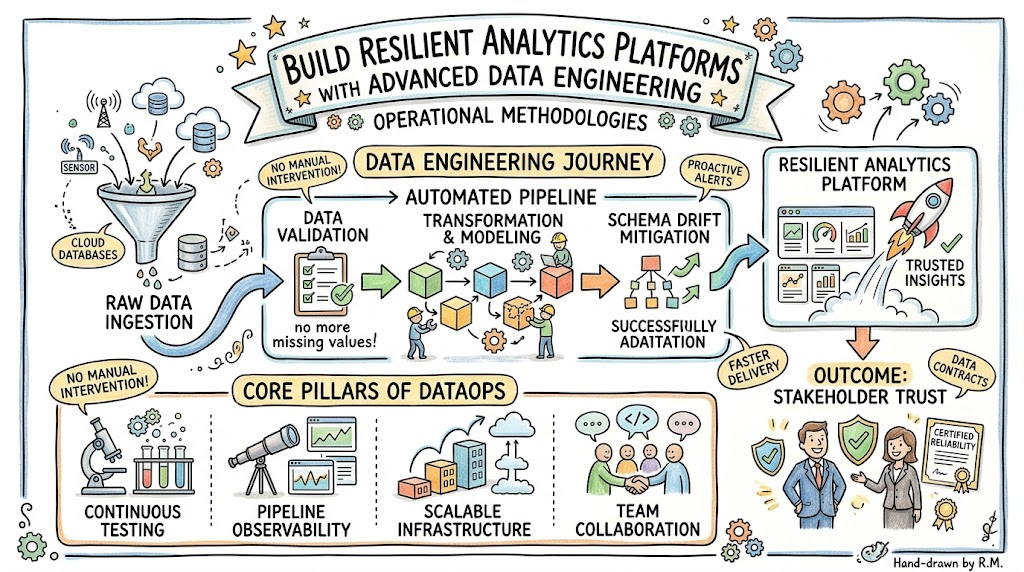
Understanding What is DataOps means viewing the analytics pipeline as an automated assembly line that produces trustworthy decision intelligence. This operational methodology unites agile sprint cadences, continuous integration pipelines, declarative infrastructure, and automated validation rules across the analytical lifecycle.
+-------------------------------------------------------------------------------+
|                       CONTINUOUS DATA FLOW ENGINE                             |
|                                                                               |
|  [ Data Sources ] ──► [ Automated Pre-Checks ] ──► [ Model Transformations ]  |
|         ▲                                                     │               |
|         │                                                     ▼               |
|  [ Anomaly Tracing ] ◄── [ Monitored Production ] ◄── [ DAG Scheduling ]      |
+-------------------------------------------------------------------------------+
Instead of deploying unreviewed transformation scripts straight into production warehouses, engineers implement automated regression testing for every pull request. Hence, organizations shorten cycle times, intercept corrupt records early, and deliver verified datasets to operational teams.
Why DataOps Matters for Modern Data Teams
Uncontrolled pipeline interruptions force engineers to spend valuable engineering sprints investigating broken downstream reports manually. Moreover, unannounced column changes from upstream APIs distort statistical models and erode stakeholder confidence in executive scorecards.
By introducing automated regression tests alongside continuous statistical monitoring, platform developers catch malformed records before databases finalize updates. Thus, technical teams deploy transformation models in minutes rather than spending entire weeks performing manual database corrections.
Core Components of a DataOps Environment
Assembling an enterprise-grade platform requires integrated automation software, modular design, and robust quality barriers at every stage.
- Automated CI/CD Delivery: Validates data transformations, executes automated assertion suites, and provisions staging environments cleanly.
- Declarative Infrastructure Sandboxes: Uses Infrastructure as Code (IaC) to spin up isolated test spaces that reproduce live warehouse setups accurately.
- Programmatic Quality Assertions: Evaluates data completeness, schema accuracy, and null constraints before models update production tables.
- Proactive Pipeline Telemetry: Tracks transformation lineage and emits real-time alerts whenever ingestion jobs exceed normal processing times.
Understanding DataOps Tools
Selecting the correct platform stack dictates whether your data platform scales effortlessly or bottlenecks under operational complexity. Consequently, developers must organize their tooling stack around distinct operational responsibilities.
| Operational Layer | Core Objective | Key Tooling Options |
|---|---|---|
| Pipeline Scheduling | Manages dependency graphs and runtime tasks | Apache Airflow, Dagster, Prefect |
| Transformations & CI/CD | Executes modular data transformations | dbt Core, SQLMesh, GitHub Actions |
| Automated Data Quality | Detects schema drift and validates values | Great Expectations, Soda Core, Monte Carlo |
| Unified Cloud Lakehouse | Delivers scalable, elastic compute resources | Snowflake, Databricks, Google BigQuery |
Mastering these integrated DataOps Tools empowers engineers to build fault-tolerant data architectures that absorb source-system changes smoothly.
How DataOps Changes the Data Engineering Workflow
Conventional engineering teams struggle with manual script launches, unchecked database edits, and stressful late-night database corrections. In sharp contrast, modern methodology mandates Git branch isolation, peer code reviews, and automated integration checks for every single code change.
Furthermore, automated continuous integration runners validate transformation logic against realistic test data before merging pull requests. As a direct result, runtime failures drop dramatically, freeing data engineers to design high-value business analytics.
DataOps Training: What Should You Learn?
Pursuing comprehensive DataOps Training equips developers to abandon brittle manual processes in favor of enterprise-grade pipeline automation. Because scalable cloud platforms demand continuous operational diligence, practitioners must cultivate several key engineering competencies.
- Modern Version Control: Master collaborative branching strategies, semantic version tags, and declarative code management tailored for data pipelines.
- Orchestration Engineering: Construct dynamic directed acyclic graphs, configure granular task retries, and automate recovery workflows.
- Automated Assertion Testing: Code declarative assertions to verify structural boundaries, unique constraints, and payload freshness.
- Cloud Infrastructure Automation: Provision repeatable analytical environments, configure role permissions, and track compute utilization.
Using a DataOps Tutorial to Build Practical Skills
Following an interactive DataOps Tutorial provides engineers with direct exposure to constructing end-to-end continuous data pipelines. For instance, learners construct a multi-layer pipeline where every Git commit triggers comprehensive schema assertion suites inside isolated sandbox environments.
[ Developer Pull Request ]
           │
           ▼
[ CI Automation Engine ] ──► Provisions branch schema & builds dbt transformations
           │
           ▼
[ Assertion Testing Framework ] ──► Validates row volumes, unique keys & syntax
           │
     (Tests Pass)
           │
           ▼
[ Production Delivery ] ──► Workflow scheduler triggers primary pipeline execution
Code language: CSS (css)
Through this exercise, developers observe firsthand how automated testing halts breaking changes before they reach downstream reporting layers.
DataOps Certification and Professional Development
Securing an industry-recognized DataOps Certification confirms your architectural acumen and gives you a distinct advantage in the hiring market. Modern enterprises actively recruit certified practitioners who know how to optimize cloud expenditures while sustaining strict governance controls.
By completing a rigorous DataOps Course, candidates master governance best practices, operational reliability engineering, and modern cloud architectural design. Ultimately, possessing verified technical credentials demonstrates your ability to lead complex data infrastructure initiatives.
Becoming a Certified DataOps Engineer
The Certified DataOps Engineer credential concentrates on core implementation mechanics, continuous integration builds, and automated monitoring setups. Professionals in this role configure deployment pipelines, manage container runtimes, and author comprehensive assertion suites every day.
Additionally, certified engineers resolve delivery bottlenecks, fine-tune alerting rules, and enforce schema contracts across ingestion points. Their hands-on contributions protect critical data streams against pipeline degradation and operational downtime.
Becoming a Certified DataOps Architect
Earning the Certified DataOps Architect credential demands systemic design expertise, platform strategy, and cross-functional leadership capabilities. Architects assess technology stacks, implement scalable lakehouse architectures, and guide continuous observability strategies across business domains.
Furthermore, these leaders define data protection standards, negotiate operational SLAs, and reduce cloud computing waste. Their foundational blueprints enable decentralized engineering pods to release stable data assets while maintaining strict governance standards.
DataOps Consulting for Organizations
Enterprises often struggle with legacy databases, disconnected reporting teams, and undocumented transformation pipelines that lack standard automation. Specialized DataOps Consulting addresses these challenges by delivering targeted architectural reviews, pipeline modernizations, and customized operational playbooks.
Experienced practitioners evaluate legacy infrastructure, identify systemic bottlenecks, and establish resilient deployment workflows tailored to internal technical teams. Consequently, enterprises increase release frequency, minimize broken dashboards, and optimize cloud infrastructure costs.
DataOps Services for Growing Teams
Scaling startups and mid-market companies frequently require dedicated platform support without hiring entire internal operations departments immediately. Hence, professional DataOps Services provide turnkey management for cloud lakehouses, automated testing suites, and performance optimizations.
These specialized service teams handle infrastructure provisioning, monitor continuous ingestion pipelines, and resolve complex pipeline incidents around the clock. As a result, internal business intelligence analysts focus entirely on extracting strategic value without worrying about underlying compute failures.
Who Can Benefit From Learning DataOps?
Modernizing operational delivery practices provides major advantages for diverse technology specialists seeking to scale infrastructure and expand career opportunities.
- Data Engineers: Eradicate endless manual debugging by building automated test suites, modular transformations, and dynamic DAG workflows.
- DevOps Specialists: Translate continuous delivery, infrastructure provisioning, and containerization principles directly to large-scale data platforms.
- Analytics Engineers: Apply mature software engineering patterns, automated testing suites, and branch isolation to analytics modeling.
- Cloud Solutions Architects: Create highly available, compliant data platforms that reliably serve machine learning and executive intelligence workloads.
A Practical DataOps Learning Roadmap
Transitioning into this specialized discipline requires following a structured progression from fundamental operational principles to enterprise architectural design.
+-------------------------------------------------------------------------------+
|                      COMPREHENSIVE DATAOPS ROADMAP                            |
|                                                                               |
|  [ Phase 1: Core Fundamentals ]                                               |
|    • Shell Automation, Git Trunk Workflows, SQL Modeling, Python Programming  |
|                                                                               |
|  [ Phase 2: Orchestration & Modeling ]                                        |
|    • Containerized Pipelines, Airflow DAGs, Modular dbt Transformations       |
|                                                                               |
|  [ Phase 3: CI/CD & Automated Governance ]                                    |
|    • Continuous Delivery Runners, Assertion Suites, Data Contract Enforcement |
|                                                                               |
|  [ Phase 4: Enterprise Observability & FinOps ]                                |
|    • Metadata Lineage, Statistical Anomaly Alerts, Compute Optimization       |
+-------------------------------------------------------------------------------+
Advancing systematically through these milestones equips engineers with hands-on coding proficiency alongside comprehensive architectural expertise.
Common DataOps Mistakes to Avoid
Many engineering organizations purchase costly commercial monitoring tools while neglecting basic software development disciplines. For example, purchasing an observability platform yields minimal value if teams lack Git-based version control and pull request gates.
Similarly, leaving data testing to end users creates massive friction and ruins executive confidence. Engineers must instead shift quality assertions left by applying schema contracts right at ingestion points.
How DataOpsSchool Can Support Your Learning Journey
Featuring comprehensive educational courses, hands-on lab environments, and direct mentorship, this dedicated learning portal speeds up your mastery of operational principles. Students conquer interactive challenges, follow curated roadmaps, and build enterprise-grade pipeline architectures that reflect actual production requirements.
Whether you need practical tutorials, recognized professional credentials, or strategic implementation guidance, these specialized programs deliver immediate technical results. By applying professional software engineering standards to data operations, engineers create resilient data pipelines that power strategic business expansion.
Frequently Asked Questions About DataOpsSchool
- Which technical professionals gain the greatest advantage from these programs?
Data engineers, platform developers, analytics specialists, and cloud architects seeking automated, scalable pipelines benefit most from this curriculum.
- Where do these practices depart from classic software DevOps?
Standard DevOps focuses on application code and runtime availability, whereas this operational framework coordinates code delivery alongside constantly fluctuating data payloads.
- Can practitioners prepare for verified professional certifications on the platform?
The platform offers targeted examination pathways for both implementation-focused engineers and enterprise platform architects.
- Which tools form the core of the practical syllabus?
Students gain hands-on proficiency using dbt, Apache Airflow, Docker, Great Expectations, Snowflake, and automated CI/CD tools like GitHub Actions.
- Should candidates possess programming skills prior to enrolling?
Familiarity with foundational SQL and standard Python scripting gives learners the best starting foundation for the advanced modules.
- Do enterprises have access to tailored advisory support?
Experienced specialists provide organizations with dedicated architecture reviews, pipeline audits, and migration roadmaps to eliminate technical debt.
- How does automated testing stop analytics failures?
Automated suites inspect data types, enforce unique keys, and block anomalous payloads before downstream reporting dashboards ingest new records.
- What daily duties define the DataOps Engineer position?
These professionals configure automated CI/CD runners, build declarative pipeline tests, and monitor data flows across multiple cloud environments.
- Do students build projects in actual cloud environments?
Candidates construct production-grade deployment workflows and orchestration jobs inside realistic sandbox environments modeled after enterprise architectures.
- Will completing these courses enhance my professional prospects?
Mastering automated delivery and operational reliability positions developers for elite engineering roles across data-intensive organizations.
Final Thoughts
Committing to automated operational workflows completely transforms how organizations extract value from information assets. Eliminating manual intervention through continuous testing, declarative scheduling, and end-to-end monitoring guarantees that analytical reports stay accurate under changing market conditions.
Embracing these production standards enables your team to construct elastic, dependable platforms that satisfy complex business requirements with speed and confidence.


Leave a Reply
You must be logged in to post a comment.