Introduction
Securing a direct path to the flight deck demands precise data and tactical planning. Prospective candidates face hundreds of conflicting advertisements when searching for the best pilot schools across multiple aviation authorities.
Because flight education commands substantial personal investments and disciplined study, forward-thinking students evaluate flight lines systematically before signing enrollment agreements. BestPilotsSchool delivers comprehensive program comparisons, practical insights, and detailed aviation academy profiles to guide your decisions.
Consequently, aspiring captains inspect training fleets, verify instructor credentials, and choose their flight training pathway with complete certainty.
Why Choosing the Right Pilot School Matters
Your primary training center establishes your core flying instincts, cockpit communication habits, and future employability. Premier passenger carriers actively scout candidates from flight centers that maintain spotless safety records and demanding academic standards.
In contrast, unreliable institutions bring costly flight line delays, unexpected syllabus adjustments, and poorly maintained training aircraft. Top-tier institutions invest in full-motion flight simulators, seasoned flight instructors, and modern curriculum frameworks that meet international regulatory guidelines.
Targeting an accredited flight training facility from day one ensures seamless advancement from basic maneuvers straight to multi-crew airline cockpits.
Understanding Different Types of Flight Schools
Aviation academies deliver training under distinct regulatory formats, notably structured Part 141 institutions and flexible Part 61 operations. Part 141 programs enforce strict, fast-track curriculums, while Part 61 operations allow self-paced instruction for working professionals.
Additionally, collegiate aviation departments combine four-year bachelor degrees with professional flight certifications. Dedicated vocational flight academies focus exclusively on rapid flight hour accumulation and multi-engine ratings.
| Training Structure | Strategic Advantage | Completion Window | Primary Career Pathway |
| Collegiate Aviation Programs | Academic degree plus pilot ratings | 3 to 4 Years | Airline qualification with backup credentials |
| Accelerated Flight Academies | Intensive full-time training | 14 to 18 Months | Direct entry into regional carrier hiring pools |
| Modular Flight Centers | Pay-as-you-go flexibility | Self-Paced | General aviation, charter, or instruction |
Commercial Pilot License Training Explained
Securing a commercial certificate marks the defining milestone for every aspiring professional pilot. Structured commercial pilot license training develops complete mastery over aerodynamics, multi-engine aircraft systems, instrument navigation, and emergency protocols.
Private Pilot License (PPL) ➔ Instrument Rating (IR) ➔ Commercial Pilot License (CPL) ➔ Multi-Engine Rating (MER)
Code language: PHP (php)
Trainees master complex meteorology, airspace regulations, and flight dispatch procedures during classroom ground sessions. Practical flight lessons sharpen high-workload cockpit skills, crosswind precision landings, and extended night cross-country navigation.
Completing this multi-stage qualification empowers you to command aircraft professionally and earn income across charter, cargo, or airline sectors.
How to Compare the Best Pilot Schools
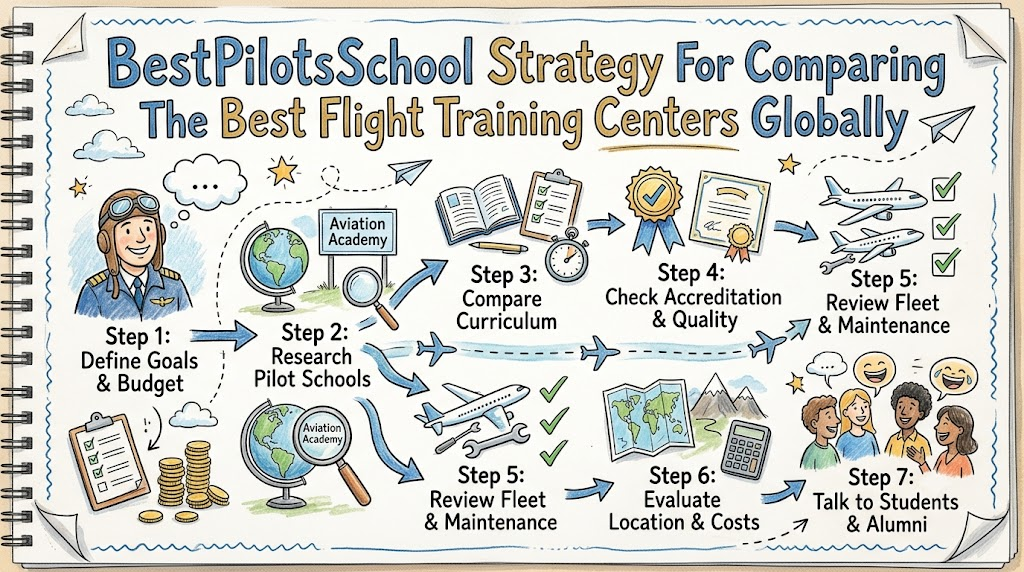
Assessing aviation academies requires looking past polished promotional brochures and promotional videos. Astute candidates investigate fleet diversity, instructor stability, local airspace congestion, and regional weather conditions.
- Instructor Dedication: Seek academies with full-time staff instructors rather than transient hourly builders.
- Maintenance Facilities: Ensure the academy operates on-site maintenance hangars with dedicated avionics technicians.
- Modern Simulation: Confirm daily access to certified flight training devices and glass-cockpit procedural trainers.
- Flyable Climate: Choose regions that provide over three hundred visual meteorological flight days annually.
Systematically verifying these operational points protects your budget from expensive ground holds and keeps your flight hours advancing.
Best Flight Schools Should Match Your Career Plan
Every student pilot brings distinct career goals to the flight line, from international long-haul passenger jets to remote cargo operations. Therefore, the best flight schools tailor their daily training syllabi to match specific industry sectors.
Direct airline cadet programs provide conditional first officer job offers before students begin their initial flight lessons. In contrast, bush and specialized cargo operators value mountain flying techniques and rugged short-field operations.
Selecting a flight school that aligns with your specific career objective saves substantial tuition funds and accelerates your commercial airline placement.
What Makes the Best Commercial Pilot Training Schools Different?
Premier flight institutes distinguish themselves by enforcing airline standard operating procedures and modern glass cockpits like the Garmin G1000. Furthermore, the best commercial pilot training schools introduce multi-crew coordination and jet bridge programs early in their flight syllabus.
Empirical aviation research confirms that students trained in airline-style environments adapt 40% faster during type-rating ground schools.
Leading centers also organize on-campus airline recruitment days, run mock simulator evaluations, and guide graduates through commercial airline interview panels.
How Much Does Pilot Training Cost?
Pursuing professional aviation credentials requires a substantial financial commitment that varies by region, aircraft fleet, and regulatory requirements. A comprehensive flight budget must cover dual flight instruction, aircraft hourly rental, fuel surcharges, ground school materials, and official examiner fees.
Total Capital Requirement = Base Course Tuition + Flight Hours + Fuel Surcharges + Checkride Fees + Living Costs
Moreover, unexpected weather disruptions and extra training flights often expand baseline budgets by ten to twenty percent. Transparent flight schools provide detailed fee schedules without hidden hangar fees, landing charges, or administrative markups.
Building an adequate financial reserve ensures continuous flight training and avoids costly pauses during multi-engine preparation.
Integrated vs. Modular Pilot Training
Prospective aviators must choose between continuous integrated courses and adaptable modular programs. Integrated tracks guide beginners from zero hours to commercial readiness within eighteen intensive months.
Conversely, modular formats allow trainees to complete private, instrument, and commercial ratings in distinct stages as their personal schedules and finances permit.
- Integrated Strategy: Requires full upfront tuition, demands strict full-time participation, and delivers rapid airline placement.
- Modular Strategy: Offers flexible pay-as-you-go payments, accommodates outside employment, and supports individual pacing.
Finding the Best Pilot Schools in the World
Global aviation candidates frequently cross borders to access modern airport infrastructure and year-round visual flying conditions. Locating the best pilot schools in the world requires evaluating international license conversion protocols and dedicated foreign student support services.
Renowned aviation hubs across North America, Europe, Australia, and the Middle East provide premier flight training recognized by major international civil aviation authorities.
International flight instruction also exposes trainees to high-density airspace, diverse control towers, and complex airport layouts, cultivating superior cockpit resourcefulness.
How to Evaluate a Pilot Training Academy
Schedule an on-site audit of any flight facility before signing an enrollment contract. Walk the ramp line, interview currently enrolled students, and discuss training standards directly with chief flight instructors.
[Facility Inspection] ➔ [Maintenance Review] ➔ [Student Feedback] ➔ [Safety Audit]
Code language: CSS (css)
A transparent pilot training academy readily shares historical checkride first-pass rates and active safety management protocols.
Observe how efficiently dispatch teams launch flight blocks and how maintenance crews address unexpected aircraft snags. Rigorous discipline on the hangar floor always reflects high safety standards in the sky.
Choosing an Airline Pilot Training Academy
Prospective airline first officers should prioritize flight centers that embed multi-pilot cooperation into standard curriculums. A top airline pilot training academy includes advanced jet transition modules and full-flight simulator exercises.
These specialized modules train students to manage cockpit workload distribution, master automated flight director systems, and execute complex emergency checklists.
By handling challenging operational scenarios inside advanced motion simulators, graduates approach airline selection evaluations and simulator profiles with complete confidence.
How to Identify the Best Flying Schools
Exceptional flight academies continually modernize their training fleets with digital glass avionics and retire aging airframes. The best flying schools employ full-time ground faculty, modern briefing rooms, and robust student support services.
Elite academies assign experienced faculty advisors to supervise each student’s milestones, resolve theoretical bottlenecks, and ensure solo flight safety.
By cultivating professional discipline and operational precision, these institutions prepare students for the strict daily routines of commercial airline cockpits.
The Importance of Student Reviews
Institutional websites rarely highlight daily administrative challenges, aircraft dispatch delays, or instructor shortages. For this reason, authentic student reviews and alumni forums provide invaluable, realistic perspectives on an academy’s actual performance.
Speaking with recent graduates uncovers true program completion timelines, realistic fleet availability, and actual airline placement rates.
Independent student discussions reveal how school managers handle schedule conflicts and adverse weather events, steering you away from poorly organized flight centers.
Using BestPilotsSchool to Research Your Options
Sorting through hundreds of flight academies across different countries can overwhelm any prospective aviator. BestPilotsSchool organizes verified flight school profiles, fleet data, and user ratings into a streamlined directory.
Our comparative system lets future aviators filter institutions by aircraft types, available licenses, and total course investments.
Rather than sifting through unverified promotional claims, you quickly locate the best aviation academy for pilot training to launch your professional cockpit career.
Common Mistakes Students Make
Many aspiring aviators commit to flight programs without performing proper due diligence. A common mistake involves transferring entire course fees upfront to financially unstable flight centers.
Frequent Errors: Paying 100% Upfront | Overlooking Hidden Fees | Ignoring Bad Weather Seasons | Skipping Medical Checks
- Postponing Aviation Medicals: Obtain an official Class 1 medical certificate before spending money on flight courses.
- Underbudgeting Living Costs: Calculate regional housing, meals, and local transit costs around the training airfield.
- Selecting Schools Solely on Low Price: Low tuition rates often reflect deferred aircraft maintenance and high instructor turnover.
Frequently Asked Questions About BestPilotsSchool
- What specific factors define a premier airline training academy?Top academies maintain modern glass-cockpit fleets, certified flight instructors, integrated multi-crew training, robust safety systems, and strong airline hiring links.
- How does BestPilotsSchool assist students during their flight school search?The platform aggregates verified institutional profiles, aircraft inventories, fee breakdowns, and student reviews to provide transparent comparisons worldwide.
- Can foreign candidates train at international aviation academies?Accredited international academies regularly issue student training visas, provide housing assistance, and assist with global license conversions.
- What total duration should students expect for commercial pilot courses?Full-time integrated flight programs take fourteen to eighteen months, whereas modular training tracks require two to three years of study.
- Why do modern training centers mandate glass cockpit avionics?Modern commercial airliners utilize digital flight displays, so learning on electronic instrumentation eases the transition to multi-engine jet cockpits.
- Which specific medical certificate must commercial candidates hold?Commercial aviation candidates must obtain and hold an unrestricted Class 1 aviation medical certificate from an authorized medical examiner.
- How does dedicated in-house maintenance optimize training schedules?In-house maintenance hangars resolve mechanical squawks quickly, ensuring high aircraft availability and preventing long training groundings.
- What primary differences separate integrated and modular paths?Integrated courses deliver an accelerated full-time curriculum from zero flight time, while modular pathways allow flexible, self-paced progress.
- Do flying academies offer contractual hiring guarantees?Cadet programs offer conditional airline employment letters, while independent academies assist graduates through networking events, career seminars, and hiring partnerships.
- How can a candidate confirm an academy’s active safety standards?Review official civil aviation audit reports, inspect maintenance logs, assess safety management systems, and interview current students directly.
Final Thoughts
Advancing your flight career demands unwavering focus, smart budgeting, and an exceptional training facility. By evaluating aircraft fleets, instructor quality, and career support services, you position yourself for long-term cockpit success.
Rely on BestPilotsSchool to compare accredited aviation academies, verify training pathways, and chart your course toward the cockpit. Plan carefully, inspect prospective facilities in person, and take control of your flight training journey today.








Leave a Reply
You must be logged in to post a comment.