Introduction
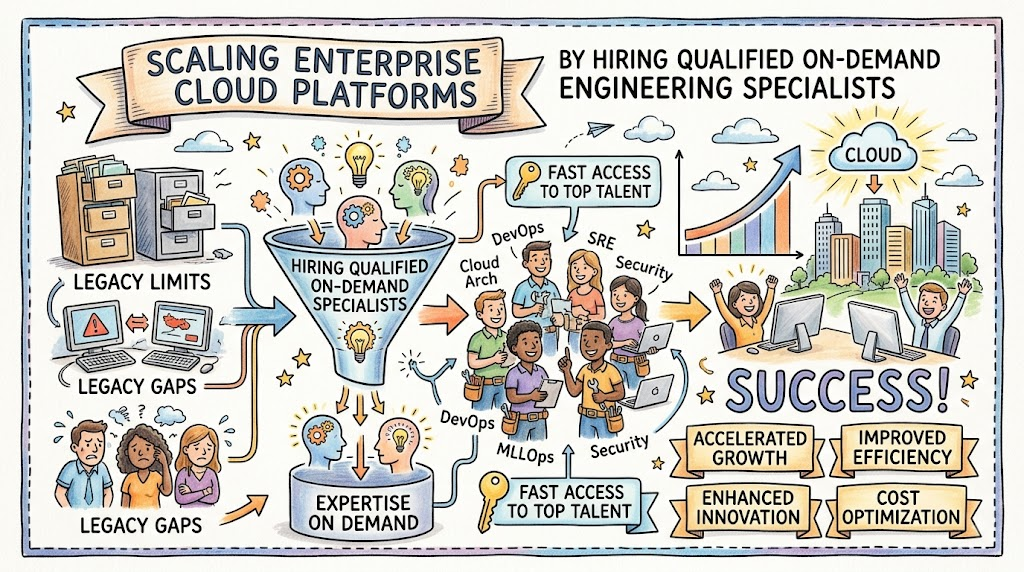
Engineering leadership teams constantly navigate the delicate balance between rapid product deployments and absolute system stability. Consequently, organizations facing tight development deadlines or infrastructure scaling challenges actively seek flexible technical solutions. Choosing to Hire DevOps Freelancer talent allows forward-thinking enterprises to modernize delivery pipelines quickly while managing operational costs effectively.
Furthermore, cloud systems demand continuous tuning across continuous integration, container orchestration, automated security, and infrastructure monitoring setups. External technical consultants assess existing deployment workflows, eliminate operational friction points, and deploy repeatable operational templates. Partnering with dedicated independent engineers transforms complex delivery pipelines into efficient competitive advantages.
What Is a DevOps Freelancer?
A modern cloud contractor operates as an independent technical specialist who builds, automates, and optimizes software delivery platforms. These specialists bridge application development and IT infrastructure management by constructing secure, repeatable deployment pipelines. Furthermore, they work on dedicated project goals or flexible retainers, helping businesses solve immediate technical hurdles. Because they focus heavily on automation, they eliminate manual release errors and accelerate software delivery cadences.
Additionally, independent consultants bring diverse hands-on experience gathered across various enterprise environments. A skilled Freelance DevOps Engineer diagnoses architectural bottlenecks, implements robust observability frameworks, and designs scalable cloud setups. Rather than managing daily routine tasks, they convert fragile manual processes into resilient, automated delivery pipelines. Consequently, organizations gain instant technical mastery without long executive recruiting delays.
Why Companies Hire DevOps Freelancers
Fast-growing technology firms regularly encounter sudden workload spikes that overwhelm internal development teams during major scaling milestones. Recruiting permanent senior infrastructure architects requires extended hiring cycles and substantial salary commitments that early-stage ventures cannot justify. Therefore, smart companies contract external cloud consultants to execute specific architectural milestones swiftly and affordably. This flexible talent strategy guarantees that critical migrations, security enhancements, and pipeline builds stay on schedule.
In addition, short-term engineering contracts help executive teams manage operational budgets with high precision. Companies bring on expert consultants during intensive development phases—such as microservices refactoring or cloud migrations—and conclude engagements once primary objectives finish. Moreover, these independent experts share modern industry standards with permanent staff. Consequently, businesses keep internal operations lean while expanding software delivery bandwidth rapidly.
What Does a Freelance DevOps Engineer Do?
These specialized technical consultants handle a broad array of tasks designed to stabilize, automate, and optimize digital infrastructure. Primarily, they build automated build and deployment pipelines that allow software developers to ship clean code safely. Furthermore, they write modular infrastructure code, configure real-time monitoring tools, and secure containerized application setups. Their daily focus centers on making software releases predictable, fast, and resistant to unexpected system outages.
Beyond basic automation tasks, these technical contractors lead complex platform upgrades and cloud migration initiatives. They systematically audit existing cloud configurations to pinpoint security risks, resource limits, and unnecessary cloud expenditure. Furthermore, they implement automated compliance controls and disaster recovery routines to safeguard corporate digital assets. Ultimately, their contributions keep software delivery pipelines running smoothly, freeing internal teams to focus on core product features.
DevOps Freelancer India: Why Organizations Consider Remote Specialists
International technology leaders frequently source remote engineering talent to sustain rapid product development while maintaining cost efficiency. Indian software professionals enjoy a strong global reputation for technical proficiency, deep domain knowledge, and disciplined project execution. Therefore, engaging a DevOps Freelancer India connects global businesses with elite engineering capabilities at highly competitive market rates. This strategic sourcing alignment enables growing companies to stretch project budgets substantially.
Moreover, working across global time zones creates a round-the-clock productivity cycle for distributed software teams. Engineering specialists in India communicate effectively within international business environments and integrate smoothly into modern agile workflows. Furthermore, their broad experience across major cloud platforms accelerates complex infrastructure deployments reliably. Consequently, collaborating with remote specialists in India offers an ideal blend of affordability, technical excellence, and continuous execution.
AWS DevOps Freelancer: When AWS Expertise Matters
Amazon Web Services serves as the primary cloud backbone for thousands of enterprise applications requiring global scalability. However, configuring complex AWS services like Elastic Kubernetes Service, Lambda functions, and custom network topologies demands deep hands-on precision. Contracting a seasoned AWS DevOps Freelancer ensures your cloud environment follows established architectural frameworks from day one. These specialists restructure underutilized cloud assets, eliminate wasteful resource allocation, and maximize network performance.
In addition, dedicated AWS experts automate infrastructure setups using native CloudFormation scripts or third-party automation frameworks. They enforce strict identity management controls, deploy automated encryption routines, and establish resilient disaster recovery systems. Furthermore, their proactive observability configurations catch performance drops before end users encounter platform disruptions. Ultimately, bringing in specialized AWS talent ensures your cloud infrastructure operates securely, predictably, and cost-effectively.
Kubernetes Freelancer: Managing Containerized Environments
Operating containerized applications across microservices architectures requires precise control over container scheduling, network routing, and storage management. As organizations expand container footprints, managing Kubernetes cluster complexity can easily overwhelm internal engineering teams. Hiring a qualified Kubernetes Freelancer enables companies to build, scale, and maintain containerized workloads without overloading internal developers. These specialists construct resilient cluster setups that automatically scale compute capacity during sudden traffic surges.
Furthermore, experienced container experts systematically resolve networking bottlenecks, establish ingress controllers, and secure inter-pod communication channels. They configure automated health checks, manage namespace isolation, and integrate comprehensive cluster monitoring stacks. Additionally, they guide software teams through seamless microservices migrations with minimal operational disruption or downtime. Consequently, hiring a container orchestration specialist ensures your application platform remains secure, highly available, and easy to maintain.
Terraform Freelancer: Building Repeatable Infrastructure
Manual cloud configurations generate dangerous configuration drift, introduce human errors, and severely hinder environment replication. Modern software teams utilize Infrastructure as Code methodologies to provision, manage, and version-control cloud resources declaratively. By contracting a skilled Terraform Freelancer, organizations transform fragile, manually configured environments into clean, version-controlled code bases. This transition ensures development, testing, and production environments remain completely identical.
Moreover, specialized Terraform consultants write reusable, modular code templates that simplify multi-cloud management and disaster recovery routines. They establish secure remote state management protocols, integrate automated linting checks, and align configurations with strict compliance frameworks. Furthermore, their automated templates allow developers to launch isolated test environments on demand without manual IT intervention. Ultimately, adopting declarative automation standards eliminates environment inconsistencies and accelerates application release cadences.
Azure DevOps Freelancer: Supporting Microsoft Cloud Environments
Enterprises building on Microsoft platforms require specialized cloud strategies tailored to the unique architecture of Azure. From configuring automated Azure Pipelines to managing Azure Kubernetes Service, specialized technical oversight remains vital for long-term platform stability. Contracting an Azure DevOps Freelancer ensures your Microsoft cloud setup aligns directly with industry-leading security and automation standards. These experts streamline enterprise software delivery while maintaining tight integration with active directory identity controls.
Additionally, Azure specialists optimize hybrid cloud connectivity, ensuring legacy on-premises servers link securely with modern cloud resources. They build automated release gates, set up comprehensive log analytics dashboards, and track cloud expenditure across enterprise subscriptions. Furthermore, their targeted pipeline enhancements help developer teams ship software updates faster with fewer release failures. Consequently, dedicated Azure expertise maximizes your return on cloud investments while preserving strict compliance standards.
DevSecOps Freelancer: Integrating Security Into Delivery
Delaying security testing until after software releases creates severe operational vulnerabilities and expensive post-release fixes. Modern engineering organizations embed automated security controls directly into continuous integration and continuous delivery pipelines from project initiation. Partnering with a skilled DevSecOps Freelancer ensures static code analysis, container vulnerability scanning, and secret detection execute automatically on every commit. This proactive approach identifies security risks early in development, where fixing them costs significantly less time and money.
Furthermore, security-focused cloud contractors assist organizations in satisfying strict regulatory standards like ISO, SOC2, and HIPAA. They write automated compliance verification scripts, enforce secure identity frameworks, and protect sensitive API endpoints systematically. Moreover, they train internal developer teams on secure coding principles and threat-modeling techniques throughout project engagements. Ultimately, embedding continuous security practices into software pipelines protects business assets without slowing down release momentum.
SRE Freelancer: Improving Reliability
Unplanned system downtime, slow database responses, and erratic application latencies directly damage customer trust and corporate revenue. Site Reliability Engineering applies software engineering methodologies directly to operational problems to maximize system uptime predictably. Contracting an experienced SRE Freelancer helps organizations define clear service level objectives, monitor error budgets, and build intuitive performance dashboards. These specialists systematically eliminate operational toil by automating manual maintenance tasks and building resilient self-healing architectures.
Additionally, site reliability consultants establish detailed incident management plans, conduct objective post-mortem reviews, and resolve recurring platform flaws. They optimize server performance under heavy traffic loads and execute chaotic testing scenarios to validate system resilience. Furthermore, their continuous observability configurations detect performance drops early, enabling engineering teams to resolve issues long before customers experience service interruptions. Consequently, investing in dedicated reliability expertise guarantees stable application performance during high-growth periods.
MLOps Freelancer: Operating Machine Learning Systems
Deploying machine learning models in production presents unique operational challenges that standard software delivery pipelines cannot solve effectively. Artificial intelligence models require continuous data pipeline monitoring, automated retraining loops, dataset versioning, and compute-intensive hardware allocations. Engaging an MLOps Freelancer bridges the gap between data science experimentation and reliable production model hosting. These experts construct robust pipelines that automate model training, testing, packaging, and scalable inference hosting.
Moreover, machine learning infrastructure specialists monitor real-time model drift, inference latency, and hardware utilization across distributed compute clusters. They streamline model deployment pipelines, allowing data scientists to push updated algorithm models into production safely. Furthermore, they optimize expensive GPU cluster allocations, drastically reducing cloud compute expenditure without impacting real-time processing speeds. Ultimately, dedicated MLOps expertise ensures your artificial intelligence investments deliver reliable, scalable business value in production.
Skills to Check Before Hiring a DevOps Freelancer
Evaluating external infrastructure contractors requires a thorough review of technical capabilities, problem-solving instincts, and communication skills. Candidates must demonstrate deep hands-on fluency in container management, pipeline automation, cloud platforms, and script writing. Furthermore, evaluating real-world project portfolios helps verify whether a technical candidate can resolve complex architectural challenges effectively. The following checklist outlines core competency areas every company should assess before finalizing an engagement:
- Cloud Platform Mastery: Deep practical skill managing core services across AWS, Azure, or Google Cloud Platform.
- Declarative Provisioning: Advanced proficiency writing clean, modular, and maintainable Terraform or CloudFormation modules.
- Container Orchestration: Strong background setting up, securing, and maintaining production-grade Kubernetes cluster environments.
- CI/CD Automation: Proven history building secure, fully automated release pipelines using tools like GitHub Actions, GitLab, or Jenkins.
- Observability Setup: Extensive experience configuring comprehensive monitoring, tracing, and logging stacks using Prometheus, Grafana, or Datadog.
Questions to Ask During a Technical Interview
Conducting a thorough technical interview ensures an external contractor possesses the practical problem-solving capabilities required for your project. Rather than focusing purely on theoretical definitions, ask scenario-based questions that reveal real-world engineering judgment and troubleshooting instincts. Furthermore, pay close attention to how clearly candidates explain complex technical trade-offs and architectural decisions under pressure. Consider incorporating these targeted discussion prompts during your candidate evaluation process:
- How do you approach migrating a legacy monolithic application to a microservices architecture with zero operational downtime?
- What specific strategies do you use to manage, secure, and isolate state files when working with Terraform at enterprise scale?
- Can you describe a situation where a production deployment failed unexpectedly, and detail the exact steps you took to diagnose and resolve it?
- How do you integrate automated security vulnerability scanning into high-velocity continuous integration pipelines without blocking developer productivity?
- What key performance metrics do you track to differentiate between healthy application latency and underlying cloud infrastructure bottlenecks?
Common Mistakes When Hiring Freelance DevOps Specialists
Organizations often make critical errors when engaging independent cloud contractors, leading to missed project deadlines and inflated budget expectations. One frequent oversight is failing to define precise project deliverables, performance expectations, and clear success metrics before work begins. Furthermore, rushing the onboarding process without providing proper system documentation or credential management protocols slows down initial productivity. Avoiding these common hiring missteps ensures a smooth, highly effective collaboration between external specialists and internal teams:
- Unclear Scope Definitions: Expecting a single contractor to solve vague, unstructured system problems without defined technical milestones.
- Ignoring Communication Fits: Selecting talent purely based on technical resumes while overlooking essential collaboration and asynchronous communication skills.
- Overlooking Security Protocols: Granting broad, unmonitored administrative access to cloud environments without enforcing strict least-privilege security policies.
- Neglecting Knowledge Transfer: Failing to mandate comprehensive documentation and technical handovers before the contractor completes their engagement contract.
How to Structure a DevOps Freelance Project
A well-structured project roadmap ensures external technical engagements run on time, remain within budget, and deliver measurable operational value. Begin by conducting a thorough discovery phase where the specialist audits existing cloud setups and outlines a clear technical strategy. Subsequently, break down complex architectural overhauls into distinct, measurable milestones with realistic deadlines and explicit technical deliverables. This organized approach maintains accountability and provides total visibility into project progress across all engineering stakeholders.
Furthermore, schedule regular asynchronous updates and weekly milestone reviews to address technical blockers and refine project priorities adaptively. Mandate that every code change, pipeline update, and architectural modification be checked into version control with complete documentation. Finally, allocate dedicated time toward the end of the contract for thorough internal team training and detailed knowledge transfer sessions. Consequently, your permanent engineering team maintains full control over newly built infrastructure long after the contractor offboards.
How DevOpsFreelancer Can Help
Finding qualified, thoroughly vetted cloud infrastructure experts often takes weeks of valuable time that growing companies simply cannot afford. DevOpsFreelancer simplifies this talent acquisition process by instantly connecting businesses with proven, high-caliber cloud engineering specialists worldwide. Whether you need a short-term consultant for an emergency cloud migration or a dedicated long-term remote specialist, the platform provides flexible engagement models matched precisely to your technical requirements.
Moreover, every specialist on the platform undergoes rigorous technical screening to verify real-world hands-on expertise across major cloud technologies. This comprehensive vetting process eliminates recruitment guesswork, allowing engineering leaders to onboard top-tier talent and initiate critical projects immediately. By pairing your business with specialized, performance-driven professionals, DevOpsFreelancer ensures your infrastructure modernizations execute cleanly, securely, and within budget.
Frequently Asked Questions About DevOpsFreelancer
- What primary services do independent cloud experts offer on the platform?
Specialists handle continuous integration automation, cloud migrations, Infrastructure as Code creation, Kubernetes management, security auditing, and site reliability engineering.
- How quickly can a business onboard a qualified expert for a critical project?
Most organizations review curated candidate profiles, conduct technical interviews, and successfully onboard specialized contractors within forty-eight hours of submitting their requirements.
- Can I hire specialists for short-term emergency troubleshooting projects?
Yes, flexible platform arrangements allow businesses to engage experts for brief emergency interventions, comprehensive system audits, or long-term infrastructure modernization projects.
- How does the platform verify candidate technical expertise and work history?
Candidates undergo multi-stage technical evaluations, including scenario-based problem-solving tests, code quality reviews, and thorough background checks regarding past client project delivery.
- Are remote experts available across different global time zones?
Absolutely, the global network includes specialists operating across various international time zones, ensuring smooth asynchronous collaboration or continuous round-the-clock technical coverage.
- What is the typical cost structure for engaging an independent cloud engineer?
Pricing varies based on technical specialization, project complexity, and total experience, with flexible hourly rates or fixed milestone-based project billing options available.
- How do businesses protect sensitive intellectual property and infrastructure data?
All technical contractors sign comprehensive non-disclosure agreements and follow strict least-privilege access security controls managed directly by your internal security administrators.
- Can an external specialist help reduce our monthly cloud service provider bills?
Yes, experienced cloud contractors systematically analyze resource allocation, remove unused assets, right-size instances, and implement cost governance strategies to lower monthly bills significantly.
- What happens if a contractor does not meet our defined project expectations?
The platform offers dedicated support to resolve communication bottlenecks or rapidly provide replacement specialists to ensure your project milestones remain on schedule.
- Do specialists handle team training and technical documentation during engagements?
Yes, standard project contracts mandate thorough system documentation, automated pipeline walkthroughs, and formal knowledge transfer sessions for your permanent internal engineering team.
Final Thoughts
Achieving operational excellence across modern cloud environments requires continuous technical adaptation, agile talent strategies, and disciplined execution frameworks. Relying solely on rigid, traditional hiring models often restricts software release cadences and overburdens internal engineering teams during critical expansion phases. Integrating specialized external contractors into your platform strategy delivers a flexible, cost-effective path toward rapid infrastructure modernization. By collaborating with independent cloud experts, your organization builds reliable, automated systems that power sustainable digital innovation over time.






Leave a Reply
You must be logged in to post a comment.