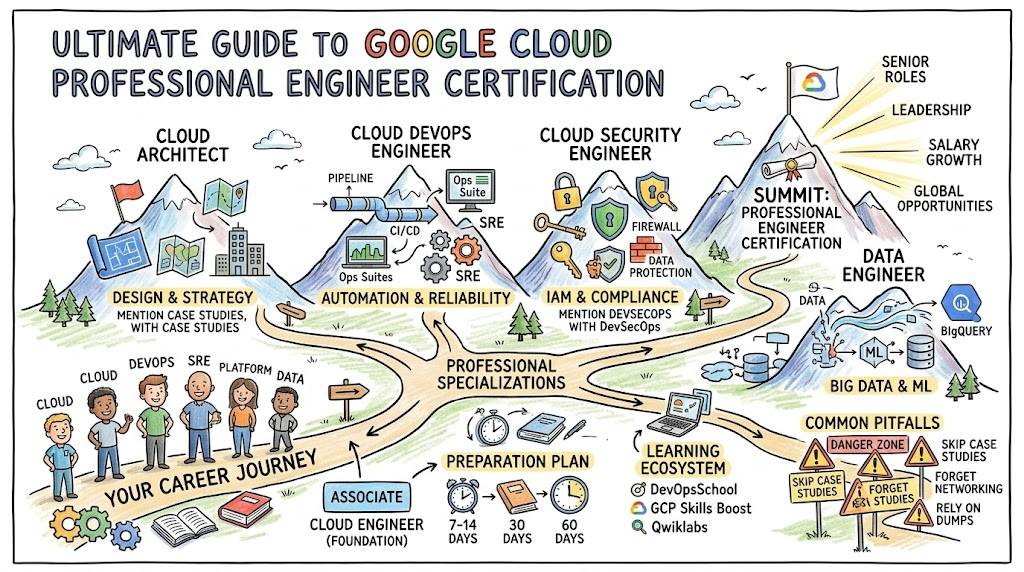
Introduction
The Google Cloud Professional Engineer represents a pinnacle of technical achievement for those steering the digital transformation of modern enterprises. This guide targets software engineers, systems architects, and operational leads who need to validate their expertise in the Google Cloud ecosystem. As the industry shifts toward complex distributed systems, DevOpsSchool provides the necessary pedagogical support to bridge the gap between abstract cloud concepts and production-grade reality. By reading this analysis, professionals can evaluate the strategic impact of this credential on their specific career trajectory. You will find actionable insights here that allow you to move beyond simple tool-based learning into true platform engineering mastery.
What is the Google Cloud Professional Engineer?
The Google Cloud Professional Engineer is a high-level certification that validates an individual’s ability to design, develop, and manage robust solutions on the Google Cloud Platform. It signifies a transition from being a casual user of cloud services to a professional architect who understands the underlying mechanics of performance and reliability. The program emphasizes a production-first mindset, focusing heavily on how to implement Site Reliability Engineering (SRE) principles in a live environment.
This certification exists to set a rigorous industry standard for cloud excellence, ensuring that engineers can handle high-velocity delivery without compromising system integrity. It aligns perfectly with modern enterprise practices by requiring candidates to demonstrate mastery over automation, monitoring, and incident response. Unlike many entry-level certificates, this credential demands a deep understanding of how specific Google Cloud services interact to support complex, global-scale applications.
Who Should Pursue Google Cloud Professional Engineer?
Software engineers looking to transition into cloud-native development will find this certification provides the necessary architectural depth to lead projects. Site Reliability Engineers (SREs) and platform specialists benefit immensely, as the curriculum mirrors the actual day-to-day challenges of maintaining high-availability systems. Cloud architects and security professionals also gain a structured framework for implementing governance and compliance at scale across the organization.
The global demand for these skills is surging, with a particularly high concentration of roles in tech hubs across India, North America, and Europe. Beginners with a strong foundation in Linux and networking can use this as an aggressive growth target, while experienced engineers can use it to solidify their market value. Managers who oversee technical teams should pursue the foundation levels to better communicate with their engineering staff and make informed budgetary decisions regarding cloud spend.
Why Google Cloud Professional Engineer is Valuable in 2026 and Beyond
As enterprise adoption of multi-cloud and hybrid-cloud strategies matures, the Google Cloud Professional Engineer remains a cornerstone of professional relevance. Google’s leadership in data analytics, machine learning, and container orchestration ensures that this certification has long-term longevity. Engineers who master these environments are better equipped to handle the shifting landscape of software delivery, regardless of which specific tools gain popularity.
The return on investment for this certification is substantial, often leading to roles with higher strategic responsibility and significantly better compensation packages. It helps professionals stay resilient against automation by focusing on high-level architectural decision-making and reliability strategy. In an era where efficiency and cost-optimization are paramount, the skills gained through this program allow engineers to prove their direct impact on the company’s bottom line.
Google Cloud Professional Engineer Certification Overview
The program is comprehensively delivered via the official Google Cloud Professional Engineer training path and is hosted on the DevOpsSchool platform. The assessment approach moves away from simple rote memorization, instead utilizing scenario-based questions that mirror real-world engineering obstacles. This ownership of the learning process ensures that the candidate can actually apply the concepts in a professional setting rather than just passing a test.
The structure is divided into specific domains including service monitoring, CI/CD pipeline optimization, and incident management. It requires a blend of theoretical knowledge and hands-on laboratory experience to achieve a passing score on the final examination. Because Google Cloud updates its services frequently, the certification program remains dynamic, reflecting the latest advancements in cloud technology and operational best practices.
Google Cloud Professional Engineer Certification Tracks & Levels
The certification hierarchy begins at the foundation level, which introduces the core services and the fundamental value proposition of Google Cloud. The professional track is where most engineers spend their time, focusing on specialized roles such as DevOps, Data Engineering, or Security. Advanced levels are reserved for those who have mastered the art of cloud architecture and can design systems that span multiple global regions.
These levels align directly with career progression, moving from an individual contributor to a lead engineer or architect. Specialization tracks allow professionals to tailor their learning to their current job function while keeping an eye on future leadership opportunities. For example, the SRE-focused tracks emphasize reliability and monitoring, while the FinOps track focuses on the financial governance of cloud resources.
Complete Google Cloud Professional Engineer Certification Table
| Track | Level | Who it’s for | Prerequisites | Skills Covered | Recommended Order |
| Cloud Digital | Foundation | Managers/Leads | None | Cloud Basics | First |
| Cloud Engineer | Associate | Junior Admins | Basic Linux | Deployment | Second |
| DevOps Engineer | Professional | DevOps/SRE | Cloud Engineer | CI/CD, SRE | Third |
| Data Engineer | Professional | Data Scientists | Python/SQL | BigQuery, ML | Optional |
| Cloud Architect | Professional | Senior Leads | 3+ Yrs Exp | System Design | Fourth |
| Security | Advanced | SecOps | Professional | IAM, Encryption | Optional |
Detailed Guide for Each Google Cloud Professional Engineer Certification
Google Cloud Professional Engineer – Cloud DevOps Engineer
What it is
This certification validates an engineer’s ability to balance service reliability with delivery speed using Google Cloud tools. It focuses heavily on the implementation of Site Reliability Engineering (SRE) principles in a production environment.
Who should take it
Current DevOps practitioners, SREs, and system administrators who want to prove their ability to manage Google Cloud infrastructure at scale. It is intended for those with at least two years of hands-on experience in cloud operations.
Skills you’ll gain
- Implementing CI/CD pipelines using Google Cloud Build
- Managing service levels using SLIs and SLOs
- Automating infrastructure deployment with Terraform
- Configuring advanced monitoring and logging in Cloud Operations
Real-world projects you should be able to do
- Building a self-healing microservices architecture on GKE
- Automating a blue-green deployment strategy for a high-traffic app
- Designing a multi-regional disaster recovery plan
Preparation plan
- 7-14 Days: Focus on core Google Cloud services and the SRE handbook fundamentals.
- 30 Days: Complete hands-on labs for GKE, Cloud Build, and Cloud Operations Suite.
- 60 Days: Deep dive into case studies and mock exams to understand scenario-based logic.
Common mistakes
- Underestimating the weight of SRE cultural concepts in favor of purely technical tool knowledge.
- Neglecting the nuances of IAM permissions when designing automation pipelines.
Best next certification after this
- Same-track option: Professional Cloud Architect
- Cross-track option: Professional Cloud Security Engineer
- Leadership option: Engineering Manager Track
Google Cloud Professional Engineer – Cloud Architect
What it is
This certification proves a professional’s ability to design, develop, and manage robust, secure, and scalable solutions. It is widely considered one of the most difficult and prestigious certifications in the cloud industry.
Who should take it
Senior engineers and technical architects who are responsible for making high-level decisions about infrastructure and application design. Candidates should have a broad understanding of both business requirements and technical constraints.
Skills you’ll gain
- Designing for high availability and disaster recovery
- Implementing complex network topologies on VPC
- Analyzing and optimizing cloud spend and resource usage
- Managing compliance and security across diverse workloads
Real-world projects you should be able to do
- Migrating a legacy monolithic application to a serverless architecture
- Designing a secure, private network for a global financial firm
- Architecting a data lake using BigQuery and Cloud Storage
Preparation plan
- 7-14 Days: Review the official case studies provided by Google Cloud.
- 30 Days: Map business requirements to specific Google Cloud service offerings.
- 60 Days: Conduct extensive architectural reviews of hypothetical enterprise environments.
Common mistakes
- Focusing too much on individual service features rather than the “big picture” of system integration.
- Failing to account for the operational cost and maintenance burden of complex designs.
Best next certification after this
- Same-track option: Professional Data Engineer
- Cross-track option: Professional Cloud Developer
- Leadership option: Chief Technology Officer Path
Choose Your Learning Path
DevOps Path
The DevOps path focuses on the lifecycle of the application, from the first line of code to the final deployment in production. Engineers in this track master Google Cloud Build, Artifact Registry, and Deployment Manager to create seamless, automated workflows. This path is ideal for those who enjoy improving the developer experience and accelerating the time-to-market for software products.
DevSecOps Path
In the DevSecOps track, security is integrated into every stage of the automated pipeline rather than being treated as an afterthought. Professionals learn to implement Binary Authorization, Cloud Armor, and Secrets Management within their CI/CD flows. This path is critical for engineers working in highly regulated industries like healthcare or finance where data integrity is the primary concern.
SRE Path
The SRE path is for those who are obsessed with system stability and high availability. It emphasizes the Google SRE handbook, focusing on error budgets, toil reduction, and automated incident response using Cloud Monitoring. This path aligns with the “run what you build” philosophy and is perfect for engineers who enjoy deep troubleshooting and performance tuning.
AIOps / MLOps Path
This path bridges the gap between machine learning models and production operations using Vertex AI and Kubeflow. Engineers learn to automate the retraining and deployment of models while monitoring for data drift and performance degradation. It is a rapidly growing field that requires a unique blend of data science awareness and infrastructure expertise.
DataOps Path
The DataOps track focuses on the reliability and automation of data pipelines using tools like BigQuery, Dataflow, and Pub/Sub. Professionals in this path ensure that data is high-quality, accessible, and delivered with low latency to downstream consumers. This is the natural progression for data engineers who want to apply DevOps principles to their data architecture.
FinOps Path
FinOps practitioners focus on the intersection of cloud engineering and financial accountability. They use Google Cloud’s billing export and Recommender tools to ensure the organization is getting the maximum value for every dollar spent on the platform. This path is essential for senior leads and managers who need to balance technical innovation with strict budgetary constraints.
Role → Recommended Google Cloud Professional Engineer Certifications
| Role | Recommended Certifications |
| DevOps Engineer | Professional DevOps Engineer, Associate Cloud Engineer |
| SRE | Professional DevOps Engineer, Professional Cloud Architect |
| Platform Engineer | Professional Cloud Architect, Professional Cloud Developer |
| Cloud Engineer | Associate Cloud Engineer, Professional DevOps Engineer |
| Security Engineer | Professional Cloud Security Engineer, Professional Cloud Architect |
| Data Engineer | Professional Data Engineer, Cloud Digital Leader |
| FinOps Practitioner | Professional Cloud Architect, Cloud Digital Leader |
| Engineering Manager | Cloud Digital Leader, Associate Cloud Engineer |
Next Certifications to Take After Google Cloud Professional Engineer
Same Track Progression
Once you have mastered the Professional DevOps Engineer certification, the next logical step is to broaden your architectural influence with the Professional Cloud Architect exam. This allows you to move from managing pipelines to designing the entire environment they live in. You can then pursue advanced specializations in networking or security to become the ultimate subject matter expert on the platform.
Cross-Track Expansion
If you are coming from a purely operational background, expanding into the Professional Data Engineer track can provide a massive career boost. Understanding how data flows through BigQuery and Dataflow allows you to better support the data science teams in your organization. Alternatively, the Professional Cloud Developer certification helps you understand the cloud from a coder’s perspective, improving your ability to build cloud-native tools.
Leadership & Management Track
For those looking to move away from day-to-day coding and into people management, the Cloud Digital Leader is an excellent way to validate your strategic understanding. You should also consider non-cloud specific certifications like the Certified Engineering Manager (CEM) or PMP. These credentials, combined with your technical Google Cloud background, make you a formidable candidate for Director of Engineering or VP of Infrastructure roles.
Training & Certification Support Providers for Google Cloud Professional Engineer
DevOpsSchool
DevOpsSchool provides an exhaustive curriculum that blends live instructor-led sessions with a massive library of on-demand content. Their approach is rooted in real-world scenarios, ensuring that students do not just pass the exam but also gain the confidence to lead enterprise projects. They offer specialized bootcamps for Google Cloud that are highly regarded for their hands-on lab environments.
Cotocus
Cotocus focuses on specialized cloud training with a heavy emphasis on containerization and Kubernetes, which are central to the Google Cloud ecosystem. Their trainers are industry veterans who bring years of production experience into the classroom. They provide excellent post-training support and mentoring for engineers looking to make significant career pivots.
Scmgalaxy
Scmgalaxy is a community-driven platform that offers a wealth of tutorials, blog posts, and study guides for Google Cloud certifications. It is an excellent resource for staying updated on the latest tool changes and community-recommended best practices. Their repository of interview questions and project ideas is particularly useful for job seekers.
BestDevOps
BestDevOps provides curated learning paths that are designed to take an engineer from zero to hero in a structured manner. Their courses focus on the practical implementation of tools like Terraform, Ansible, and Jenkins on the Google Cloud Platform. They offer one-on-one mentoring sessions that are invaluable for clearing complex architectural doubts.
devsecopsschool.com
This provider focuses exclusively on the security aspects of the DevOps lifecycle. Their Google Cloud training deep dives into IAM, network security, and compliance automation. For engineers looking to specialize in the high-demand field of cloud security, this is the premier destination for specialized knowledge.
sreschool.com
As the name suggests, this provider is dedicated to the art and science of Site Reliability Engineering. Their curriculum is heavily influenced by the Google SRE handbook and focuses on the Professional DevOps Engineer certification. They teach you how to build systems that are not just functional but also resilient and observable.
aiopsschool.com
AIOpsSchool explores the intersection of artificial intelligence and IT operations. Their Google Cloud training shows you how to use Vertex AI and other ML tools to automate incident response and capacity planning. It is a forward-looking institution for engineers who want to be at the cutting edge of automation.
dataopsschool.com
DataOpsSchool is the primary training ground for data engineers who want to apply DevOps principles to their data stacks. Their Google Cloud courses focus on BigQuery, Dataflow, and the automation of data pipelines. They emphasize data quality and reliability as core engineering requirements.
finopsschool.com
FinOpsSchool provides the necessary training to master the financial management of cloud resources. Their Google Cloud modules teach you how to interpret billing data and implement cost-saving strategies across the enterprise. For those looking to move into technical leadership, this knowledge is absolutely critical.
Frequently Asked Questions (General)
- How hard is the Google Cloud Professional Engineer exam?
The exam is quite challenging because it focuses on high-level architecture and real-world scenarios rather than simple fact-checking.
- How much time do I need to prepare?
Most engineers with some cloud experience require about 2 to 3 months of consistent study to feel confident.
- Are there any formal prerequisites for the professional level?
Google recommends 3+ years of industry experience, including 1+ year on Google Cloud, but these are not strictly enforced.
- What is the typical salary for a Google Cloud Professional Engineer?
Salaries vary by region, but in India and globally, these professionals command some of the highest pay scales in IT.
- Which is better: AWS, Azure, or Google Cloud certification?
Google Cloud is often preferred for data-heavy, ML-focused, and Kubernetes-centric roles, making it highly valuable for specialized engineers.
- Can I pass the exam with just theoretical knowledge?
No, the scenario-based questions require a level of intuition that only comes from hands-on practice in the Google Cloud console.
- How long is the certification valid?
Google Cloud professional certifications are typically valid for two years, after which you must recertify to maintain your status.
- What tools should I learn alongside the certification?
You should definitely master Terraform for Infrastructure as Code and Kubernetes (GKE) as they are central to the Google Cloud ecosystem.
- Does Google Cloud offer any free training?
Google provides a limited set of free tier services and some introductory courses, but professional-level prep usually requires paid resources.
- What is the passing score for the exam?
Google does not publish the exact passing score, but most estimates suggest you need roughly 70 percent correct to pass.
- How do I register for the exam?
You can register through the official Google Cloud certification portal and take the exam either in-person at a testing center or remotely.
- Are the questions multiple-choice?
Yes, the exams consist of multiple-choice and multiple-select questions based on architectural scenarios.
FAQs on Google Cloud Professional Engineer
- What is the core difference between the Associate and Professional levels?
The Associate level focuses on deployment and day-to-day operations, while the Professional level focuses on design, architecture, and reliability.
- How much of the exam focuses on Kubernetes?
A significant portion of the Professional DevOps and Architect exams focus on GKE, as it is Google’s flagship container service.
- Do I need to be a programmer to pass?
While you don’t need to be a senior developer, you should be comfortable with Python, Go, or Java for certain tracks like Cloud Developer.
- Is the SRE handbook really necessary for the DevOps exam?
Yes, many questions are derived directly from the principles of Site Reliability Engineering as defined by Google.
- How does Google Cloud handle multi-cloud architectures?
The Professional Architect exam will often test your knowledge of Anthos and how it allows for consistent management across different clouds.
- Are there any lab-based questions in the actual exam?
Currently, the exam is multiple-choice, but the preparation requires extensive lab work to understand the underlying logic of the answers.
- What is the most difficult Google Cloud certification?
Most experts agree that the Professional Cloud Architect and Professional Cloud Security Engineer are among the most difficult.
- Can this certification help me get a job at Google?
While it doesn’t guarantee a job, having a professional certification is a strong signal to recruiters and helps you clear technical screenings.
Final Thoughts: Is Google Cloud Professional Engineer Worth It?
If you are looking for an honest assessment from a mentor who has seen the industry evolve over two decades, the Google Cloud Professional Engineer is absolutely worth the effort. It is not just about the badge on your LinkedIn profile; it is about the mental model you build while preparing for it. This certification forces you to think like an owner of a global-scale system, considering reliability, security, and cost at every turn. In a market that is increasingly crowded with generalists, this credential marks you as a true specialist who can navigate the complexities of modern cloud-native architecture.
Don’t treat this as a checkbox exercise. Instead, use the curriculum to identify gaps in your knowledge and fill them with hands-on practice. The engineers who derive the most value from this certification are those who take the lessons back to their current teams and improve their production environments immediately. The cloud is the future of all enterprise software, and Google Cloud is at the very forefront of that innovation.