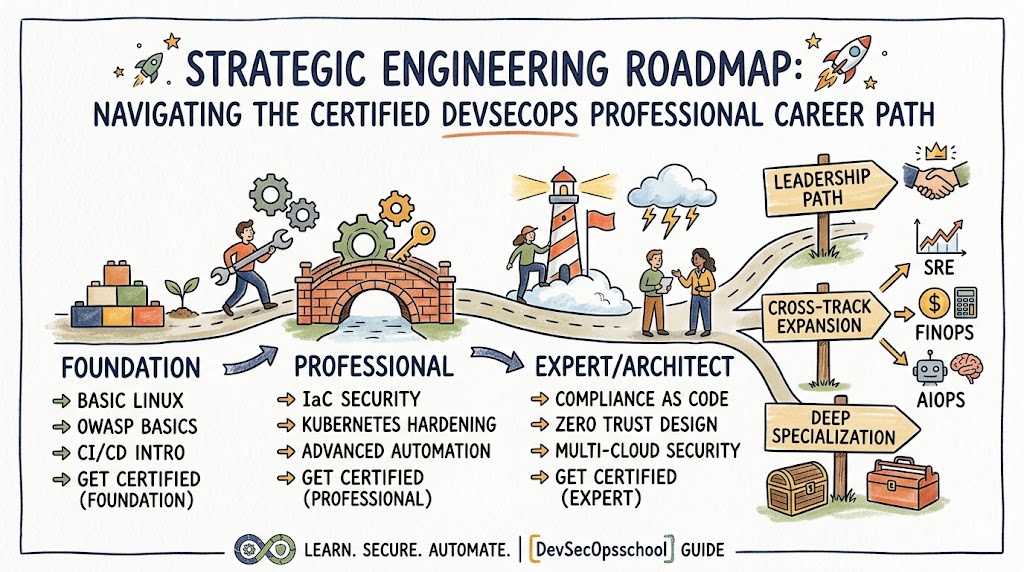
Engineers can include strong security measures straight into their automated deployment pipelines by participating in the Certified DevSecOps Professional program.. Traditional manual security audits often stall rapid software delivery, but this credential teaches a “shift-left” approach that identifies vulnerabilities during the development phase. By following the curriculum at DevSecOpsschool, developers and SREs gain the technical mastery required to protect cloud-native applications while maintaining high release velocity. This guide serves as a strategic resource for anyone looking to transition into a security-first automation role within global enterprise environments.
What is the Certified DevSecOps Professional?
This certification validates an engineer’s capability to automate security protocols across the entire software development lifecycle. It replaces abstract theory with production-focused learning, ensuring that practitioners can handle actual infrastructure challenges in real-time. The program aligns perfectly with modern engineering workflows by treating security as a continuous, programmatic process rather than a final checkbox. Organizations increasingly prioritize this credential because it demonstrates a candidate’s ability to bake protection into every container, script, and cloud configuration.
Who Should Pursue Certified DevSecOps Professional?
Cloud architects, software developers, and system administrators find immense value in this specialized training path. It specifically targets professionals who manage infrastructure as code and want to eliminate security bottlenecks before they reach production. While beginners use the foundation to enter the industry with high-demand skills, senior leaders use it to architect secure digital transformations. The certification holds significant weight in India’s growing tech hubs and across the global engineering landscape. Managers also benefit by learning the technical language necessary to oversee secure, high-performing engineering departments.
Why Certified DevSecOps Professional is Valuable and Beyond
Enterprises face increasingly sophisticated cyber threats, making the demand for DevSecOps expertise reach an all-time high. This credential ensures long-term career relevance because it focuses on a security-first mindset that survives regardless of which specific tools a company adopts. It helps professionals stay competitive as the industry shifts toward platform engineering and AI-driven security operations. Investing time in this certification provides a significant return through career stability and access to elite technical roles. It effectively transforms a standard DevOps engineer into a specialized security automation expert.
Certified DevSecOps Professional Certification Overview
The program delivers high-quality training via the official portal and uses the hosting site for all practical assessments. It employs a rigorous evaluation model where candidates must solve real security scenarios in a simulated production environment. The structure offers multiple tiers of expertise, allowing for a logical progression from basic concepts to advanced architectural design. Industry experts own and update the curriculum to ensure it reflects the latest vulnerabilities and mitigation strategies. This approach guarantees that your certification remains a respected and credible asset among technical peers.
Certified DevSecOps Professional Certification Tracks & Levels
The program offers foundation, professional, and advanced levels to support an engineer’s growth at every career stage. Specialization tracks allow learners to focus on niche areas such as SRE, FinOps, or Cloud Security for deeper expertise. These tiers align with professional advancement, moving from individual contributor tasks to high-level strategic governance and leadership. By providing these distinct paths, the program ensures that individuals can customize their learning to match their specific job requirements. This modularity makes it easy to earn recognized credentials while pursuing long-term mastery.
Complete Certified DevSecOps Professional Certification Table
| Track | Level | Who it’s for | Prerequisites | Skills Covered | Recommended Order |
| Core Security | Foundation | Junior Engineers | Linux / Git | SAST, SCA, CI/CD | 1 |
| Core Security | Professional | DevOps Engineers | Foundation | DAST, IAST, Vault | 2 |
| Strategic Ops | Advanced | Security Architects | Professional | RASP, Governance | 3 |
| Infrastructure | Specialist | Platform / SRE | IaC Knowledge | Terraform Security | 1 |
| Cloud Defense | Specialist | Cloud Architects | Cloud Basics | IAM, VPC Hardening | 2 |
Detailed Guide for Each Certified DevSecOps Professional Certification
Certified DevSecOps Professional – Foundation
What it is
This entry-level credential confirms that you understand the basic principles of “shift-left” security and early-stage automation.
Who should take it
Aspiring developers and system admins who want to build a career in secure software delivery should start here.
Skills you’ll gain
- Running Static Application Security Testing (SAST).
- Managing Software Composition Analysis (SCA) for libraries.
- Implementing basic security gates in Jenkins or GitLab.
Real-world projects you should be able to do
- Create a pipeline that automatically scans code for hardcoded secrets.
- Set up a tool that generates a full Bill of Materials for a microservice.
Preparation plan
- 7–14 days: Study the fundamental principles of security automation.
- 30 days: Complete hands-on labs with open-source scanners.
- 60 days: Build and test a complete secure CI/CD pipeline.
Common mistakes
Many candidates focus exclusively on the tools and forget to learn the underlying security concepts.
Best next certification after this
- Same-track option: Professional DevSecOps level.
- Cross-track option: Cloud Security Specialist.
- Leadership option: Team Lead Path.
Certified DevSecOps Professional – Professional
What it is
The professional tier validates your ability to protect live applications and manage secrets in complex production environments.
Who should take it
Mid-level DevOps engineers and security analysts responsible for maintaining production systems should pursue this.
Skills you’ll gain
- Configuring Dynamic Application Security Testing (DAST).
- Managing enterprise secrets with HashiCorp Vault.
- Hardening Kubernetes clusters and container images.
Real-world projects you should be able to do
- Deploy a production-ready secret management system.
- Implement runtime security policies for a cloud-native cluster.
Preparation plan
- 7–14 days: Focus on advanced configuration for DAST and IAST tools.
- 30 days: Deep-dive into container security and orchestration hardening.
- 60 days: Architect a full-stack security automation framework.
Common mistakes
Engineers often fail to account for the performance overhead that heavy security scans add to a pipeline.
Best next certification after this
- Same-track option: Advanced Security Architect.
- Cross-track option: Certified SRE Specialist.
- Leadership option: Engineering Manager Path.
Choose Your Learning Path
DevOps Path
This path prioritizes the seamless integration of security into the existing engineering culture. Engineers learn to treat security as a standard quality metric, ensuring that every piece of code meets safety requirements before deployment. This track helps you accelerate delivery without introducing unnecessary risks to the organization.
DevSecOps Path
The dedicated security automation track focuses on becoming an expert in defense-in-depth across the entire lifecycle. You will master everything from pre-commit hooks to production runtime protection and threat modeling. This path prepares you for high-impact roles in cybersecurity and specialized engineering departments.
SRE Path
Site Reliability Engineers use this path to balance system uptime with robust security requirements. You will learn how to apply SRE principles to security vulnerabilities, ensuring that protection does not compromise reliability. This track focuses on building resilient systems that can withstand and recover from cyberattacks.
AIOps Path
This track introduces the application of machine learning to security operations for predictive threat detection. You will learn how to analyze massive log datasets to identify anomalies before they become critical breaches. This path suits engineers working with large-scale, complex distributed systems.
MLOps Path
Machine Learning professionals use this path to secure the unique pipelines used for model training and deployment. You will focus on protecting data integrity, securing model endpoints, and preventing adversarial attacks. This track is essential for data engineers who want to deploy AI products safely.
DataOps Path
The DataOps track focuses on securing the flow of information across complex data pipelines. You will master encryption techniques, access controls, and data masking to ensure privacy compliance. This path is vital for organizations that handle sensitive financial or healthcare data.
FinOps Path
This track connects security automation with cloud cost management and financial accountability. You will learn how security choices, such as logging levels and firewall configurations, impact the overall cloud budget. This path helps you build secure systems that remain cost-effective.
Role → Recommended Certified DevSecOps Professional Certifications
| Role | Recommended Certifications |
| DevOps Engineer | Foundation + Professional Levels |
| SRE | Infrastructure Specialist + SRE Track |
| Platform Engineer | Advanced DevSecOps + Cloud Security |
| Cloud Engineer | Cloud Defense Specialist |
| Security Engineer | Complete DevSecOps Professional Path |
| Data Engineer | DataOps Track + Foundation |
| FinOps Practitioner | FinOps Track + Professional |
| Engineering Manager | Leadership Track + Foundation |
Next Certifications to Take After Certified DevSecOps Professional
Same Track Progression
Advance your career by pursuing master-level credentials in security governance and orchestration. These certifications focus on designing enterprise-wide frameworks and managing high-level risk for the entire organization. You will move from executing technical tasks to defining the security strategy for your company.
Cross-Track Expansion
Broaden your horizons by exploring related domains like SRE or DataOps to become a versatile technical expert. Understanding how security interacts with reliability and data quality gives you a holistic view of the modern tech stack. This expansion increases your value to employers who need adaptable engineers.
Leadership & Management Track
Transition into senior management by focusing on the business and strategic aspects of engineering. These certifications teach you how to manage budgets, lead diverse teams, and align technical goals with company objectives. You will learn how to explain complex risks to non-technical stakeholders effectively.
Training & Certification Support Providers for Certified DevSecOps Professional
DevOpsSchool
This provider offers comprehensive hands-on labs and expert-led training sessions for all major DevOps credentials. They focus on providing practical skills that engineers can use in their daily production environments immediately.
Cotocus
This organization specializes in technical consulting and high-end training for large enterprise teams. They help organizations adopt modern workflows through customized learning paths and specialized technical support.
Scmgalaxy
As a community-driven platform, this provider offers an extensive library of tutorials, resources, and certification guides. They are a primary source for troubleshooting and learning the latest automation tools in the market.
BestDevOps
This portal curates content and provides clear certification roadmaps for professionals seeking career growth. They simplify complex technical topics through well-structured guides and practical explanations.
devsecopsschool.com
This official site serves as the central hub for all DevSecOps-specific training and certification details. It provides the most accurate and current information regarding exam structures and curriculum updates.
sreschool.com
This platform focuses exclusively on Site Reliability Engineering and system resilience training. They offer deep-dive courses on monitoring, incident response, and performance tuning for complex systems.
aiopsschool.com
This provider leads the industry in teaching engineers how to apply artificial intelligence to infrastructure operations. Their courses cover machine learning models, predictive analytics, and automated remediation strategies.
dataopsschool.com
This site specializes in the intersection of data engineering and automated infrastructure operations. They teach learners how to build secure, scalable, and high-quality data pipelines for modern enterprises.
finopsschool.com
This organization helps engineers understand the financial impact of their technical infrastructure decisions. They offer specialized training on cloud billing, cost optimization, and financial governance.
Frequently Asked Questions
- How difficult is the Certified DevSecOps Professional exam?
The assessment maintains a high difficulty level because it tests actual technical tool configuration rather than simple memorization of concepts.
- How long does the training process usually take?
Most professionals complete the core curriculum within four to eight weeks, though dedicated hands-on practice in the labs speeds up mastery.
- Are there any specific prerequisites for this course?
Candidates should possess a working knowledge of Linux commands, Git version control, and basic familiarity with at least one CI/CD tool.
- Will this certification increase my earning potential?
Yes, specialized security automation skills command a significant premium in the current job market as companies prioritize data protection.
- Is the final assessment lab-based or multiple-choice?
The assessment typically features a combination of conceptual questions and hands-on lab challenges to ensure you can perform technical tasks.
- How often must I renew this certification?
Most industry certifications require renewal every two to three years to ensure your skills stay current with the evolving threat landscape.
- Can I take the certification exam remotely?
Yes, the program offers proctored online exams so that professionals can earn their credentials from anywhere with a stable internet connection.
- What tools will I master during this program?
Practitioners work with industry-standard tools like SonarQube, Snyk, HashiCorp Vault, and various dynamic scanning solutions for comprehensive pipeline defense.
- Is there a support community for students?
Yes, you gain access to a network of professionals and mentors for ongoing networking, technical troubleshooting, and valuable career advice.
- What is the expected ROI for this certification?
The return on investment is excellent given the massive global shortage of DevSecOps talent and the resulting high-paying job opportunities.
- Does the curriculum include Kubernetes security?
Yes, the professional tiers cover container hardening and Kubernetes orchestration security to prepare you for modern cloud-native environments.
- Will my employer pay for this training?
Many companies provide training budgets for upskilling and actively encourage their engineers to get certified in security-related automation tracks.
FAQs on Certified DevSecOps Professional
- How does the program address cloud-native security?
The training covers security principles that apply across AWS, Azure, and GCP, using both cloud-native and third-party automation software.
- What differentiates this from a standard cybersecurity exam?
Standard exams often focus on manual auditing, whereas this program focuses entirely on building security directly into the automation code.
- Do students get access to practice labs?
Yes, the program provides cloud-based lab environments where you can safely practice tool configurations without risking actual production data.
- Does the course cover “Compliance as Code”?
Yes, you learn how to automate compliance audits using tools like Open Policy Agent, keeping your team audit-ready at all times.
- Is this content suitable for global industry standards?
The program aligns with international standards used by major tech firms, making it suitable for professionals working in any global region.
- How does the certification incorporate AI security?
Advanced modules introduce concepts for securing AI models and using machine learning for automated threat detection and incident response.
- Can I pursue a specific track like FinOps or SRE?
Yes, the modular structure allows you to choose specialist tracks that align with your specific job role and career goals.
- What support is available for complex technical issues?
Students have access to expert mentors and dedicated technical forums to resolve challenges quickly during their training journey.
Final Thoughts: Is Certified DevSecOps Professional Worth It?
For engineers hoping to succeed in contemporary software delivery, choosing this specific qualification offers a significant professional edge. Gaining proficiency in secure automation will turn you from a generalist into a valuable architect who can protect intricate infrastructure. This route ensures that your career is durable against changing industry trends by replacing marketing jargon with useful technical capability. In the end, this certification is a potent evidence of your dedication to excellence, dependability, and safeguarding digital assets in an increasingly dangerous environment.