Introduction
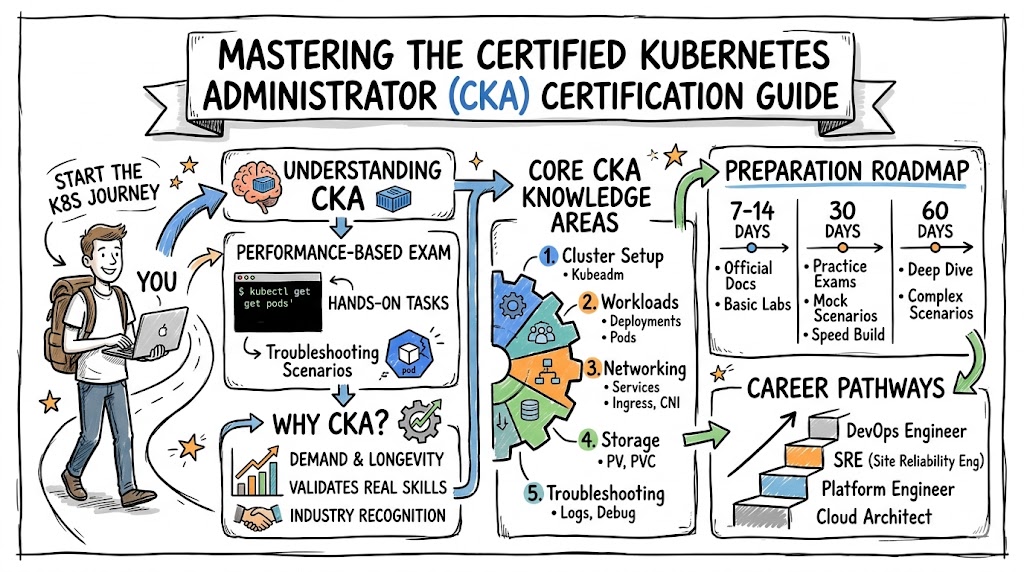
Navigating the cloud-native landscape requires a validated understanding of container orchestration, making the Certified Kubernetes Administrator (CKA) Certification a cornerstone for modern engineering careers. This guide is designed for professionals who want to move beyond theoretical knowledge and master the practical complexities of managing production-grade clusters. As organizations globally migrate to microservices, the DevOpsSchool curriculum provides the hands-on rigor necessary to excel in DevOps, Site Reliability Engineering (SRE), and platform engineering roles. By following this roadmap, engineers and technical leaders can make informed decisions about their skill development and long-term career trajectory in an increasingly automated world.
What is the Certified Kubernetes Administrator (CKA)?
The Certified Kubernetes Administrator (CKA) represents the industry standard for demonstrating competence in managing Kubernetes clusters. It exists to provide a benchmark for the skills required to install, configure, and manage production-ready Kubernetes deployments. Unlike many multiple-choice exams, this certification focuses on a performance-based assessment where candidates solve real-world problems in a command-line environment. This approach ensures that individuals can handle the operational demands of modern enterprise workflows and maintain the stability of containerized infrastructures.
Who Should Pursue Certified Kubernetes Administrator (CKA)?
Systems administrators, DevOps engineers, and Site Reliability Engineers (SREs) benefit most from this certification as it directly validates their ability to handle core infrastructure tasks. Cloud architects and security professionals also find it essential for understanding the underlying mechanics of the platforms they design and protect. While it is tailored for experienced hands-on practitioners, aspiring engineers use it to bridge the gap between basic container knowledge and enterprise-level orchestration. In both the Indian and global markets, this credential is a primary filter used by hiring managers to identify qualified technical talent.
Why Certified Kubernetes Administrator (CKA) is Valuable and Beyond
The demand for Kubernetes expertise continues to grow as enterprises move away from legacy virtualization toward more scalable, cloud-native architectures. Achieving this certification ensures longevity in a career because the core principles of orchestration remain consistent even as specific tools evolve. It provides a significant return on time investment by qualifying professionals for high-impact roles in massive-scale environments. Furthermore, the global adoption of Kubernetes means that a certified professional possesses a portable skill set recognized by major tech hubs worldwide.
Certified Kubernetes Administrator (CKA) Certification Overview
The program delivers training through a structured curriculum and professional hosting environments. It utilizes a practical assessment approach where candidates are required to perform tasks on a live cluster within a limited timeframe. The certification structure tests troubleshooting, networking, storage, and security configurations rather than rote memorization. This ownership-centric model ensures that anyone holding the credential can be trusted with the keys to an organization’s mission-critical container infrastructure.
Certified Kubernetes Administrator (CKA) Certification Tracks & Levels
The certification ecosystem follows a logical progression starting with foundational concepts of containerization and moving into professional-grade administration. Advanced levels focus on specialized domains such as security hardening or application development within the Kubernetes framework. Specialization tracks allow professionals to align their certification journey with specific career paths like SRE or FinOps. This tiered approach ensures that as an engineer progresses from a junior to a lead role, their certifications reflect their increasing level of responsibility and technical depth.
Complete Certified Kubernetes Administrator (CKA) Certification Table
| Track | Level | Who it’s for | Prerequisites | Skills Covered | Recommended Order |
| Core Administration | Professional | SREs & Admins | Linux Basics | Cluster Setup, Logging, Storage | 1 |
| Security | Advanced | Security Engineers | CKA Knowledge | Hardening, RBAC, Network Policies | 2 |
| Application | Professional | Developers | Container Basics | Deployment Patterns, Resources | 1 |
| Networking | Specialist | Cloud Engineers | CKA Knowledge | Ingress, CNI, Service Mesh | 3 |
Detailed Guide for Each Certified Kubernetes Administrator (CKA) Certification
Certified Kubernetes Administrator (CKA) – Administrator Level
What it is
This certification validates the ability to perform the duties of a Kubernetes administrator, including cluster installation, configuration, and day-to-day operational management.
Who should take it
It is ideal for system administrators, DevOps engineers, and SREs who are responsible for maintaining the health and availability of containerized environments.
Skills you’ll gain
- Mastery of the Kubernetes command-line interface.
- Proficiency in cluster maintenance and software updates.
- Ability to configure persistent storage and volumes.
- Understanding of core networking and service discovery.
- Troubleshooting skills for nodes and control plane components.
Real-world projects you should be able to do
- Building a multi-node Kubernetes cluster from scratch using administrative tools.
- Implementing high-availability solutions for the control plane.
- Migrating legacy application data to persistent volumes.
Preparation plan
- 14 days: Review the curriculum and focus on core components like Pods and Services.
- 30 days: Engage in daily lab exercises, focusing on troubleshooting and networking tasks.
- 60 days: Perform full-length mock exams and practice building clusters in various cloud environments.
Common mistakes
- Managing time poorly during the performance-based exam sessions.
- Ignoring the documentation search feature available during the testing window.
- Neglecting basic Linux command-line proficiency and terminal navigation.
Best next certification after this
- Same-track option: Security Specialist.
- Cross-track option: Application Developer.
- Leadership option: Cloud Management or Engineering Leadership modules.
Choose Your Learning Path
DevOps Path
The DevOps path focuses on the seamless integration of Kubernetes into the software delivery pipeline. Engineers learn how to automate deployments, manage resource quotas, and ensure that developers have a stable platform for releasing code. This path emphasizes the cultural shift toward collaboration and the technical automation required to support frequent updates. It is the most common route for those looking to bridge the gap between software development and IT operations.
DevSecOps Path
The DevSecOps path prioritizes security at every layer of the Kubernetes stack, from the container image to the network layer. Professionals in this track focus on implementing Role-Based Access Control, network policies, and automated security scanning. By integrating security into the orchestration layer, they ensure that the platform is resilient against internal and external threats. This is a critical path for those working in regulated industries like finance or healthcare.
SRE Path
Site Reliability Engineering focuses on the scalability and reliability of Kubernetes clusters. This path involves deep dives into monitoring, logging, and observability to maintain high availability. SREs learn to manage error budgets and automate incident response within the cluster environment. This path is essential for engineers who are responsible for maintaining large-scale production systems with strict uptime requirements.
AIOps Path
The AIOps path leverages artificial intelligence to optimize Kubernetes operations. Engineers explore how to use data-driven insights to predict cluster failures and automate capacity planning. This specialization involves integrating intelligent tools with Kubernetes to handle complex scaling decisions that are too rapid for manual intervention. It represents the cutting edge of automated infrastructure management through machine intelligence.
MLOps Path
MLOps focuses specifically on the challenges of deploying and managing machine learning models within containerized environments. This path covers the orchestration of data pipelines, model training jobs, and serving infrastructure on Kubernetes. Professionals learn how to manage hardware resources and high-performance storage to support data-intensive workloads. It is the ideal path for data engineers transitioning into a more operational role.
DataOps Path
DataOps applies DevOps principles to data management, ensuring that data pipelines are as reliable and scalable as software deployments. On Kubernetes, this involves managing distributed databases, data warehouses, and streaming platforms. Engineers learn to treat data infrastructure as code, allowing for rapid iteration and high data quality. This path is vital for organizations that rely on real-time data analytics.
FinOps Path
The FinOps path addresses the financial management of Kubernetes resources to prevent unexpected cloud expenses. Professionals learn to implement cost allocation, rightsizing, and automated scaling to ensure maximum efficiency. By mapping resource usage to business units, they provide visibility into the cost of running containerized applications. This path is increasingly important as organizations look to optimize their cloud spend.
Role → Recommended Certified Kubernetes Administrator (CKA) Certifications
| Role | Recommended Certifications |
| DevOps Engineer | CKA, CKAD, Jenkins Engineer |
| SRE | CKA, Prometheus Specialist, SRE Associate |
| Platform Engineer | CKA, Terraform Associate, CKS |
| Cloud Engineer | CKA, Multi-Cloud Architect, CKS |
| Security Engineer | CKA, CKS, DevSecOps Professional |
| Data Engineer | CKA, Spark Developer, DataOps Associate |
| FinOps Practitioner | CKA, FinOps Certified Practitioner |
| Engineering Manager | CKA Foundational, Cloud Business Leader |
Next Certifications to Take After Certified Kubernetes Administrator (CKA)
Same Track Progression
Once the CKA is achieved, the natural progression is toward the Security Specialist track. This allows an administrator to deepen their expertise in hardening clusters against modern threats. Deep specialization in the administrator track ensures that a professional can handle the most complex infrastructure challenges an enterprise might face.
Cross-Track Expansion
Expanding into the Application Developer track allows an administrator to understand the developer’s perspective. This cross-pollination of skills is highly valued in collaborative environments where the line between infrastructure and code is blurred. Learning related tools like infrastructure-as-code or service meshes further broadens the professional’s utility within a technical team.
Leadership & Management Track
For those looking to move into management, the technical foundation provided by the CKA is invaluable for leading engineering teams. Transitioning to certifications focused on IT strategy, project management, or cloud economics allows a leader to make data-driven decisions. This ensures that technical leadership remains grounded in the practical realities of infrastructure management.
Training & Certification Support Providers for Certified Kubernetes Administrator (CKA)
DevOpsSchool
DevOpsSchool provides a comprehensive training ecosystem that blends theoretical concepts with intensive hands-on labs. Their approach is designed for working professionals who need to master Kubernetes in a real-world context. With a focus on performance-based learning, they ensure that every student can confidently navigate a live cluster environment. The curriculum is updated frequently to reflect the latest changes in the Kubernetes ecosystem.
Cotocus
Cotocus offers specialized consulting and training services that focus on the architectural side of Kubernetes. They help engineers understand the high-level design patterns required for building resilient and scalable cloud-native platforms. Their training programs are often integrated with corporate transformation initiatives, making them a preferred choice for enterprise teams.
Scmgalaxy
Scmgalaxy is a community-driven platform that provides a wealth of resources for software configuration management and DevOps. Their training modules for Kubernetes are built on years of industry experience and community feedback. They offer a practical perspective on how orchestration fits into the broader software delivery lifecycle.
BestDevOps
BestDevOps focuses on delivering high-quality, streamlined training for busy professionals seeking certification. Their prep courses are known for being concise and highly effective, targeting the specific skills needed to pass the exam. They provide a supportive learning environment that helps bridge the gap for those new to containerization.
devsecopsschool.com
This provider specializes in the intersection of security and operations within the Kubernetes framework. Their curriculum is essential for professionals moving toward advanced security certifications or those responsible for securing enterprise clusters. They emphasize automated security testing and compliance as a core part of the administrative workflow.
sreschool.com
Sreschool.com focuses on the reliability and observability aspects of Kubernetes management. Their training programs cover advanced topics like Service Level Objectives, error budgeting, and automated incident response. This is the go-to resource for engineers who want to excel in Site Reliability Engineering roles.
aiopsschool.com
Aiopsschool.com provides training on using artificial intelligence to simplify and automate the management of complex Kubernetes environments. Their courses teach engineers how to implement machine learning models that monitor cluster health and predict potential outages. This is a forward-looking track for engineers interested in the next generation of operations.
dataopsschool.com
Dataopsschool.com addresses the unique challenges of running data workloads on Kubernetes clusters. Their training covers the orchestration of big data tools and the management of stateful applications in a containerized world. It is a critical resource for data engineers who need to understand the underlying infrastructure.
finopsschool.com
Finopsschool.com teaches the financial management skills necessary to run cost-effective Kubernetes operations. Their courses focus on cloud cost optimization, budgeting, and the implementation of financial accountability in engineering teams. This is an essential skill set for managers and architects responsible for large cloud budgets.
Frequently Asked Questions (General)
- How difficult is the CKA exam compared to other certifications?
The exam is considered moderately difficult because it is performance-based rather than multiple-choice, requiring actual command-line proficiency and problem-solving skills.
- How much time do I need to prepare for the certification?
Most professionals with some Linux experience require between thirty and sixty days of consistent study and hands-on practice.
- Are there any prerequisites before I can take the exam?
There are no formal prerequisites, but a strong understanding of Linux administration and container basics is highly recommended.
- What is the return on investment for this certification?
The return is high, as it often leads to higher salary brackets and opens doors to senior roles in DevOps and SRE.
- In what sequence should I take Kubernetes certifications?
It is generally recommended to start with the CKA to build a solid infrastructure foundation before moving to security or development tracks.
- Does the certification expire?
Yes, the certification is typically valid for three years, after which you must recertify to stay current with the platform’s changes.
- Can I use the official documentation during the exam?
Yes, candidates are allowed to access the official Kubernetes documentation website during the test, which mimics real-world work scenarios.
- Is the exam conducted online or at a center?
The exam is proctored online, allowing you to take it from your home or office environment under strict supervision.
- What happens if I fail the first attempt?
The certification typically includes one free retake, allowing you to learn from your first experience and try again.
- How does this certification help an Engineering Manager?
It provides the technical context needed to make informed decisions about infrastructure spend, team hiring, and project timelines.
- Is Kubernetes knowledge relevant for non-cloud environments?
Yes, Kubernetes is widely used in on-premises data centers and hybrid cloud setups, making the skill set highly versatile.
- Are there specific labs included in the training?
Yes, reputable training providers include extensive lab environments where you can practice without risking production systems.
FAQs on Certified Kubernetes Administrator (CKA)
- What core domains are covered in the CKA exam?
The CKA exam covers cluster architecture, installation, configuration, services, networking, troubleshooting, and storage management.
- How do I practice for the performance-based tasks?
Candidates should use tools like Minikube or cloud-based lab environments to gain hands-on experience before the test.
- What is the passing score for the certification?
You typically need a score of 66% or higher to pass, and the exam usually lasts two hours.
- Is Linux knowledge mandatory?
Basic Linux navigation and shell terminal editing are essential skills because you must perform actual configuration tasks on a live cluster.
- How is the exam kept up to date?
The exam is updated regularly to reflect a recent stable version of Kubernetes, ensuring that the certification remains relevant to current industry standards.
- Can I search for specific commands during the exam?
You are permitted to use the official documentation site, which is vital for finding YAML syntax and command flags under pressure.
- What happens if I encounter technical issues during the test?
Online proctors are available to assist with connectivity or platform issues, though they cannot help with exam content.
- How soon do I receive my results?
Results are typically delivered within twenty-four hours of completing the exam via email notification.
Final Thoughts: Is Certified Kubernetes Administrator (CKA) Worth It?
The Certified Kubernetes Administrator (CKA) certification remains one of the most respected credentials in the modern tech stack. It represents a commitment to technical excellence and a practical ability to manage the complexities of container orchestration. For an engineer, it provides a clear path to career advancement and technical authority. For a manager, it ensures that the team possesses the foundational skills necessary to maintain system stability. While the preparation requires significant effort and hands-on practice, the resulting expertise is a vital asset in an industry that is increasingly built on Kubernetes. It is a sound investment for anyone serious about a long-term career in cloud-native engineering.