Introduction
The modern cloud-native landscape requires engineers who can navigate the complexities of container orchestration with precision and speed. Consequently, mastering the Kubernetes Certified Administrator & Developer (KCAD) program has become a defining milestone for professionals aiming to excel in DevOpsschool methodologies. This guide serves as a strategic roadmap for software engineers, systems administrators, and platform architects who need to validate their ability to build and manage production-grade clusters. Furthermore, by exploring this comprehensive breakdown, you will gain the clarity needed to align your technical skills with the rigorous demands of global enterprise environments.
What is the Kubernetes Certified Administrator & Developer (KCAD)?
The Kubernetes Certified Administrator & Developer (KCAD) represents a holistic approach to mastering the most dominant container orchestration platform in the industry. It exists to bridge the gap between theoretical knowledge of containers and the practical execution of managing live, high-availability environments. Unlike traditional exams that focus on multiple-choice theory, this program emphasizes hands-on competency in configuring, troubleshooting, and deploying applications within Kubernetes. Moreover, it aligns perfectly with modern engineering workflows by forcing practitioners to interact directly with the command line and API resources.
Who Should Pursue Kubernetes Certified Administrator & Developer (KCAD)?
This certification is designed for a broad spectrum of technical roles, ranging from back-end developers to Site Reliability Engineers (SREs). Beginners find it useful for establishing a standardized mental model of cloud-native infrastructure, while experienced engineers use it to formalize years of “on-the-job” learning. In the context of the Indian and global tech markets, recruiters prioritize candidates who hold these credentials because they prove immediate project readiness. Engineering managers also benefit from this path as it provides them with the technical vocabulary necessary to lead complex platform migrations.
Why Kubernetes Certified Administrator & Developer (KCAD) is Valuable in 2026 and Beyond
As organizations transition from simple cloud migration to “cloud-native” maturity, the demand for Kubernetes expertise remains at an all-time high. The Kubernetes Certified Administrator & Developer (KCAD) ensures longevity in a professional’s career because Kubernetes has effectively become the operating system of the cloud. While specific tools and plugins might change, the core architectural principles taught in this program remain constant. Therefore, investing time in this certification provides a significant return on investment by making an engineer versatile across AWS, Azure, Google Cloud, and on-premise data centers.
Kubernetes Certified Administrator & Developer (KCAD) Certification Overview
The program is delivered via the official training modules and hosted on the primary platform. It utilizes a performance-based assessment approach, meaning candidates are tested in a live terminal environment rather than through static questions. This structure ensures that anyone who earns the certification possesses the muscle memory required to handle real-world incidents. The ownership of the curriculum is maintained by industry experts who frequently update the objectives to reflect the latest stable releases of the software.
Kubernetes Certified Administrator & Developer (KCAD) Certification Tracks & Levels
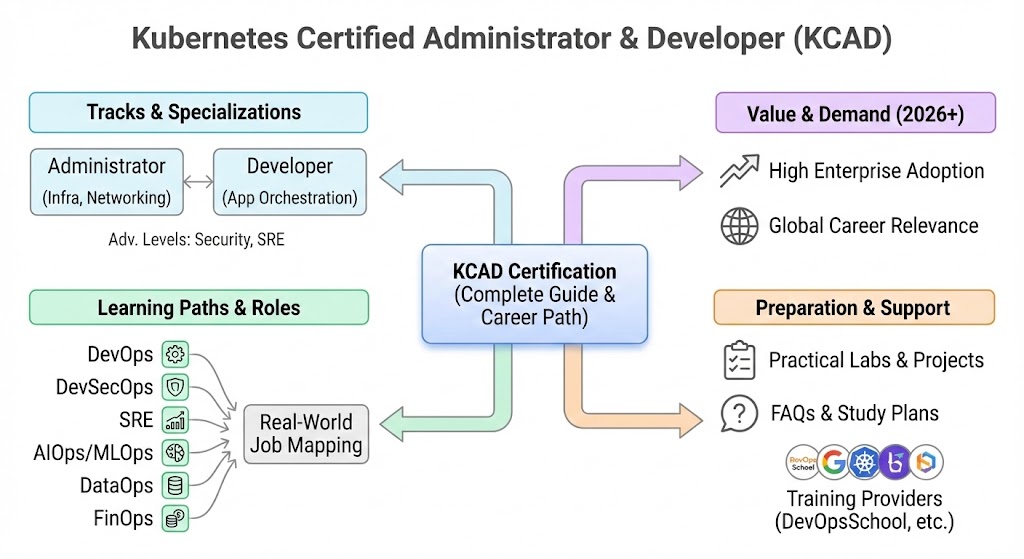
The certification is structured to guide a professional from fundamental understanding to deep architectural mastery. It starts with foundation levels that cover basic pod orchestration and moves into professional tracks focused on security, networking, and storage. Advanced levels challenge engineers to perform complex cluster upgrades and multi-node troubleshooting. By following these tracks, an individual can move from a junior developer role into a specialized SRE or Lead Platform Engineer position with a clear sense of progression.
Complete Kubernetes Certified Administrator & Developer (KCAD) Certification Table
| Track | Level | Who it’s for | Prerequisites | Skills Covered | Recommended Order |
| Core Admin | Professional | System Admins | Linux Basics | Cluster Setup, Logging, Monitoring | 1 |
| App Development | Professional | Software Engineers | Docker/OCI Basics | Pod Design, State Persistence | 2 |
| Security | Advanced | DevSecOps | KCAD Admin Level | Network Policies, Secret Management | 3 |
| SRE/Networking | Advanced | SREs | KCAD Admin Level | Ingress Controllers, Service Mesh | 4 |
Detailed Guide for Each Kubernetes Certified Administrator & Developer (KCAD) Certification
Kubernetes Certified Administrator & Developer (KCAD) – Administrator Level
What it is
This certification validates an engineer’s ability to perform the installation, configuration, and management of production-ready Kubernetes clusters. It focuses heavily on the underlying infrastructure, networking, and maintenance tasks required for cluster health.
Who should take it
It is ideal for system administrators, cloud architects, and DevOps engineers who are responsible for maintaining the uptime and scalability of organizational infrastructure. Candidates should have a strong grasp of Linux command-line operations.
Skills you’ll gain
- Cluster installation using tools like Kubeadm.
- Troubleshooting node failures and networking issues.
- Managing cluster security via Role-Based Access Control (RBAC).
- Implementing persistent storage and volume claims.
Real-world projects you should be able to do
- Set up a multi-node cluster from scratch on bare metal or cloud VMs.
- Perform a zero-downtime version upgrade of a production cluster.
- Diagnose and fix a “CrashLoopBackOff” error in a complex microservice.
Preparation plan
- 7–14 days: Intensive review of core components (Etcd, API Server, Scheduler) and practicing basic Imperative commands.
- 30 days: Deep dive into networking (CNI) and storage (CSI) with daily lab exercises on cluster troubleshooting.
- 60 days: Comprehensive study including mock exams, security hardening, and mastering the documentation search.
Common mistakes
- Relying too much on YAML editors instead of using imperative commands for speed.
- Neglecting the study of ETCD backup and restore procedures.
- Poor time management during the hands-on lab environment.
Best next certification after this
- Same-track option: Kubernetes Security Specialist.
- Cross-track option: Cloud Provider Architect (AWS/Azure).
- Leadership option: Certified IT Manager.
Kubernetes Certified Administrator & Developer (KCAD) – Developer Level
What it is
This level confirms that a professional can design, build, and configure applications for Kubernetes. It focuses on how to use Kubernetes resources to create scalable and resilient application architectures.
Who should take it
Software developers and application architects who want to move beyond writing code and start managing how that code behaves in a containerized environment should pursue this.
Skills you’ll gain
- Defining resource requirements and limits for containers.
- Using ConfigMaps and Secrets to manage application data.
- Implementing Health Probes (Liveness and Readiness).
- Orchestrating multi-container pod patterns like Sidecars.
Real-world projects you should be able to do
- Package a legacy application into an OCI-compliant image and deploy it.
- Configure a rolling update strategy for a high-traffic web service.
- Set up automated scaling based on CPU or custom metrics.
Preparation plan
- 7–14 days: Focus on YAML syntax, Pod definitions, and basic Deployment strategies.
- 30 days: Practice multi-container patterns and persistent volume integration.
- 60 days: Full mastery of application lifecycle management and debugging application-level logs.
Common mistakes
- Forgetting to set resource limits, leading to node instability.
- Improperly configuring Probes, which causes unnecessary container restarts.
- Hardcoding sensitive data instead of using Kubernetes Secrets.
Best next certification after this
- Same-track option: Kubernetes Advanced Networking.
- Cross-track option: DevOps Professional Certification.
- Leadership option: Technical Product Manager.
Choose Your Learning Path
DevOps Path
The DevOps path focuses on the automation of deployment pipelines and the integration of Kubernetes into the CI/CD lifecycle. Professionals here learn how to treat infrastructure as code (IaC) using tools like Helm and Terraform. This path is essential for those who want to reduce the lead time between code commit and production deployment. By mastering these skills, engineers ensure that the development and operations teams work in a unified, efficient manner.
DevSecOps Path
The DevSecOps path emphasizes security at every layer of the Kubernetes stack, from container images to network policies. It involves implementing automated security scanning and ensuring that RBAC policies follow the principle of least privilege. Engineers on this path learn to defend clusters against runtime threats and manage encrypted secrets effectively. This specialization is increasingly critical as regulatory compliance becomes a standard requirement for cloud-native applications.
SRE Path
The Site Reliability Engineering (SRE) path centers on the observability, reliability, and scalability of Kubernetes environments. This involves deep dives into monitoring tools like Prometheus and logging stacks like Fluentd or ELK. SREs focus on maintaining Service Level Objectives (SLOs) and managing error budgets through automated recovery. This path is perfect for those who enjoy high-stakes troubleshooting and optimizing system performance under heavy loads.
AIOps / MLOps Path
This path explores the intersection of Artificial Intelligence and Kubernetes, focusing on how to run machine learning workloads at scale. Engineers learn to manage GPU resources within clusters and deploy specialized operators for frameworks like TensorFlow or PyTorch. The goal is to automate the training and deployment of models using Kubernetes as the underlying compute engine. This path is vital for organizations looking to integrate data science into their standard production workflows.
DataOps Path
The DataOps path focuses on managing data-intensive applications and stateful sets within Kubernetes. It covers the complexities of running databases, data warehouses, and streaming platforms like Kafka in a containerized world. Professionals learn how to handle data persistence, backup, and high availability for stateful workloads. This path bridges the gap between traditional database administration and modern cloud-native orchestration.
FinOps Path
The FinOps path is dedicated to cloud financial management within Kubernetes, focusing on cost visibility and optimization. Engineers learn to use labels and namespaces to accurately attribute costs to specific teams or projects. It involves implementing autoscaling policies that balance performance with expenditure to prevent “cloud bill shock.” This path is essential for engineering leaders who need to demonstrate the economic value of their technical infrastructure.
Role → Recommended Kubernetes Certified Administrator & Developer (KCAD) Certifications
| Role | Recommended Certifications |
| DevOps Engineer | Administrator Level + Developer Level |
| SRE | Administrator Level + Security Specialist |
| Platform Engineer | Administrator Level + Advanced Networking |
| Cloud Engineer | Administrator Level + Cloud Architect |
| Security Engineer | Security Specialist + Administrator Level |
| Data Engineer | Developer Level + DataOps Specialization |
| FinOps Practitioner | Administrator Level + FinOps Associate |
| Engineering Manager | Administrator Level (Foundation) |
Next Certifications to Take After Kubernetes Certified Administrator & Developer (KCAD)
Same Track Progression
Once you have mastered the basics of administration and development, the natural progression is to move toward the Security Specialist (CKS) level. This allows you to deepen your expertise within the same ecosystem while tackling more complex organizational challenges. Deep specialization ensures you become the “go-to” expert for Kubernetes within your company.
Cross-Track Expansion
After securing your Kubernetes credentials, broadening your skills into specific cloud providers like AWS (Certified Solutions Architect) or Azure is a smart move. This expansion allows you to understand how Kubernetes interacts with proprietary cloud services. Skill broadening makes you a more versatile architect who can design hybrid-cloud or multi-cloud solutions.
Leadership & Management Track
For those looking to move into leadership, certifications in IT Management or Project Management are excellent follow-ups. These programs help you translate your deep technical Kubernetes knowledge into business value and team strategy. Transitioning to leadership requires a shift from “how to build” to “why we build,” and these certifications facilitate that mental pivot.
Training & Certification Support Providers for Kubernetes Certified Administrator & Developer (KCAD)
DevOpsSchool
DevOpsSchool provides a highly interactive and lab-heavy training environment that focuses on real-world scenarios. Their instructors are industry veterans who bring decades of experience to the classroom, ensuring that students learn more than just the exam objectives. They offer extensive support through recorded sessions, live projects, and a robust community of learners. This provider is particularly well-regarded for its ability to transform theoretical knowledge into practical, job-ready skills for engineers worldwide.
Cotocus
Cotocus is known for its specialized consulting-led training approach, which tailors the learning experience to the specific needs of corporate teams. They focus on the architectural nuances of Kubernetes, helping organizations migrate complex workloads to the cloud with minimal friction. Their curriculum is constantly updated to reflect the latest industry trends and security best practices. By choosing this provider, professionals gain access to high-level strategic insights that go beyond standard certification prep.
Scmgalaxy
Scmgalaxy acts as a massive knowledge hub for the DevOps community, offering a wealth of free resources, tutorials, and community support. Their training programs are designed to be accessible and comprehensive, covering everything from basic version control to advanced orchestration. They emphasize the importance of a continuous learning culture and provide a platform for engineers to share their experiences. It is an excellent choice for self-starters who want a mix of structured training and community-driven learning.
BestDevOps
BestDevOps focuses on delivering high-impact, short-term bootcamps that are designed to get engineers certified quickly and efficiently. Their methodology is centered on “learning by doing,” with a heavy emphasis on practice exams and simulated lab environments. They cater to busy professionals who need to gain skills without spending months in a traditional classroom setting. Their streamlined approach ensures that every hour spent studying translates directly into exam success and technical competency.
devsecopsschool.com
This provider specializes in the critical intersection of security and operations, making it the premier choice for aspiring security engineers. Their courses go deep into container security, automated auditing, and compliance within Kubernetes clusters. They teach students how to build “security-first” cultures within their engineering teams. If your goal is to master the CKS exam or secure enterprise-grade infrastructure, this school provides the specialized tools and knowledge required.
sreschool.com
Sreschool.com is dedicated to the art and science of reliability engineering, focusing on monitoring, logging, and system resilience. Their curriculum is designed around the Google SRE handbook principles, adapted for practical Kubernetes application. They provide unique insights into managing large-scale distributed systems and handling production incidents with composure. This is the ideal training ground for engineers who want to specialize in keeping complex systems running smoothly under pressure.
aiopsschool.com
Aiopsschool.com sits at the cutting edge of technology, teaching engineers how to apply artificial intelligence to IT operations. Their training covers the use of machine learning algorithms to predict system failures and automate routine maintenance tasks. They provide specialized tracks for running AI workloads on Kubernetes, making it a unique destination for forward-thinking professionals. This provider prepares you for the future of automated, self-healing infrastructure.
dataopsschool.com
Dataopsschool.com addresses the growing need for streamlined data pipelines and robust data management in the cloud. Their courses focus on the integration of data engineering practices with DevOps automation. Students learn how to manage big data frameworks and stateful applications within Kubernetes environments. This provider is essential for data professionals who want to leverage containerization to speed up their analytics and reporting workflows.
finopsschool.com
Finopsschool.com focuses on the financial side of cloud engineering, teaching professionals how to optimize costs without sacrificing performance. Their curriculum covers cloud billing, resource tagging, and budget forecasting specifically for Kubernetes users. They provide the framework for teams to take ownership of their cloud spend and drive financial accountability. This is a must-visit for anyone looking to bridge the gap between engineering execution and business profitability.
Frequently Asked Questions (General)
- How difficult is the Kubernetes Certified Administrator & Developer (KCAD) exam?The exam is considered moderately difficult because it is a hands-on, performance-based test rather than a multiple-choice exam. You must be comfortable with the command line and YAML editing.
- How much time is required to prepare for the certification?Most professionals with prior Linux experience require between 30 to 60 days of consistent study and lab practice to feel confident.
- What are the prerequisites for starting this certification?While there are no formal prerequisites, a strong understanding of Linux containers, networking basics, and command-line interfaces is highly recommended.
- Is the certification worth the investment in 2026?Yes, as Kubernetes has become the industry standard for container orchestration, holding this certification significantly increases your market value and job security.
- In what order should I take the certifications?Typically, it is recommended to start with the Administrator level to understand the infrastructure, followed by the Developer level to understand application deployment.
- What is the validity period of the certification?Most Kubernetes-related certifications are valid for two or three years, after which you must renew them to stay current with software updates.
- Can I use the official documentation during the exam?Yes, the exam allows you to access the official Kubernetes documentation website, which is a crucial resource for looking up YAML syntax.
- What kind of salary increase can I expect?While it varies by region, certified professionals often see a salary increase of 20% to 40% due to the high demand for these specialized skills.
- Does the exam focus on a specific cloud provider?No, the certification is cloud-agnostic, meaning the skills you learn apply to any environment where Kubernetes is running.
- What happens if I fail the exam on the first attempt?Most registration fees include one free retake, allowing you to learn from your mistakes and try again without additional cost.
- Are there any hands-on labs provided during the training?Yes, reputable training providers include extensive lab environments that mimic the actual exam interface to build your muscle memory.
- How does this certification help an Engineering Manager?It provides managers with the technical foundation to make informed decisions about tool selection, hiring, and architectural strategy.
FAQs on Kubernetes Certified Administrator & Developer (KCAD)
- What is the core focus of the KCAD curriculum?The core focus is on the operational and development aspects of Kubernetes. This includes cluster components, API primitives, and the lifecycle of containerized applications. It ensures that you can not only build a cluster but also ensure that the applications running on it are scalable and resilient.
- Does the program cover security in detail?While basic security like RBAC and Secrets is covered, deep security topics are reserved for the specialized Security track. However, the foundational knowledge provided is essential for anyone moving into a DevSecOps role later.
- How is the exam proctored?The exam is proctored remotely via a webcam and screen sharing. You must be in a quiet room with a clear desk, and a proctor monitors your session in real-time to ensure integrity.
- Is there a focus on Helm or other package managers?The certification primarily focuses on native Kubernetes objects. However, understanding Helm is often covered in training programs as it is the industry standard for managing Kubernetes applications in the real world.
- What version of Kubernetes is used in the exam?The exam usually runs on a version that is within one or two releases of the current stable version of Kubernetes. It is updated frequently to remain relevant.
- Can I take the exam in languages other than English?Yes, the exam is available in several languages, including Chinese and Japanese, though English remains the most common choice for global professionals.
- How do I verify my certification status to employers?Upon passing, you receive a digital badge and a certificate with a unique verification ID that can be shared on LinkedIn or included in your resume.
- What is the passing score for the exams?Generally, a score of 66% or higher is required to pass the Administrator and Developer level exams, though this is subject to change by the governing body.
Final Thoughts: Is Kubernetes Certified Administrator & Developer (KCAD) Worth It?
From the perspective of a senior mentor, the Kubernetes Certified Administrator & Developer (KCAD) is one of the few certifications that truly proves your worth in the trenches. It is not a “paper certification” that you can pass by simply memorizing answers. Instead, it demands that you demonstrate real-world proficiency under pressure. For any engineer looking to stay relevant in an era dominated by cloud-native technology, this path is not just an option—it is a necessity. It provides a standardized language and a rigorous framework that will serve you well across different companies and technologies for years to come. Focus on the labs, master the command line, and the career growth will naturally follow.