Introduction
Modern software delivery demands a seamless integration of development and operations to maintain a competitive edge. The Certified DevOps Professional (CDP) designation serves as a rigorous benchmark for engineers who aim to master this integration through automation, culture, and advanced tooling. This guide addresses the needs of practitioners who seek to validate technical expertise and transition into high-impact roles within cloud-native and platform engineering environments. Organizations no longer view DevOps as a secondary function but as a core requirement for business agility. Consequently, professionals must understand how to architect resilient systems that support continuous deployment and rapid scaling. This comprehensive breakdown helps you evaluate the curriculum, understand the industry standing of the certification, and determine how it aligns with specific career goals. By reading this guide, you gain the clarity needed to choose the right specialization and navigate the complex landscape of modern engineering certifications.
What is the Certified DevOps Professional (CDP)?
The Certified DevOps Professional (CDP) represents a practical, industry-aligned framework designed to bridge the gap between theoretical knowledge and production-grade implementation. Unlike basic certifications that focus solely on tool syntax, this program emphasizes the lifecycle of a software product from initial code commit to global scale-out. It exists to certify that an engineer can handle the complexities of distributed systems while maintaining security and performance standards. The program aligns closely with modern enterprise workflows by incorporating principles of GitOps, Infrastructure as Code, and Observability. It forces candidates to think like architects rather than just operators, ensuring they can design workflows that reduce lead time for changes. By focusing on real-world scenarios, the certification ensures that participants solve the actual bottlenecks that slow down engineering teams in large-scale organizations.
Who Should Pursue Certified DevOps Professional (CDP)?
Cloud engineers and system administrators who want to move beyond manual provisioning find immense value in the Certified DevOps Professional (CDP) path. Software developers looking to take ownership of deployment pipelines also benefit significantly by learning the operational side of the software lifecycle. Additionally, Site Reliability Engineers (SREs) use this certification to formalize knowledge of automation and system resilience. The certification caters to a diverse global audience, including the booming tech sectors in India where large-scale digital transformation is a priority. Technical leaders and engineering managers should also consider this track to better understand the capabilities and constraints of the teams they lead. Whether you are an early-career engineer building a first CI/CD pipeline or a seasoned professional seeking to standardize skills, this certification provides the necessary technical depth and professional recognition.
Why Certified DevOps Professional (CDP) is Valuable and Beyond
The demand for skilled DevOps practitioners continues to outpace the supply of qualified talent across all major industries. Companies increasingly adopt microservices and containerized environments, which require the sophisticated orchestration skills taught within this program. By earning this certification, you demonstrate a commitment to lifelong learning and a mastery of the methodologies that define modern software engineering. The longevity of the Certified DevOps Professional (CDP) stems from its focus on principles rather than just ephemeral toolsets. Tools may change, but the need for fast feedback loops, automated testing, and reliable infrastructure remains constant. This certification provides a high return on investment by positioning you for senior-level roles and providing technical confidence to lead complex migration projects. Professionals who hold this credential often see faster career progression and greater access to high-stakes projects in the global market.
Certified DevOps Professional (CDP) Certification Overview
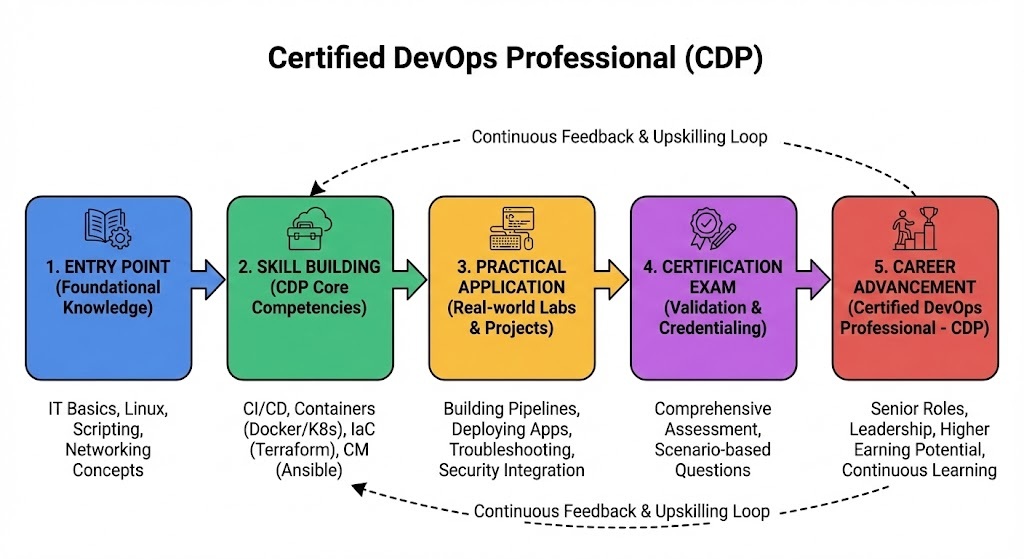
The Certified DevOps Professional (CDP) program provides a structured approach to mastering the entire DevOps ecosystem. This comprehensive training and assessment journey is hosted on DevOpsSchool, which serves as the primary authority for the curriculum and examination. The program utilizes a rigorous assessment approach that combines theoretical exams with practical, lab-based challenges to ensure that candidates possess both conceptual understanding and hands-on proficiency. Ownership of the certification belongs to a team of industry veterans who update the content regularly to reflect changes in the cloud-native landscape. The structure focuses on incremental learning, moving from core fundamentals to advanced architectural patterns. By participating in this program, you engage with a curriculum that covers the most relevant aspects of the current engineering landscape, ensuring skills remain sharp and applicable to modern production environments.
Certified DevOps Professional (CDP) Certification Tracks & Levels
The certification hierarchy starts with the Foundation level, which establishes a baseline of DevOps terminology, culture, and basic automation concepts. This level serves as an entry point for those new to the field or managers who need a high-level technical understanding. It ensures every participant speaks the same language before moving into the more technical implementation phases. The Professional level dives deep into the specific tools and processes required to build and maintain a CI/CD pipeline. This track focuses on implementation, covering specific technologies like Docker, Kubernetes, and various CI/CD engines. Finally, the Advanced level targets architects and senior engineers who must design entire platforms. These tracks allow professionals to specialize in areas like SRE, FinOps, or DevSecOps, aligning education with specific career trajectories and organizational needs.
Complete Certified DevOps Professional (CDP) Certification Table
| Track | Level | Who it’s for | Prerequisites | Skills Covered | Recommended Order | Official Link |
| Core DevOps | Foundation | Aspiring Engineers | Basic Linux | Culture, YAML, Git | First | Official Link |
| Engineering | Professional | Working Engineers | Foundation Level | CI/CD, Docker, K8s | Second | Official Link |
| Architecture | Advanced | Senior SREs | Professional Level | Scaling, IAC, Security | Third | Official Link |
| Security | DevSecOps | Security Analysts | Professional Level | SAST, DAST, Vault | Optional | Official Link |
| Operations | SRE | Operations Leads | Professional Level | SLIs, SLOs, Monitoring | Optional | Official Link |
Detailed Guide for Each Certified DevOps Professional (CDP) Certification
Certified DevOps Professional (CDP) – Foundation
What it is
The Foundation level validates your understanding of the core philosophy and fundamental building blocks of DevOps. It ensures you understand how collaboration and automation reduce the “wall of confusion” between development and operations teams.
Who should take it
This certification suits junior engineers, project managers, and quality assurance professionals who need to understand the DevOps lifecycle. It provides the necessary context for anyone starting a journey in a modern engineering department.
Skills you’ll gain
- Mastery of DevOps terminology and cultural principles.
- Understanding of the SDLC and continuous integration concepts.
- Basic familiarity with version control using Git.
- Knowledge of various automation categories and their benefits.
Real-world projects you should be able to do
- Map a Value Stream for a simple software delivery process.
- Configure a basic Git repository with branching strategies.
- Identify bottlenecks in a traditional deployment workflow.
Preparation plan
- 7 Days: Focus on the DevOps Manifesto and core cultural concepts through intensive reading.
- 30 Days: Complete introductory labs on Git and basic Linux command-line operations.
- 60 Days: Study various case studies and take multiple practice exams to master the terminology.
Common mistakes
- Ignoring cultural aspects of DevOps in favor of only learning tool names.
- Underestimating the importance of Linux fundamentals and shell scripting.
Best next certification after this
- Same-track option: CDP Professional Level
- Cross-track option: Cloud Practitioner
- Leadership option: Agile Scrum Master
Certified DevOps Professional (CDP) – Professional
What it is
The Professional level validates your ability to implement and manage a full automation pipeline using industry-standard tools. It shifts the focus from theory to practice, requiring hands-on proficiency in containerization and deployment orchestration.
Who should take it
Active developers and system administrators should pursue this level to prove technical competence. It is the most common requirement for job roles specifically titled “DevOps Engineer.”
Skills you’ll gain
- Implementation of Continuous Integration and Continuous Deployment (CI/CD) pipelines.
- Advanced container management using Docker and Kubernetes orchestration.
- Configuration management and Infrastructure as Code (IaC) implementation.
- Monitoring and logging implementation for production applications.
Real-world projects you should be able to do
- Build a multi-stage Jenkins pipeline for a microservices application.
- Containerize a legacy application and deploy it to a production cluster.
- Automate infrastructure provisioning using tools like Terraform.
Preparation plan
- 7 Days: Focus exclusively on Docker and container networking fundamentals.
- 30 Days: Build and tear down at least five complete CI/CD pipelines for different languages.
- 60 Days: Deep dive into Kubernetes manifests and persistent storage configurations.
Common mistakes
- Hardcoding secrets and configurations directly into pipeline scripts.
- Failing to implement proper roll-back mechanisms in the deployment logic.
Best next certification after this
- Same-track option: CDP Advanced Level
- Cross-track option: Certified Kubernetes Administrator (CKA)
- Leadership option: Technical Lead / Engineering Manager tracks
Choose Your Learning Path
DevOps Path
Engineers following this path focus on the total lifecycle of delivery, emphasizing speed and quality. They master the art of integrating diverse tools into a cohesive system that allows developers to ship code multiple times per day. This path requires a balanced knowledge of both software development and systems engineering.
DevSecOps Path
The DevSecOps path prioritizes the “Shift Left” mentality by integrating security checks directly into the automated pipeline. Practitioners learn how to automate vulnerability scanning, manage secrets securely, and ensure compliance without slowing down the delivery process. This path is essential for engineers working in highly regulated industries.
SRE Path
Site Reliability Engineering focuses on using software engineering principles to solve operations problems. This path emphasizes system availability, latency, performance, and capacity management. Engineers learn to define and track Service Level Objectives (SLOs) to balance the need for new features with system stability.
AIOps / MLOps Path
This specialized path addresses the unique challenges of deploying and managing machine learning models in production. Engineers learn to automate the data pipeline, model training, and model serving layers. It combines traditional DevOps practices with data science workflows to ensure AI applications remain reliable and scalable.
DataOps Path
DataOps focuses on the automated, policy-based management of data across an organization. Engineers following this path build pipelines that handle data ingestion, transformation, and distribution with the same rigor as software code. They implement automated testing for data quality to prevent failures in analytical systems.
FinOps Path
The FinOps path centers on the financial management of cloud resources to ensure maximum business value. Practitioners learn how to track cloud spending, optimize resource allocation, and foster a culture of financial accountability among engineering teams. This path bridges the gap between engineering, finance, and business leadership.
Role → Recommended Certified DevOps Professional (CDP) Certifications
| Role | Recommended Certifications |
| DevOps Engineer | CDP Foundation + CDP Professional |
| SRE | CDP Professional + SRE Specialized Track |
| Platform Engineer | CDP Professional + CDP Advanced |
| Cloud Engineer | CDP Foundation + Cloud Provider Certification |
| Security Engineer | CDP Professional + DevSecOps Track |
| Data Engineer | CDP Professional + DataOps Track |
| FinOps Practitioner | CDP Foundation + FinOps Track |
| Engineering Manager | CDP Foundation + Leadership Track |
Next Certifications to Take After Certified DevOps Professional (CDP)
Same Track Progression
Once you master the professional level, you should pursue the CDP Advanced or Expert level to solidify your standing as an architect. Deep specialization involves mastering complex orchestration patterns and multi-cloud strategies. This progression ensures you can lead large-scale digital transformation efforts within enterprise environments. Advanced practitioners often move into consultancy roles where they design delivery systems for various clients across different industries.
Cross-Track Expansion
Broadening your skills often involves looking toward adjacent disciplines like security or data engineering. For example, a DevOps professional might pursue a specialized Kubernetes certification or a Cloud Architect credential. This expansion makes you a “T-shaped” professional with deep expertise in one area and broad knowledge across many others. Cross-training ensures that you remain indispensable as organizational needs shift between different technical priorities.
Leadership & Management Track
If you transition toward leadership, consider certifications focused on project management, team dynamics, or business strategy. Understanding how DevOps impacts the bottom line allows you to advocate for technical resources at the executive level. This track prepares you for roles such as Head of Engineering or VP of Infrastructure. Management training helps you bridge the communication gap between highly technical engineers and business stakeholders.
Training & Certification Support Providers for Certified DevOps Professional (CDP)
DevOpsSchool
This provider offers extensive deep-dive training sessions led by industry experts who have handled production environments. They provide a comprehensive curriculum that covers all levels of the CDP program with a heavy emphasis on hands-on labs. Students receive ongoing support and access to a vast library of technical resources to aid preparation.
Cotocus
Cotocus specializes in delivering high-quality consulting and training services focused on modern cloud-native technologies. Their instructors bring real-world experience to the classroom, helping students understand the practical application of DevOps tools. They focus on delivering personalized learning experiences that cater to the specific needs of corporate teams.
Scmgalaxy
As a community-driven platform, Scmgalaxy provides a wealth of free and paid resources for version control and configuration management. They offer specialized workshops that help engineers master the intricacies of software configuration and build automation. Their content serves as an excellent supplementary resource for anyone pursuing professional certification.
BestDevOps
BestDevOps provides curated learning paths and certification guidance for engineers at all stages of their careers. They focus on identifying the most relevant tools and methodologies to ensure students spend time on high-impact skills. Their simplified approach to complex topics makes them a favorite among beginners and intermediate learners.
devsecopsschool.com
This platform focuses exclusively on the intersection of security and DevOps, providing specialized training for the DevSecOps track. They teach students how to integrate security tools like SonarQube, Vault, and various scanning engines into the CI/CD pipeline. This provider is the go-to resource for engineers looking to specialize in automated security.
sreschool.com
Sreschool.com offers dedicated training for Site Reliability Engineering principles and practices. Their curriculum covers monitoring, incident response, and the mathematical foundations of service level management. They help operations professionals transition into software-centric reliability roles using modern observability stacks.
aiopsschool.com
Focusing on the future of operations, this provider teaches how to use artificial intelligence and machine learning to improve system management. They cover topics like automated root cause analysis and predictive scaling. This training is ideal for advanced engineers looking to stay ahead of the technology curve.
dataopsschool.com
Dataopsschool.com addresses the growing need for automated data management and pipeline orchestration. They provide practical training on tools that ensure data quality and reliability throughout the lifecycle. Their courses help data engineers apply DevOps rigor to complex data environments.
finopsschool.com
This provider focuses on the economic side of cloud computing, teaching engineers how to optimize costs without sacrificing performance. They provide the frameworks necessary to manage cloud budgets and implement cost-saving measures across large organizations. This training is essential for those looking to manage infrastructure as a business asset.
Frequently Asked Questions (General)
- How difficult is the Certified DevOps Professional (CDP) exam for beginners?The exam is structured to test both conceptual understanding and practical application. For someone with absolutely no IT background, the professional level will be quite challenging as it assumes basic familiarity with Linux and networking. However, the foundation level is designed specifically to introduce beginners to the core concepts without overwhelming them with deep technical implementation. If you follow the recommended study paths and complete the required lab work, you will find the difficulty level is manageable. It requires consistency and a genuine interest in how software systems work under the hood.
- What is the average time required to prepare for the professional level?Most candidates find that 60 to 90 days of consistent study is sufficient to master the professional curriculum. This timeline assumes you are spending about 10 to 15 hours per week on reading and hands-on practice. If you already have experience with tools like Docker or Jenkins, you might be able to shorten this period to 45 days. The key is not just reading the material but actually building the pipelines in a lab environment. Dedicating time to troubleshooting common errors is where the most valuable learning occurs during your preparation.
- Are there any specific hardware requirements for the training labs?You do not need an expensive high-end computer to complete the labs for this certification. A modern laptop with at least 8GB of RAM and a reliable internet connection is usually sufficient, as most labs are conducted on cloud-based platforms. You will primarily interact with remote servers via a terminal or a web browser. Many training providers include access to pre-configured lab environments, so you don’t have to worry about local setup issues. This allows you to focus entirely on learning the tools and workflows rather than managing your own hardware.
- Does the certification cover multi-cloud strategies?Yes, the advanced levels of the program specifically address the complexities of managing infrastructure across multiple cloud providers like AWS, Azure, and Google Cloud. You will learn how to use cloud-agnostic tools like Terraform and Kubernetes to ensure your skills are portable. This approach is highly valued by modern enterprises that want to avoid vendor lock-in and require resilient architectures that span multiple regions and providers. Understanding multi-cloud strategies makes you a more versatile architect and allows you to design highly available systems for global organizations.
- How does the certification keep up with the fast pace of technology?The curriculum undergoes regular reviews and updates by a board of industry veterans who actively work in the DevOps space. This ensures that the training reflects current best practices and includes the latest versions of popular tools. When major shifts occur in the industry—such as the move toward serverless or AI-driven operations—these topics are integrated into the relevant tracks. This proactive approach ensures that your certification remains relevant long after you have passed the exam, providing you with a foundation that evolves with the industry.
- Is there a community or alumni network I can join?Participants in the CDP program gain access to a global community of alumni and instructors through various online forums and social groups. This network is an invaluable resource for job referrals, technical troubleshooting, and staying updated on industry trends. Engaging with other professionals allows you to share experiences and learn how DevOps is implemented across different types of organizations. Many practitioners find that the connections they make during their certification journey are just as valuable as the technical knowledge they gain during the course.
- What kind of salary increase can I expect after certification?While salary varies by region and experience, professionals with a DevOps certification often command a 20% to 30% premium over those without one. In major tech hubs, this can represent a significant annual increase due to the high demand for verified skills. Beyond the initial jump, the certification opens doors to senior roles that carry even higher compensation packages. Employers are willing to pay more for candidates who can demonstrate they have been through a rigorous, standardized assessment process, as it reduces the risk associated with hiring.
- Can I take the exam online or must I visit a center?The certification exams are typically offered online through a proctored environment, allowing you to take them from the comfort of your home or office. You will need a stable internet connection, a webcam, and a quiet space to complete the assessment. This flexibility makes the program accessible to professionals worldwide, regardless of their proximity to physical testing centers. The online proctoring process ensures the integrity of the exam while providing the convenience that busy working professionals require to advance their careers.
- Are the lab exercises based on real-world scenarios?Every lab in the CDP program is modeled after actual problems that DevOps engineers face in production environments. You won’t just learn how to start a service; you will learn how to troubleshoot a failing deployment, optimize a slow pipeline, and secure a cluster. This focus on “production-grade” learning ensures that you are ready to add value to a team from day one. By solving these realistic challenges during your training, you build the muscle memory needed to handle high-pressure situations in your actual job.
- Is the certification recognized by large enterprise companies?Yes, major global corporations and Indian tech giants recognize the CDP as a valid measure of an engineer’s capability. Many organizations use this certification as a benchmark for internal training programs or as a requirement for certain senior-level positions. The focus on vendor-neutral tools and industry-standard practices makes the certification applicable to a wide range of corporate environments. Holding this credential signals to recruiters that you possess a standardized set of skills that can be immediately applied to large-scale digital transformation projects.
- What happens if the tools covered in the course become obsolete?The program focuses on the underlying principles of DevOps, which remain constant even as specific tools evolve. If a particular tool becomes less relevant, the curriculum is updated to include the new industry standard. Because you learn the “why” behind the automation, transitioning to a new tool becomes much easier. For example, once you master the principles of container orchestration, moving from one platform to another is a matter of learning syntax rather than learning a whole new philosophy. This ensures your career remains future-proof.
- Does the program offer any job placement assistance?While the certification itself does not guarantee a job, many training providers offer career support services including resume reviews, interview preparation, and access to a partner network of hiring companies. They help you translate your technical skills into a professional brand that appeals to recruiters. By highlighting your certification and the practical projects you completed, you can significantly improve your chances of landing a high-impact role. The alumni network also serves as a hidden job market where many opportunities are shared before they are posted publicly.
FAQs on Certified DevOps Professional (CDP)
- How does the CDP certification handle the integration of legacy systems?The curriculum includes modules on how to bridge the gap between traditional monolithic applications and modern microservices. You will learn strategies for containerizing legacy code and integrating it into modern CI/CD pipelines without requiring a full rewrite. This is a critical skill for engineers working in established enterprises that cannot move everything to the cloud overnight. Mastering these “hybrid” scenarios makes you a highly valuable asset for companies undergoing long-term digital transformations, as you can manage both the old and the new.
- What is the passing score for the CDP professional exam?While the exact passing score can vary depending on the specific version of the exam, it generally requires a score of 70% or higher to pass. The assessment is weighted toward the practical labs, meaning you must demonstrate a high level of proficiency in the hands-on tasks to succeed. This ensures that only those who can actually perform the work receive the certification. If you do not pass on your first attempt, you will receive a detailed report highlighting the areas where you need further study before retaking the test.
- Can I use the CDP certification to move into a Site Reliability Engineering (SRE) role?Absolutely, the CDP Professional level provides the foundational automation and orchestration skills required for any SRE role. Many engineers use the CDP as a stepping stone before specializing in the SRE track, which focuses more on system availability and performance at scale. The overlap between DevOps and SRE is significant, and having a strong DevOps foundation makes the transition much smoother. Most SRE teams look for candidates who already understand CI/CD and Infrastructure as Code, both of which are core components of the CDP program.
- Is the Certified DevOps Professional (CDP) suitable for freelance consultants?Freelance consultants find immense value in the CDP because it provides an objective validation of their expertise to potential clients. When you are moving between different projects and organizations, having a recognized certification helps build trust quickly with new teams. It also ensures that you are following industry-standard practices, which makes the systems you build easier for your clients to maintain after your contract ends. The broad range of tools covered in the program allows you to offer a wider variety of services to a diverse client base.
- Does the program cover automated testing in depth?Yes, the professional level emphasizes the importance of automated testing within the CI/CD pipeline. You will learn how to integrate unit tests, integration tests, and security scans into your automated workflows to ensure that only high-quality code reaches production. The program teaches you how to treat your test suites as a first-class citizen in the development process. Understanding how to automate quality assurance is one of the key differences between a “scripter” and a true DevOps professional who understands the entire software lifecycle.
- How does the CDP address the challenges of “DevOps at scale”?The advanced levels of the CDP program focus specifically on the challenges of managing hundreds of microservices and large-scale infrastructure. You will learn about service meshes, advanced deployment strategies like canary releases, and how to manage global traffic. These topics are essential for engineers working in “Big Tech” or high-growth startups where manual management is impossible. Learning how to scale your automation as the organization grows is a core part of becoming a senior DevOps practitioner or architect within an enterprise environment.
- What is the role of Infrastructure as Code (IaC) in the CDP exam?Infrastructure as Code is a central pillar of the CDP certification, and you will be expected to demonstrate proficiency in tools like Terraform or CloudFormation. You will learn how to version control your infrastructure just like your application code, allowing for reproducible and consistent environments. The exam often requires you to provision a set of resources using a script rather than a manual console. This ensures you understand the “GitOps” approach to infrastructure management, which is now the standard for all modern cloud-native engineering teams.
- Does the CDP certification include training on observability and monitoring?Observability is a major component of the curriculum, as you cannot improve what you cannot measure. You will learn how to implement comprehensive monitoring, logging, and tracing using tools like ELK stack, Prometheus, and Grafana. The program goes beyond basic “uptime” monitoring and teaches you how to extract meaningful insights from your system data. This allows you to proactively identify issues before they impact users, which is a key requirement for maintaining high-performing production environments in the cloud.
Final Thoughts: Is Certified DevOps Professional (CDP) Worth It?
When you evaluate the current state of the engineering industry, the shift toward automation and cloud-native architectures is undeniable. The Certified DevOps Professional (CDP) offers a structured and recognized way to validate the skills required to navigate this landscape. It is not merely a piece of paper but a comprehensive learning journey that forces you to master the tools and philosophies that drive modern software companies. If you are committed to high-level engineering, the time and effort invested in this program will pay dividends throughout your career.
However, you must approach this certification with a practical mindset. The real value lies in the labs you build, the scripts you write, and the problems you solve during your preparation. A certification might help you get an interview, but your ability to apply those skills in a production environment will help you keep the job. If you are looking for a way to standardize your knowledge and join the ranks of elite engineering professionals, the CDP is an excellent and worthy investment in your professional future.