Introduction (100–200 words)
3D modeling tools are applications that let you create and edit 3D objects—digital “real-world” shapes you can render into images/videos, animate, simulate, 3D print, or send into manufacturing and real-time engines. In practice, they’re the backbone of modern pipelines for product design, entertainment, architecture, and interactive experiences.
Why it matters now (2026+): 3D has become a default deliverable, not a specialist novelty. Product pages increasingly use interactive 3D; engineering teams iterate faster with parametric histories; studios expect procedural workflows to reduce rework; and AI assistance is quietly improving the “boring but expensive” parts of production (cleanup, retopo hints, UV suggestions, mesh fixes).
Real-world use cases include:
- Product design + prototypes (CAD modeling, assemblies, manufacturing handoff)
- Ecommerce visuals (render-ready assets, real-time previews, variations)
- Games/real-time (optimized meshes, LODs, baked textures)
- Film/VFX (high-detail sculpting, rig-ready topology, pipeline automation)
- Architecture & interiors (concepting, visualization, client review)
What buyers should evaluate (6–10 criteria):
- Modeling approach fit: polygonal vs sculpting vs parametric vs procedural
- Non-destructive editing (modifiers, histories, node graphs)
- Interoperability (common formats; predictable material/scale behavior)
- Rendering/look-dev pathway (native or via external renderers)
- Automation options (scripting, nodes, batch tools)
- Collaboration patterns (review, versioning, governance)
- Performance/stability on large scenes and dense meshes
- Ecosystem depth (plugins, training, talent availability)
- Security expectations (especially for cloud collaboration)
- Total cost (licenses, add-ons, training, hardware, time-to-productivity)
Mandatory paragraph
- Best for: 3D artists, motion designers, architects, industrial designers, CAD engineers, and cross-functional product teams that need reliable 3D creation and handoffs—especially when assets must serve multiple outputs (manufacturing + marketing + real-time).
- Not ideal for: teams that only need occasional 3D (a single concept render per quarter) or organizations without the time to train users and standardize workflows. In those cases, outsourcing, template-driven visualization, or simpler concept tools can deliver faster ROI.
Key Trends in 3D Modeling Tools for 2026 and Beyond
- AI as workflow glue, not a replacement: practical AI shows up in cleanup, mesh repair, UV guidance, retopology assistance, and smart selection—speeding tasks that used to be manual and error-prone.
- Procedural and non-destructive modeling becomes mainstream: modifier stacks, node graphs, and parametric histories reduce rework when requirements change late.
- Interoperability becomes a purchase driver: teams select tools based on how predictably they exchange geometry, UVs, materials, and scale across pipelines (DCC ↔ CAD ↔ real-time).
- Real-time constraints move upstream: creators model with optimization in mind from day one—LODs, baking workflows, poly budgets, and material compatibility.
- Cloud collaboration grows, but governance matters more: browser-first CAD and review workflows are common, and buyers increasingly ask about admin controls and access policies.
- More specialization, not less: sculpting, procedural FX, motion design, and CAD keep deepening; “one tool for everything” is less realistic as quality expectations rise.
- Usage-based pricing expands for compute-heavy features: rendering, simulation, and some AI-powered capabilities can shift budgets from seats to consumption.
- Pipeline automation becomes a differentiator: scripting, APIs, and node-based systems drive repeatable output and fewer human errors.
- Security expectations mirror SaaS standards: even creative tooling is evaluated for identity, access, and auditability when used in enterprise contexts.
How We Selected These Tools (Methodology)
- Focused on widely recognized tools with durable adoption across major 3D segments (DCC, sculpting, CAD, procedural).
- Included a balanced mix: open-source, studio-standard DCC, motion design-friendly tools, and cloud CAD options.
- Prioritized tools that support real production workflows, not just demos—stability, performance, repeatable outputs.
- Considered ecosystem strength (plugins, training, availability of experienced talent).
- Evaluated interoperability and handoff reliability: how well tools fit into multi-tool pipelines.
- Considered automation and extensibility (scripting, node graphs, pipelines).
- Factored in customer fit from solo creators to enterprise teams.
- Considered security posture signals primarily where cloud collaboration is involved; for desktop tools, security is usually shaped by internal IT controls and storage governance.
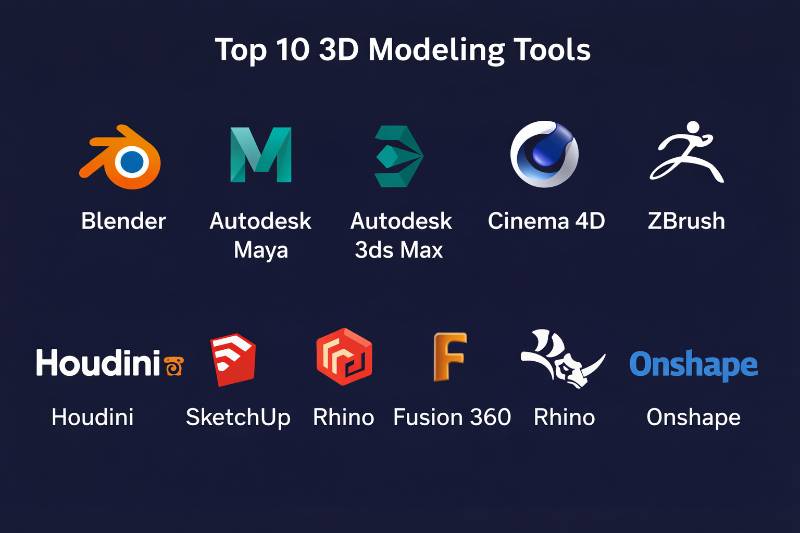
Top 10 3D Modeling Tools
#1 — Blender
Short description (2–3 lines): A full-featured open-source 3D suite for modeling, sculpting, animation, rendering, and procedural workflows. Best for creators and teams that want flexibility, strong community momentum, and exceptional value.
Key Features
- Polygon modeling with a deep modifier-based workflow
- Geometry Nodes for procedural, non-destructive modeling and scene logic
- Sculpting toolset suitable for concepting and production detailing
- UV editing and mesh cleanup workflows
- Python scripting for pipeline automation and custom tools
- Large add-on ecosystem for specialized workflows
- Strong “generalist hub” capability across many pipeline steps
Pros
- Very strong price/value and broad capability coverage
- Flexible for studios through scripting and add-ons
- Huge community learning ecosystem and rapid iteration culture
Cons
- Team consistency depends on governance (standard add-ons, conventions)
- Enterprise support and SLAs are Varies / Not publicly stated (depends on how you source support)
- Some niche pipelines may still require specialized companion tools
Platforms / Deployment
Windows / macOS / Linux
Deployment: Varies / N/A
Security & Compliance
SSO/SAML: Not publicly stated
MFA: Not publicly stated
Encryption: Not publicly stated
Audit logs: Not publicly stated
RBAC: Not publicly stated
Note: For desktop tools, security typically depends on endpoint management, identity policies, and storage controls.
Integrations & Ecosystem
Blender integrates into many pipelines via exporters/importers, add-ons, and scripting—often acting as a “hub” tool.
- Export/import workflows commonly used with real-time engines (via standard formats)
- Python-based pipeline tooling and batch automation
- Add-ons for retopology helpers, UV utilities, and asset workflows (varies)
- Common pairing with dedicated texturing/baking tools (pipeline-dependent)
- Community marketplaces and repositories of extensions (availability varies)
- Studio integrations through internal tooling (varies)
Support & Community
Exceptional community size and learning content. Support is typically community-driven or handled via third-party providers; formal support is Varies / Not publicly stated.
#2 — Autodesk Maya
Short description (2–3 lines): A production-grade DCC tool widely used in film, VFX, and game pipelines—especially where rigging/animation and pipeline customization matter. Best for studios that need mature workflows and extensibility.
Key Features
- Professional polygon modeling and UV workflows
- Rigging and animation depth (often central to adoption)
- Strong scene management for production pipelines
- Scripting/extensibility (Python/MEL) for custom tooling
- Broad plugin ecosystem for specialized workflows
- Pipeline-friendly architecture for studios with technical teams
- Interoperability patterns common in established production stacks
Pros
- Strong talent availability in studio markets
- Scales well with custom tools and pipeline engineering
- Mature workflows for production environments
Cons
- Licensing can be expensive for small teams
- Learning curve is real—best outcomes require training standards
- Some modeling workflows may feel slower than niche modelers for certain tasks
Platforms / Deployment
Windows / macOS / Linux
Deployment: Varies / N/A
Security & Compliance
SSO/SAML: Not publicly stated
MFA: Not publicly stated
Encryption: Not publicly stated
Audit logs: Not publicly stated
RBAC: Not publicly stated
Integrations & Ecosystem
Maya often sits at the center of studio pipelines, connecting modeling to rigging, animation, rendering, and asset systems.
- Scripting APIs for pipeline automation and custom tools
- Plugin ecosystem for rendering, modeling utilities, and pipeline features (varies)
- Common interchange workflows with other DCC tools (format-dependent)
- Asset/version management integrations are typically pipeline-built (varies)
- Third-party training and certification-style learning paths (availability varies)
- Production conventions and tools are widely shared across studios
Support & Community
Large professional user base with extensive training resources. Vendor support tiers are plan/region dependent; community help is broad.
#3 — Autodesk 3ds Max
Short description (2–3 lines): A long-running 3D tool favored in archviz and certain game environment pipelines, known for fast hard-surface workflows and a mature modifier stack. Best for Windows-based teams using established visualization ecosystems.
Key Features
- Mature polygon modeling with an efficient modifier stack
- Strong for hard-surface modeling and environment asset production
- Ecosystem depth for visualization-heavy workflows (plugins common)
- Scene assembly and iteration workflows used in archviz pipelines
- Scripting/automation options (varies by setup)
- Interchange via commonly used formats in visualization/game workflows
- Large legacy knowledge base and training availability
Pros
- Very productive for many hard-surface and environment workflows
- Deep plugin ecosystem for visualization pipelines
- Established adoption in archviz segments
Cons
- Windows-only limits cross-platform standardization
- Many pipelines become plugin-dependent (cost + complexity)
- Licensing can be a hurdle for smaller teams
Platforms / Deployment
Windows
Deployment: Varies / N/A
Security & Compliance
SSO/SAML: Not publicly stated
MFA: Not publicly stated
Encryption: Not publicly stated
Audit logs: Not publicly stated
RBAC: Not publicly stated
Integrations & Ecosystem
3ds Max often thrives in pipelines where plugins define rendering, scattering, materials, and productivity.
- Plugin ecosystem for rendering and archviz utilities (varies)
- Scriptable automation for production tasks (varies)
- Common export workflows into real-time engines (format-dependent)
- Asset libraries and material systems often integrated via plugins (varies)
- Interchange using standard geometry formats (pipeline-dependent)
- Strong third-party education ecosystem for archviz workflows
Support & Community
Large community with deep archviz focus. Support depends on licensing arrangements; community knowledge is mature.
#4 — Cinema 4D
Short description (2–3 lines): A widely used tool for motion design and brand visuals, valued for approachable UX and fast iteration. Best for creative teams producing product animations, social assets, and broadcast-style motion graphics.
Key Features
- Intuitive modeling suited for rapid creative iteration
- Non-destructive workflows through generators/deformers (pipeline-dependent)
- Strong scene organization for design-driven projects
- Motion design-friendly workflows (procedural behaviors vary)
- Plugin ecosystem for rendering and workflow enhancements (varies)
- Interoperability commonly used in creative toolchains (format-dependent)
- Good fit for teams prioritizing speed-to-output
Pros
- Typically faster onboarding for designers moving into 3D
- Strong for “many deliverables, tight timelines” content production
- Balanced power and usability for motion-centric pipelines
Cons
- Advanced character/VFX depth may require companion tools
- Costs can grow with add-ons and renderer choices
- “Studio pipeline” customization may be less central than in Maya/Houdini setups
Platforms / Deployment
Windows / macOS
Deployment: Varies / N/A
Security & Compliance
SSO/SAML: Not publicly stated
MFA: Not publicly stated
Encryption: Not publicly stated
Audit logs: Not publicly stated
RBAC: Not publicly stated
Integrations & Ecosystem
Cinema 4D commonly pairs with creative suites and third-party renderers via plugins and export workflows.
- Integrations with external renderers (typically via plugins; varies)
- Export/import workflows for common DCC handoffs (format-dependent)
- Plugin ecosystem for motion utilities and modeling helpers (varies)
- Template-driven content pipelines and asset libraries (team-dependent)
- Scripting/extensibility options (capabilities vary)
- Strong training ecosystem for motion design audiences
Support & Community
Strong motion-design community and extensive learning materials. Vendor support tiers vary; onboarding content is generally abundant.
#5 — ZBrush
Short description (2–3 lines): A specialized sculpting tool used for high-detail characters, creatures, and concept work. Best for artists who need fast organic modeling and fine surface detail.
Key Features
- High-detail sculpting workflows optimized for dense meshes
- Brush-based sculpting system built for speed and iteration
- Tools that support remeshing/retopology-style workflows (approach varies)
- Polypaint-style concepting workflows (pipeline-dependent)
- Efficient detail authoring for film/game-quality assets
- Export workflows to other tools for rigging, UVs, and final assembly
- Strong ecosystem of brushes, alphas, and artist workflows
Pros
- Best-in-class for organic detail and character sculpting
- Very fast for concept-to-detail iteration
- Excellent complement to a broader DCC pipeline
Cons
- Not a full replacement for general modeling/animation pipelines
- Workflow conventions can be unique for new users
- Downstream steps (retopo, UVs, rigging) often require other tools
Platforms / Deployment
Windows / macOS
Deployment: Varies / N/A
Security & Compliance
SSO/SAML: Not publicly stated
MFA: Not publicly stated
Encryption: Not publicly stated
Audit logs: Not publicly stated
RBAC: Not publicly stated
Integrations & Ecosystem
ZBrush is typically one stage in a pipeline and integrates primarily through mesh exchange and downstream handoffs.
- Standard mesh export workflows into DCC tools (format-dependent)
- Pipeline pairing with baking and texturing tools (varies)
- Community assets: brushes/alphas/materials (availability varies)
- Common use alongside rigging/animation tools (pipeline-dependent)
- Workflow utilities and productivity add-ons (varies)
- Strong industry conventions for character pipelines
Support & Community
Large artist community with deep tutorial coverage. Support specifics vary by plan; community help is strong for character-focused work.
#6 — SideFX Houdini
Short description (2–3 lines): A procedural, node-based platform used for scalable modeling, effects, and automation-heavy pipelines. Best for technical artists and studios that need repeatable, parameter-driven output.
Key Features
- Node-based procedural modeling for reusable asset generation
- Strong data/attribute workflows for complex transformations
- Non-destructive pipeline design: changes propagate through graphs
- Powerful automation patterns for batch and variation workflows
- Works well in complex scene builds and production contexts
- Extensible via scripting and pipeline tooling (varies)
- Commonly used alongside other DCC tools in advanced pipelines
Pros
- Exceptional for procedural assets, variations, and automation
- Reduces rework through non-destructive graphs
- Great fit for technical pipelines and tool-building cultures
Cons
- Steep learning curve for non-technical users
- Can be overkill for simple modeling-only needs
- Best ROI requires pipeline maturity and standardized practices
Platforms / Deployment
Windows / macOS / Linux
Deployment: Varies / N/A
Security & Compliance
SSO/SAML: Not publicly stated
MFA: Not publicly stated
Encryption: Not publicly stated
Audit logs: Not publicly stated
RBAC: Not publicly stated
Integrations & Ecosystem
Houdini is built for pipelines and commonly integrates through exporters, engine connectors, and studio tooling.
- Interchange workflows with other DCC apps (format-dependent)
- Node graphs reused across teams for standardized outputs
- Scripting/tooling for pipeline automation (varies)
- Renderer and engine integrations (often via plugins/connectors; varies)
- Integration with asset/version systems is typically studio-driven (varies)
- Large library of community procedural assets (availability varies)
Support & Community
Strong technical community and professional learning resources. Support varies by license; community is especially strong among technical artists.
#7 — SketchUp
Short description (2–3 lines): A fast, accessible modeler widely used for architecture, interiors, and early spatial concepting. Best for teams that prioritize speed, communication, and stakeholder-friendly workflows.
Key Features
- Fast conceptual modeling with low friction
- Strong for architectural massing and interior layout iteration
- Large library ecosystem for reusable components (availability varies)
- Presentation and documentation-friendly workflows (pipeline-dependent)
- Export pathways commonly used for visualization and real-time (format-dependent)
- Mobile/tablet access options for certain workflows (varies)
- Extension ecosystem for productivity and reporting (varies)
Pros
- Very quick for concept iteration and spatial communication
- Easier onboarding than many DCC tools
- Broad ecosystem of models/extensions and learning content
Cons
- Not ideal for high-end character/VFX or dense topology control
- Complex manufacturing precision may require CAD-first tools
- Large, detailed scenes can require careful organization and optimization
Platforms / Deployment
Web / Windows / macOS / iOS (varies)
Deployment: Cloud (varies) / Varies / N/A
Security & Compliance
SSO/SAML: Not publicly stated
MFA: Not publicly stated
Encryption: Not publicly stated
Audit logs: Not publicly stated
RBAC: Not publicly stated
Note: For web/cloud features, confirm admin controls and sharing governance for your plan.
Integrations & Ecosystem
SketchUp’s ecosystem is a major reason it’s adopted in AEC-adjacent workflows.
- Extensions for reporting, modeling utilities, and visualization workflows (varies)
- Export workflows into common renderers (pipeline-dependent)
- Interchange formats for real-time engine workflows (format-dependent)
- Component libraries used for speed and consistency (availability varies)
- Integration into documentation workflows (varies)
- Community-driven templates and best practices (availability varies)
Support & Community
Very strong community and accessible training. Support tiers vary by plan; many teams rely on community knowledge and extension developers.
#8 — Rhinoceros (Rhino)
Short description (2–3 lines): A flexible modeler widely used in industrial design, architecture, and fabrication contexts, combining precision with freeform capability. Best for teams bridging concept design and fabrication constraints.
Key Features
- Precision modeling suitable for fabrication and product design workflows
- Strong handling of complex surfaces and freeform shapes
- Grasshopper ecosystem for parametric and algorithmic modeling
- Broad interoperability with design and manufacturing pipelines (format-dependent)
- Suitable for product, jewelry, footwear, and architectural detailing niches
- Plugin ecosystem for analysis, rendering, and specialized modeling (varies)
- Scriptability and automation patterns (capabilities vary)
Pros
- Strong balance of precision + creative freeform modeling
- Grasshopper enables repeatable parametric systems and variations
- Useful bridge between concept and engineering handoff
Cons
- Collaboration/version control is typically handled by external systems
- Some advanced workflows require plugins and standardization
- Not purpose-built for character animation pipelines
Platforms / Deployment
Windows / macOS
Deployment: Varies / N/A
Security & Compliance
SSO/SAML: Not publicly stated
MFA: Not publicly stated
Encryption: Not publicly stated
Audit logs: Not publicly stated
RBAC: Not publicly stated
Integrations & Ecosystem
Rhino’s ecosystem is often anchored by Grasshopper, plus a wide set of niche plugins for design-to-fabrication workflows.
- Grasshopper components and community toolsets (availability varies)
- Plugins for rendering, analysis, and fabrication workflows (varies)
- Interchange with CAD/manufacturing formats (format-dependent)
- Automation via scripting (capabilities vary)
- Pairing with visualization tools for final output (pipeline-dependent)
- Strong computational design community patterns
Support & Community
Active community with deep niche expertise, especially around Grasshopper. Support and onboarding resources are generally solid; enterprise-grade support is Varies / Not publicly stated.
#9 — Autodesk Fusion 360
Short description (2–3 lines): A CAD-centric platform combining parametric modeling with workflows that can support product development and fabrication handoff. Best for SMB product teams that iterate frequently and want an integrated toolchain.
Key Features
- Parametric modeling with history-based iteration
- Assemblies and feature-based change propagation
- Manufacturing-adjacent workflows (capabilities vary by configuration)
- Cloud-connected collaboration and sharing (governance required)
- Common import/export pathways for engineering formats (format-dependent)
- Good fit for prototype-to-production iteration cycles
- Extensions/add-ons for advanced needs (varies)
Pros
- Strong for product development where changes are constant
- Reduces tool sprawl for many SMB engineering workflows
- Collaboration features can reduce file duplication (when governed)
Cons
- Not designed for high-end character/VFX modeling
- Collaboration/data controls can be plan-dependent
- Advanced users may still need specialized CAD suites for certain requirements
Platforms / Deployment
Windows / macOS
Deployment: Hybrid
Security & Compliance
SSO/SAML: Not publicly stated
MFA: Not publicly stated
Encryption: Not publicly stated
Audit logs: Not publicly stated
RBAC: Not publicly stated
Note: For cloud-connected CAD, verify identity, access, and logging needs during procurement.
Integrations & Ecosystem
Fusion 360 commonly integrates into product stacks where manufacturing, documentation, and iteration speed matter.
- Interoperability with common CAD formats (format-dependent)
- Extensions/add-ons for advanced workflows (varies)
- Export pathways into visualization pipelines (pipeline-dependent)
- APIs/automation capabilities (availability varies)
- Common integration patterns with maker/fabrication workflows (varies)
- Works alongside DCC tools for marketing visuals (pipeline-dependent)
Support & Community
Large community with many tutorials and structured learning paths. Support tiers vary by plan; community forums are a major resource for many teams.
#10 — Onshape
Short description (2–3 lines): A browser-first cloud CAD platform built around collaboration, centralized data, and versioning workflows. Best for distributed teams that want real-time collaboration without managing desktop file sprawl.
Key Features
- Cloud-based parametric CAD modeling
- Built-in versioning and change tracking patterns (plan-dependent)
- Real-time collaboration for review and iteration
- Centralized data approach for distributed teams
- Access from browsers; mobile support for review/markup (varies)
- Interoperability with engineering formats (format-dependent)
- Admin governance patterns for teams (capabilities vary by plan)
Pros
- Excellent for distributed collaboration and stakeholder review
- Reduces “copy-of-copy” file chaos common in CAD teams
- Faster access for contractors and cross-functional reviewers (with proper controls)
Cons
- Internet reliability can be a constraint for some workflows
- Teams migrating from legacy CAD may need process changes
- Enterprise controls and integrations can be plan-dependent
Platforms / Deployment
Web / iOS / Android
Deployment: Cloud
Security & Compliance
SSO/SAML: Not publicly stated
MFA: Not publicly stated
Encryption: Not publicly stated
Audit logs: Not publicly stated
RBAC: Not publicly stated
Note: Confirm identity, access controls, logging, and data handling for your plan during procurement.
Integrations & Ecosystem
Onshape’s ecosystem tends to emphasize collaboration, APIs, and structured workflows rather than desktop file-based customization.
- APIs for automation and integrations (availability varies)
- Interchange with CAD formats (format-dependent)
- Integration patterns for PLM/PDM-style processes (varies)
- Collaboration workflows for external partners (governance-dependent)
- Admin tooling and access policies (plan-dependent)
- Growing ecosystem of add-ons/connectors (availability varies)
Support & Community
Documentation is designed for faster onboarding and cloud-first workflows. Enterprise onboarding and support tiers are plan-dependent; community resources vary by region.
Comparison Table (Top 10)
| Tool Name | Best For | Platform(s) Supported | Deployment (Cloud/Self-hosted/Hybrid) | Standout Feature | Public Rating |
|---|---|---|---|---|---|
| Blender | General-purpose modeling + procedural workflows | Windows / macOS / Linux | Varies / N/A | Geometry Nodes procedural modeling | N/A |
| Autodesk Maya | Studio production pipelines, rigging/animation + modeling | Windows / macOS / Linux | Varies / N/A | Pipeline extensibility via scripting/plugins | N/A |
| Autodesk 3ds Max | Archviz + hard-surface/environment workflows | Windows | Varies / N/A | Modifier stack + visualization ecosystem | N/A |
| Cinema 4D | Motion design, fast iteration for brand visuals | Windows / macOS | Varies / N/A | Designer-friendly workflow for motion content | N/A |
| ZBrush | High-detail sculpting and organic modeling | Windows / macOS | Varies / N/A | Best-in-class sculpting workflow | N/A |
| SideFX Houdini | Procedural modeling and automation-heavy pipelines | Windows / macOS / Linux | Varies / N/A | Node-based procedural scalability | N/A |
| SketchUp | AEC concepting and stakeholder-friendly modeling | Web / Windows / macOS / iOS (varies) | Cloud (varies) / Varies / N/A | Speed and accessibility for spatial concepts | N/A |
| Rhinoceros (Rhino) | Precision + freeform design-to-fabrication | Windows / macOS | Varies / N/A | Grasshopper parametric ecosystem | N/A |
| Autodesk Fusion 360 | Parametric product development + iteration cycles | Windows / macOS | Hybrid | Integrated CAD workflow for SMB teams | N/A |
| Onshape | Cloud CAD collaboration for distributed teams | Web / iOS / Android | Cloud | Centralized collaboration + versioning patterns | N/A |
Evaluation & Scoring of 3D Modeling Tools
Scoring model:
- Each criterion is scored 1–10 (10 = strongest for typical buyers).
- Weighted total (0–10) uses the weights below.
Weights:
- Core features – 25%
- Ease of use – 15%
- Integrations & ecosystem – 15%
- Security & compliance – 10%
- Performance & reliability – 10%
- Support & community – 10%
- Price / value – 15%
| Tool Name | Core (25%) | Ease (15%) | Integrations (15%) | Security (10%) | Performance (10%) | Support (10%) | Value (15%) | Weighted Total (0–10) |
|---|---|---|---|---|---|---|---|---|
| Blender | 9 | 7 | 8 | 5 | 8 | 9 | 10 | 8.20 |
| Autodesk Maya | 9 | 6 | 8 | 6 | 8 | 8 | 5 | 7.30 |
| Autodesk 3ds Max | 8 | 6 | 7 | 6 | 8 | 7 | 5 | 6.80 |
| Cinema 4D | 8 | 8 | 7 | 5 | 7 | 7 | 6 | 7.05 |
| ZBrush | 9 | 7 | 6 | 4 | 8 | 7 | 6 | 7.00 |
| SideFX Houdini | 9 | 5 | 8 | 5 | 8 | 8 | 6 | 7.20 |
| SketchUp | 7 | 9 | 7 | 5 | 6 | 7 | 7 | 7.00 |
| Rhinoceros (Rhino) | 8 | 7 | 7 | 4 | 7 | 7 | 8 | 7.10 |
| Autodesk Fusion 360 | 8 | 8 | 7 | 6 | 7 | 7 | 7 | 7.30 |
| Onshape | 7 | 8 | 8 | 7 | 7 | 7 | 6 | 7.15 |
How to interpret the scores:
- These are comparative scores for typical use cases—not a guarantee for your specific workflow.
- If two tools are within ~0.3 points, prioritize pipeline fit and team skill availability.
- Security scores reflect procurement readiness (especially for cloud), not whether a local desktop tool is “unsafe.”
- Your best choice may be a specialist tool even if its overall score is lower.
Which 3D Modeling Tool Is Right for You?
Solo / Freelancer
If you want maximum flexibility and minimal cost, Blender is often the best starting point. Add ZBrush if sculpting quality is your differentiator, or choose SketchUp if your work is primarily AEC concepting and quick client communication.
SMB
SMBs typically win by reducing tool sprawl and speeding onboarding:
- Blender for broad 3D work when budget and flexibility matter.
- Fusion 360 when you need parametric iteration and product-development workflows.
- Rhino if you live in freeform shapes but still need precision and fabrication-friendly handoffs.
Mid-Market
Mid-market teams need repeatability, hiring scalability, and predictable handoffs:
- Cinema 4D for high-volume marketing and motion output.
- Maya when your pipeline is talent-heavy and production-oriented.
- Onshape if distributed CAD collaboration is a major friction point.
Enterprise
Enterprise choices usually prioritize governance, predictability, and support expectations:
- Maya + Houdini for studio-style production and procedural pipelines.
- 3ds Max for established archviz ecosystems on Windows.
- Onshape for cloud-first CAD collaboration—provided security and admin needs are validated during procurement.
Budget vs Premium
- Budget-optimized: Blender (broad), SketchUp (for concept speed; plan-dependent), Rhino (strong niche value).
- Premium ecosystems: Maya, Houdini, Cinema 4D, 3ds Max—often justified by pipeline maturity, plugin depth, and hiring consistency.
Feature Depth vs Ease of Use
- Feature depth: Houdini (procedural), Maya (production pipelines), ZBrush (sculpting).
- Ease of use: SketchUp and Cinema 4D typically ramp faster for many users.
- Balanced “do a lot well”: Blender and Rhino (with the right standards and training).
Integrations & Scalability
- If you need custom pipelines and automation, prioritize Maya, Houdini, or Blender.
- If your pain is CAD collaboration and version chaos, prioritize Onshape (cloud-first) or a governed Fusion workflow.
- If you rely on archviz plugin ecosystems, 3ds Max and SketchUp remain common anchors.
Security & Compliance Needs
- Desktop tools: focus on endpoint management, storage encryption, access control, and data governance.
- Cloud tools: require clear answers on SSO/MFA, RBAC, audit logs, and data handling. If details are Not publicly stated, treat that as a due-diligence checkpoint before standardizing.
Frequently Asked Questions (FAQs)
What’s the difference between polygon modeling, sculpting, and parametric CAD?
Polygon modeling builds forms from vertices/edges/faces; sculpting shapes “digital clay” for organic detail; parametric CAD uses features and histories for precise, editable dimensions.
Do I need one tool or a toolchain?
Most professional workflows use a toolchain: a hub for general modeling, plus specialists for sculpting, procedural generation, CAD, or texturing. Start with one anchor tool and expand only after real pipeline tests.
Are AI features safe to rely on for production assets?
AI can accelerate repetitive tasks, but you still need human review for topology, UVs, scale, and manufacturability. Treat AI as a speed layer—not a final authority.
What’s the most common pricing model in 3D tools?
Subscriptions are common for commercial tools; open-source options exist; and compute-heavy features (rendering/simulation/AI) may be metered. Exact pricing: Varies / Not publicly stated.
How long does implementation/onboarding usually take?
Basic productivity can happen within days for simpler tools, but consistent team output often takes weeks or months due to standards, libraries, and pipeline conventions.
What are the biggest mistakes teams make when choosing a tool?
Choosing based on a single feature, ignoring interoperability, underinvesting in training, and failing to standardize naming/export rules. Another common mistake is skipping a real pilot with representative assets.
What should I check for enterprise security reviews?
For cloud tools, ask about SSO/MFA, RBAC, audit logs, encryption, and data governance. If those details aren’t clear publicly, handle it as part of vendor due diligence.
How do we avoid “broken imports” between tools?
Define standard export settings, units/scale conventions, naming rules, and material/UV expectations. Run round-trip tests early (export → import → validate → re-export) before committing.
Can I switch tools later without redoing everything?
You can usually migrate geometry, but procedural histories, rigs, and materials often don’t transfer perfectly. Plan a migration by testing a small, representative asset set first.
Which tools are best for real-time engines?
Tools that support predictable export and optimization workflows tend to work well. The “best” depends on whether your pipeline is character-heavy (DCC) or CAD-to-real-time (requires careful conversion).
What’s best for 3D printing: DCC or CAD?
CAD tools are typically better for dimensioned parts and assemblies; DCC tools can be great for sculptural prints but often require mesh cleanup and watertight validation.
Conclusion
The “best” 3D modeling tool depends on your workflow: procedural vs sculpt vs CAD vs motion, your team’s skill profile, the integrations you must support, and how much governance/security your organization requires—especially for cloud collaboration. Blender is a standout for breadth and value; Maya and Houdini shine in production and automation-heavy pipelines; ZBrush dominates sculpting; and Fusion 360 and Onshape are strong picks for modern product development and collaborative CAD.






Leave a Reply
You must be logged in to post a comment.