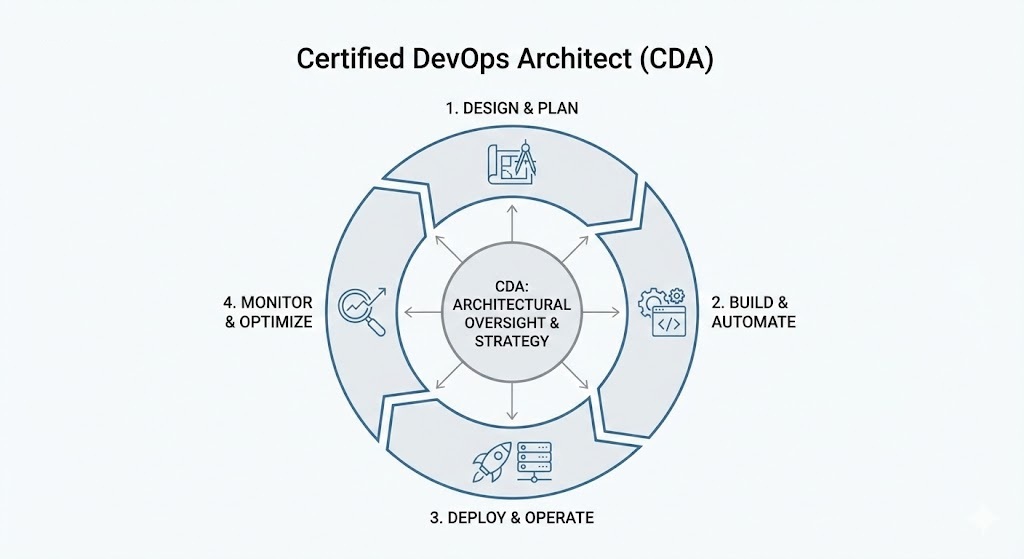
Why DevOps Architecture Is Important Today
Modern engineering teams no longer struggle with tools. They struggle with scale, cost, reliability, and governance. As systems grow distributed and cloud-first, poor architectural choices create long-term pain. Certified DevOps Architect (CDA) exists for professionals who want to solve these problems at design level. This guide helps working engineers and leaders understand how CDA fits into real careers, not just certification paths. You’ll learn who should pursue it, what it actually teaches, and how it impacts long-term growth.
Understanding the Role of a DevOps Architect
A DevOps Architect designs how software moves from idea to production safely and repeatedly. This role focuses on platform consistency, team workflows, policy enforcement, and operational resilience. Unlike DevOps engineers, architects think in systems rather than scripts. Certified DevOps Architect (CDA) prepares professionals to design platforms that support dozens or hundreds of teams. It emphasizes decision-making under real constraints like budget, compliance, and uptime.
Who Gains the Most from Certified DevOps Architect (CDA)
CDA suits professionals who already work close to production systems. Senior DevOps engineers benefit when they want design ownership. Platform and cloud engineers gain clarity on large-scale system patterns. SREs use CDA to shift from reaction to prevention. Engineering managers find value when they must evaluate and approve architectural decisions. Professionals in India and global enterprises face similar scale challenges, making CDA widely relevant.
Long-Term Value of Certified DevOps Architect (CDA)
Tools change every year, but architectural mistakes last for years. CDA stays valuable because it teaches thinking, not tooling. Professionals who understand architectural trade-offs adapt faster to change. As organizations mature, they reward people who prevent failures rather than fix them. CDA pushes engineers closer to strategic roles where influence and compensation grow together.
Program and Certification Details
The Certified DevOps Architect (CDA) program runs through Certified DevOps Architect (CDA) certification and is hosted by DevOpsSchool. The certification evaluates architecture decisions using real-world scenarios. It avoids theoretical exams and focuses on production-level reasoning. The program structure supports progression from architectural basics to enterprise-grade design. Ownership reflects industry-driven skill needs rather than academic frameworks.
Levels and Progression Model
CDA follows a step-by-step growth model. Entry levels establish architectural thinking. Mid-level certifications focus on scale and coordination across teams. Advanced levels emphasize governance, compliance, and enterprise alignment. Specialization tracks allow architects to deepen expertise in SRE, FinOps, security, or data platforms. Each level reflects increasing responsibility rather than just difficulty.
Certified DevOps Architect (CDA) Certification Matrix
| Track | Level | Target Audience | Required Experience | Core Focus | Suggested Sequence | Official Reference |
|---|---|---|---|---|---|---|
| Architecture Core | Foundation | DevOps Engineers | CI/CD exposure | Design basics | First | Certified DevOps Architect (CDA) certification |
| Architecture Core | Professional | Senior Engineers | Production systems | Scale design | Second | Certified DevOps Architect (CDA) certification |
| Architecture Core | Advanced | Architects | Multi-team systems | Governance | Third | Certified DevOps Architect (CDA) certification |
| Reliability Focus | Advanced | SRE Leads | Incident handling | Resilience | Optional | Certified DevOps Architect (CDA) certification |
| Cost Focus | Advanced | FinOps Roles | Cloud billing | Cost control | Optional | Certified DevOps Architect (CDA) certification |
Certification Breakdown by Level
CDA Foundation
Purpose
This level builds architectural thinking for DevOps environments.
Ideal candidates
DevOps engineers who want to shift from execution to design.
Capabilities developed
- CI/CD architecture planning
- Environment consistency
- Toolchain standardization
Expected outcomes
- Design DevOps workflows for teams
- Define platform-level standards
Study approach
7–14 days: revisit DevOps fundamentals
30 days: create architecture diagrams
60 days: analyze failure patterns
Common pitfalls
- Obsessing over tools
- Ignoring future scale
Next steps
Same track: CDA Professional
Cross track: SRE fundamentals
Leadership path: Technical leadership basics
CDA Professional
Purpose
This level validates system design under operational pressure.
Ideal candidates
Senior engineers and platform owners.
Capabilities developed
- Shared platform architecture
- Observability design
- Cloud-native patterns
Expected outcomes
- Build reusable DevOps platforms
- Support multiple product teams
Study approach
7–14 days: review system design cases
30 days: practice platform layouts
60 days: simulate outage scenarios
Common pitfalls
- Overdesigning solutions
- Ignoring cost impact
Next steps
Same track: CDA Advanced
Cross track: FinOps architecture
Leadership path: Engineering management
CDA Advanced
Purpose
This level certifies enterprise-level architectural judgment.
Ideal candidates
Principal engineers, architects, and technical leads.
Capabilities developed
- Policy-driven platforms
- Compliance-ready systems
- Cross-cloud alignment
Expected outcomes
- Define organization-wide standards
- Review and approve architectures
Study approach
7–14 days: analyze real enterprises
30 days: perform architecture reviews
60 days: simulate large organizations
Common pitfalls
- Ignoring people and culture
- Designing in isolation
Next steps
Same track: Advanced specializations
Cross track: Security architecture
Leadership path: Enterprise architecture
Mapping CDA to Career Paths
DevOps-Centric Roles
CDA enables engineers to own platform decisions instead of maintaining scripts. It supports long-term career stability.
Security-Focused Roles
Architects embed controls directly into pipelines. This approach reduces friction between speed and compliance.
Reliability Roles
SREs apply CDA principles to prevent incidents rather than firefight them.
AI and Automation Roles
CDA supports scalable intelligent operations through sound platform design.
Data Engineering Roles
Architectural clarity improves pipeline reliability and governance.
Financial Operations Roles
CDA helps professionals design cost-aware infrastructure from day one.
Role-Based Certification Recommendations
| Role | Suggested CDA Path |
|---|---|
| DevOps Engineer | Foundation → Professional |
| SRE | Professional → Reliability track |
| Platform Engineer | Professional → Advanced |
| Cloud Engineer | Foundation → Professional |
| Security Engineer | Professional with security focus |
| Data Engineer | Foundation with DataOps alignment |
| FinOps Specialist | Professional → Cost track |
| Engineering Manager | Advanced |
What to Do After CDA
Deep Specialization
Stay within architecture tracks and deepen technical authority.
Skill Expansion
Add security, finance, or data architecture to widen influence.
Leadership Transition
Use architectural credibility to move into leadership roles.
Training and Support Ecosystem
DevOpsSchool
Offers enterprise-focused architecture training.
Cotocus
Supports consulting and large-scale solution design.
Scmgalaxy
Focuses on DevOps automation learning.
BestDevOps
Provides industry-aligned preparation resources.
devsecopsschool.com
Covers secure architecture design.
sreschool.com
Specializes in reliability engineering.
aiopsschool.com
Addresses intelligent operations.
dataopsschool.com
Focuses on data platform architecture.
finopsschool.com
Covers cost-driven system design.
Common Questions Engineers Ask
Certified DevOps Architect (CDA) challenges thinking more than memory. Preparation time varies with experience. Engineers with production exposure progress faster. The certification remains vendor-neutral. Managers benefit because it improves technical decision-making. Freshers should gain experience first. Architecture skills remain globally relevant. Compensation often improves with design responsibility.
Final Perspective
Certified DevOps Architect (CDA) fits professionals who want influence, not just execution work. It rewards people who think in systems and consequences. The certification does not replace experience; it sharpens it. Engineers who want to shape platforms, reduce failure, and guide teams will find CDA genuinely useful.






Leave a Reply
You must be logged in to post a comment.