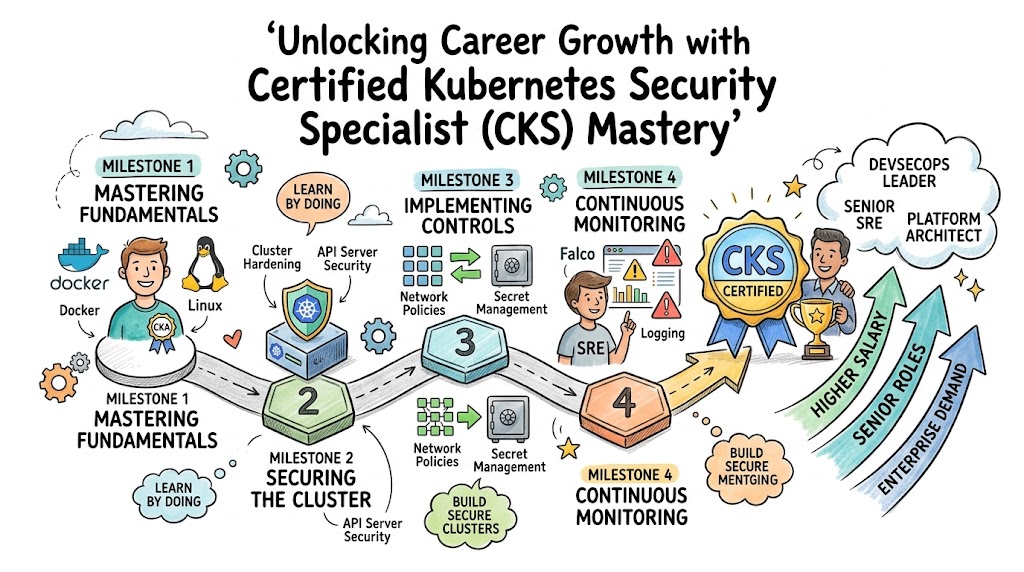
Introduction
Securing containerized workloads has become a mandatory requirement for modern engineering teams worldwide. The Certified Kubernetes Security Specialist (CKS) credential validates your technical ability to harden clusters and protect cloud-native applications against evolving threats. This comprehensive guide helps DevOpsSchool professionals navigate the transition from basic orchestration to advanced security implementation. As organizations expand their digital footprint, they increasingly seek experts who can mitigate risks across build, deployment, and runtime phases. We examine how this certification functions as a definitive roadmap for those striving to lead in DevSecOps and high-stakes platform engineering roles.
What is the Certified Kubernetes Security Specialist (CKS)?
The Certified Kubernetes Security Specialist (CKS) serves as a performance-based assessment that measures an individual’s competency in securing container-based environments. It bypasses theoretical questions in favor of a live CLI environment where candidates must solve real-world security challenges. This certification exists to ensure that engineers can implement rigorous security compliance within functional cluster management workflows. By emphasizing the broad cloud-native ecosystem, it equips professionals to defend against supply chain attacks and runtime vulnerabilities. Modern enterprise practices demand this specific expertise to maintain resilient infrastructure and protect sensitive data.
Who Should Pursue Certified Kubernetes Security Specialist (CKS)?
Cloud Architects, SREs, and DevOps engineers who already possess a solid grasp of Kubernetes administration find this track essential. Security professionals transitioning into the cloud-native domain also benefit significantly by learning how traditional security primitives apply to dynamic, orchestrated environments. While beginners should target this as a long-term milestone, engineering managers can use the curriculum to establish architectural standards for their departments. Whether you work in India’s booming tech sector or the global market, this credential signals a high level of technical maturity and a commitment to infrastructure integrity.
Why Certified Kubernetes Security Specialist (CKS) is Valuable and Beyond
The appetite for Kubernetes security proficiency continues to grow as enterprises migrate mission-critical applications to the cloud. Since Kubernetes operates as the primary operating system for cloud environments, these specialized skills offer immense career longevity regardless of specific vendor tools. Earning this certification delivers a massive return on investment by positioning you as a high-value asset capable of thwarting costly data breaches. It ensures your skill set remains relevant as the industry prioritizes “security as code” and automated compliance. Investing your time in this certification guarantees alignment with the future of resilient, scalable infrastructure.
Certified Kubernetes Security Specialist (CKS) Certification Overview
The program reaches students via the official training modules and remains hosted on the primary platform. This professional-level certification utilizes a hands-on assessment approach rather than standard multiple-choice questions. The Cloud Native Computing Foundation (CNCF) maintains ownership of the program, which ensures the content stays vendor-neutral and industry-standard. The curriculum covers cluster hardening, system security, and the minimization of microservice vulnerabilities. Professionals must demonstrate their ability to navigate complex Linux and Kubernetes security configurations within a high-pressure, timed environment.
Certified Kubernetes Security Specialist (CKS) Certification Tracks & Levels
The certification journey typically starts with foundational Kubernetes knowledge via the CKA track. Upon achieving the professional level with the CKS, engineers often branch out into specialized domains like DevSecOps or Cloud-Native Security. These levels mirror career progression from Junior DevOps roles to Senior DevSecOps Engineers or Security Architects. Advanced stages involve mastering third-party tools such as Falco, Trivy, and OPA Gatekeeper to enhance cluster defenses. Each step in this track reinforces previous knowledge, providing a comprehensive understanding of the modern security landscape.
Complete Certified Kubernetes Security Specialist (CKS) Certification Table
| Track | Level | Who it’s for | Prerequisites | Skills Covered | Recommended Order |
| Infrastructure Defense | Professional | DevSecOps Engineers | CKA Certification | Cluster Hardening, RBAC, Network Policies | 1st |
| Governance | Advanced | Security Architects | CKS Knowledge | OPA, Auditing, Benchmarking | 2nd |
| Threat Detection | Specialization | SREs | CKS Knowledge | Falco, Seccomp, AppArmor | 3rd |
| Pipeline Integrity | Specialization | Platform Engineers | CKS Knowledge | Image Signing, SCA, Admission Controllers | 4th |
Detailed Guide for Each Certified Kubernetes Security Specialist (CKS) Certification
Certified Kubernetes Security Specialist (CKS) – Professional Level
What it is
This certification confirms an expert’s ability to secure a Kubernetes cluster and its hosted applications. It focuses on applying practical security controls across the entire container lifecycle.
Who should take it
Senior DevOps Engineers, Security Analysts, and SREs who have cleared the CKA exam and want to specialize in infrastructure defense should take this.
Skills you’ll gain
- Harden clusters using CIS Benchmarks.
- Restrict pod communication through Network Policies.
- Protect the API Server and Etcd storage.
- Mitigate runtime threats using Falco.
- Encrypt data at rest and manage secrets.
Real-world projects you should be able to do
- Construct a hardened Kubernetes cluster that satisfies strict security audits.
- Integrate automated vulnerability scanning into a production CI/CD pipeline.
- Deploy granular RBAC policies to enforce the principle of least privilege.
Preparation plan
- 7–14 days: Refresh all CKA concepts and study the official Kubernetes documentation.
- 30 days: Practice with specific security tools like OPA Gatekeeper and Trivy in dedicated lab environments.
- 60 days: Complete multiple full-length mock exams to improve speed and accuracy in the CLI.
Common mistakes
- Devoting too much time to a single complex troubleshooting task.
- Failing to use the official documentation for quick command references.
- Neglecting Linux-level security features like AppArmor or Seccomp profiles.
Best next certification after this
- Same-track option: Advanced Cloud-Native Security Specialist.
- Cross-track option: Certified Cloud Security Professional (CCSP).
- Leadership option: Technical Management or CISO Training Tracks.
Choose Your Learning Path
DevOps Path
This learning track integrates Kubernetes security directly into the standard DevOps lifecycle. Professionals learn to maintain development speed while automating essential compliance checks. It focuses on mastering infrastructure as code security to ensure that defenses never become a bottleneck for the team. This path suits engineers who want to remain versatile generalists while maintaining a strong defensive mindset.
DevSecOps Path
The DevSecOps path emphasizes the “Shift Left” philosophy by weaving security into every development stage. You will focus on image signing, software composition analysis, and admission controllers to block insecure deployments. This route appeals to those who want to act as the primary liaison between development teams and security auditors.
SRE Path
Site Reliability Engineers follow this path to ensure cluster resilience and availability during malicious attacks. The curriculum focuses on runtime security, auditing, and incident response within orchestrated environments. You will learn to monitor for anomalies and automate the isolation of compromised pods without disrupting system uptime.
AIOps Path
Professionals in the AIOps path apply machine learning techniques to Kubernetes security logs and metrics. You will focus on using AI tools to predict potential breaches and automate complex policy decisions across the cluster. This emerging field caters to those interested in the intersection of data science and cloud-native security.
MLOps Path
This path tailors security strategies for machine learning pipelines running on Kubernetes. You will learn how to protect sensitive training data and secure various components of the ML stack like Kubeflow. It ensures that compute-heavy workloads remain isolated and strictly follow access control protocols.
DataOps Path
The DataOps path prioritizes the security of data persistence and movement within containerized environments. You will master volume encryption, secure database connectivity, and advanced data masking techniques. This expertise is vital for organizations handling regulated data, such as financial transactions or health records, in the cloud.
FinOps Path
While FinOps typically addresses costs, this path examines how security configurations influence cloud spending. You will learn to identify redundant security resources and optimize the expenses associated with security monitoring tools. It offers a balanced perspective on maintaining a robust security posture while ensuring financial efficiency in Kubernetes operations.
Role → Recommended Certified Kubernetes Security Specialist (CKS) Certifications
| Role | Recommended Certifications |
| DevOps Engineer | CKA, CKS, DevSecOps Professional |
| SRE | CKS, Cloud-Native Runtime Security |
| Platform Engineer | CKS, Infrastructure as Code Specialist |
| Cloud Engineer | AWS/Azure/GCP Security, CKS |
| Security Engineer | CKS, CISSP, Pentesting Specialist |
| Data Engineer | CKS, Big Data Security Certification |
| FinOps Practitioner | CKS, FinOps Certified Practitioner |
| Engineering Manager | CKS (Foundation), Leadership & Compliance |
Next Certifications to Take After Certified Kubernetes Security Specialist (CKS)
Same Track Progression
If you want to stay within the Kubernetes ecosystem, you should move toward specialized cloud provider security certifications. You might also explore expert-level training in Service Mesh security, such as Istio, to manage microservice communications. Mastering eBPF-based security tools provides another excellent way to maintain a sharp technical edge in this track.
Cross-Track Expansion
Consider certifications in public cloud security, such as the AWS Certified Security – Specialty, to broaden your professional horizons. Understanding how Kubernetes integrates with broader cloud identity and access management (IAM) proves crucial for high-level roles. You might also pursue automation certifications like HashiCorp Certified: Terraform Associate to secure your infrastructure provisioning.
Leadership & Management Track
Transitioning to leadership requires moving your focus from technical execution to strategy and risk management. Certifications like CISM (Certified Information Security Manager) or CISA (Certified Information Systems Auditor) represent logical next steps. These credentials allow you to translate Kubernetes security risks into business impact, facilitating your move into executive roles.
Training & Certification Support Providers for Certified Kubernetes Security Specialist (CKS)
DevOpsSchool
DevOpsSchool delivers a comprehensive curriculum covering every aspect of the CKS exam through instructor-led training. Their method prioritizes heavy hands-on lab sessions that mirror the actual exam environment. They provide lifetime access to course materials and a dedicated community of experts for ongoing support.
Cotocus
Cotocus offers high-intensity bootcamps designed for working professionals who need to clear the CKS exam quickly. Their training focuses on the most critical exam topics and effective time-management strategies. They provide customized lab environments so students can practice complex scenarios without managing their own infrastructure.
Scmgalaxy
Scmgalaxy provides a wealth of community-driven resources, including mock tests and technical blogs for CKS candidates. They bridge the gap between learning and employment by offering career guidance alongside technical training. Their curriculum emphasizes practical implementation and real-world troubleshooting.
BestDevOps
BestDevOps produces detailed video tutorials and step-by-step guides for mastering Kubernetes security. Their content structure makes complex security concepts accessible to intermediate-level engineers. They highlight the use of open-source tools within the broader Kubernetes security ecosystem.
devsecopsschool.com
This platform focuses entirely on the DevSecOps movement, making it a perfect match for the CKS certification. Their courses integrate security into the CI/CD pipeline so students understand the logic behind every configuration. They offer specialized modules dedicated to automated security testing.
sreschool.com
SRESchool emphasizes the reliability and observability aspects of Kubernetes security. Their CKS training includes deep dives into auditing and logging to help SREs respond to threats effectively. They teach security as a vital component of overall system health and performance.
aiopsschool.com
AIOpsSchool explores the future of automated security operations through the lens of artificial intelligence. Their curriculum explains how to use AI to analyze Kubernetes audit logs for suspicious patterns. This resource helps those looking to lead in the field of automated threat detection.
dataopsschool.com
DataOpsSchool provides specialized training on securing data pipelines and stateful applications in Kubernetes. Their CKS content focuses on volume security and secret management for database-intensive workloads. They ensure that data integrity remains intact throughout the container lifecycle.
finopsschool.com
FinOpsSchool teaches professionals to understand the financial implications of their security choices. Their training covers how to implement cost-effective security monitoring and logging within Kubernetes. This unique resource helps engineers justify security spending to business stakeholders.
Frequently Asked Questions (General)
- How much effort does the CKS require compared to CKA?
The CKS demands significantly more effort because it requires a deeper understanding of both Kubernetes and Linux security. It tests your ability to secure components against various attack vectors rather than just configuring them.
- What prerequisites must I meet before taking the CKS?
You must hold a valid Certified Kubernetes Administrator (CKA) certification before you can attempt the CKS exam. This ensures you have the foundational knowledge required for advanced security.
- What is the typical preparation time for this certification?
Most experienced Kubernetes administrators require 4 to 8 weeks of dedicated study to prepare. This time includes lab practice and a thorough review of the official documentation.
- Do I have to answer multiple-choice questions?
No, the CKS is a performance-based exam where you solve tasks on a live Kubernetes cluster using a terminal.
- Which score do I need to pass the CKS?
A passing score for the CKS exam is typically 67%. Candidates should prioritize speed and accuracy to finish all tasks within the time limit.
- Are external websites allowed during the exam?
You can only access specific official documentation sites while taking the exam. You cannot use external blogs, personal notes, or search engines.
- How long does the certification remain active?
The CKS certification remains valid for two years from the date you pass the exam. You must recertify after this period to maintain your status.
- Will this certification improve my job prospects in DevSecOps?
Yes, the industry respects the CKS as a top-tier certification in the DevSecOps field. It proves you possess the hands-on skills to protect cloud-native environments.
- Which specific tools should I master for the CKS?
You should master tools like Falco, Trivy, OPA Gatekeeper, and Linux security modules like AppArmor and Seccomp.
- What happens if I fail the first attempt?
Most exam purchases include one free retake if you do not pass on your first try. Always verify the current policy during registration.
- How much does the exam registration cost?
The standard price is approximately $395 USD, although discounts frequently appear during special promotions or through training partners.
- Should I get the CKS if I already have cloud security certs?
Yes, because cloud provider certifications often focus on managed services, while CKS addresses the internal security of the Kubernetes cluster.
FAQs on Certified Kubernetes Security Specialist (CKS)
- Does the CKS exam include network security topics?
Yes, a major portion of the exam involves configuring Network Policies to control traffic between pods and namespaces.
- Must I demonstrate image scanning techniques?
Yes, you must show how to scan container images for vulnerabilities and prevent insecure images from running in the cluster.
- Is programming knowledge necessary for the CKS?
While you do not need deep coding skills, you must be proficient in YAML and basic shell scripting to modify configurations.
- Which Kubernetes version does the exam use?
The exam typically uses a version within a few releases of the current stable Kubernetes version.
- How much weight do third-party tools carry?
Third-party tools like Falco and Trivy are central to the exam as they are standard in the security ecosystem.
- Does the CKS cover RBAC configurations?
RBAC is a core component of the exam, emphasizing the principle of least privilege for users and service accounts.
- How should I practice for the CKS tasks?
Using platforms like Killer.sh or setting up local clusters with Kind or Minikube provides the best hands-on practice for the exam.
- Is secret management a critical part of the exam?
Absolutely, you must know how to create, use, and encrypt secrets at the Etcd level to pass the certification.
Final Thoughts: Is Certified Kubernetes Security Specialist (CKS) Worth It?
Serious cloud-native engineers should view the CKS as one of their most valuable career investments. It transforms you from a standard user of technology into a sophisticated protector of infrastructure. The performance-based nature of the exam guarantees that you truly understand the tasks, providing far more value than a certificate based on rote memorization. Although the preparation process feels intense, the resulting confidence and marketability remain unparalleled. In a landscape defined by constant security threats, the ability to lock down a cluster makes you an indispensable asset to any organization.