Introduction
Navigating the landscape of modern infrastructure requires more than just knowing how to write code; it demands an understanding of how to keep that code running reliably at scale. The Site Reliability Engineering Certified Professional (SRECP) serves as a comprehensive bridge between traditional operations and software engineering. This guide helps software engineers, system administrators, and technical leaders understand how this specific certification validates the skills needed to manage complex cloud-native environments. As organizations shift toward platform engineering and automated resilience, mastering these principles ensures your career remains relevant and competitive. This program, offered by DevOpsSchool, provides the roadmap for this transformation.
What is the Site Reliability Engineering Certified Professional (SRECP)?
The Site Reliability Engineering Certified Professional (SRECP) represents a rigorous validation of an engineer’s ability to apply software engineering mindsets to IT operations challenges. It exists to standardize the SRE way of working, moving beyond theoretical knowledge into the practical application of Service Level Objectives (SLOs) and error budgets. This program focuses heavily on production-grade scenarios, ensuring that practitioners can handle high-pressure environments while maintaining system uptime. By aligning with modern engineering workflows, it provides a blueprint for building scalable and highly available distributed systems.
Who Should Pursue Site Reliability Engineering Certified Professional (SRECP)?
This certification targets a wide range of professionals who are responsible for the stability and performance of digital products. Software engineers looking to move into infrastructure roles find the curriculum particularly useful for understanding the lifecycle of their code. Experienced DevOps practitioners and cloud engineers use this track to formalize their expertise in automation and incident management. Engineering managers and technical leaders also benefit from the program as it provides the vocabulary and metrics necessary to lead high-performing reliability teams.
Why Site Reliability Engineering Certified Professional (SRECP) is Valuable in 2026 and Beyond
As enterprises continue their massive adoption of distributed architectures, the demand for reliability experts grows exponentially. The Site Reliability Engineering Certified Professional (SRECP) offers long-term career value because it focuses on principles—like automation and observability—that survive shifting tool trends. Professionals holding this credential demonstrate a commitment to operational excellence that reduces business risk and improves customer satisfaction. Investing time in this certification pays off by positioning you as a high-value asset capable of managing the complex interdependencies of modern cloud environments.
Site Reliability Engineering Certified Professional (SRECP) Certification Overview
The program delivers its curriculum via the official SRECP course and is hosted on the DevOpsSchool website. The certification uses a practical, assessment-based approach that tests a candidate’s ability to solve real-world reliability problems. It covers a broad spectrum of topics including monitoring, incident response, and capacity planning. The ownership of the program ensures that the content stays updated with the latest industry shifts, providing a structured path from foundational concepts to expert-level implementation.
Site Reliability Engineering Certified Professional (SRECP) Certification Tracks & Levels
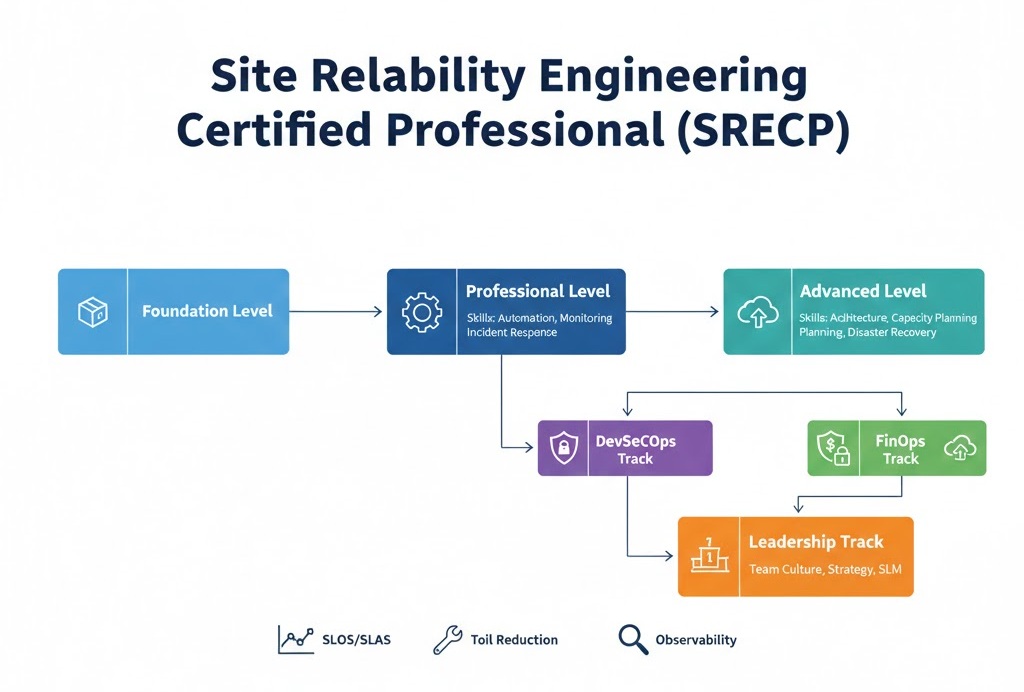
The certification structure caters to different stages of professional growth through Foundation, Professional, and Advanced levels. The Foundation level introduces core SRE terminology and the philosophy of toil reduction, making it ideal for those new to the field. The Professional level dives deep into implementation, covering specific specialization tracks like SRE for DevOps and FinOps integration. Advanced levels focus on architectural resilience and leading SRE transformations within large organizations, allowing engineers to progress from individual contributors to strategic technical leaders.
Complete Site Reliability Engineering Certified Professional (SRECP) Certification Table
| Track | Level | Who it’s for | Prerequisites | Skills Covered | Recommended Order |
| Core SRE | Foundation | Beginners/Devs | Basic Linux/Cloud | SLIs, SLOs, Error Budgets | 1st |
| Engineering | Professional | SREs/DevOps | Foundation Level | Automation, CI/CD, IaC | 2nd |
| Operations | Professional | Cloud Engineers | Foundation Level | Incident Management, On-call | 3rd |
| Strategic | Advanced | Architects/Leads | Professional Level | Capacity Planning, Resilience | 4th |
Detailed Guide for Each Site Reliability Engineering Certified Professional (SRECP) Certification
Site Reliability Engineering Certified Professional (SRECP) – Foundation
What it is
This certification validates a candidate’s grasp of the fundamental SRE principles and the cultural shift required to bridge development and operations. It ensures you understand how to measure reliability through the lens of the user.
Who should take it
Aspiring SREs, junior DevOps engineers, and software developers who want to understand how their code behaves in production environments should start here.
Skills you’ll gain
- Defining Service Level Indicators (SLIs) and Service Level Objectives (SLOs).
- Understanding and calculating error budgets.
- Identifying and eliminating operational toil.
- Basic incident response terminology.
Real-world projects you should be able to do
- Create a reliability dashboard for a microservice.
- Draft an error budget policy for a development team.
- Perform a basic post-mortem analysis after a service interruption.
Preparation plan
- 7–14 days: Review the core SRE handbook and familiarize yourself with key vocabulary.
- 30 days: Engage with online labs focusing on monitoring tools and basic automation scripts.
- 60 days: Complete a full mock project involving the setup of a small, reliable web application.
Common mistakes
- Focusing too much on specific tools rather than the underlying principles.
- Neglecting the cultural and psychological aspects of SRE, such as blameless culture.
Best next certification after this
- Same-track option: SRECP Professional Level.
- Cross-track option: DevOps Certified Professional.
- Leadership option: Certified SRE Manager.
Choose Your Learning Path
DevOps Path
Professionals on this path focus on integrating reliability into the continuous integration and delivery pipeline. You learn how to use Site Reliability Engineering Certified Professional (SRECP) principles to build guardrails that prevent unstable code from reaching production. This approach emphasizes automated testing and deployment strategies like canary releases to minimize risk. By combining DevOps agility with SRE stability, you create a seamless flow from development to high-availability operations.
DevSecOps Path
In this specialized path, you weave security practices into the reliability framework. You treat security vulnerabilities as reliability risks, applying SLOs to security patching and incident response. The Site Reliability Engineering Certified Professional (SRECP) training helps you automate security compliance checks within the SRE workflow. This ensures that the system remains not only up and running but also hardened against external threats at all times.
SRE Path
This is the core journey for those dedicated to the craft of system uptime and performance. You spend your time deep-diving into distributed systems, observability, and complex incident management. The path guides you through the technicalities of building self-healing systems that can survive hardware or regional cloud failures. It transforms you into a specialist who views every operational challenge as a software problem waiting for an automated solution.
AIOps / MLOps Path
This path applies SRE principles to the world of Artificial Intelligence and Machine Learning models. You learn how to monitor model drift and data integrity as part of your service level objectives. The Site Reliability Engineering Certified Professional (SRECP) knowledge assists in managing the heavy compute resources required for AI workloads efficiently. This ensures that machine learning pipelines remain performant and reliable under varying data loads.
DataOps Path
DataOps professionals use this path to ensure the reliability of data pipelines and warehouse architectures. You apply SRE concepts like error budgets to data quality and latency, ensuring that business intelligence stays accurate. The training helps in automating the recovery of failed data jobs and managing complex data dependencies. This leads to a more robust data infrastructure that supports real-time decision-making without constant manual intervention.
FinOps Path
This path merges reliability with cost-efficiency, ensuring that systems are performant without overspending on cloud resources. You learn to include cost as a metric within your SRE dashboards and capacity planning sessions. The Site Reliability Engineering Certified Professional (SRECP) framework provides the data-driven mindset needed to optimize resource allocation based on actual service demand. This ensures the organization achieves high reliability at the lowest possible operational expense.
Role → Recommended Site Reliability Engineering Certified Professional (SRECP) Certifications
| Role | Recommended Certifications |
| DevOps Engineer | SRECP Foundation + Professional Engineering Track |
| SRE | Full SRECP Suite (Foundation to Advanced) |
| Platform Engineer | SRECP Professional + Infrastructure Automation Specialist |
| Cloud Engineer | SRECP Foundation + Cloud Architecture Certs |
| Security Engineer | SRECP Foundation + DevSecOps Specialist |
| Data Engineer | SRECP Foundation + DataOps Professional |
| FinOps Practitioner | SRECP Foundation + Cloud Financial Management |
| Engineering Manager | SRECP Foundation + Strategic Leadership Track |
Next Certifications to Take After Site Reliability Engineering Certified Professional (SRECP)
Same Track Progression
Deepening your specialization involves moving into advanced architectural certifications that focus on multi-cloud resilience and chaos engineering. These programs challenge you to design systems that are inherently anti-fragile, meaning they improve under stress. You will focus on high-level strategy, such as defining global reliability standards for an entire enterprise. This level of expertise prepares you for roles like Principal Reliability Architect or Head of Infrastructure.
Cross-Track Expansion
Broadening your skills means looking into adjacent fields like Cyber Security or Advanced Data Analytics. Understanding the security implications of your infrastructure choices makes you a more versatile engineer. Alternatively, learning how to manage large-scale data systems allows you to apply SRE principles to the fastest-growing sector of the tech industry. This cross-pollination of skills makes you indispensable in complex, multi-disciplinary engineering environments.
Leadership & Management Track
Transitioning to leadership requires a focus on people, processes, and business alignment. Certifications in technical management or executive leadership help you translate SRE metrics into business value for stakeholders. You learn how to build and scale SRE teams, manage budgets, and drive cultural change across large organizations. This path is ideal for those who want to move from hands-on engineering to shaping the future of an engineering department.
Training & Certification Support Providers for Site Reliability Engineering Certified Professional (SRECP)
DevOpsSchool
DevOpsSchool provides an extensive array of resources for aspiring SREs, offering both live instructor-led sessions and self-paced modules. Their curriculum for the Site Reliability Engineering Certified Professional (SRECP) is deeply rooted in practical, hands-on labs that simulate real production environments. They focus on bridging the gap between theoretical knowledge and the actual technical skills required in the industry today. With a strong community of mentors, they offer continuous support to students even after the certification process is complete.
Cotocus
Cotocus specializes in high-end technical training for corporate teams and individual professionals looking to master cloud-native technologies. Their approach to the Site Reliability Engineering Certified Professional (SRECP) emphasizes enterprise-scale automation and architectural best practices. They provide customized training paths that align with specific organizational goals, ensuring that teams can implement what they learn immediately. Their trainers are industry veterans who bring a wealth of practical experience to every classroom session.
Scmgalaxy
Scmgalaxy acts as a massive knowledge hub for the DevOps and SRE community, providing a wealth of tutorials, blogs, and technical documentation. They offer specialized support for the Site Reliability Engineering Certified Professional (SRECP) by curating the best learning materials and practice exams. Their focus is on the how-to of SRE, giving engineers the specific commands and configurations needed to succeed. It is an excellent resource for those who prefer a more research-heavy and community-driven learning experience.
BestDevOps
BestDevOps focuses on delivering premium certification training with a focus on career transition and job readiness. Their Site Reliability Engineering Certified Professional (SRECP) program includes intensive interview preparation and resume building as part of the package. They pride themselves on a high success rate and a curriculum that is updated monthly to reflect the latest tool versions. This provider is ideal for professionals who want a structured, result-oriented path to their next big career move.
devsecopsschool.com
This platform focuses specifically on the intersection of security and operations within the SRE framework. They provide specialized modules for the Site Reliability Engineering Certified Professional (SRECP) that highlight vulnerability management and automated compliance. Their training ensures that reliability engineers can maintain uptime without compromising the security posture of the application. It is the go-to provider for engineers who want to specialize in building secure, resilient systems.
sreschool.com
As a dedicated institution for reliability engineering, sreschool.com offers a deep dive into the nuances of the SRE role. Their Site Reliability Engineering Certified Professional (SRECP) content is exclusively focused on observability, incident response, and performance tuning. They use advanced simulation environments to teach candidates how to handle massive traffic spikes and system outages. Their narrow focus ensures that students receive the most detailed and specialized education available in the market.
aiopsschool.com
Aiopsschool.com addresses the growing need for artificial intelligence in managing modern infrastructure. They integrate machine learning concepts into the Site Reliability Engineering Certified Professional (SRECP) curriculum, teaching students how to use AI for predictive maintenance and anomaly detection. This provider is perfect for engineers looking to stay ahead of the curve by automating SRE tasks with intelligent algorithms. Their training prepares you for the next generation of automated operations.
dataopsschool.com
Dataopsschool.com provides a unique perspective on reliability by focusing on the data lifecycle and pipeline integrity. Their support for the Site Reliability Engineering Certified Professional (SRECP) includes specific tracks for managing large-scale databases and real-time streaming platforms. They teach how to apply SRE principles to ensure data consistency and availability across distributed networks. This is an essential stop for any reliability engineer working in data-heavy organizations.
finopsschool.com
Finopsschool.com focuses on the financial accountability aspect of cloud engineering and reliability. They supplement the Site Reliability Engineering Certified Professional (SRECP) training with modules on cloud cost optimization and value engineering. Their curriculum helps engineers understand the business impact of their technical decisions, teaching them how to balance performance with profitability. This training is vital for SREs who want to play a more strategic role in their organization’s financial health.
Frequently Asked Questions (General)
- How difficult is it to obtain this certification?The difficulty is moderate to high because it requires understanding both development and operations. Candidates must prove they can apply reliability principles to real-world infrastructure challenges rather than just passing a theory test.
- What are the prerequisites for the professional level?You should ideally have a foundational understanding of Linux, cloud computing basics, and a programming language like Python. Completing the Foundation level first provides the necessary conceptual framework for success.
- How much time should I dedicate to studying?Most professionals find that 30 to 60 days of consistent study is sufficient. Dedicating 10 hours per week to labs and reading ensures you grasp the practical nuances of the curriculum.
- Is this certification recognized globally?Yes, the principles covered are based on standard industry practices used by major tech firms. The skills you gain are transferable across different regions and various cloud-native service providers.
- What is the return on investment for this program?Engineers with this certification often see significant salary increases and access to senior roles. It validates high-value skills that reduce business risk, making you a top choice for hiring managers.
- Do I need to be an expert coder to succeed?You do not need to be a software architect, but you should be comfortable with basic scripting. SRE is about using code to solve operational problems, so a functional coding level is essential.
- How does this differ from a standard DevOps certification?DevOps focuses on the speed of the delivery pipeline, while this program focuses on the stability and performance of systems in production. It picks up where traditional delivery ends.
- Are there recertification requirements?To stay current with evolving technology, it is recommended to pursue advanced levels or attend updated workshops every few years. This ensures your knowledge remains relevant to current industry standards.
- Can I take the exam online?Yes, the certification assessment is accessible globally through online proctored platforms. This allows working professionals to complete their validation from any location with a stable internet connection.
- Does the course include hands-on labs?Practical application is a core component of the learning experience. The program includes numerous labs designed to simulate production-grade issues, ensuring you gain true hands-on experience during your preparation.
- How does this help in career progression?It validates your ability to handle complex infrastructure responsibilities at scale. This credential often serves as a prerequisite for lead SRE or infrastructure architect positions in major enterprises.
- What tools will I learn to use?The curriculum covers a variety of industry-standard tools for monitoring, containerization, and configuration management. You learn how these tools specifically support reliability goals like observability and automated recovery.
FAQs on Site Reliability Engineering Certified Professional (SRECP)
- How does the program define the relationship between SRE and DevOps?The program treats SRE as a specific implementation of DevOps principles, focusing on how software engineering can optimize systems and maintain high availability.
- What role do Error Budgets play in the certification assessment?You must demonstrate how to calculate and use error budgets to make data-driven decisions regarding feature release velocity versus system stability requirements.
- Does the training include incident response strategies?Yes, the curriculum provides a structured approach to managing production incidents, including effective communication, on-call management, and conducting blameless post-mortem analyses.
- Are observability and monitoring covered in detail?The program dives deep into building comprehensive observability frameworks, ensuring you can identify the difference between basic monitoring and deep system insights.
- How does the certification address the concept of toil?You learn to identify repetitive, manual tasks and develop automation strategies to eliminate them, freeing up engineering time for high-value reliability projects.
- Is chaos engineering part of the advanced curriculum?Advanced tracks include chaos engineering principles, teaching you how to inject controlled failures into systems to verify their resilience and automated recovery capabilities.
- What is the focus on Service Level Objectives (SLOs)?The course teaches you how to define meaningful SLOs from a user’s perspective, ensuring that reliability targets align with actual business needs and customer satisfaction.
- How does the SRECP handle capacity planning?You learn to use historical data and traffic trends to predict future resource requirements, preventing performance degradation during peak load events or organic growth.
Final Thoughts: Is Site Reliability Engineering Certified Professional (SRECP) Worth It?
In an industry where downtime translates directly into lost revenue and damaged reputations, the ability to ensure system reliability is a superpower. The Site Reliability Engineering Certified Professional (SRECP) is not just a badge to add to your profile; it is a rigorous training ground that changes how you approach software and infrastructure. It shifts your perspective from keeping the lights on to engineering resilience. If you are looking to move beyond manual firefighting and into a role where you build intelligent, self-scaling systems, this certification is an excellent investment. The real-world focus ensures that what you learn can be applied immediately to any production environment.