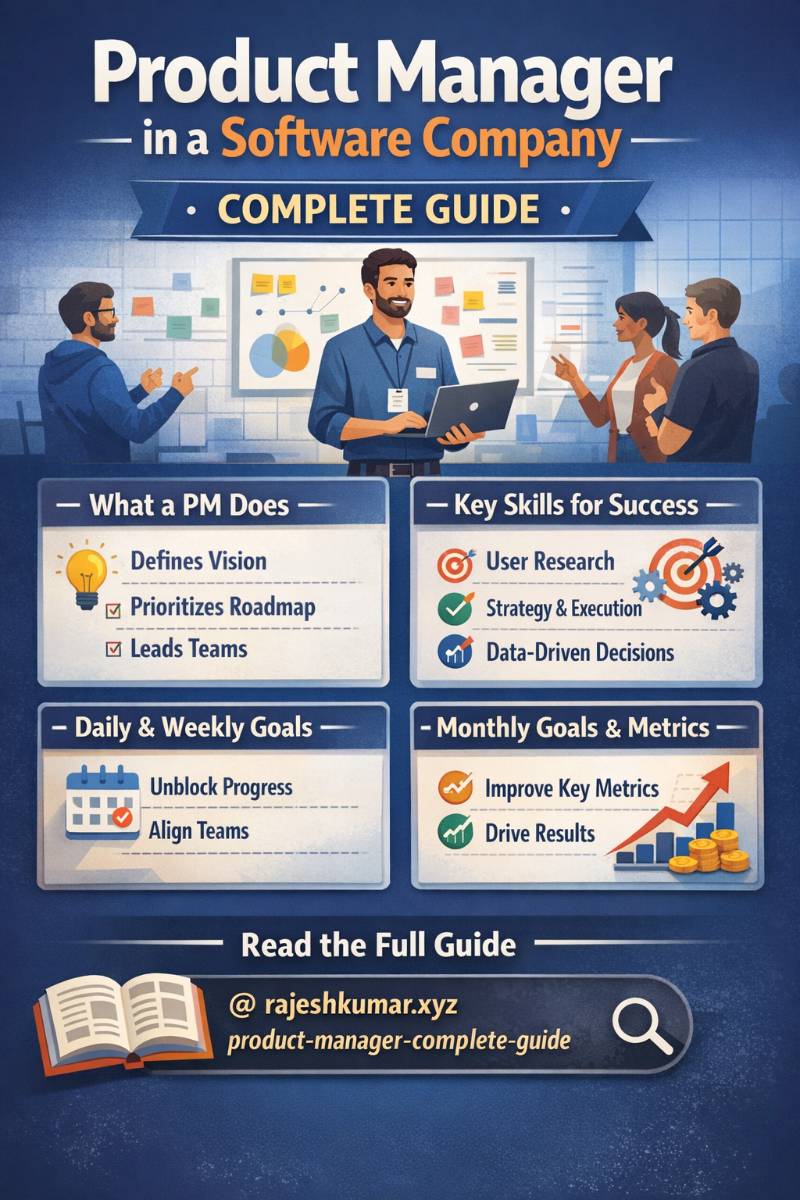
Product Manager in a Software Company: Complete Guide (Role, Skills, Daily/Weekly/Monthly Goals)
A Product Manager (PM) in a software company is the person responsible for deciding what to build, why to build it, and in what order—so the product creates real value for users and meets business goals.
A PM is not the “boss of engineers” and not just a “requirements writer.” A PM is the owner of product outcomes: adoption, retention, revenue, satisfaction, and overall impact.
Think of a PM as the connector between:
- Customers / users (needs, pain points, behaviors)
- Business (strategy, revenue, positioning, growth)
- Engineering & design (building feasible, usable solutions)
1) What is a Product Manager in a Software Company?
A Product Manager is a problem-and-priority leader.
They:
- Discover and define user problems worth solving
- Create a product strategy aligned with business goals
- Prioritize what gets built (and what doesn’t)
- Ensure teams deliver solutions that work and ship
- Measure results and iterate based on data and feedback
A PM is responsible for:
✅ Product outcomes (value delivered, metrics improved)
Not just: ❌ “shipping features” or “writing documents”
2) What is the role of a Product Manager in a Software Company?
A PM’s role can be grouped into 7 big responsibilities:
A) Understand users and the market
- Talk to customers, prospects, support teams
- Observe usage patterns, friction points, drop-offs
- Study competitors and market trends
- Build a clear understanding of “who the product is for”
B) Define product vision and strategy
- What are we building long-term?
- What problem area do we want to win?
- What differentiates us?
- What outcomes are we targeting in 3–12 months?
C) Prioritize and build the roadmap
- Identify opportunities (new features, improvements, tech debt, UX fixes)
- Rank them by impact vs effort and strategic importance
- Maintain a roadmap that is realistic and aligned
D) Turn goals into clear execution plans
- Define problem statements, success metrics, constraints
- Write clear requirements/user stories (just enough)
- Align on scope and tradeoffs with design and engineering
E) Lead cross-functional execution
- Coordinate with engineering, design, QA, marketing, sales, support
- Remove ambiguity and unblock decisions
- Keep everyone aligned on the “why” and “what success means”
F) Launch and go-to-market support
- Plan release strategy (beta, phased rollout, full launch)
- Work with marketing/sales on positioning and messaging
- Ensure documentation and support readiness
G) Measure, learn, and iterate
- Monitor metrics after launch
- Collect user feedback and issues
- Improve, fix, refine based on evidence
3) Key skill sets required to be a good Product Manager
1) User empathy + customer discovery
- Conduct interviews
- Ask the right questions
- Identify real pain vs “nice-to-have requests”
- Translate feedback into insights
2) Product thinking (problem-first mindset)
- Define problems clearly
- Avoid “solution jumping”
- Evaluate options and tradeoffs
- Focus on value and impact
3) Prioritization & decision-making
- Decide what matters most now
- Say “no” with confidence and logic
- Balance short-term wins vs long-term foundations
4) Communication & storytelling
- Explain “why this matters”
- Write clearly (PRDs, specs, release notes)
- Align stakeholders and manage expectations
5) Data literacy
You don’t need to be a data scientist, but you must:
- Understand funnels, retention, activation, conversion
- Read dashboards, define metrics
- Run basic experiments and interpret results
6) Execution & project coordination
- Break down work into milestones
- Manage scope
- Coordinate dependencies
- Deliver reliably
7) Collaboration and influence (without authority)
- Engineering doesn’t “report to PM”
- PM must influence through clarity, logic, and trust
8) Business understanding
- Pricing/packaging basics
- Revenue models (SaaS, subscription, usage-based, marketplace)
- Unit economics (CAC, LTV, churn) at a high level
9) UX sensibility
- Understand usability principles
- Work closely with design
- Ensure the product feels simple and intuitive
10) Technical fluency (not coding, but understanding)
- APIs, integrations, limitations, constraints
- Knowing what “feasible” means
- Speaking the same language as engineers
4) Daily goals for a Product Manager
Daily goals are about clarity, alignment, and progress.
Typical daily goals:
- Unblock the team: decisions, priorities, scope tradeoffs
- Maintain clarity: keep requirements and acceptance criteria clean
- Stay close to users: review feedback, support tickets, calls, recordings
- Check product health: key metrics, incidents, anomalies
- Coordinate across teams: design/engineering/QA/marketing/sales
- Keep roadmap honest: adjust based on new learnings
Example daily routine (practical)
- Review key metrics/dashboard (15 min)
- Check user feedback/support issues (15–30 min)
- Standup or team sync (15 min)
- Work on discovery or PRD/spec refinement (60–120 min)
- Stakeholder alignment meetings (30–60 min)
- Review builds, QA notes, release readiness (30 min)
- Write updates: what’s shipped, what’s blocked, next steps (15 min)
5) Weekly goals for a Product Manager
Weekly goals focus on delivery momentum + learning + alignment.
Weekly goals:
- Move 1–2 key initiatives forward meaningfully
- Validate assumptions (user research, prototype testing, experiment results)
- Keep engineering/design aligned on priorities and scope
- Review sprint outcomes (what shipped, what slipped, why)
- Update stakeholders with progress + changes + risks
- Refine backlog (clarify top stories, remove junk, reorder priorities)
- Track competitor/market signals (light but consistent)
Weekly PM checklist
- Sprint planning/backlog grooming done
- 3–5 customer insights collected (calls, feedback, analytics)
- Roadmap updated if priorities changed
- Stakeholder update shared
- Post-launch metrics reviewed for recent releases
6) Monthly goals for a Product Manager
Monthly goals focus on outcomes, strategy, and measurable improvements.
Monthly goals:
- Improve one or more key product metrics
- Activation rate, retention, conversion, churn, engagement, NPS, revenue
- Deliver a meaningful release (or iteration) that impacts users
- Run discovery continuously
- Identify top problems, validate opportunities, reduce risk
- Review roadmap vs reality
- Adjust priorities, rescope, move items based on learning
- Cross-functional alignment
- Ensure sales/support/marketing are aligned with direction and messaging
- Post-mortems and learning
- What worked? What didn’t? What do we do next month?
Monthly deliverables a strong PM usually produces
- Updated product roadmap (now/next/later)
- A metrics review (what moved, why, what didn’t)
- A short “insights report” from customer discovery
- A prioritization decision record (why we chose X over Y)
7) What makes a PM “good” vs “average”?
Average PM
- Writes requirements
- Attends meetings
- Ships features
Good PM
- Ensures the right problem is solved
- Prioritizes ruthlessly
- Ships improvements that move metrics
Great PM
- Builds a strong product vision
- Creates alignment across teams
- Delivers repeated measurable outcomes
- Turns customer understanding into strategy
- Makes the product “win” in the market
8) Common PM responsibilities by product stage
Early-stage startup
- Heavy discovery
- Fast prototyping + MVP
- Talking to users daily
- Shipping quickly and iterating
Growth-stage (scale-up)
- Funnels, onboarding, conversion optimization
- Experimentation and analytics
- Scalable processes, reliability of execution
Enterprise product
- Stakeholder management, compliance, security
- Roadmaps, integrations, complex requirements
- Sales enablement, long adoption cycles
9) A practical template set (copy-paste friendly)
A) Problem statement template
- User type: (who)
- Pain: (what is hard today)
- Impact: (why it matters, cost/time/risk)
- Current workaround: (how they solve it now)
- Success metric: (how we know it’s improved)
B) Success metrics template
- Primary metric: (e.g., activation rate)
- Guardrails: (support tickets, load time, error rate)
- Target: (increase from X% to Y% by date)
C) Prioritization quick score
Score each item 1–5:
- User impact
- Business impact
- Confidence
- Effort (reverse)
- Strategic fit
Pick the highest “impact/confidence/fit” with reasonable effort.
10) If you want to become a PM: a simple learning path
- Learn product fundamentals (user + business + execution)
- Practice writing clear problem statements and success metrics
- Learn analytics basics (funnels, retention, cohorts)
- Do mock product cases (prioritization, tradeoffs)
- Build a small product project (even a simple app idea)
- Improve communication: docs, storytelling, stakeholder updates