Introduction
Software delivery now demands extreme velocity without compromising safety, which makes the DevSecOps Certified Professional (DSOCP) an essential asset for modern engineers. This guide assists professionals in navigating the complexities of cloud-native security, platform engineering, and automated governance. Furthermore, readers will understand how to integrate security early in the lifecycle to protect their infrastructure from evolving threats. Mastering these skills at DevOpsSchool helps you make better career decisions and provides a clear path toward high-value roles in a competitive market. Therefore, this comprehensive overview serves as a roadmap for those aiming to lead security transformations within their organizations today.
What is the DevSecOps Certified Professional (DSOCP)?
The DevSecOps Certified Professional (DSOCP) represents a modern approach to digital security where safety is treated as a continuous process rather than a final checklist. It exists because traditional security models fail to keep pace with rapid deployment cycles and the scale of cloud-native environments. Furthermore, this certification emphasizes real-world, production-focused learning, moving beyond abstract concepts to focus on actual implementation. It aligns with modern engineering workflows by promoting the “Security as Code” philosophy, which allows teams to automate defense mechanisms. Consequently, organizations adopt this framework to maintain compliance and reduce risk without slowing down their development teams.
Who Should Pursue DevSecOps Certified Professional (DSOCP)?
Software engineers and site reliability engineers benefit immensely from this program because it adds a critical layer of security expertise to their operational skills. Cloud professionals and security analysts who want to transition into automated roles will find the curriculum directly applicable to their daily tasks. Additionally, engineering managers and technical leaders should pursue this path to understand the strategic impact of automated governance on their delivery pipelines. The program caters to both beginners in the field and experienced professionals looking to formalize their expertise in security automation. Its relevance remains high for professionals in India and across the global tech landscape who seek to lead technical teams.
Why DevSecOps Certified Professional (DSOCP) is Valuable
Organizations across the globe are facing increasingly sophisticated cyber threats, which makes the demand for security-conscious engineers higher than ever before. DevSecOps principles ensure that professionals stay relevant even as specific tools or platforms evolve over time. Furthermore, the industry is shifting toward “Shift Left” strategies, where security becomes the responsibility of every person involved in the software lifecycle. Consequently, this certification offers a significant return on career investment by positioning you as a versatile expert capable of solving complex architectural challenges. Enterprise adoption of these practices continues to grow, ensuring that these skills remain a long-term asset for any technical professional.
DevSecOps Certified Professional (DSOCP) Certification Overview
The program delivers high-quality instruction via official training modules and remains hosted on the DevSecOps School website. It utilizes a practical, assessment-driven approach to ensure that every candidate can implement the strategies they learn in a live environment. Moreover, the ownership and structure of the program focus on vendor-neutral principles while incorporating industry-standard tools for hands-on labs. This approach ensures that your skills remain portable across different cloud providers and organizational structures. Consequently, the certification validates your ability to manage security at scale, from the initial code commit to the final production deployment.
DevSecOps Certified Professional (DSOCP) Certification Tracks & Levels
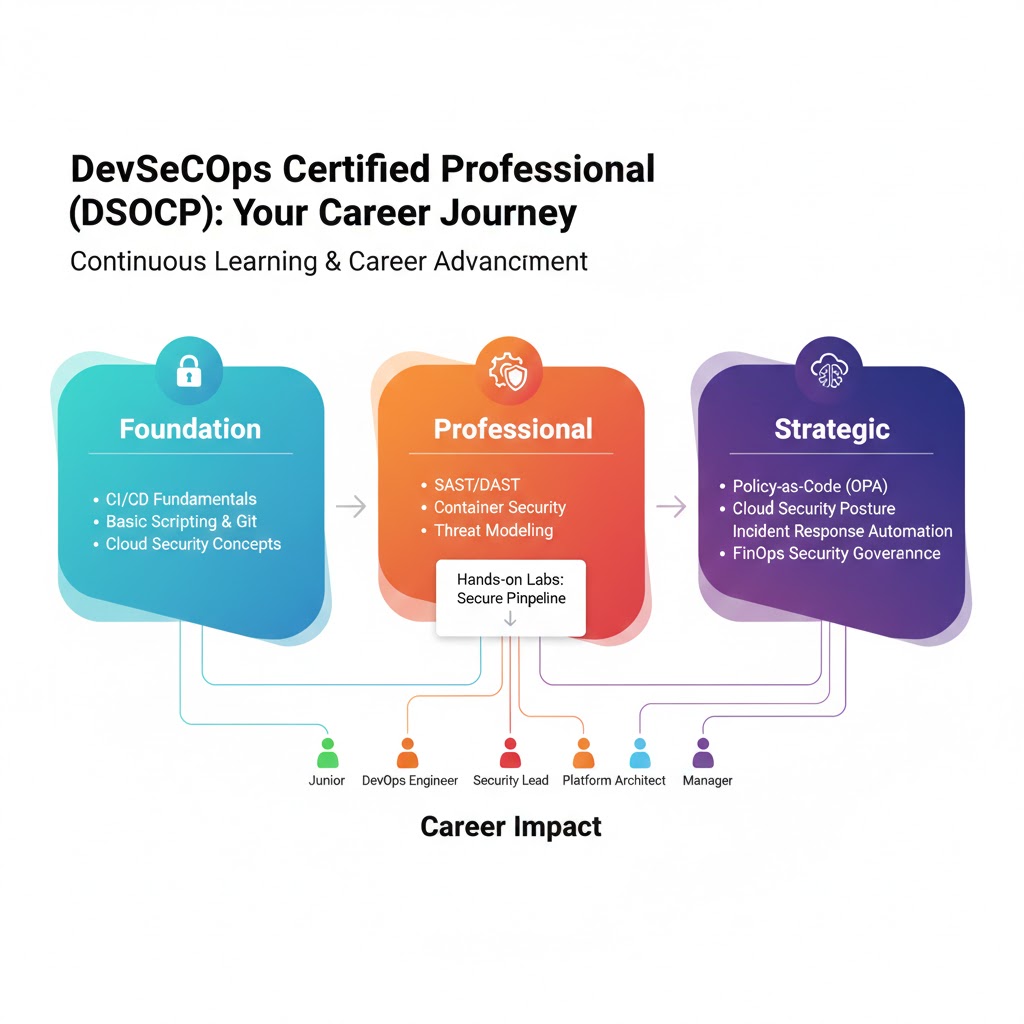
The DSOCP program offers a structured progression through foundation, professional, and advanced levels to support long-term career growth. The foundation level introduces core concepts like vulnerability scanning and automated testing within the CI/CD pipeline. Transitioning to the professional level allows you to master more complex topics such as container security, secrets management, and runtime protection. Furthermore, the advanced tracks focus on architectural governance, compliance as code, and enterprise-wide risk management. This logical alignment ensures that professionals can specialize in the areas most relevant to their specific roles and organizational needs.
Complete DevSecOps Certified Professional (DSOCP) Certification Table
| Track | Level | Who it’s for | Prerequisites | Skills Covered | Recommended Order | Official Link |
| Security | Foundation | Junior Engineers | Basic Linux/Git | SAST, DAST, SCA | 1st | DSOCP Official |
| Operations | Professional | SREs/DevOps | Foundation | Vault, Containers | 2nd | DSOCP Official |
| Architecture | Advanced | Senior Leads | Professional | Compliance as Code | 3rd | DSOCP Official |
| Governance | Expert | Managers | Advanced | Risk Management | 4th | DSOCP Official |
Detailed Guide for Each DevSecOps Certified Professional (DSOCP) Certification
DevSecOps Certified Professional (DSOCP) – Foundation
What it is
The Foundation level validates your grasp of fundamental security integration within the software development life cycle. It serves as the baseline for understanding how to automate security checks without interrupting the developer’s workflow.
Who should take it
Junior developers, QA engineers, and system administrators who are new to security automation should begin with this level. It is also suitable for those moving from manual security auditing into a more technical, automation-focused role.
Skills you’ll gain
- Integrating Static Application Security Testing (SAST) into pipelines.
- Managing third-party library risks through Software Composition Analysis.
- Understanding the DevSecOps cultural shift and shared responsibility.
- Basic vulnerability remediation and reporting.
Real-world projects you should be able to do
- Configure a GitHub Action to automatically scan code for common vulnerabilities.
- Set up a dependency scanner that blocks builds containing critical security flaws.
Preparation plan
- 7–14 days: Review the core principles of the DevSecOps Manifesto and basic pipeline concepts.
- 30 days: Practice setting up automated scanners in a local development environment.
- 60 days: Complete a full project where you integrate security into a multi-stage CI pipeline.
Common mistakes
- Focusing purely on tools while ignoring the cultural changes required for success.
- Failing to understand the difference between false positives and real security threats.
Best next certification after this
- Same-track option: DSOCP Professional.
- Cross-track option: SRE Certified Professional.
- Leadership option: Engineering Management Foundation.
DevSecOps Certified Professional (DSOCP) – Professional
What it is
The Professional level expands your expertise into infrastructure security and the protection of running applications. It focuses on the technical mastery of container environments and the secure management of sensitive data.
Who should take it
DevOps engineers and SREs who have mastered the basics of CI/CD and now need to secure complex cloud environments should take this. It is designed for those who act as the technical security anchor for their teams.
Skills you’ll gain
- Hardening Docker images and securing Kubernetes orchestration.
- Implementing enterprise secrets management with HashiCorp Vault.
- Performing Dynamic Application Security Testing (DAST) in staging.
- Setting up real-time security monitoring and automated alerting.
Real-world projects you should be able to do
- Design a system that automatically rotates database credentials every 24 hours.
- Secure a multi-node Kubernetes cluster using network policies and RBAC.
Preparation plan
- 7–14 days: Deep dive into the CIS Benchmarks for Linux and containers.
- 30 days: Master the implementation of secrets management and IAM roles.
- 60 days: Build a resilient monitoring stack that detects and alerts on security anomalies.
Common mistakes
- Over-engineering security controls so that they break legitimate application traffic.
- Neglecting the security of the build server and the automation infrastructure itself.
Best next certification after this
- Same-track option: DSOCP Advanced.
- Cross-track option: Cloud Security Architect.
- Leadership option: Technical Lead Certification.
DevSecOps Certified Professional (DSOCP) – Advanced
What it is
The Advanced level addresses large-scale governance and the creation of automated compliance frameworks. It validates your ability to design security systems that work across entire organizations and multiple cloud providers.
Who should take it
Principal engineers, security architects, and technical leads responsible for the security posture of an entire company should pursue this. It focuses on high-level strategy and technical governance.
Skills you’ll gain
- Writing enterprise-wide security policies using Policy as Code.
- Automating compliance auditing for frameworks like SOC2 or ISO 27001.
- Designing secure multi-cloud and hybrid-cloud architectures.
- Leading advanced threat modeling and risk mitigation exercises.
Real-world projects you should be able to do
- Implement a global policy that prevents the creation of public S3 buckets.
- Create an automated compliance dashboard that pulls data from multiple cloud accounts.
Preparation plan
- 7–14 days: Study global compliance standards and how they translate to technical checks.
- 30 days: Master Rego or similar languages to write automated policy enforcement rules.
- 60 days: Develop a comprehensive security framework for a simulated enterprise organization.
Common mistakes
- Implementing policies without first consulting with development and operations teams.
- Focusing on compliance checkboxes instead of building actual technical resilience.
Best next certification after this
- Same-track option: Expert Governance track.
- Cross-track option: FinOps Professional.
- Leadership option: CISO Training and Certification.
Choose Your Learning Path
DevOps Path
A DevOps professional should prioritize the automation aspect of security to maintain high deployment frequency. Start with the DSOCP Foundation to learn how to integrate security tools into your current Jenkins or GitLab pipelines. Furthermore, focus on the Professional level to master container security, which is vital for modern platform engineering. This path ensures that security becomes an automated feature of your delivery process rather than a manual delay. Consequently, you will become a more valuable engineer capable of delivering safe software at high speeds.
DevSecOps Path
The dedicated DevSecOps path is for those who want to make security automation their primary career focus. You should follow the DSOCP levels sequentially to build a deep, end-to-end understanding of the entire security lifecycle. This path requires you to understand both offensive and defensive strategies to better protect your systems. Moreover, you will learn to build self-healing infrastructures that can detect and remediate threats automatically. This specialization leads to high-demand roles in industries with strict regulatory requirements, such as finance and healthcare.
SRE Path
Site Reliability Engineers must view security through the lens of system availability and operational health. Since security incidents often cause major outages, your goal is to build resilient systems that withstand attacks. Focus heavily on the DSOCP Professional level to master monitoring, alerting, and secrets management in production. Furthermore, use the Advanced concepts to implement automated recovery procedures for security-related failures. This path makes you a comprehensive reliability expert who can handle both operational bugs and malicious threats with equal proficiency.
AIOps / MLOps Path
As artificial intelligence becomes central to business, securing the data and models that drive it becomes paramount. Professionals in this path should use DSOCP to learn how to secure the infrastructure hosting ML workloads. Focus on securing data pipelines, protecting model integrity, and ensuring that training environments remain isolated. Consequently, you will build a “Secure ML” lifecycle that protects intellectual property and user privacy. This path bridges the gap between traditional infrastructure security and the emerging world of data-driven automation.
DataOps Path
DataOps professionals focus on the secure and rapid movement of data across the enterprise, making the DSOCP Foundation essential. Use these principles to implement automated data masking, encryption, and access controls within your pipelines. Furthermore, the Advanced modules help you automate the compliance audits required for sensitive data handling. This ensures that your organization meets global data protection standards like GDPR without manual effort. Consequently, you become the primary advocate for data security and integrity within your engineering team.
FinOps Path
FinOps professionals benefit from DSOCP by understanding the financial impact of security risks and misconfigurations. Unsecured cloud resources often lead to unexpected costs through unauthorized usage or security breaches. By learning the Foundation and Professional levels, you can identify expensive security gaps that also hurt the bottom line. Furthermore, you will learn to advocate for security tools that offer the best return on investment and operational efficiency. This path allows you to manage the cloud budget and the security posture simultaneously.
Role → Recommended DevSecOps Certified Professional (DSOCP) Certifications
| Role | Recommended Certifications |
| DevOps Engineer | DSOCP Foundation, DSOCP Professional |
| SRE | DSOCP Professional, DSOCP Advanced |
| Platform Engineer | DSOCP Professional, DSOCP Advanced |
| Cloud Engineer | DSOCP Foundation, DSOCP Professional |
| Security Engineer | DSOCP Professional, DSOCP Advanced |
| Data Engineer | DSOCP Foundation, Data Security Track |
| FinOps Practitioner | DSOCP Foundation, FinOps Certified |
| Engineering Manager | DSOCP Foundation, Governance Track |
Next Certifications to Take After DevSecOps Certified Professional (DSOCP)
Same Track Progression
After completing the DSOCP Advanced level, you should seek deep specialization in specific cloud environments or security domains. This might include earning platform-specific security certifications from AWS, Azure, or Google Cloud to round out your technical profile. Furthermore, exploring advanced penetration testing or digital forensics can help you understand the mindset of an attacker. Deep specialization allows you to tackle the most complex security challenges at an enterprise scale. Consequently, you position yourself for roles like Principal Security Architect or Distinguished Engineer.
Cross-Track Expansion
Broadening your skills into related fields like SRE or FinOps creates a much more versatile and valuable professional profile. Understanding how security impacts system reliability or cloud costs allows you to provide holistic advice to your organization. Moreover, certifications in Kubernetes administration or cloud architecture can provide a stronger technical foundation for your security work. This cross-pollination of skills is especially useful in startup environments where engineers need to handle multiple domains. Therefore, expanding your knowledge base ensures you remain a competitive candidate for high-level technical roles.
Leadership & Management Track
For those aiming to move into strategic roles, the leadership track is the natural progression after mastering the technical aspects of DSOCP. This involves moving from managing tools and pipelines to managing teams, budgets, and corporate risk. Certifications in engineering management or executive leadership will help you transition into roles like Engineering Director or CISO. You will use your technical background to make informed decisions that protect the company’s long-term interests. Consequently, this path focuses on communication, strategy, and building a strong security culture across the entire organization.
Training & Certification Support Providers for DevSecOps Certified Professional (DSOCP)
DevOpsSchool stands as a premier institution for technical training, specifically focusing on the integration of security and operations. They provide an immersive learning environment that combines theoretical depth with rigorous practical application through cloud-based labs. Furthermore, their instructors bring decades of industry experience, ensuring that students understand the nuances of production-grade security. Consequently, candidates gain the confidence to implement complex DevSecOps pipelines in real-world enterprise settings. Additionally, the school offers continuous support through community forums and alumni networks, fostering a culture of lifelong learning.
Cotocus provides specialized consulting and training services that focus on deep technical mastery of DevSecOps and cloud-native technologies. Their approach is highly practical, emphasizing the use of real-world scenarios and hands-on exercises to reinforce learning. Moreover, they tailor their programs to meet the specific needs of modern engineering teams, ensuring that the skills learned are immediately applicable. Consequently, professionals who train with Cotocus often find themselves better prepared for the challenges of managing large-scale, secure production environments. They offer an intensive learning experience that prioritizes technical depth and operational excellence.
Scmgalaxy is a long-standing community and training platform that provides a wealth of resources for those pursuing the DSOCP certification. They offer a massive library of tutorials, webinars, and technical articles that supplement their formal certification training. Furthermore, their focus on the history and evolution of software configuration management provides a unique perspective on modern security automation. Scmgalaxy fosters a strong community where professionals can share knowledge, solve problems together, and stay updated on the latest industry trends. Consequently, their students gain a well-rounded understanding of the entire software delivery lifecycle.
BestDevOps specializes in delivering high-impact training sessions that are tailored to the needs of modern cloud-native engineers. Their DSOCP preparation programs are designed to be flexible, accommodating the busy schedules of working professionals. They emphasize the use of open-source tools, ensuring that students can apply their knowledge without being locked into expensive proprietary software. Furthermore, BestDevOps focuses on building a strong foundation of core principles before moving into advanced automation and governance. Consequently, they produce engineers who are capable of leading security initiatives in any technical environment.
devsecopsschool.com acts as a dedicated hub for professionals who want to master the intersection of development, security, and operations. They provide a centralized platform for learning paths, tool comparisons, and industry news specifically focused on the DevSecOps movement. Furthermore, their training programs are highly structured, taking students through a logical progression from beginner concepts to expert-level automation. The platform also offers various free resources to help engineers start their journey toward becoming a certified professional. Consequently, it has become a vital resource for anyone looking to stay at the forefront of the security-as-code revolution.
sreschool.com provides targeted training for site reliability engineers who need to incorporate security into their daily operational workflows. They teach students how to build resilient systems that can withstand both operational failures and malicious security threats. Furthermore, their curriculum emphasizes the importance of monitoring, alerting, and automated recovery in maintaining a secure production environment. Consequently, SREs who train here gain a unique perspective on security that is often missed in traditional training programs. They bridge the gap between reliability and security, ensuring that uptime and safety are treated as equally important goals.
aiopsschool.com focuses on the future of operations and security by incorporating artificial intelligence into the DevSecOps lifecycle. They offer advanced training on how machine learning can be used to detect threats, automate responses, and optimize security configurations. Furthermore, their programs help engineers understand the unique security challenges posed by AI and ML workloads in production. Consequently, they prepare professionals for the next generation of technical roles where AI and security become inextricably linked. Their cutting-edge curriculum ensures that students stay ahead of the curve in a rapidly evolving technological landscape.
dataopsschool.com addresses the critical need for security within the high-speed world of data engineering and analytics. They provide comprehensive training on how to apply DevSecOps principles to secure data pipelines and protect sensitive information. Furthermore, their programs focus on the automated implementation of data masking, encryption, and access controls at scale. Consequently, data professionals who train here can ensure their organizations remain compliant with global data protection laws while still delivering fast insights. They bridge the gap between data engineering and corporate security standards, making them a vital partner for modern data teams.
finopsschool.com offers a unique perspective on how security decisions impact the financial health and cloud budget of an organization. They teach students how to identify misconfigured resources that pose both a security risk and a financial waste to the company. Furthermore, their training helps professionals build a business case for security investments by showing the long-term cost savings of automated prevention. Consequently, you learn to manage the cloud infrastructure with a focus on both safety and financial efficiency. This dual expertise is highly valued by leadership teams who need to balance technical excellence with fiscal responsibility.
Frequently Asked Questions (General)
- What is the overall difficulty level of the DSOCP certification track?
The difficulty is moderate to high because it requires a combination of development, operations, and security skills. It focuses on practical application rather than simple rote memorization.
- How much time should I dedicate to complete the entire program?
Most professionals spend between three to six months to move from foundation to advanced levels. This includes time for theoretical study and hands-on lab work.
- Are there any mandatory prerequisites before starting the Foundation level?
There are no strict formal requirements, but knowing basic Linux commands and Git is highly recommended. Having a basic understanding of any programming language will also help.
- What is the expected return on investment for this certification?
The ROI is substantial as DevSecOps specialists often command higher salaries and have access to more senior roles. It provides long-term job security in a high-demand field.
- Is the DSOCP certification recognized by international employers?
Yes, the curriculum covers industry-standard tools and principles used by global enterprises. This makes the skills you gain highly portable across different regions and markets.
- Do I need a background in cybersecurity to succeed in this course?
No, the program is designed to teach security from the perspective of an engineer or developer. You only need a basic technical background and a willingness to learn automation.
- What specific tools will I master during the training?
You will work with a wide range of tools including SonarQube, Snyk, Jenkins, Docker, Kubernetes, and HashiCorp Vault. These are the current standards for automated security.
- How are the certification exams structured and delivered?
The exams usually consist of a combination of technical questions and practical tasks in a lab environment. You must demonstrate that you can actually solve security problems.
- Can I take the Advanced level exam before the Foundation level?
While possible, it is not recommended because the Advanced level assumes you already understand the core concepts taught in the previous tracks.
- Does the certification expire after a certain period of time?
Like most technical certifications, it usually requires renewal or continuing education every two to three years. This ensures that your skills stay current with new threats.
- How does DSOCP compare to other security certifications like CISSP?
CISSP is focused on high-level security management and theory, while DSOCP is a technical, hands-on certification for engineers working in automated environments.
- Are there any community resources available for students during their study?
Yes, various providers offer access to forums, webinars, and alumni groups where you can ask questions and share knowledge with other professionals.
FAQs on DevSecOps Certified Professional (DSOCP)
- Why is “Shift Left” such a core part of the DSOCP curriculum?
Shifting left means catching security issues early in the development cycle, which is much cheaper and faster than fixing them after the software is deployed.
- How does the DSOCP program handle compliance automation?
It teaches you how to turn regulatory requirements into automated tests that run every time a change is made to the infrastructure or code.
- Can this certification help me move into a Lead or Architect role?
Yes, the Advanced level specifically focuses on the architectural design and technical governance needed for senior leadership and principal engineering positions.
- What is the role of containers in the DSOCP Professional level?
The course teaches you how to secure the entire container lifecycle, from building small, hardened images to managing secrets in a running Kubernetes cluster.
- How does DSOCP address the “Security as Code” philosophy?
It teaches you to treat security policies and configurations just like application code, meaning they are versioned, tested, and deployed automatically.
- Is there a focus on specific cloud providers like AWS or Azure?
The program is vendor-neutral, but it shows you how to apply these security principles using the native tools and APIs of major cloud platforms.
- How does the course prepare you for real-world security incidents?
The labs include scenarios where you must detect and respond to simulated attacks, teaching you how to use monitoring and alerting tools effectively.
- Why is secrets management a major topic in the Professional track?
Hardcoded credentials are a leading cause of security breaches, so mastering tools like Vault is essential for protecting access to sensitive data and systems.
Final Thoughts: Is DevSecOps Certified Professional (DSOCP) Worth It?
When you consider the direction of the global technology market, security has transitioned from an afterthought to a core requirement for every business. Pursuing the DevSecOps Certified Professional (DSOCP) is a strategic investment that transforms you into a highly sought-after expert capable of bridging the gap between velocity and safety. This journey requires dedication and a passion for continuous technical improvement, but the career opportunities it unlocks are among the best in the industry. You will no longer just be an engineer; you will be a guardian of digital infrastructure, ensuring that your organization can innovate without fear. My advice as a mentor is to embrace the challenge, master the tools, and lead the way in building a more secure digital future for everyone.