Introduction
Securing cloud infrastructure is no longer a peripheral task but a core requirement for every modern engineering team. The AWS Certified Security – Specialty designation validates an engineer’s ability to design and implement complex security controls within the Amazon Web Services ecosystem. This guide is specifically designed for professionals navigating the intersection of cloud architecture and risk management, providing a clear roadmap for career advancement. By mastering these competencies, you can effectively transition into high-demand roles within the DevOpsSchool framework. Furthermore, this comprehensive analysis helps technical leaders and individual contributors determine the most efficient path toward achieving enterprise-grade security expertise.
What is the AWS Certified Security – Specialty?
The AWS Certified Security – Specialty represents a high-level validation of technical expertise in securing the AWS platform. It exists to bridge the gap between general cloud knowledge and the specialized skills required to defend production environments against sophisticated threats. Instead of focusing on theoretical concepts, the curriculum emphasizes real-world application, such as automated incident response and fine-grained identity management. It aligns perfectly with modern engineering workflows by treating security as code, ensuring that protection is integrated directly into the continuous integration and delivery pipelines used by global enterprises.
Who Should Pursue AWS Certified Security – Specialty?
This certification is highly beneficial for Cloud Security Engineers, DevSecOps professionals, and Senior Systems Administrators who manage sensitive data. SREs and Platform Engineers also find immense value here, as it provides the tools necessary to build resilient and compliant infrastructure. While it is accessible to motivated mid-level engineers, it is primarily targeted at those with at least two years of hands-on experience in AWS environments. In both the Indian tech hub and the global market, managers often look for this credential when hiring for leadership roles that require a deep understanding of governance and data protection.
Why AWS Certified Security – Specialty is Valuable and Beyond
As enterprise adoption of cloud-native technologies continues to accelerate, the demand for specialized security talent remains at an all-time high. This certification offers long-term career longevity because the fundamental principles of encryption, identity, and logging remain constant even as specific tools evolve. It provides a significant return on time investment by making a professional indispensable during audits and high-stakes infrastructure migrations. By earning this, you demonstrate a commitment to protecting organizational assets, which is a top priority for C-level executives across all industries.
AWS Certified Security – Specialty Certification Overview
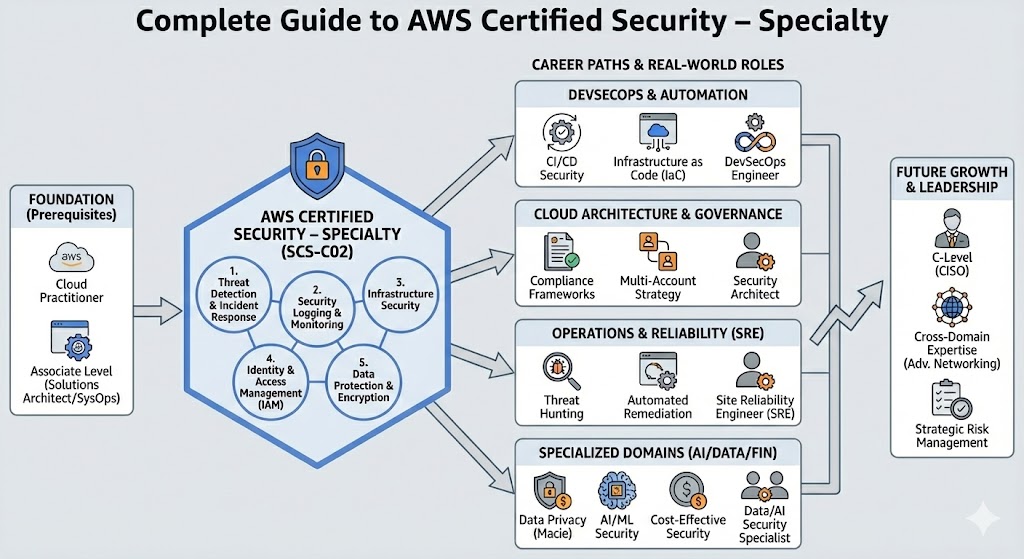
The program is delivered via the official training portal and hosted on DevOpsSchool, offering a structured approach to mastering the SCS-C02 exam domains. The assessment approach focuses on scenario-based questions that require candidates to troubleshoot broken policies and recommend architectural improvements. It covers five primary domains: Threat Detection and Incident Response, Security Logging and Monitoring, Infrastructure Security, Identity and Access Management, and Data Protection. Ownership of this certification proves that a professional can handle the shared responsibility model with absolute precision.
AWS Certified Security – Specialty Certification Tracks & Levels
The AWS ecosystem follows a logical progression starting from Foundational and Associate levels before moving into Professional and Specialty tracks. This specific certification sits at the Specialty level, meaning it requires a deep dive into one specific domain rather than a broad overview of all services. Specialization tracks like DevSecOps or Cloud Security Architect often use this as a capstone to validate expert-level skills. As you progress from an Associate-level Architect to a Security Specialist, your career path typically shifts toward higher-impact roles with increased technical oversight.
Complete AWS Certified Security – Specialty Certification Table
| Track | Level | Who it’s for | Prerequisites | Skills Covered | Recommended Order |
| Cloud Security | Specialty | Security Engineers | AWS Associate Level | Encryption, IAM, Logging | After Solutions Architect |
| Infrastructure | Professional | DevOps Engineers | 2+ Years Experience | Automation, Scaling, Security | After SysOps Associate |
| Core Cloud | Associate | Beginners | Basic Cloud Knowledge | Core Services, Security Basics | First Step |
Detailed Guide for Each AWS Certified Security – Specialty Certification
AWS Certified Security – Specialty
What it is
This certification validates a candidate’s ability to secure production workloads on AWS. It confirms expertise in using specialized security services and implementing industry-standard compliance frameworks.
Who should take it
It is ideal for security architects, compliance auditors, and senior DevOps engineers. Candidates should have a strong grasp of networking, encryption, and identity management before attempting the exam.
Skills you’ll gain
- Implementation of advanced Identity and Access Management (IAM) policies.
- Deployment of automated remediation using AWS Lambda and Config.
- Management of encryption keys using KMS and CloudHSM.
- Configuration of network security layers like WAF, Shield, and Security Groups.
Real-world projects you should be able to do
- Designing a multi-region logging and monitoring solution using CloudTrail and GuardDuty.
- Implementing a zero-trust architecture for internal microservices.
- Automating the rotation of secrets and database credentials across an enterprise.
Preparation plan
- 7–14 days: Review the official exam guide and focus on your weakest domains through intensive documentation reading.
- 30 days: Complete a full video course and start practicing with hands-on labs to understand service integrations.
- 60 days: Take multiple full-length practice exams, analyze every wrong answer, and build a capstone security project.
Common mistakes
- Overlooking the nuances of cross-account IAM roles and permissions.
- Failing to understand the specific differences between various encryption methods.
- Neglecting the operational aspects of incident response and automated alerting.
Best next certification after this
- Same-track option: AWS Certified Solutions Architect – Professional
- Cross-track option: AWS Certified DevOps Engineer – Professional
- Leadership option: Certified Information Systems Security Professional (CISSP)
Choose Your Learning Path
DevOps Path
The DevOps path focuses on integrating security directly into the automated deployment pipeline. Engineers learn to use tools like AWS CodePipeline along with security scanning services to ensure that vulnerabilities are caught before they reach production. This path emphasizes “shifting left,” where security becomes a shared responsibility early in the lifecycle. It is perfect for those who want to build fast, reliable, and secure delivery systems.
DevSecOps Path
This path is a specialized evolution of DevOps that places security at the center of every operational decision. You will focus heavily on automated policy enforcement and continuous compliance monitoring using AWS Config and Service Control Policies. It involves creating custom automated responses to security events, ensuring the environment is self-healing. Professionals here act as the bridge between traditional security teams and rapid development squads.
SRE Path
Site Reliability Engineers use this certification to ensure that security measures do not compromise system performance or availability. The focus is on building secure, scalable systems that can withstand both traffic spikes and malicious attacks. You will learn to manage fine-grained access without creating bottlenecks in operational workflows. This path is essential for maintaining the “reliability” pillar of the Well-Architected Framework.
AIOps / MLOps Path
As machine learning models become critical assets, securing the data pipelines becomes a top priority. This path focuses on protecting S3 buckets, managing access to SageMaker, and ensuring that training data remains encrypted at rest and in transit. You will learn how to apply security specialty knowledge to the unique challenges of large-scale data processing. It ensures that AI-driven insights are not compromised by unauthorized access.
DataOps Path
DataOps professionals focus on the secure flow of data from ingestion to analytics. Mastering this specialty allows you to implement robust data masking, tokenization, and fine-grained access control across Redshift and Athena. You will ensure that data privacy regulations like GDPR or CCPA are met through technical controls on AWS. This path is vital for organizations that handle massive amounts of sensitive customer information.
FinOps Path
FinOps practitioners use security knowledge to ensure that cost-management tools and billing data are strictly protected. Since financial data is a high-value target, implementing MFA and restrictive IAM policies for billing consoles is a core requirement. This path also covers the secure use of third-party cost optimization tools through secure API integrations. It helps maintain the financial integrity of the cloud environment while optimizing spend.
Role → Recommended AWS Certified Security – Specialty Certifications
| Role | Recommended Certifications |
| DevOps Engineer | Security Specialty + DevOps Professional |
| SRE | Security Specialty + Solutions Architect Pro |
| Platform Engineer | Security Specialty + Advanced Networking |
| Cloud Engineer | Security Specialty + SysOps Associate |
| Security Engineer | Security Specialty + Database Specialty |
| Data Engineer | Security Specialty + Data Engineer Associate |
| FinOps Practitioner | Security Specialty + Cloud Practitioner |
| Engineering Manager | Security Specialty + Solutions Architect Assoc |
Next Certifications to Take After AWS Certified Security – Specialty
Same Track Progression
After achieving the Security Specialty, the most logical step is to move toward the AWS Certified Solutions Architect – Professional. This allows you to apply your security knowledge to much larger, complex architectural patterns. You will gain a holistic view of how security interacts with high availability and disaster recovery. Deepening your expertise in this track makes you a primary candidate for Lead Security Architect positions.
Cross-Track Expansion
If you want to broaden your skill set, consider moving into the Advanced Networking Specialty or the Data Engineer Associate track. Security is heavily dependent on how data moves through a network, so understanding VPC peering and Direct Connect is incredibly valuable. Alternatively, moving into data tracks allows you to specialize in the protection of big data environments. This cross-pollination of skills makes you a versatile asset in any technical organization.
Leadership & Management Track
For those looking to move into management, transitioning toward certifications like the CISM or CISSP is a wise move. These certifications focus more on the “why” and “how” of security governance rather than the “what” of technical implementation. They complement your AWS technical skills with the business logic required to lead security departments. This path is perfect for aspiring CISOs or IT Directors who need to speak both “tech” and “business.”
Training & Certification Support Providers for AWS Certified Security – Specialty
DevOpsSchool
DevOpsSchool provides an extensive array of resources specifically tailored for the AWS Security Specialty exam. Their approach combines high-quality video tutorials with hands-on lab environments that simulate real-world security breaches. They focus on the practical application of IAM and encryption, ensuring students don’t just pass the test but actually gain usable skills. Their instructors are industry veterans who bring years of production experience into the classroom setting.
Cotocus
Cotocus is known for its boutique training style, offering personalized mentorship for engineers seeking to master cloud security. Their curriculum for the AWS Security track is updated frequently to reflect the latest changes in the exam domains. They emphasize a deep understanding of infrastructure security and threat detection, providing students with custom-built scenarios to solve. This focus helps candidates build the confidence needed to handle complex security incidents in a live enterprise environment.
Scmgalaxy
Scmgalaxy serves as a community-driven hub for DevOps and security professionals looking for reliable study materials. They offer a wealth of blog posts, practice questions, and implementation guides that cover the breadth of the AWS Security Specialty requirements. Their content is particularly useful for those who prefer a self-paced learning style supported by a global network of peers. By leveraging their extensive repository, candidates can stay updated on the latest security best practices.
BestDevOps
BestDevOps focuses on delivering high-impact training sessions that prioritize the most critical aspects of the security exam. Their courses are designed to be concise yet comprehensive, stripping away the fluff to focus on core competencies like Data Protection and Logging. They provide excellent practice exams that mirror the actual difficulty level of the AWS Specialty certifications. This ensures that professionals can efficiently manage their study time while still achieving a deep mastery.
devsecopsschool.com
This platform is dedicated entirely to the integration of security within the DevOps lifecycle, making it a perfect companion for the AWS Security Specialty. Their training modules go beyond the exam guide to show how AWS security services fit into a larger DevSecOps pipeline. They offer specialized workshops on automated compliance and vulnerability management. For engineers who want to specialize specifically in the intersection of security and automation, this school provides focused curriculum.
sreschool.com
Sreschool approaches AWS security through the lens of reliability and system health. Their training emphasizes how security configurations impact the overall stability and performance of cloud-based applications. They teach students how to build secure systems that are also resilient to failure and easy to monitor. This perspective is invaluable for SREs who need to balance strict security requirements with the need for high uptime during critical operational windows.
aiopsschool.com
Aiopsschool provides a unique perspective on security by incorporating artificial intelligence and machine learning into the monitoring process. Their training for the AWS Security Specialty includes how to use AI-driven services like Amazon GuardDuty and Macie for intelligent threat detection. They teach students how to automate the analysis of security logs using advanced analytics. This is a forward-thinking path for professionals who want to be at the cutting edge.
dataopsschool.com
Dataopsschool focuses on the critical task of securing the modern data estate on AWS. Their curriculum highlights the specific challenges of protecting data lakes, warehouses, and real-time processing streams. They provide deep dives into S3 security, Redshift encryption, and Lake Formation permissions. This training is essential for anyone responsible for data privacy and security in a data-heavy organization handling massive amounts of sensitive customer information.
finopsschool.com
Finopsschool addresses the often-overlooked connection between cloud security and financial management. Their training explains how to secure the financial data and billing consoles within an AWS environment to prevent unauthorized spend or data leaks. They focus on the IAM policies required for cost management tools and the security of financial reporting pipelines. This provides a holistic view of cloud governance, ensuring that security professionals can contribute to financial integrity.
Frequently Asked Questions (General)
- How difficult is the AWS Certified Security – Specialty exam?The exam is considered one of the more challenging AWS certifications because it requires a very deep understanding of service interactions and complex policy logic.
- What are the prerequisites for this certification?There are no formal prerequisites required by AWS, but it is highly recommended to have an Associate-level certification and at least two years of hands-on experience.
- How long does it take to prepare for the exam?Most professionals spend between 30 and 60 days preparing, depending on their existing experience with AWS security services.
- Is this certification worth it for a DevOps engineer?Absolutely. Security is a primary pillar of DevOps, and this certification proves you can build automated pipelines that are both fast and secure.
- Does the certification expire?Yes, AWS certifications are valid for three years. To remain certified, you must either retake the current exam or pass a higher-level Professional exam.
- What is the passing score for the exam?The passing score is 750 out of 1000. The exam uses a scaled scoring model, meaning some questions may carry more weight than others.
- Can I take the exam online?Yes, AWS offers the option to take the exam via online proctoring or at a physical testing center, providing flexibility for candidates globally.
- What is the cost of the exam?The standard price for a Specialty-level exam is 300 USD. However, if you have passed a previous AWS exam, you likely have a discount voucher.
- How does this compare to the Azure Security Engineer certification?While both cover similar concepts like IAM and encryption, the AWS version is deeply rooted in the specific architecture and service ecosystem of Amazon.
- Does this certification help in getting a job in India?Yes, India has a massive demand for cloud security professionals, and major tech firms prioritize candidates with AWS Specialty certifications for their projects.
- Should I take the Solutions Architect – Professional first?It depends on your goals. If you want to be a broad architect, take the Professional first. If you want to specialize, this Specialty is better.
- Are practice exams useful for this certification?Practice exams are essential. They help you get used to the long, scenario-based questions and identify areas where your understanding of specific service limits is lacking.
FAQs on AWS Certified Security – Specialty
- Which AWS security service is most emphasized on the exam?Identity and Access Management is the most critical service. You must understand roles, policies, and cross-account access in extreme detail to pass successfully.
- Do I need to know how to code for this exam?While you do not need to be a developer, you must be able to read and write JSON policies and understand how Lambda functions work.
- How much networking knowledge is required?A strong understanding of VPCs, Security Groups, NACLs, and PrivateLink is mandatory, as network isolation is a core part of the security domain.
- Is encryption a major part of the curriculum?Yes, you must understand KMS, including the difference between AWS managed and customer managed keys, as well as how to handle key rotation securely.
- How does the exam cover incident response?It focuses on the automated detection of threats using GuardDuty and the subsequent logging of those events in CloudTrail for detailed forensic analysis.
- What role does AWS Config play in the exam?AWS Config is featured heavily for its ability to monitor compliance and trigger automated remediation when resources drift from a secure and desired state.
- Are third-party security tools covered?The exam focuses almost exclusively on AWS native tools, although you should understand where a third-party tool might integrate with services like WAF or Inspector.
- How relevant is the exam to the SCS-C02 version?The SCS-C02 is the current version and includes updated content on more recent security services and advanced automated response strategies used in modern enterprises today.
Final Thoughts: Is AWS Certified Security – Specialty Worth It?
Although obtaining the AWS Certified Security – Specialty requires a substantial investment, the professional benefits are indisputable. In a time when data breaches can cost businesses millions of dollars, the most important person in the room is the one who knows how to stop them. This certification requires you to learn the finer points of cloud defense that many generalists miss, so it’s more than simply a badge. This is one of the most prestigious certifications you can obtain if you want to bolster your standing as a senior technical lead or security architect. It gives businesses a clear indication that you have the technical expertise and strict discipline needed to safeguard their most valuable assets.