Introduction
The modern IT landscape demands a shift from reactive monitoring to proactive, intelligent operations. This guide explores the AiOps Certified Professional (AIOCP) program, a comprehensive credential designed for engineers navigating the intersection of artificial intelligence and systems reliability. As enterprises scale their cloud-native environments, traditional manual intervention becomes a bottleneck, making AI-driven insights a necessity rather than a luxury. By following this roadmap, DevOpsSchool helps professionals understand how to integrate machine learning into their operational workflows to reduce noise and accelerate incident resolution. Whether you are an SRE looking to automate root cause analysis or a manager aiming to optimize infrastructure costs, this guide provides the clarity needed to make informed career decisions in the evolving world of platform engineering.
What is the AiOps Certified Professional (AIOCP)?
The AiOps Certified Professional (AIOCP) represents a specialized standard for engineers who want to master the application of AI and machine learning in IT operations. It exists to bridge the gap between pure data science and practical system administration, focusing on production-grade implementation rather than just theoretical modeling. This certification validates an individual’s ability to handle massive datasets generated by modern distributed systems and turn them into actionable intelligence. It aligns perfectly with modern engineering workflows by promoting “observability as code” and automated remediation strategies that are essential in high-velocity enterprise environments.
Who Should Pursue AiOps Certified Professional (AIOCP)?
This certification primarily targets DevOps engineers, Site Reliability Engineers (SREs), and Cloud Architects who are responsible for maintaining uptime in complex environments. Security professionals and Data Engineers also benefit significantly, as the principles of anomaly detection and pattern recognition are universal across these domains. Beginners with a strong foundation in Linux and scripting can use AIOCP to leapfrog into high-demand roles, while experienced leads find it essential for driving digital transformation. In both the Indian and global markets, there is a massive surge in demand for talent that can reduce the “mean time to repair” using intelligent automation.
Why AiOps Certified Professional (AIOCP) is Valuable in 2026 and Beyond
As infrastructure grows more ephemeral and complex, the sheer volume of telemetry data surpasses human processing capabilities. The AiOps Certified Professional (AIOCP) is valuable because it focuses on long-term architectural principles rather than fleeting software tools, ensuring professionals stay relevant despite shifts in the vendor landscape. Enterprises are aggressively adopting AI to manage their hybrid-cloud footprints, creating a durable demand for certified experts who can prove ROI through increased system stability. Investing time in this certification offers a high return by positioning you as a forward-thinking leader capable of managing self-healing infrastructures.
AiOps Certified Professional (AIOCP) Certification Overview
The program is delivered via the official curriculum and hosted on the specialized platform. It utilizes a multi-tiered assessment approach that combines theoretical knowledge with rigorous practical labs to ensure candidates can perform in real-world scenarios. The certification structure is designed to be progressive, allowing learners to start with core concepts before moving into advanced algorithmic applications. Ownership of the curriculum is maintained by industry practitioners who update the content regularly to reflect the latest trends in natural language processing for logs and predictive analytics for capacity planning.
AiOps Certified Professional (AIOCP) Certification Tracks & Levels
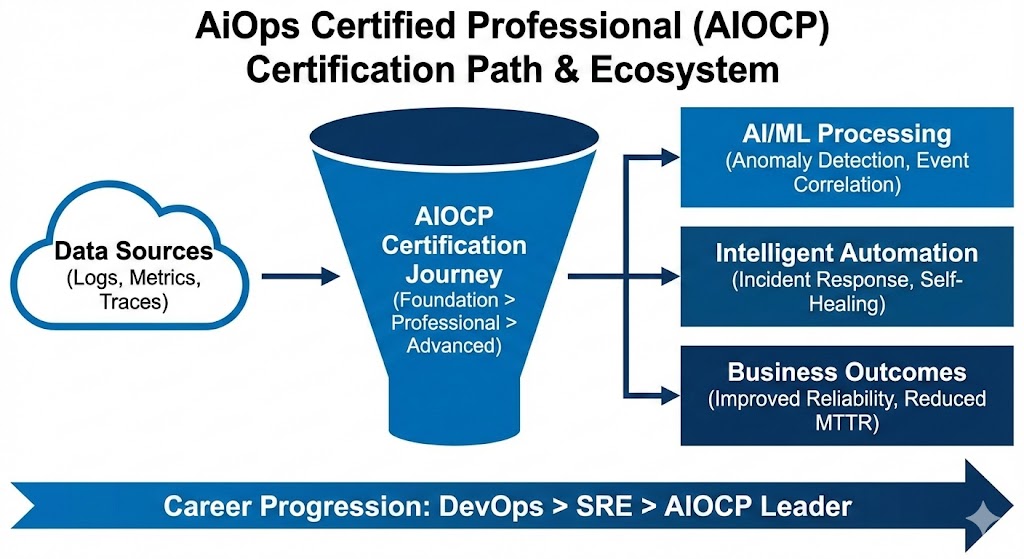
The certification is divided into three distinct levels: Foundation, Professional, and Advanced. The Foundation level introduces the core concepts of data ingestion and basic statistical analysis for operations. The Professional level dives deep into machine learning model deployment and integration with existing CI/CD pipelines. The Advanced level is reserved for architects designing cross-functional AI strategies spanning FinOps, SecOps, and SRE. This tiered progression ensures that as you grow in your career, your certification reflects your ability to handle increasingly complex organizational challenges.
Complete AiOps Certified Professional (AIOCP) Certification Table
| Track | Level | Who it’s for | Prerequisites | Skills Covered | Recommended Order |
| Core Operations | Foundation | Junior Engineers | Basic Linux & Scripting | Monitoring, Data Types, Stats | 1 |
| Engineering | Professional | SREs & DevOps | Python & Cloud Basics | ML Models, Anomaly Detection | 2 |
| Architecture | Advanced | Tech Leads / Managers | 5+ Years Experience | Strategy, ROI, Multi-cloud AI | 3 |
| Specialized | Security AI | SecOps Engineers | Network Security | Threat Hunting, Pattern Match | 4 |
Detailed Guide for Each AiOps Certified Professional (AIOCP) Certification
AiOps Certified Professional (AIOCP) – Foundation
What it is
This certification validates a candidate’s understanding of the basic pillars of AI-driven operations. It confirms you know how to distinguish between traditional monitoring and intelligent observability.
Who should take it
Ideal for junior system administrators or recent graduates who want to enter the DevOps field with a competitive edge. It is also suitable for traditional IT managers needing a conceptual grasp of AI.
Skills you’ll gain
- Understanding telemetry data (Logs, Metrics, Traces).
- Basic Python for data manipulation.
- Visualizing operational data.
- Identifying noise vs. signals in alerts.
Real-world projects you should be able to do
- Configure a centralized logging dashboard with basic filtering.
- Write a script to identify redundant alerts in a 24-hour cycle.
Preparation plan
- 7–14 days: Focus on core definitions and the history of ITIL vs. AIOps.
- 30 days: Learn basic data visualization tools and Python syntax.
- 60 days: Complete mock exams and build a basic monitoring lab.
Common mistakes
- Overcomplicating the math behind AI instead of focusing on its operational application.
- Ignoring the importance of high-quality data ingestion.
Best next certification after this
- Same-track: AIOCP Professional Level.
- Cross-track: Cloud Practitioner.
- Leadership: ITIL Foundation.
AiOps Certified Professional (AIOCP) – Professional
What it is
This level confirms your ability to build and maintain AI models specifically for operational health. It focuses on automation and predictive maintenance within a production environment.
Who should take it
Active DevOps engineers and SREs who have at least two years of experience in cloud environments and want to automate incident management.
Skills you’ll gain
- Deploying machine learning models for log analysis.
- Implementing automated incident remediation.
- Managing “ModelOps” for infrastructure.
- Advanced anomaly detection techniques.
Real-world projects you should be able to do
- Build an automated system that predicts disk space exhaustion before it happens.
- Create a self-healing script triggered by an AI-detected performance degradation.
Preparation plan
- 7–14 days: Review ML algorithms like clustering and regression.
- 30 days: Work on hands-on labs involving API integrations with monitoring tools.
- 60 days: Execute a full end-to-end project on a staging environment.
Common mistakes
- Failing to tune models, leading to excessive false positives.
- Neglecting the integration of AI tools with existing ticketing systems.
Best next certification after this
- Same-track: AIOCP Advanced Architect.
- Cross-track: Certified Kubernetes Administrator (CKA).
- Leadership: Project Management Professional (PMP).
Choose Your Learning Path
DevOps Path
The DevOps path focuses on integrating AI directly into the software development lifecycle. Engineers learn to use AI to predict build failures and optimize deployment frequencies. This path emphasizes the reduction of developer friction through intelligent automation of testing and staging environments. It is perfect for those who want to move from manual pipeline management to “smart” delivery systems.
DevSecOps Path
In this path, the focus shifts toward security intelligence and automated threat response. Professionals learn how to apply AI to identify behavioral anomalies that signify a breach or a vulnerability. It covers the automation of security audits and real-time compliance checking. This is the ideal route for engineers who want to specialize in modern, AI-powered cybersecurity operations.
SRE Path
The SRE path is heavily weighted toward reliability, uptime, and incident response. It teaches how to use AI for automated root cause analysis and noise reduction in complex microservices architectures. Professionals focus on maintaining Service Level Objectives (SLOs) through predictive scaling and intelligent failover mechanisms. This path is essential for those managing high-traffic, mission-critical systems.
AIOps / MLOps Path
This specialized path bridges the gap between data science and operations by focusing on the lifecycle of ML models. It covers how to package, deploy, and monitor AI models just like any other software artifact. It ensures that the AI used for operations is itself reliable, scalable, and reproducible. This is designed for engineers who want to be at the absolute forefront of operational technology.
DataOps Path
The DataOps path focuses on the health and flow of the data pipelines that feed AI systems. It teaches how to use AI to monitor data quality, detect schema drift, and optimize data processing jobs. Without solid DataOps, AIOps cannot function effectively. This path is perfect for professionals who enjoy working with large-scale data engineering and orchestration.
FinOps Path
This path applies AI to cloud financial management and cost optimization. Engineers learn to use predictive analytics to forecast cloud spending and identify wasted resources automatically. It bridges the gap between finance and engineering, ensuring that AI-driven insights lead to direct cost savings. It is a highly sought-after skill set for large enterprises looking to control their cloud budgets.
Role → Recommended (Topic name) Certifications
| Role | Recommended Certifications |
| DevOps Engineer | AIOCP Foundation + Professional |
| SRE | AIOCP Professional + Advanced |
| Platform Engineer | AIOCP Professional |
| Cloud Engineer | AIOCP Foundation |
| Security Engineer | AIOCP Security Specialization |
| Data Engineer | AIOCP DataOps Track |
| FinOps Practitioner | AIOCP FinOps Track |
| Engineering Manager | AIOCP Advanced + Leadership |
Next Certifications to Take After AiOps Certified Professional (AIOCP)
Same Track Progression
Once you have mastered the professional level, the logical step is to move toward the Advanced Architect tier. This involves mastering the design of holistic AI systems that govern entire enterprise infrastructures. You should focus on multi-cloud AI strategies and learning how to lead cross-functional teams in adopting intelligent operations.
Cross-Track Expansion
To become a well-rounded expert, consider branching into specialized cloud certifications or container orchestration. Understanding the underlying infrastructure (like Kubernetes) is vital for applying AI effectively. Certifications in specific cloud provider AI services can also provide a broader perspective on the tools available in the market.
Leadership & Management Track
For those looking to move into executive roles, pairing your technical AI knowledge with management credentials is key. This allows you to speak the language of both engineers and business stakeholders. Focus on certifications that emphasize digital transformation strategy and the financial impact of technical decisions.
Training & Certification Support Providers for AiOps Certified Professional (AIOCP)
DevOpsSchool
This provider offers extensive resources and structured bootcamps specifically designed for the AIOCP curriculum. They focus on practical, hands-on labs that simulate real-world production issues, ensuring that students do not just pass an exam but gain actual competence. Their mentorship program connects learners with industry veterans who provide insights into the current hiring landscape and technical best practices for AI implementation in DevOps environments.
Cotocus
Known for its specialized consulting and training approach, this organization helps professionals master the complexities of AI-driven infrastructure. They provide tailored learning paths that align with specific corporate needs, making them a preferred choice for enterprise teams. Their training modules are updated frequently to keep pace with the rapid changes in machine learning libraries and cloud-native monitoring tools used in the AIOps domain.
Scmgalaxy
This platform serves as a massive community hub and training provider for all things related to software configuration management and intelligent operations. They offer a wealth of free resources alongside their premium certification support programs. Their approach is community-driven, providing candidates with access to a vast network of experts who share scripts, case studies, and troubleshooting tips for AIOCP candidates.
BestDevOps
Focusing on the highest standards of DevOps education, this provider offers deep dives into the analytical side of IT operations. Their curriculum for AIOCP is noted for its rigor and its emphasis on the mathematical foundations of anomaly detection. They cater to experienced professionals who want to move beyond surface-level tool knowledge and understand the core logic of intelligent systems.
devsecopsschool.com
This site specializes in the intersection of security and automation, making it a vital resource for those pursuing the security tracks of AIOps. They provide specialized labs focused on using AI for threat detection and automated security policy enforcement. Their instructors are typically active security practitioners who bring real-world breach scenarios into the virtual classroom for students to solve using AI.
sreschool.com
With a laser focus on reliability engineering, this provider offers training that maps perfectly to the SRE requirements of the AIOCP certification. They emphasize the use of AI for maintaining SLOs and managing error budgets. Their courses often include modules on building automated failover systems and predictive capacity planning models that are essential for modern high-scale digital platforms.
aiopsschool.com
As a dedicated institution for artificial intelligence in operations, this provider offers the most direct and focused training for the AIOCP. Their entire catalog is built around the evolution of AIOps, from basic data collection to advanced autonomous systems. They provide a comprehensive environment where students can experiment with various ML models specifically tuned for IT telemetry and log data.
dataopsschool.com
This provider addresses the critical “Data” component of AI-driven operations. They teach students how to build the robust data pipelines required to feed AIOps engines. Their training covers data quality, governance, and orchestration, ensuring that the insights generated by AI are based on clean, reliable, and timely information from across the entire infrastructure stack.
finopsschool.com
Specializing in the financial side of cloud operations, this provider helps professionals apply AIOCP principles to cloud cost management. They offer unique training on how to use machine learning for spot instance orchestration and automated cost anomaly detection. This is a vital resource for engineers who need to prove the economic value of their technical AI implementations to management.
Frequently Asked Questions (General)
- How difficult is the AIOCP certification?The difficulty is moderate to high, depending on your background in Python and data statistics. It requires a solid grasp of operational concepts before moving into the AI components.
- How much time does it take to get certified?Most professionals spend between 2 to 4 months of consistent study, including hands-on lab work, to fully prepare for the professional level exam.
- Are there any prerequisites for the foundation level?No formal prerequisites exist for the foundation level, though a basic understanding of how servers and networks function is highly recommended for success.
- What is the ROI of this certification?Certified professionals often see significant salary increases and are eligible for senior roles such as AI Operations Architect or Lead SRE in major tech firms.
- Does the certification expire?Yes, typically certifications in this fast-moving field are valid for two to three years, after which recertification is required to ensure knowledge of new technologies.
- In what order should I take the certifications?It is best to follow the linear path: Foundation, then Professional, and finally the Advanced or Specialized tracks based on your specific career goals.
- Is Python mandatory for AIOCP?While not strictly mandatory for the foundation, Python is essential for the Professional and Advanced levels where you will be building and deploying actual models.
- Can I skip the Foundation level if I have experience?If you have over 3 years of active DevOps experience and understand basic data science, you may choose to start directly at the Professional level.
- Does this certification cover specific tools like Splunk or ELK?The certification focuses on the principles of AIOps, but you will use popular tools like ELK, Prometheus, and various ML libraries during the practical labs.
- How is the exam conducted?The exam is usually an online proctored test consisting of multiple-choice questions and, for higher levels, a practical lab assessment.
- Is there a community for AIOCP students?Yes, there are active forums and Slack channels where candidates share study tips, practice questions, and real-world implementation challenges.
- Are there global job opportunities for AIOCP holders?Absolutely; major tech hubs in the US, Europe, and India have a high demand for experts who can manage AI-driven infrastructure at scale.
FAQs on AiOps Certified Professional (AIOCP)
- What specifically makes AIOCP different from a standard Data Science cert?AIOCP focuses on IT operational data like logs and metrics, whereas data science is broader and often focuses on business or consumer data.
- Can I use AIOCP to transition from a traditional SysAdmin role?Yes, it provides the perfect bridge by teaching you how to apply modern automation and AI to traditional server management tasks.
- What kind of math is required?You need a basic understanding of statistics, such as mean, median, standard deviation, and probability, to understand how anomaly detection works.
- How does AIOCP help with incident management?It teaches you to build systems that automatically correlate events, reducing alert fatigue and helping you find the root cause of issues faster.
- Is this certification recognized by major cloud providers?While it is an independent certification, the skills taught are directly applicable to AWS, Azure, and Google Cloud AI services.
- Will this certification help me in a FinOps role?Yes, the predictive analytics portion of the course is directly applicable to forecasting cloud spend and optimizing resource utilization.
- Are there hands-on labs included in the training?Yes, the program emphasizes practical application, requiring students to set up observability pipelines and deploy ML models in sandbox environments.
- How does AIOCP address “Black Box” AI concerns?The curriculum includes sections on explainable AI, ensuring that engineers understand why a model made a specific operational recommendation.
Final Thoughts: Is AiOps Certified Professional (AIOCP) Worth It?
As an industry veteran, I have seen many buzzwords come and go, but the transition toward intelligent, automated operations is a fundamental shift that is here to stay. The AiOps Certified Professional (AIOCP) is not just a badge; it is a rigorous training path that forces you to rethink how systems are managed at scale. If you are looking for a way to differentiate yourself in a crowded DevOps market, this is a solid investment. It moves you away from being a “tool operator” to becoming an “architect of intelligence.” While the learning curve can be steep—especially if you are new to data science—the ability to manage self-healing systems is perhaps the most valuable skill an engineer can possess in the current era. If you are committed to the future of platform engineering, this certification is a logical and highly beneficial next step.