Introduction
Pursuing the Azure DevOps Engineer Expert (AZ-400) credential places you at the forefront of the modern cloud revolution. This guide provides a detailed blueprint for engineers and managers who want to validate their ability to deliver high-quality software through automation and collaboration. By mastering these specific skills, you ensure your organization remains agile and secure in a competitive digital landscape. Leading training providers like DevOpsSchool offer the hands-on experience necessary to transform theoretical knowledge into production-ready expertise. This roadmap helps you navigate the complexities of the certification process while aligning your learning with long-term career goals.
What is the Azure DevOps Engineer Expert (AZ-400)?
The Azure DevOps Engineer Expert (AZ-400) certification confirms your ability to integrate people, processes, and tools to drive continuous value. Microsoft designed this track to validate senior-level skills in designing and implementing strategies for collaboration, code, infrastructure, and compliance. It represents the pinnacle of DevOps mastery within the Azure ecosystem, focusing on real-world automation rather than simple administration. Professionals who earn this title demonstrate they can lead entire departments toward more efficient and reliable delivery cycles.
Who Should Pursue Azure DevOps Engineer Expert (AZ-400)?
Senior software developers, system administrators, and site reliability engineers benefit most from this advanced certification. It specifically targets professionals who already manage cloud resources and want to specialize in deep automation and CI/CD orchestration. Managers and architects also find value in this track as it provides the technical vocabulary needed to lead large-scale digital transformations. Whether you are building your career in India’s technology hubs or working for a global enterprise, this certification signals your readiness for expert-level responsibilities.
Why Azure DevOps Engineer Expert (AZ-400) is Valuable in 2026 and Beyond
As organizations abandon manual deployments in favor of “everything-as-code,” the demand for certified DevOps experts continues to surge. This certification provides long-term career resilience because it focuses on core principles like observability and security that remain relevant across different toolsets. Professionals holding the AZ-400 title often command higher salaries and qualify for leadership roles in platform engineering. Investing in this credential now ensures you possess the skills required to manage the increasingly complex and AI-driven cloud environments of the future.
Azure DevOps Engineer Expert (AZ-400) Certification Overview
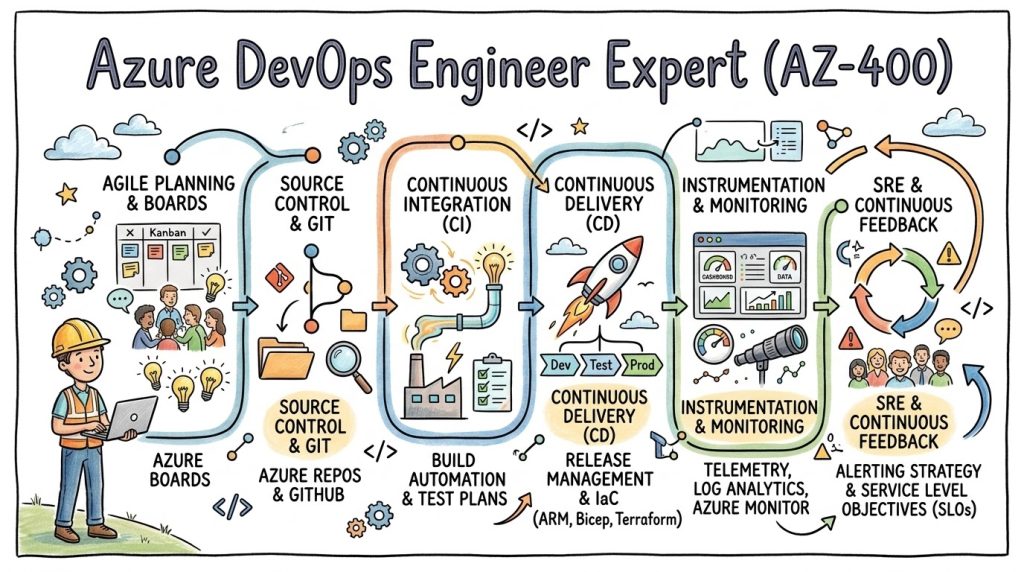
Candidates access the official training curriculum and final assessments through the Website name platform. The program requires individuals to demonstrate expertise in designing instrumentation strategies, managing source control, and implementing continuous integration. This expert-level exam tests your practical judgment through case studies and performance-based tasks in a live environment. The structure covers seven critical functional areas, ensuring that every certified professional can manage a modern DevOps lifecycle from end to end.
Azure DevOps Engineer Expert (AZ-400) Certification Tracks & Levels
The certification journey follows a tiered approach that ensures you have a solid foundation before tackling expert-level concepts. You must first complete an associate-level prerequisite, such as the Azure Administrator or Azure Developer track, to establish technical credibility. From there, the AZ-400 allows you to specialize in advanced tracks like DevSecOps, SRE, or DataOps. This progression aligns perfectly with a professional career ladder, moving you from basic task execution to high-level architectural design.
Complete Azure DevOps Engineer Expert (AZ-400) Certification Table
| Track | Level | Who it’s for | Prerequisites | Skills Covered | Recommended Order |
| Expert DevOps | Expert | Senior Engineers | AZ-104 or AZ-204 | CI/CD, IaC, Compliance | Final Milestone |
| Cloud Ops | Associate | Administrators | Fundamentals | Governance, Security | Initial Step |
| App Delivery | Associate | Developers | Fundamentals | API, Serverless, SDK | Initial Step |
Detailed Guide for Each Azure DevOps Engineer Expert (AZ-400) Certification
Azure DevOps Engineer Expert (AZ-400) – Expert Level
What it is
This certification validates your capacity to design and implement a complete DevOps strategy for an enterprise. It proves you can automate the entire software lifecycle while maintaining high security and performance standards.
Who should take it
Senior Cloud Engineers and Technical Architects with a background in either administration or development should take this exam. It is for those who want to be the primary authority on delivery pipelines within their team.
Skills you’ll gain
- Designing modern source control strategies using Git and branching models.
- Implementing automated build and release pipelines in Azure DevOps.
- Managing infrastructure through Bicep and Terraform templates.
- Configuring site reliability engineering practices and monitoring.
- Integrating security scanning and compliance checks into every deployment.
Real-world projects you should be able to do
- Deploy a containerized microservices application using Azure Kubernetes Service.
- Automate cloud infrastructure provisioning using a secure CI/CD pipeline.
- Build a comprehensive monitoring dashboard that tracks application health and user experience.
Preparation plan
- 7–14 days: Intensive review of the Microsoft Learn modules and practice exams for experienced users.
- 30 days: Daily study sessions focused on specific exam domains and hands-on lab exercises.
- 60 days: Complete the prerequisite associate certification followed by deep-dive training on advanced Azure DevOps features.
Common mistakes
- Skipping the associate-level prerequisites, which are mandatory for the expert designation.
- Focusing exclusively on the Azure Portal and ignoring the command-line interface and scripting.
- Failing to study the integration between Azure DevOps and GitHub, which is now a major part of the exam.
Best next certification after this
- Same-track option: Azure Network Engineer Associate.
- Cross-track option: Azure Security Engineer Associate.
- Leadership option: Azure Solutions Architect Expert.
Choose Your Learning Path
DevOps Path
The DevOps path focuses on the fundamental goal of delivering software faster and more reliably. You master the tools required for continuous integration and delivery, ensuring that your team can release updates with confidence. This track prioritizes automation at every stage, from code commits to production monitoring, to eliminate manual bottlenecks.
DevSecOps Path
This path integrates security directly into the heartbeat of your development cycle. You learn to use tools like Azure Key Vault and automated security scanners to protect your application from day one. By following this route, you ensure that speed never comes at the cost of vulnerability or non-compliance.
SRE Path
The Site Reliability Engineering path centers on keeping systems stable, scalable, and highly available. You gain expertise in Azure Monitor and Log Analytics to track system performance and respond to incidents automatically. This path is essential for those managing large-scale, mission-critical applications that require 99.9% uptime.
AIOps / MLOps Path
This cutting-edge path applies DevOps discipline to the world of machine learning and artificial intelligence. You learn to build pipelines that handle data training, model validation, and automated deployment. It represents the future of engineering, where software learns and improves based on production data.
DataOps Path
Data professionals follow this path to bring the rigor of software engineering to data pipelines. You focus on automating data flows with Azure Data Factory and Synapse while ensuring data integrity and version control. This approach reduces the “time-to-insight” for business stakeholders and improves data reliability.
FinOps Path
The FinOps path teaches you how to manage the financial aspects of a cloud-first organization. You learn to use Azure Cost Management to track spending and implement policies that prevent resource waste. This track ensures that your cloud infrastructure remains cost-effective as it scales to meet user demand.
Role → Recommended Azure DevOps Engineer Expert (AZ-400) Certifications
| Role | Recommended Certifications |
| DevOps Architect | AZ-400 Expert, AZ-305 Architect |
| Reliability Lead | AZ-400 Expert, Azure Monitor Specialist |
| Cloud Security Lead | AZ-400 Expert, AZ-500 Security |
| Senior Data Engineer | AZ-400 Expert, DP-203 Data Engineer |
| Engineering Director | AZ-400 Expert, AZ-305 Architect |
Next Certifications to Take After Azure DevOps Engineer Expert (AZ-400)
Same Track Progression
Deepen your expertise by mastering specific Azure networking or storage technologies that support your pipelines. Earning the Azure Network Engineer Associate certification provides the underlying knowledge needed to secure and optimize high-traffic environments. This path keeps your technical skills sharp and relevant to the evolving cloud landscape.
Cross-Track Expansion
Expand your versatility by pursuing certifications in security or data engineering. The Azure Security Engineer Associate credential allows you to take full responsibility for the safety of your cloud assets. Broadening your skills this way makes you a more holistic engineer capable of solving problems across the entire technology stack.
Leadership & Management Track
Transition toward strategic roles by earning the Azure Solutions Architect Expert certification. This move shifts your focus from individual pipelines to the overarching design of enterprise ecosystems. You will learn to balance technical requirements with business objectives, preparing you for roles such as CTO or VP of Engineering.
Training & Certification Support Providers for Azure DevOps Engineer Expert (AZ-400)
DevOpsSchool provides industry-leading mentorship and hands-on training for aspiring Azure experts. Their curriculum focuses on actual production scenarios, ensuring that you gain the practical confidence needed to pass the AZ-400 exam and excel in your professional role.
Cotocus specializes in helping organizations and individuals navigate the complexities of digital transformation. Their Azure DevOps workshops emphasize infrastructure as code and automated testing, providing a clear path to technical mastery through expert-led sessions.
Scmgalaxy offers a wealth of community resources and structured training for configuration management professionals. They provide deep dives into version control and release orchestration, making them a top choice for those looking to broaden their DevOps knowledge.
BestDevOps focuses on streamlined, high-impact training that helps engineers earn their certifications quickly. Their updated study materials and lab environments reflect the latest changes in the Azure platform, ensuring you are always learning the most relevant skills.
devsecopsschool.com addresses the growing demand for security-focused engineering. Their training modules teach you how to bake security into your CI/CD pipelines, preparing you to lead DevSecOps initiatives within your organization effectively.
sreschool.com provides specialized education for those focused on system reliability and observability. Their courses cover the critical monitoring aspects of the AZ-400 exam, teaching you how to maintain high-performance cloud environments.
aiopsschool.com focuses on the intersection of automation and artificial intelligence. They teach students how to use machine learning to improve system monitoring and automate operational tasks, keeping you at the cutting edge of the industry.
dataopsschool.com helps data engineers apply DevOps principles to their specific workflows. Their curriculum shows you how to build automated pipelines for data warehousing and analytics, ensuring consistency and speed in data delivery.
finopsschool.com focuses on the critical skill of cloud financial management. They teach you how to optimize Azure spending and implement governance policies that ensure your cloud operations remain profitable and sustainable.
Frequently Asked Questions (General)
- How difficult is the AZ-400 exam?
The AZ-400 is a challenging, expert-level exam that requires a deep understanding of both technical tools and strategic processes.
- What is the recommended study time for a working professional?
Most professionals succeed by dedicating 10 to 12 hours per week over a period of two to three months.
- Do I need to be an expert coder to pass?
You do not need to be a full-stack developer, but you must be comfortable with YAML and basic scripting in PowerShell or Bash.
- Is the associate prerequisite strictly necessary?
Yes, Microsoft will only award the “Expert” title after you have successfully passed either the AZ-104 or AZ-204 exam.
- How much does the certification exam cost?
The exam fee is generally 165 USD, although this varies depending on your geographic location and local taxes.
- Does this certification help me get a job in India?
Yes, the AZ-400 is highly respected in the Indian tech market and is often a requirement for senior DevOps roles.
- How long is the certification valid?
The certification remains valid for one year, after which you must pass a free renewal assessment on the Microsoft Learn portal.
- Does the exam include hands-on labs?
Yes, many versions of the exam include performance-based labs where you must configure real Azure resources.
- Can I take the exam from home?
Microsoft offers proctored online exams that allow you to take the test from your home or office.
- What is the passing score for the AZ-400?
You must achieve a scaled score of at least 700 to pass the examination.
- Should I learn Terraform or Bicep first?
While Bicep is native to Azure, the exam often references both, so a basic understanding of each is beneficial.
- Is this certification worth the investment?
Absolutely, as it validates your expertise in one of the highest-paying and most in-demand fields in technology today.
FAQs on Azure DevOps Engineer Expert (AZ-400)
- What are the main functional groups in the exam?
The exam focuses on instrumentation, SRE, security, source control, continuous integration, continuous delivery, and feedback loops.
- Does the exam cover GitHub integration?
Yes, a significant portion of the exam now focuses on GitHub Actions and GitHub repository management.
- How often does Microsoft update the exam content?
Microsoft updates the exam objectives every few months to reflect the latest changes and features in the Azure platform.
- Can I use the Azure Portal during the exam?
Only during specific lab portions will you have access to a simulated Azure environment; the rest is based on questions.
- Is there a negative marking for wrong answers?
No, Microsoft does not penalize you for incorrect answers, so it is best to answer every question.
- What is the best way to get hands-on experience?
Using the free Azure tier and following the official Microsoft Learn labs is the best way to gain practical experience.
- Are there any case studies in the exam?
Yes, you will likely encounter one or two case studies that require you to solve business problems using Azure DevOps tools.
- Can I retake the exam if I fail the first time?
Yes, you can retake the exam after 24 hours, though subsequent attempts require a longer waiting period.
Final Thoughts: Is Azure DevOps Engineer Expert (AZ-400) Worth It?
Investing in the Azure DevOps Engineer Expert (AZ-400) certification represents a significant commitment to your professional growth. From my experience mentoring senior engineers, I can confirm that this credential serves as a powerful differentiator in a crowded job market. It forces you to move beyond simple automation and develop a holistic view of the software delivery lifecycle. You learn how to balance the need for speed with the requirements of security and stability, which is the ultimate goal of any DevOps professional. If you want to lead high-performing teams and manage complex enterprise systems, this certification provides the authoritative validation you need to succeed.